
Cost Advantages of an All-in-One Speech API Like Deepgram (2026)
Summarize this article with:
Deepgram's all-in-one API (Nova-3 pre-recorded at $0.0077/min, diarization add-on at $0.0020/min, audio intelligence at token-based rates) costs more per-minute than some alternatives like AssemblyAI's $0.15/hr base, but offers a single integration point, one SDK, and one bill. The real cost advantage is operational: fewer vendor relationships means less integration engineering, less maintenance, and no cross-service egress charges. Bundling wins most clearly for teams that need multiple features simultaneously and cannot afford to maintain a multi-vendor stack, but loses ground when you need only basic transcription at scale.
The cost of a speech processing pipeline is not the per-minute transcription rate. It is the per-minute rate, plus the rates of every additional feature you need, plus the engineering hours to integrate and maintain each vendor relationship. Once you account for all three, the comparison between a single all-in-one API and a stitched multi-vendor stack looks very different from the headline numbers.
This post works through verified 2026 pricing for Deepgram and comparable providers, the real add-on cost structure that vendors often undersell, and the specific conditions where consolidating onto one API actually saves money versus where it does not.
What Deepgram Actually Charges in 2026
The existing narrative around Deepgram as "everything included at one low rate" has not survived the 2026 pricing page unchanged.
Nova-3 Monolingual pre-recorded costs $0.0077/min ($0.462/hr) on Pay-As-You-Go. The Growth plan (minimum $4,000 annual spend) brings that to $0.0065/min. Streaming is $0.0048/min Pay-As-You-Go.
Speaker diarization is a separate add-on: $0.0020/min, making a typical multi-speaker pre-recorded job roughly $0.0097/min all-in before any audio intelligence features.
Audio intelligence (summarization, topic detection, sentiment analysis, intent recognition) uses token-based billing: $0.0003 per 1,000 input tokens and $0.0006 per 1,000 output tokens on Pay-As-You-Go. For a 30-minute interview transcript of roughly 5,000 words (~6,700 tokens), the audio intelligence add-on runs well under $0.01 per file. For high-volume pipelines processing thousands of calls per day, those token costs add up and belong in your model.
Smart Formatting (punctuation, capitalization, number formatting) is the one feature genuinely included at no extra charge.
For a broader comparison of 2026 transcription API rates, see our full pricing breakdown.
Provider Comparison: Base Rates and Add-On Structure
Comparing providers fairly requires a consistent unit. Per-hour is cleaner when providers mix different billing models.
| Provider | Base Rate (pre-recorded) | Diarization | Summarization | Sentiment |
|---|---|---|---|---|
| Deepgram Nova-3 | $0.462/hr | +$0.12/hr add-on | Token-based add-on | Token-based add-on |
| AssemblyAI Universal-2 | $0.15/hr | +$0.02/hr add-on | +$0.03/hr (deprecated) | +$0.02/hr add-on |
| AssemblyAI Universal-3.5 Pro | $0.21/hr | +$0.02/hr (standard) | Included via LeMUR | +$0.02/hr add-on |
| AWS Transcribe (Tier 1) | ~$1.44/hr | Included | Not offered natively | Not offered natively |
| OpenAI Whisper/GPT-4o | $0.36/hr | Not available | Not available natively | Not available natively |
AWS Transcribe (per vendor pricing documentation, rates unverified from primary source) includes speaker diarization in its base price with no add-on, making it meaningfully simpler for multi-speaker workloads, though it lacks native summarization or sentiment features. AssemblyAI's base per-hour rate is lower than Deepgram's, with add-ons that stack clearly. OpenAI's Whisper and GPT-4o Transcribe offer no diarization at all.
The point of this table is not to declare a winner. It is to show that "all-in-one" means different things at different providers, and the math depends on exactly which features you use.
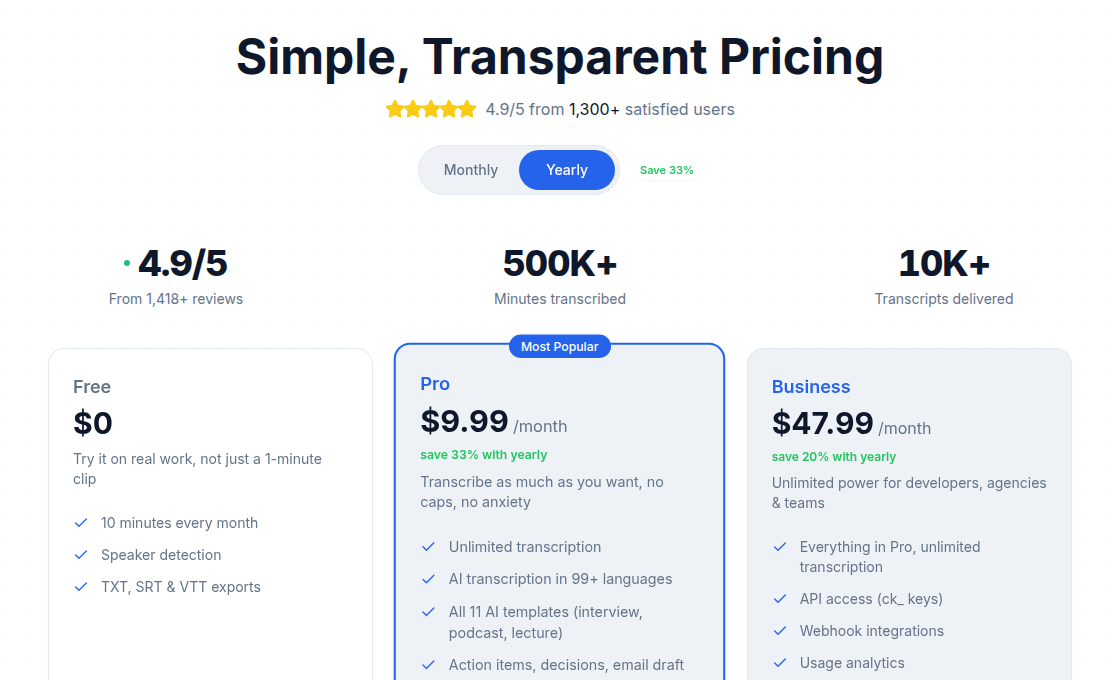
Pricing tiers and feature sets vary significantly across providers. The blended cost of a multi-feature pipeline matters more than base per-minute rates alone.
The Real Cost Calculation: Stacked Features
Here is a concrete worked example. A podcast transcription feature needs pre-recorded audio, speaker diarization (to label host vs. guest), and summarization (for show notes). Volume: 200 hours per month.
Deepgram Nova-3 stack:
- Base transcription: 200 hr x $0.462/hr = $92.40/mo
- Diarization add-on: 200 hr x $0.12/hr = $24.00/mo
- Summarization (token-based, roughly $0.005 per episode): ~$5/mo
- Total API cost: roughly $121/mo
AssemblyAI Universal-3.5 Pro stack:
- Base transcription: 200 hr x $0.21/hr = $42.00/mo
- Diarization add-on: 200 hr x $0.02/hr = $4.00/mo
- LeMUR summarization (included): $0
- Total API cost: roughly $46/mo
Multi-vendor stitched (OpenAI Whisper + external LLM for summaries):
- Transcription: 200 hr x $0.36/hr = $72.00/mo
- Diarization: requires a separate integration (no native offering); add-on service or custom post-processing
- Summarization via GPT-4o-mini: variable per transcript length, roughly $5-20/mo
- Total API cost: $77-92/mo, plus one extra integration to build and maintain
These are illustrative at assumed rates, not guarantees. At a loaded engineering cost of roughly $150/hr, a single extra vendor integration (authentication, response parsing, retry logic, error handling) typically takes at least a week of engineering time. Maintaining that integration against API changes costs ongoing hours every month. One vendor means one of those burdens; four vendors means four.
My take: the per-API-call cost gap between providers is narrower than it looks from base rates. The bigger lever is how many features you need and how many vendor relationships you are willing to maintain. Deepgram's advantage is breadth and consistency of a single developer experience, not necessarily the lowest total API cost.
The Hidden Cost that Vendor Comparisons Skip
Every additional API vendor adds operational overhead that does not appear on any invoice line.
Integration engineering. Each provider has its own authentication model, request format, response schema, error codes, and SDK. A production-grade integration that handles retries, timeouts, partial failures, and schema changes takes time. That time has a real cost at any engineering salary.
Maintenance drag. APIs change. SDKs release breaking updates. Providers deprecate features. Each vendor in your stack means a separate changelog to monitor, a separate upgrade to test, and a separate failure mode to handle at 2am. Teams with a single speech provider spend roughly half the monthly maintenance hours of teams running three or four vendors.
Data egress. When you transcribe audio with one service and then send that transcript to a second service for analysis, you pay egress fees on the transcript data. Cloud providers typically charge $0.08-0.12 per GB for outbound transfer. For a text-heavy pipeline processing hundreds of hours monthly, cross-service egress is a small but real recurring cost that a single-vendor approach eliminates.
Billing complexity. Multiple vendors mean multiple billing cycles, multiple metering methodologies, and multiple support channels when a charge looks wrong. Finance reconciliation costs real time, especially when each vendor reports usage in different units.
These costs do not appear in a per-minute pricing comparison. They show up in your engineering headcount, your on-call rotation, and your monthly finance overhead. See the full breakdown of hidden transcription costs for a framework to model them.
When All-in-One Wins Versus When It Does Not
All-in-one wins clearly when:
You need three or more speech features simultaneously. Transcription plus diarization plus summarization plus sentiment is where consolidation creates a genuine economic argument. The operational overhead of four separate integrations is real, and the token-based cost of audio intelligence features is modest per file.
You are a small team. A two-person backend team cannot afford 20 or 30 hours per month maintaining integrations across multiple providers. Single-vendor simplicity frees engineering capacity for product work.
Speed to market matters. One SDK, one auth flow, one response format. Teams integrating a single API ship in days rather than weeks.
All-in-one loses ground when:
You only need basic transcription. If you just want accurate text with no speaker labels, no summaries, and no classification, the gap between providers narrows sharply and the lowest base rate wins. For this use case, AssemblyAI Universal-2 at $0.15/hr is worth evaluating.
You are at extreme scale with negotiating power. AWS Transcribe's volume tiers (per vendor documentation) bring per-minute costs down significantly at 250,000 or more minutes per month, and it includes diarization at no add-on cost. At very high volume, enterprise pricing conversations with individual providers can produce rates that undercut any list-price all-in-one.
You need broad language coverage. Deepgram's Nova-3 covers dozens of languages, but Google Cloud's STT family covers 125 or more. For applications serving long-tail language markets, breadth of coverage may matter more than cost consolidation.
For a direct side-by-side on accuracy and latency beyond pricing, the Deepgram vs AWS Transcribe comparison covers the full picture.
The Bundling Economics: A Straightforward Summary
The original argument for all-in-one APIs rested on a premise that has since changed: that features like diarization and summarization were "included" in Deepgram's base rate. They are not. They are priced transparently as add-ons.
That does not make the argument for consolidation disappear. It makes it more precise. The advantage is:
- Token-based audio intelligence is often cheaper per-file than routing transcripts to a separate LLM API for the same output.
- One integration is cheaper to build and maintain than three or four integrations, at any engineering wage.
- A single bill with unified usage analytics is easier to forecast and reconcile than four separate invoices.
The math holds most strongly when you use multiple features, run moderate volumes, and have limited engineering capacity to maintain a multi-vendor stack. It holds least strongly when you need only transcription at high volume, where the lowest base rate from any single provider tends to win.
If you want to explore what a production speech pipeline costs across providers with different feature mixes, the transcription pricing comparison for 2026 works through the numbers in detail. And for context on where Deepgram's Nova-3 model sits on accuracy and speed, see our Nova-3 model deep dive.
If you need a clean transcript for a meeting, podcast, or interview without wiring up an API yourself, ConvertAudioToText's audio-to-text tool handles the integration and gives you formatted output directly.
FAQ
How much does Deepgram Nova-3 cost per minute in 2026?
Nova-3 Monolingual pre-recorded runs $0.0077/min ($0.46/hr) on Pay-As-You-Go, dropping to $0.0065/min on the Growth plan (minimum $4,000 annual spend). Streaming is cheaper: $0.0048/min Pay-As-You-Go. Speaker diarization is a $0.0020/min add-on, bringing a typical multi-speaker pre-recorded job to roughly $0.0097/min. Audio intelligence features (summarization, topic detection, sentiment) are billed per token at $0.0003/1k input and $0.0006/1k output.
Is speaker diarization included in Deepgram's base price?
No, not as of 2026. Deepgram's pricing page lists diarization as a separate add-on at $0.0020/min (Pay-As-You-Go) or $0.0017/min (Growth). Smart Formatting (punctuation and capitalization) is the one feature included at no extra cost. Summarization, topic detection, and sentiment analysis are charged per token. This is a meaningful change from earlier pricing tiers and affects any total-cost model that assumed all features were bundled.
When does a single-vendor API stack cost less than a multi-vendor approach?
Single-vendor wins clearly when you need three or more speech features simultaneously: if you stack Deepgram's base transcription, diarization, and audio intelligence, you pay one per-minute rate plus a small token cost instead of integrating a separate diarization service, a separate LLM for summaries, and a separate classification API. The operational savings compound: one integration, one SDK version to maintain, one support channel, and no cross-cloud egress fees. The advantage shrinks when you only need basic transcription at high volume, where a provider with a lower base rate may be cheaper.
What does Deepgram's $200 free credit cover?
The $200 credit requires no credit card and does not expire. At Nova-3 Monolingual pre-recorded rates of $0.0077/min, it covers roughly 26,000 minutes (about 433 hours) of pure transcription without add-ons. If you enable diarization on every job, that drops to around 20,800 minutes. It is enough to run a complete integration, benchmark accuracy on your own audio, and process meaningful production volume before committing to a paid plan.
Sources
Try transcription free
Convert any audio or video to clean, unwatermarked text — speaker labels, timestamps, and AI summaries included. First 10 minutes free, no account.
Related Articles

AWS Transcribe Pricing 2026: $0.024/min Entry, $0.0078 at Scale
AWS Transcribe pricing 2026: Standard starts at $0.024/min and drops to $0.0078/min above 5M minutes/month. Medical is $0.075/min. Free 60 min/month for first 12 months. When AWS beats Deepgram and when it doesn't.
Best Speech-to-Text APIs in 2026 (Real Prices)
A current, honestly-priced comparison of the best speech-to-text APIs in 2026: Deepgram, AssemblyAI, OpenAI, Google, AWS, Rev, Speechmatics, and Cloudflare. Real per-minute and per-hour prices from ea