
Hidden Costs of Transcription Services: 2026 Checklist
Summarize this article with:
Transcription services routinely bury real costs behind "unlimited" labels, asterisked footnotes, and feature-gated tiers. This post walks through six cost categories that inflate bills without appearing in headline pricing: per-minute minimums and overages, rush fees, speaker-diarization gating, export format restrictions, data retention limits, and per-seat pricing. Knowing these patterns before you sign up takes about 30 minutes and can save hundreds of dollars a year.
The real cost of a transcription plan is almost never what the headline says. Per-minute overages, rush surcharges, export format locks, speaker-diarization gates, data retention cliffs, and per-seat multiplication all show up after you sign up, not before. The patterns are consistent enough across vendors that a 30-minute checklist run before any purchase catches most of them.
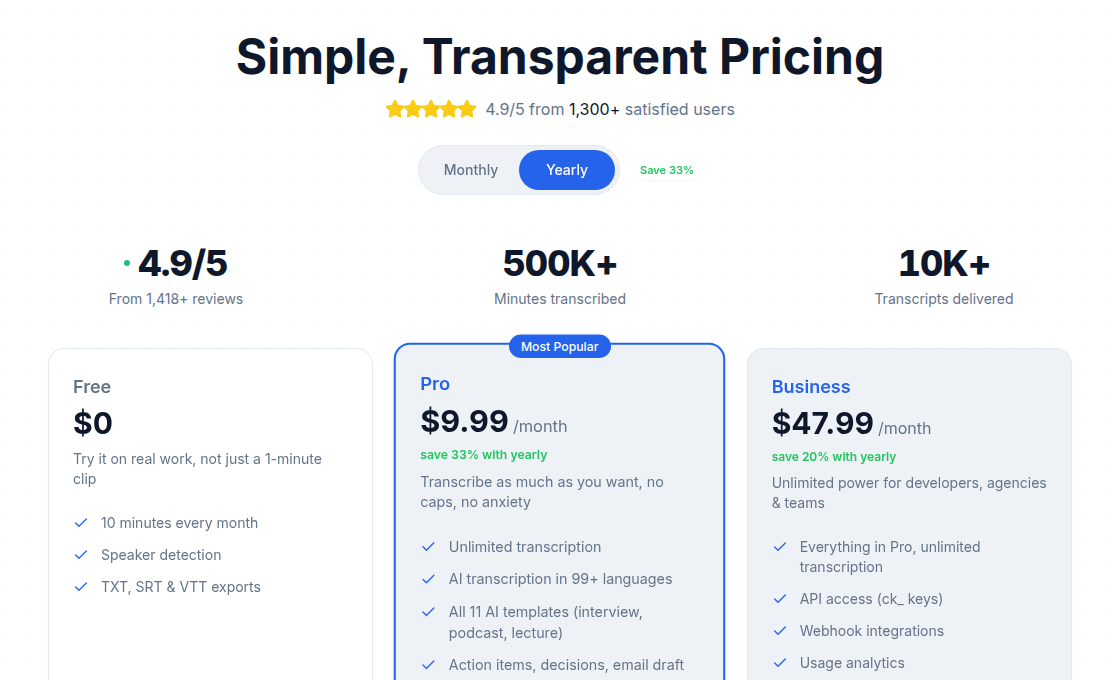 A pricing page with the caps stated up front
This post covers six cost categories with verified examples from current 2026 pricing pages.
1. Per-Minute Minimums and Overage Charges
Most AI transcription subscriptions sell monthly minute bundles. The per-minute economics shift sharply the moment you exceed your allotment.
Happy Scribe charges €0.20 per minute for usage beyond your plan's included minutes. Its Basic plan (€17/month) includes 120 minutes. A researcher with a 4-hour interview batch would hit the cap in the first two uploads and then pay overages on every minute after that. Pro includes 600 minutes; Business, 6,000.
Otter.ai's Basic free plan includes 300 minutes per month with a 90-minute per-meeting cap. The free tier also limits lifetime audio file imports to three. Once those are used, import is gone unless you upgrade.
A related pattern: per-minute minimums. Some services round up to the nearest minute (or longer unit), so a 45-second clip costs the same as a full minute. The search results do not surface a named vendor that uses longer minimums as of mid-2026, but it is a documented pattern in per-transaction pricing models. If you have very short clips, verify the billing granularity before choosing a metered service.
Useful context on how metered versus subscription models actually compare: transcription pricing models explained.
2. Rush Fees on Human Transcription
AI turnaround is now measured in minutes, but human transcription still takes hours to days, and speed costs money.
Rev charges $1.99 per audio minute as the base rate for human-verified transcription. Faster turnaround tiers carry premium rates. Verbatim transcription, which captures filler words, false starts, and stutters, adds a per-minute surcharge on top of the standard rate. If you need a same-day transcript with verbatim output, those two surcharges compound.
Rev explicitly states it does not charge extra for multiple speakers, difficult audio, specialized terminology, or accents at the human tier. That matters because those surcharges exist at other vendors.
Happy Scribe human proofreading starts at €1.75 per minute for most tiers, with a Business-tier discount to €1.66 per minute.
For most use cases, AI transcription has made human transcription optional. But for legal depositions, medical dictation, or broadcast work where accuracy below 99% is unacceptable, the human tier is often the right choice. The AI versus human transcription breakdown covers when each model makes sense.
3. Speaker Diarization Gating
Speaker diarization, the ability to label who said what, is one of the most requested transcription features. It is also one of the most commonly gated.
Descript's free plan does not include speaker detection at all. The capability to detect 8 or more speakers is available on Hobbyist ($16/month annual) and above. A user on the free plan who needs speaker labels for a multi-person interview has no path forward without upgrading.
Otter.ai includes speaker diarization across its paid plans but limits the free Basic tier to basic speaker ID with a 30-minute per-meeting constraint.
Fireflies.ai's approach is different: its free tier includes unlimited transcription and AI summaries, but downloading transcripts and recordings requires Pro ($10/month annual) or higher. You can read the speakers in the interface; you just cannot get the file out.
My take: speaker diarization gating is the single feature restriction that most surprises users who try a free tier and then discover the output they want requires an upgrade. If you need labeled speakers, confirm it is included before uploading anything. More on what diarization actually does: speaker diarization explained.
4. Export Format Paywalls
The transcript exists. Getting it out in the format you need is sometimes a separate purchase.
Otter.ai's free Basic plan exports MP3 audio and TXT only. PDF, DOCX, and SRT are gated to Pro. If you need subtitle files or a Word document, the free tier is a dead end.
Happy Scribe gates its full library of 15 or more export formats, including VTT, STL, XML, FCPXML, and EDL, to Pro and Business plans. Basic plan users get TXT, SRT, PDF, and DOCX. The free trial watermarks video exports.
TurboScribe takes a different position: all export formats, including PDF, DOCX, TXT, SRT, VTT, and CSV, are available even on the free tier (capped at three files per day, each up to 30 minutes). That is an exception, and a notable one, in a market where format access is frequently used as a tier differentiator.
For video-centric workflows, check whether subtitle export formats like SRT and VTT are in your tier before choosing. The subtitle generator tool gives you a quick sense of what output a transcription engine produces.
5. Data Retention Limits
Some services limit how long they store your transcripts and audio files, especially on free or entry tiers.
Fireflies.ai's free tier caps total storage at 400 minutes per team. Pro expands this to 8,000 minutes per seat; Business and Enterprise offer unlimited storage. Once you hit the free cap, older meetings drop off unless you upgrade.
Otter.ai's free Basic plan limits you to your 25 most recent conversations, regardless of how many minutes they consume. Older conversations are not accessible in the interface.
The pattern: free and entry tiers use retention limits as an upgrade lever. If you need a searchable archive of past meetings or recordings, the free tier behavior of most meeting-focused tools is a temporary sandbox, not a long-term archive.
6. Per-Seat Pricing at Team Scale
Consumer pricing is usually per account. Team pricing is almost always per seat, and the multiplication is the most common source of sticker shock.
Otter.ai Business is $19.99 per user per month billed annually. A five-person team pays $1,199 per year. Otter's Business plan adds unlimited meeting transcription, 6,000 imported-file minutes per user monthly, and a four-hour per-meeting cap, but the per-seat cost is real.
Trint's Starter tier runs approximately $80 per seat per month. For a five-person editorial team, that is roughly $400 per month for seven files per seat monthly. The Advanced tier (approximately $100/seat) removes the file cap for single users but compounds the per-seat multiplication for teams.
Fireflies.ai is more moderate at $10 to $19 per seat per month (annual), but the same multiplication applies. Five people on Fireflies Business annual equals $95 per month.
The mitigation is not always obvious: sometimes a shared power-user account handles the transcription workload for a whole team, and individual accounts are not needed. Before adopting a per-seat tool at team scale, map which users actually generate transcription volume and which only read the output.
For teams evaluating whether the volume justifies individual seats or a different model, the unlimited versus metered transcription pricing comparison breaks down the math at different usage levels.
The Honest Comparison Table
| Vendor | Pricing model | Key hidden cost to verify |
|---|---|---|
| Rev (human) | $1.99/min base | Rush tier premiums, verbatim surcharge |
| Rev (AI) | Subscription, 5K-10K AI min/month | Overage to human tier cost |
| Otter.ai | Per seat, $19.99/seat/month Business | Export format lock on Basic, seat multiplication |
| Descript | Per account, $16-$50/month annual | Speaker diarization not on free; media hour caps |
| Fireflies.ai | Per seat, $10-$19/seat/month annual | Storage cap on free (400 min), download gating |
| Happy Scribe | Subscription bundles, €0.20/min overage | Format library gated to Pro, EUR currency |
| TurboScribe | $10/month annual | Free tier: 3 files/day cap |
| Trint | ~$80-$100/seat/month | File count caps at Starter, per-seat scale |
If you just need clean transcripts without a meeting bot, seat fees, or minute bundle math, ConvertAudioToText runs a flat $14.99/month Pro plan with all formats, all languages, and speaker diarization included. No per-seat math, no overage at normal usage volumes. If you need a one-time option, the $9.99 Weekly Pass gives 1,200 minutes (20 hours) for 7 days with no subscription.
How to Read a Pricing Page for Hidden Costs
A short pass through these points catches most surprises before you commit:
- Read every asterisk. Fair-use clauses, feature restrictions, and overage triggers live in footnotes, not in plan headlines.
- Look for "per user" in the plan description. A $20 Business plan is actually a $100 commitment for a five-person team.
- Check export format access at your tier. Many services list formats on the pricing page only in the highest tier column.
- Locate the fair-use or overage policy. "Unlimited" almost always has a ceiling somewhere in the terms of service.
- Confirm speaker diarization explicitly. If the feature is not listed in your tier's column, assume it is not included.
- Verify the cancellation path. Annual commitments on plans you cannot test monthly are a real downside risk.
Free Tier Hidden Costs
Free tiers have their own category of gotchas beyond the standard hidden costs.
Account creation may require a credit card on file. Cancellation friction is real, especially when you stored recordings in the service and need to export them before leaving.
Some free tiers produce watermarked output. Happy Scribe watermarks video exports on the free plan. Descript's free tier watermarks exported video. A transcript you need to share externally is not actually free if the watermark makes it unusable.
File count and lifetime import limits (Otter Basic: three lifetime audio file imports) mean you use up the free tier quickly and have no obvious path backward once the import slots are gone.
The free versus paid transcription breakdown covers when free tiers make sense and when they create more friction than they save.
FAQ
Are "unlimited" transcription plans actually unlimited?
Not always. Most services define fair-use thresholds in their terms of service. For typical individual use, you will rarely hit the cap. For high-volume workflows like podcast networks or agencies, read the fair-use clause carefully before committing to any plan marketed as unlimited.
Do transcription services charge extra for multiple speakers?
It depends on the service. Rev explicitly states it does not charge extra for multiple speakers. Other AI services include speaker diarization at all paid tiers or gate it to higher plans rather than charging a per-speaker surcharge. The cost usually comes from a tier upgrade, not a separate line item.
Which transcription services restrict export formats on cheaper plans?
Otter.ai's free Basic tier limits exports to MP3 and TXT only, excluding PDF, DOCX, and SRT. Happy Scribe gates its full 15-plus format library to Pro and above, and watermarks video exports on lower tiers. TurboScribe includes all formats on its free tier, which is unusual.
What are rush fees for human transcription?
Rush fees vary by service and turnaround time. Rev charges $1.99 per audio minute for standard human transcription and adds premiums for faster turnaround tiers. The faster the turnaround, the higher the rate. Verbatim transcription (capturing filler words and false starts) also carries an additional per-minute surcharge at Rev.
How do seat-based pricing models add unexpected costs for teams?
Per-seat plans bill each user individually rather than per workspace. Otter.ai's Business plan runs $19.99 per user per month. Trint is approximately $80 per seat per month at its Starter tier. Fireflies.ai bills $10 to $19 per user per month on annual plans. A team of five can easily reach $100 to $400 per month from a plan that looked cheap for a single user.
Sources
- Rev Pricing - subscription plan structure and human transcription base rate
- Rev Transcription Cost Calculator - $1.99/min human rate confirmed
- Otter.ai Pricing - plan tiers, export restrictions, minute limits
- Descript Pricing - plan tiers, media hour limits, speaker diarization gating
- Fireflies.ai Pricing - per-seat rates, storage caps, feature gating
- Happy Scribe Pricing - plan prices (EUR), minute limits, overage rates, format access
- TurboScribe - plan pricing confirmed via search (page returned 403 on direct fetch)
Try transcription free
Convert any audio or video to clean, unwatermarked text — speaker labels, timestamps, and AI summaries included. First 30 minutes free, no account.
Related Articles

Spotify Transcript Extractor: How to Copy and Download Episode Text
Get a Spotify podcast transcript you can copy and download: paste a public episode link, 30 minutes free with no signup, TXT or SRT files on eligible plans.
Call Transcription for Customer Support QA: A Practical CATT Workflow
Use call transcription for customer support QA to review calls faster and coach agents. Upload audio or a meeting URL, get speaker labels and AI summaries.