
Unlimited vs Metered Transcription Pricing: How to Pick in 2026
Summarize this article with:
Flat-rate unlimited plans (CATT at $14.99/month, TurboScribe at $10/month annual) beat metered APIs once you exceed roughly 18-32 hours of audio per month. Below that threshold, developer APIs like AssemblyAI ($0.0025/min) or Deepgram Nova-3 ($0.0077/min) cost less. The right answer depends on your actual monthly volume, how predictable it is, and whether you need a UI or just raw transcripts.
Flat-rate unlimited wins once you exceed roughly 18-32 hours of audio per month. Below that, metered per-minute APIs are cheaper. This post shows the exact numbers so you can pick without guessing.
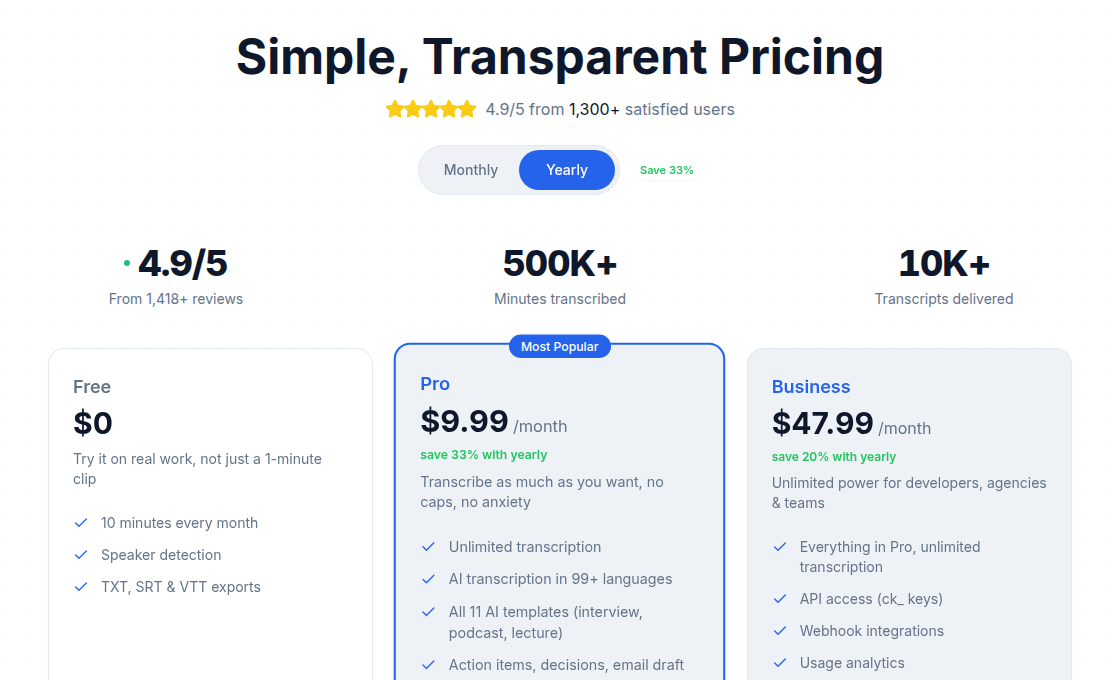 An unlimited plan next to metered per-minute rates
The Two Models Defined
Flat-rate unlimited means a fixed monthly fee with no per-minute charge. Your unit cost drops as usage rises because the fee stays constant. Examples in 2026:
- CATT Pro: $14.99/month month-to-month, or $99.99/year billed annually, unlimited transcription.
- TurboScribe Unlimited: $10/month (annual) or $20/month (monthly), unlimited transcription.
- Otter.ai Business: $19.99/user/month (annual), unlimited meeting recordings (6,000 min/user cap on imported files).
Metered per-minute means you pay only for what you process. No monthly minimum, no churn cost. Examples with 2026 verified rates:
- Deepgram Nova-3: $0.0077/min ($0.46/hr) pay-as-you-go.
- AssemblyAI Universal-2: $0.0025/min ($0.15/hr).
- OpenAI Whisper-1 / gpt-4o-transcribe: $0.006/min ($0.36/hr).
- Rev.ai Reverb: $0.0033/min ($0.20/hr).
Note: metered rates above are base transcription only. Speaker diarization, sentiment analysis, and topic detection stack on top as add-ons. For a deeper look at API rate structures, see transcription pricing models explained.
The Break-Even Math
The break-even is the monthly volume at which both models cost the same. Above it, flat-rate wins. Below it, metered wins.
CATT Pro ($14.99/month) vs Deepgram Nova-3 ($0.0077/min):
Break-even = $14.99 / $0.0077 = 1,947 minutes = 32.4 hours per month.
CATT Pro vs AssemblyAI Universal-2 ($0.0025/min):
Break-even = $14.99 / $0.0025 = 5,996 minutes = 99.9 hours per month.
AssemblyAI's base rate is low enough that metered beats flat-rate for most individual users. The catch: diarization adds $0.02/hr, sentiment adds $0.02/hr, and so on. A fully-featured job matches closer to $0.20-0.25/hr, which brings the break-even down to roughly 60-75 hours.
CATT Pro vs Rev.ai Reverb ($0.0033/min):
Break-even = $14.99 / $0.0033 = 4,542 minutes = 75.7 hours per month.
At these rates, CATT is cheaper for anyone above 76 hours/month, while Rev.ai undercuts it below that. Rev.ai's rates have dropped considerably from the per-minute model it used a few years ago.
Monthly Cost at 2, 10, and 40 Hours
The chart below compares CATT Pro (flat $14.99/month) against Deepgram Nova-3 ($0.0077/min) at three usage levels. At 40 hours per month, flat-rate comes out ahead.
CATT Pro @ $14.99/mo vs Deepgram Nova-3 @ $0.0077/min. Verified July 2026.
At 2 hours per month, Deepgram costs $0.92 versus $14.99 flat-rate. At 10 hours, $4.62 versus $14.99. At 40 hours, the metered bill is $18.48 and the flat-rate bill is still $14.99. The crossover for this specific pair is 32.4 hours.
When Metered Pricing Is the Right Call
Three situations where per-minute billing genuinely wins.
Very low volume. If you transcribe under 10 hours per month, you are unlikely to break even on most flat-rate plans. Paying $0.92 per month on Deepgram beats paying $14.99 flat-rate for light use. The CATT free tier (first file on the premium engine, then up to 30 files a day, up to 30 minutes each, with free reading and copying) covers light use without any cost at all.
Highly variable volume. If your usage swings from zero one month to 80 hours the next, metered pricing lets you pay nothing in the quiet months. Annual flat-rate subscriptions (often 30-50% off monthly rates) partially offset this, but you still pay for every month you subscribed.
Building a product. If transcription is a feature inside your own software, metered pricing aligns your cost to your revenue per job. A flat-rate plan would mean absorbing variable costs or building a custom usage layer on top. For builders, see the comparison in speech-to-text API pricing 2026.
When Flat-Rate Unlimited Is the Right Call
Most consumer and prosumer workflows.
Consistent moderate-to-high volume. Any user consistently above their specific break-even point saves money every month. The savings compound significantly at higher volumes: at 100 hours per month, CATT at $14.99 implies a $0.0025/min effective rate, the same as AssemblyAI's base rate and below every other API listed here.
Predictable budget. A known monthly cost makes financial planning simpler. This matters more for teams with expense approval processes than for solo users, but it is a real advantage.
Feature bundling. Consumer flat-rate plans typically include a UI, editor, speaker labels, AI summaries, and export formats in the subscription. Building equivalent functionality on top of a raw API adds real engineering cost that the math above ignores. If you would otherwise pay for those features separately, the effective break-even on flat-rate shifts lower.
Experimentation. Re-running the same audio for different export formats or correcting speaker labels does not cost extra on a flat-rate plan. On metered pricing, every re-process is a new charge.
The Hidden Variables in the Comparison
A few factors the simple math misses.
Add-ons stack. Metered API headlines are base transcription only. On AssemblyAI, diarization adds $0.02/hr. On Deepgram, diarization and keyterm prompting are separate line items. On a feature-comparable basis, the effective metered rate can be 30-100% above the base figure. Consumer flat-rate plans bundle most of these features into the subscription price. The hidden costs of transcription services post has a full breakdown.
Fair-use clauses. Unlimited flat-rate plans include fair-use terms. For typical individual or small-team workloads (5-150 hours per month), this rarely matters. At agency or network scale, it is worth reading the terms before committing.
Volume discounts on metered. Deepgram's Growth plan drops Nova-3 to $0.0065/min from $0.0077/min, but requires a $4,000+ annual commitment. At enterprise volume with negotiated rates, metered pricing can beat flat-rate again. See enterprise transcription pricing for that case.
Who Should Choose Which
| User type | Typical monthly volume | Better model |
|---|---|---|
| Casual user | Under 1 hour | Free tier or metered |
| Student / occasional | 1-5 hours | Metered API or free tier |
| Solo podcaster (weekly show) | 4-8 hours | Metered API or free tier |
| Journalist or researcher | 10-30 hours | Flat-rate on yearly billing, or metered under about 18 hours (close call) |
| Active YouTuber | 30-80 hours | Flat-rate consumer plan |
| Marketing team | 40+ hours/month | Flat-rate team plan |
| Documentary editor | 50-200 hours over project | Flat-rate for project duration |
| Developer building a product | Variable | Metered API |
| High-volume agency | 500+ hours | Metered with volume discount or self-hosted |
My take: for anyone who transcribes more than about four to five hours of audio a week on a yearly plan, or seven to eight hours a week paying month to month, a flat-rate consumer plan wins on cost against a mid-priced metered API. The uncertainty shows up only at the edges: very low volume, very irregular use, or pure API-integration use cases.
A Worked Annual View
Annual numbers make the trade-off concrete. Assume CATT Pro at $14.99/month month-to-month ($179.88/year; $99.99 if you pay yearly) versus Deepgram Nova-3 at $0.0077/min:
- 5 hours/month: Deepgram = $27.72/year. Flat-rate = $179.88/year. Metered saves $152.
- 20 hours/month: Deepgram = $110.88/year. Flat-rate = $179.88/year. Metered saves $69. On the $99.99 yearly plan, flat-rate saves $11.
- 40 hours/month: Deepgram = $221.76/year. Flat-rate = $179.88/year. Flat-rate saves $42.
- 100 hours/month: Deepgram = $554.40/year. Flat-rate = $179.88/year. Flat-rate saves $375.
The cross-over sits at roughly 32-33 hours per month for this pair. Readers who are unsure of their volume should track it for one month. The CATT free tier (first file on the premium engine, then up to 30 files a day, up to 30 minutes each, with free reading and copying) plus the no-signup preview of the first 30 minutes of any file covers a sample during that measurement period. See also free vs paid transcription services for the broader landscape.
If you just need a clean transcript without meeting-bot infrastructure, a monthly limit, or per-job billing, CATT's audio-to-text tool works on upload or URL, and the $14.99/month plan gives unlimited transcription for normal use.
Frequently Asked Questions
What is the break-even point between unlimited and metered transcription?
It depends on the specific plans you compare. Against Deepgram Nova-3 at $0.0077/min, the break-even with a $14.99/month flat-rate plan is roughly 1,947 minutes (about 32.4 hours per month). Against AssemblyAI Universal-2 at $0.0025/min, the break-even rises to 5,996 minutes (about 99.9 hours per month) because the metered rate is so low. Always run the math against the specific services you are evaluating.
Does "unlimited" actually mean no limits?
Usually not in an absolute sense. Most unlimited flat-rate plans include a fair-use clause in their terms of service. TurboScribe and CATT both state no hard per-month cap, but heavy commercial use (think podcast networks processing thousands of hours) can trigger a conversation with support. For typical individual or small-team workloads, the plans genuinely work as advertised.
When does metered per-minute pricing make more sense?
Three situations: (1) you transcribe fewer than 20-30 hours per month and do not need a consumer UI, (2) your volume is highly unpredictable with several zero-usage months per year, or (3) you are building a product and need per-minute cost to align with your unit economics. In all three cases, a developer API with no monthly minimum is structurally the better fit.
Are there hidden costs in metered transcription APIs?
Yes. Speaker diarization, sentiment analysis, topic detection, and translation are usually priced as add-ons on top of the base transcription rate. AssemblyAI, for example, adds $0.02/hr for standard diarization on top of its $0.15/hr base rate. Deepgram lists diarization and keyterm prompting as separate line items. These stacked costs can push the effective rate 30-100% above the headline number. Consumer flat-rate plans typically bundle diarization and exports into the subscription price.
Can I start metered and switch to flat-rate later?
Yes, and this is actually a sensible approach. Use a metered service or the free tier of a consumer tool for a month or two to measure your real volume. Once you have data, the math becomes straightforward. Most flat-rate plans bill monthly with no long-term lock-in (annual plans save 30-50% but require commitment), so switching costs are low if your usage pattern changes.
Sources
- Deepgram Pricing - Nova-3 pay-as-you-go and Growth plan rates verified July 2026.
- TurboScribe Pricing - Monthly and annual Unlimited plan rates.
- AssemblyAI Pricing - Universal-2 base rate and add-on pricing.
- Rev.ai Pricing - Reverb Transcription hourly rate.
- Otter.ai Pricing - Pro and Business plan tier structure and limits.
- OpenAI Transcription Pricing - Whisper-1 and gpt-4o-transcribe per-minute rates.
- Deepgram Pricing 2026 (diyai.io) - Nova-3 rate cross-reference.
- BrassTranscripts Deepgram Pricing - Pay-as-you-go vs Growth plan comparison.
Try transcription free
Convert any audio or video to clean, unwatermarked text — speaker labels, timestamps, and AI summaries included. First 30 minutes free, no account.
Related Articles

Best Transcription Tool Alternatives, Honestly Compared (2026)
Leaving Otter, Descript, Transkriptor, Rev, or TurboScribe? Honest, sourced comparisons of every major transcription tool: real limits, verified pricing, and where each one genuinely wins.
Descript Alternatives in 2026: When You Just Want the Transcript
Descript is an editor first, with media-hour caps from $16/month. If you only need transcripts, here are the honest alternatives, the real cost math, and when keeping Descript is the right call.