
Enterprise Transcription Cost 2026: $0.0078–$0.024/min at Scale
Summarize this article with:
At enterprise scale, published API rates drop significantly with volume: AWS Transcribe falls from $0.024/min to $0.0078/min at 5M+ minutes per month, and most vendors offer custom contracts below that at 1,000+ hours monthly. The pricing model matters as much as the headline rate, since compliance, streaming latency, and custom model requirements each add cost layers that can exceed the base compute bill. Self-hosted Whisper on cloud GPU is not the cheap escape the math suggests once you account for realistic throughput and engineering overhead.
At enterprise scale, transcription pricing is not a single number. Published API rates drop from $0.024/min to under $0.008/min with volume, and custom contracts push further below that. The hard part is knowing which costs to compare and what drives the total bill beyond the per-minute rate.
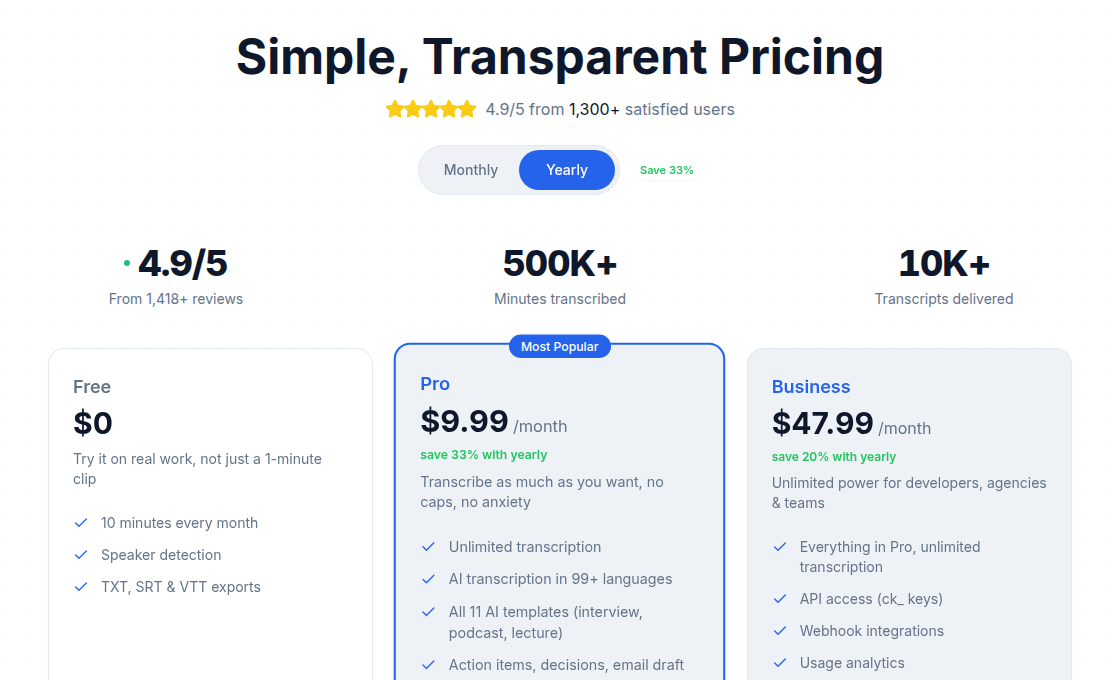 Published flat-rate plans are the baseline to negotiate against
What Counts as Enterprise
A practical threshold: 1,000+ audio-hours per month, organization-wide deployment, or any use case with compliance requirements that standard consumer plans cannot satisfy. Common examples:
- Contact center QA teams transcribing recorded calls for quality review.
- Healthcare systems running AI-assisted clinical documentation.
- Financial services firms archiving client communications for regulatory compliance.
- Media companies producing captions for broadcast and streaming content.
- Legal practices managing depositions and hearing records at scale.
- Government agencies processing recorded proceedings.
These use cases share three traits: high volume, compliance requirements that change the vendor shortlist, and multiple internal stakeholders (IT, legal, procurement) in the decision.
Published Volume Tiers: What the APIs Actually Charge
The clearest published tier structure in the enterprise segment belongs to AWS Transcribe. Rates apply to both batch and streaming (they are priced identically):
| Monthly volume | Rate per minute |
|---|---|
| 0 to 250,000 min | $0.024 |
| 250,000 to 1,000,000 min | $0.015 |
| 1,000,000 to 5,000,000 min | $0.0102 |
| 5,000,000+ min | $0.0078 |
That 5M+ tier represents a 67.5% discount versus the list rate. Note: PII content redaction adds $0.0024/min at Tier 1 (also tiered downward), and custom language models add $0.006/min.
Google Cloud Speech-to-Text V2 (which includes the Chirp model at no premium) follows a similar decay:
| Monthly volume | Rate per minute |
|---|---|
| 0 to 500,000 min | $0.016 |
| 500,000 to 1,000,000 min | $0.010 |
| 1,000,000 to 2,000,000 min | $0.008 |
| 2,000,000+ min | $0.004 |
Dynamic Batch processing drops to $0.003/min with up to 24-hour turnaround. Google bills in 15-second increments rounded up, which matters for short recordings.
AssemblyAI does not publish volume discount tiers. Base rates are $0.0025/min ($0.15/hr) for Universal-2 and $0.0035/min ($0.21/hr) for Universal-3.5 Pro. Custom enterprise contracts require contacting their sales team. One relevant data point: effective July 1, 2026, AssemblyAI's in-region model pricing increases 10%, but customers can pass model_region: global in API requests to keep current rates.
Deepgram publishes a Growth plan at roughly 12-20% below pay-as-you-go rates (Nova-3 Monolingual streaming: $0.0048/min pay-as-you-go, $0.0042/min Growth). Above that, enterprise contracts are custom and undisclosed.
Rev.ai lists Reverb transcription at $0.20/hr ($0.0033/min) as its published rate. Enterprise volume pricing is not disclosed and requires a sales engagement.
Published rates, US East (N. Virginia). Tier 4 (5M+ min/mo) is 67.5% below list.
What Drives the Total Bill Beyond Per-Minute Rates
The headline rate is rarely the dominant line item for large deployments. Five factors reliably inflate it.
Compliance overhead. HIPAA requires a signed BAA, encryption at rest and in transit, audit logging, and configurable data retention. SOC 2 Type II is now the baseline expectation, not a differentiator. GDPR adds data residency and processing agreements. FedRAMP authorization is required for US federal work and represents a substantial cost that vendors pass through. Expect 15-30% above comparable non-compliance pricing where vendors quote it separately.
Streaming versus batch. AssemblyAI charges $0.45/hr for real-time Universal-3.5 Pro streaming versus $0.21/hr for async. AWS prices both identically. Always verify the delivery mode you actually need, not the model's general headline rate.
Add-on features. Speaker diarization, sentiment analysis, topic detection, PII redaction: each adds per-minute charges. AWS Call Analytics (which includes analytics features) runs $0.030/min at Tier 1 versus $0.024/min for standard transcription.
Custom models. Custom vocabulary files are generally free or low-cost. Fine-tuned acoustic or language models are professional services engagements that can run from modest setup fees to $50,000+ for domain-specific work.
Integration and support. SLA-backed uptime (99.9%+), dedicated account management, and custom API integrations are typically bundled into annual enterprise contracts and are not in the per-minute rate. They add real cost.
For a deeper look at what hides inside vendor pricing, the hidden costs of transcription services post covers this in detail.
Worked Arithmetic from Verified Rates
Rather than publishing round estimates, here is what the verified rates produce at specific volumes:
Contact center, 10,000 hours/month (600,000 min): At AWS Tier 2, the first 250,000 min cost $6,000 and the next 350,000 min cost $5,250, for a total of $11,250/month before any compliance add-ons. At Google's equivalent tier ($0.010/min), the total is $6,000 for the first 500,000 min plus $1,000 for the next 100,000, totaling $7,000/month. Custom contracts from either vendor would likely undercut these published rates.
Financial compliance archive, 4,000 hours/month (240,000 min): This sits entirely in Tier 1 for AWS ($0.024/min = $5,760/month) and Google ($0.016/min = $3,840/month). The compliance overhead (FINRA-relevant retention, audit logging, encryption) brings in additional cost depending on vendor and contract structure.
Media captioning, 5,000 hours/month (300,000 min): AWS at mixed Tier 1 and Tier 2 rates: first 250,000 min at $0.024 = $6,000, next 50,000 at $0.015 = $750, total $6,750/month for standard. If real-time streaming captions are needed, the streaming premium (where it applies) adds material cost.
See transcription pricing comparison 2026 for a broader vendor comparison, and cost of transcription per hour for per-unit benchmarks.
Self-Hosted: Honest Math
Self-hosting Whisper Large-v3 on cloud GPU is frequently cited as the cheap alternative. The actual numbers are less dramatic.
A100 GPU rental runs $1.49-$3.43/hr in 2026 depending on provider. Whisper Large-v3 processes roughly 6-10 hours of audio per GPU-hour on optimized inference. That puts effective compute cost at $0.15-$0.25 per audio-hour, or $0.0025-$0.0042 per minute.
At those compute rates, self-hosting beats AWS Tier 1 and is competitive with Tier 2. But compute is not the full cost:
- Engineering time to build, maintain, and operate the pipeline (monitoring, scaling, failure recovery, model updates).
- Infrastructure beyond compute: storage, networking, orchestration.
- Compliance is not delegated; the organization owns it entirely.
My take: self-hosting makes sense above roughly 5,000 audio-hours monthly with predictable, stable workloads and existing infrastructure engineering capacity. Below that threshold, the engineering overhead reliably exceeds the compute savings. For organizations without a GPU infrastructure team, managed APIs at Tier 2-3 pricing are almost always cheaper on total cost of ownership.
Deepgram Nova-3 covers the engine performance characteristics behind the managed API route.
Three Pricing Models at Enterprise Scale
Enterprise transcription contracts use three structures, often combined.
Volume-discounted per-minute. The AWS and Google tiers above are examples: published brackets that reduce per-unit cost as consumption increases. Custom contracts extend this below the published floor.
Reserved capacity. A commitment to fixed monthly throughput in exchange for a further discount and dedicated processing. Typical for contact centers with predictable call volumes. The discount for committing to a specific capacity band is usually 20-40% off standard volume pricing.
Annual spend commitment. A total annual dollar commitment with a corresponding volume guarantee. Provides budget predictability and unlocks white-glove onboarding, custom integration support, and dedicated account management. Common in $100,000+ range for large deployments.
See unlimited vs. metered transcription pricing for a broader look at how these models compare for different workload types.
What Enterprise Procurement Actually Evaluates
Price is not the first filter. In practice, vendors get disqualified before pricing conversations for failing on:
Security and compliance posture. Can the vendor sign a BAA? Do they have current SOC 2 Type II certification? Where does data reside, and can the customer configure retention? Vendors that cannot answer precisely are out early.
SLAs. Uptime commitments of 99.9% or better, support response time guarantees, and documented RTO/RPO for outages. These are load-bearing for production deployments.
Accuracy on domain-specific audio. Many enterprises run RFP-style accuracy tests on their own representative audio before shortlisting vendors. Published WER benchmarks on clean studio audio do not predict performance on call center audio with background noise and domain vocabulary.
Vendor stability. Will this vendor exist in three years? Do they have a public track record at comparable scale? Enterprise procurement weighs this heavily; it affects both risk and switching cost.
Integration quality. API documentation quality, SDK availability, webhook support, and compatibility with the customer's existing stack (CRM, EHR, compliance archiving platforms).
Where to Start
Define your evaluation framework before talking to vendors. You need four things: your accuracy floor on representative audio, your compliance requirements (which narrows the shortlist immediately), your volume profile and workload predictability, and your integration needs.
Then run two or three vendors against your own audio. The vendor that clears the accuracy and compliance bar at the lowest total cost of ownership wins. Headline per-minute rates matter less than most buyers assume at enterprise scale; the compliance, integration, and support layers are where the real cost differential lives.
If your organization needs clean transcription at a smaller or variable scale before committing to an enterprise contract, ConvertAudioToText handles audio-to-text without meeting bot dependencies or seat-based licensing. It is not an enterprise contract product, but it covers the 100-to-1,000-hour-per-month range cleanly. See our pricing page for current plan details including the Business tier with webhooks and analytics.
Sources
- AWS Transcribe Pricing (volume tier table via CostGoat corroboration)
- Google Cloud Speech-to-Text Pricing (tier table via CostBench corroboration)
- AssemblyAI Pricing
- Deepgram Pricing
- Rev.ai Pricing
- JarvisLabs: A100 GPU Pricing 2026
FAQ
What is the cheapest per-minute rate for enterprise transcription?
AWS Transcribe's published Tier 4 rate (5M+ minutes per month) is $0.0078/min. Google Cloud Speech-to-Text reaches $0.004/min at 2M+ minutes per month, or $0.003/min via Dynamic Batch (with up to 24-hour turnaround). AssemblyAI and Deepgram do not publish discount brackets but offer custom contracts below list price for high-volume buyers.
Does HIPAA compliance cost more for transcription?
Yes, typically. Vendors that support HIPAA require a signed Business Associate Agreement (BAA), enforce encryption at rest and in transit, provide audit logging, and limit data retention. These obligations add operational overhead the vendor prices in. Expect a 15-30% premium over a comparable non-HIPAA deployment, though the exact premium depends on the vendor and contract terms.
When does self-hosting Whisper beat managed APIs on cost?
The break-even is higher than most estimates assume. A100 GPU rental runs $1.49-$3.43/hr in 2026, and Whisper Large-v3 processes roughly 6-10 hours of audio per GPU-hour, putting effective compute cost at $0.15-$0.25 per audio-hour. That beats AWS Tier 1 but is close to Tier 2-3 rates. Self-hosting wins clearly above 5,000 audio-hours per month with predictable load and existing engineering capacity; below that threshold, managed APIs are usually cheaper once you count the engineering and operational overhead.
What compliance certifications should I require from an enterprise transcription vendor?
At minimum: SOC 2 Type II (the de facto baseline in 2026), plus a signed HIPAA BAA if you handle health data, and GDPR data processing agreements for EU data. For US federal deployments, FedRAMP authorization is required. ISO 27001 is common as a secondary verification. Ask for current audit reports, not self-attestation.
Is real-time streaming transcription more expensive than batch?
It depends on the vendor. AWS Transcribe prices batch and streaming identically within each tier. AssemblyAI charges roughly 3x more for real-time streaming ($0.45/hr) versus async processing ($0.15/hr) on its Universal-3.5 Pro model. Deepgram's streaming and pre-recorded rates also differ. Always compare the specific model and delivery mode you need, not headline rates.
Try transcription free
Convert any audio or video to clean, unwatermarked text — speaker labels, timestamps, and AI summaries included. First 30 minutes free, no account.
Related Articles

Best Transcription Tool Alternatives, Honestly Compared (2026)
Leaving Otter, Descript, Transkriptor, Rev, or TurboScribe? Honest, sourced comparisons of every major transcription tool: real limits, verified pricing, and where each one genuinely wins.
Looking for a Transkriptor Alternative? Here's the Honest Math (2026)
Transkriptor meters your minutes and lets unused ones expire monthly. Here is its real 2026 pricing decoded, when staying is rational, and the unlimited alternatives at the same sticker price.