
When to Pay for Transcription: 5 Questions That Decide It
Summarize this article with:
Pay for transcription when your monthly volume consistently exceeds what free tiers cover, when errors carry real downstream cost, or when you need export formats and speaker labels your free plan locks away. For most working professionals, a flat-rate AI plan around $10 per month is the right answer. Human transcription enters the picture only when the audio is hard, the stakes are high, and you cannot do a review pass yourself.
Pay for transcription when the friction of your free tier costs you more time than the subscription costs you money. That is the short answer. The longer answer depends on five questions, and your responses to them map almost directly to a tier.
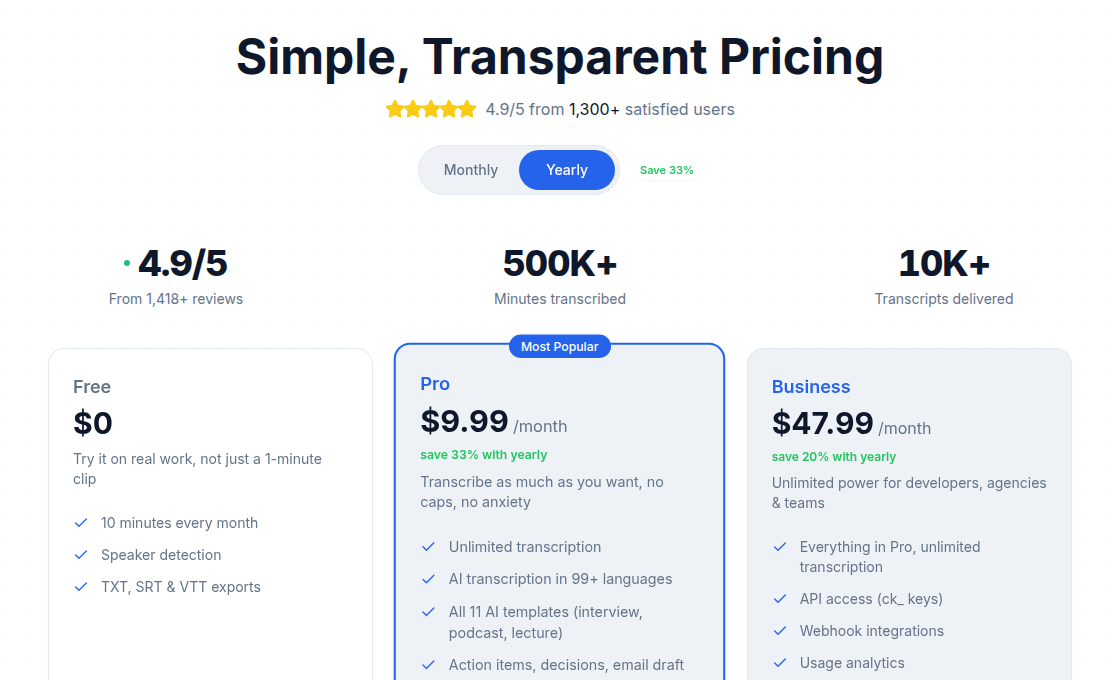 Flat monthly pricing makes the breakeven math simple
If you want a tool-by-tool breakdown of what each free and paid service actually offers, the sibling post free vs. paid transcription services covers that comparison. This post is the decision layer: how to figure out which tier fits you before you go shopping.
1. What is your monthly volume?
Volume is the most reliable proxy for the right choice, because every major free tier has a hard cap.
Otter.ai's free plan gives you 300 minutes per month. Descript's free tier is 60 minutes. Fireflies' free plan stores only 400 minutes total before you start losing old recordings. ConvertAudioToText's free tier runs your first file on the premium engine (up to an hour), then keeps transcribing free: up to 30 files a day, up to 30 minutes each.
The threshold that consistently makes a paid plan worth it: roughly 5 hours per month. Below that, most users can stay free or pay only when they genuinely hit a cap. Above that, the math flips. A $9.99 unlimited plan divided across 5 or 10 or 50 hours of audio is a rounding error compared to the time you spend workarounds, re-uploading, and splitting files.
Volume by tier:
| Monthly volume | Right move |
|---|---|
| Under 1 hour | Stay on a free tier |
| 1 to 5 hours | Free tier works; upgrade if you hit caps more than once a month |
| 5 to 30 hours | Flat-rate AI plan, almost certainly |
| 30 to 100 hours | Flat-rate plan or per-minute API depending on whether you need a UI |
| 100+ hours | Enterprise pricing or a self-hosted Whisper deployment |
For the 100+ hour category, the cost of transcription per hour post walks through the real per-unit math at scale.
2. What does an error actually cost you?
Accuracy separates the tiers in a meaningful way. Paid AI on clean audio typically runs 93-97% word accuracy. Free tools can drop to 80-90% on the same file, and the gap widens on multi-speaker audio or recordings with background noise.
The question is not whether errors exist. They will. The question is whether they have downstream cost.
If you are taking personal notes or creating a first draft for your own reference, a 90% accurate transcript is usually fine. You scan it, you know what you meant, you move on.
If a wrong word in your transcript creates real cost, paid or human transcription starts to pay for itself:
- A published article that gets issued a correction
- A legal case with a mis-transcribed key term
- A clinical note with an inaccurate value
- A regulatory submission with a wrong figure
At 93-97% accuracy on a one-hour recording, you have roughly 150-350 word-level errors to review. At 80%, that climbs to 1,200. The review time difference alone can justify an upgrade.
3. Do you need features your free tier locks away?
Most free tiers withhold the features that make transcription actually useful in a professional workflow.
What gets locked behind paid tiers on most platforms: speaker labels (diarization), SRT and VTT subtitle exports, DOCX and JSON export, AI summaries, multi-language support, longer file sizes, and faster processing queues.
If you are a podcaster who needs an SRT file to add captions to your episode, a free tier that only exports plain text is a hard blocker. If you are a journalist who needs to attribute quotes to named speakers, a tool without diarization costs you manual cleanup time that dwarf the subscription cost.
My take: the feature gap between free and paid tiers is underrated as a reason to upgrade. People often frame the decision purely as accuracy or volume, and then find themselves manually editing speaker labels that a $10 plan would have handled automatically.
Look at your workflow and identify the first step where you are currently doing something manually that a paid tier would automate. If that step takes more than 30 minutes per month, the math already favors upgrading.
4. Can you do a manual review pass yourself?
This question decides whether AI transcription is enough or whether you need human transcription.
Modern AI transcription on clean audio reaches 93-97% accuracy on paid tiers. That accuracy level, with a single careful review pass, is good enough for nearly every professional use case: published articles, podcast show notes, research interview transcripts, internal meeting records, video subtitles.
The case for human transcription rests on three conditions being true simultaneously. When all three are present at once, paying for human transcription is worth it:
- The audio is hard: heavy accents on a degraded recording, overlapping speakers, specialized terminology, or an environment the AI was not trained on
- The errors have real cost: legal record, medical documentation, regulatory filing, or a public-facing document where corrections damage credibility
- You cannot do a review pass yourself: no time, no access to the original audio, or no subject-matter familiarity to catch errors
If only one or two of those are true, AI with a review pass typically gets you there.
For the cases where human transcription is the right call, current market rates: Rev charges $1.99 per audio minute ($119 per hour) for human transcription with a 99% accuracy guarantee. GoTranscript offers more competitive rates in the $0.99 per minute range ($59 per hour), with pricing varying by turnaround time and language. The general market for professional human transcription runs $60-180 per hour. For context, see the AI vs. human transcription breakdown.
The hybrid pattern works well for most users with mixed stakes: flat-rate AI for the bulk of the work, human transcription for the small subset of audio where all three conditions above are true.
5. Are you building, or doing?
If you need transcription for your own use, a UI-based subscription is the right choice. If you are integrating transcription into a product you are building, a per-minute API is almost always cheaper and gives you programmatic control over the output.
The cost difference at volume is significant. A flat-rate UI plan at $10 per month is good value for a solo user. For a product processing 1,000 hours of audio monthly, per-minute API pricing from AWS Transcribe or Deepgram typically runs a fraction of the cost compared to UI-tier plans scaled to that volume. For the numbers, the speech-to-text API pricing post has current per-minute rates from the major providers.
For builders, the choice between API providers is a separate decision from the pay-or-free question. The pay-or-free answer for builders is usually: API from the start, even at low volume, because you need programmatic output formats and control flow that UI tools are not designed to provide.
The Pattern That Holds
For most working professionals in 2026, the decision is not complicated once you have answers to those five questions.
Under 1 hour a month and no professional stakes: free tiers are enough. You do not need to pay.
Consistent volume above 5 hours a month or features you need that are locked: a flat-rate AI plan at $10-20 per month pays for itself in the first week of use.
Hard audio, high stakes, and no time to review: human transcription on that specific audio, AI on everything else. You do not need to pay human rates across your full volume.
If you just need a clean transcript without meeting bots or heavy feature suites, ConvertAudioToText handles the upload. TXT downloads are free on every account; DOCX, PDF, SRT, VTT and JSON come with the first file, the Weekly Pass, a top-up or a paid plan.
The free-vs-paid decision for subscriptions is covered in more depth in free vs. paid transcription services. For the unlimited vs. per-minute choice at higher volumes, see unlimited vs. metered transcription pricing.
Common Questions
How much audio per month justifies a paid transcription plan?
Roughly 5 hours per month is the crossover point where a flat-rate AI plan becomes cheaper than the time cost of working around free-tier limits. Under 1 hour per month, free tiers are genuinely enough for most people.
What accuracy can I expect from paid AI transcription vs. free tools?
Paid AI tools on clean audio typically land at 93-97% accuracy. Free tools, especially those with less capable underlying models, can drop to 80-90% on the same audio. The gap widens significantly on noisy recordings or multi-speaker audio.
When does human transcription actually make sense over AI?
Human transcription is worth the premium when three things are true at once: the audio is hard (heavy accents, overlapping speakers, background noise), errors have real cost (legal, medical, regulatory), and you cannot do a manual review pass yourself. Meeting one of those conditions usually is not enough.
Is a hybrid AI-plus-human approach practical for most users?
Yes, and it is what most journalists, researchers, and podcast producers settle into naturally. Use a flat-rate AI plan for the bulk of your work, then send the small subset of high-stakes audio to a human service. The math usually beats paying for human transcription across everything.
Sources
- Rev Pricing - current plans and human transcription rates
- Descript Pricing - free tier and paid plan details
- Happy Scribe Pricing - subscription plans
- Fireflies.ai Pricing - free tier storage limits and paid plans
- TurboScribe Pricing - unlimited plan details
- Otter.ai Pricing - free and Pro plan limits
- ConvertAudioToText Pricing - free tier and paid plan details
- GoTranscript Pricing - human transcription rate calculator
Try transcription free
Convert any audio or video to clean, unwatermarked text — speaker labels, timestamps, and AI summaries included. First 30 minutes free, no account.
Related Articles

Best Transcription Tool Alternatives, Honestly Compared (2026)
Leaving Otter, Descript, Transkriptor, Rev, or TurboScribe? Honest, sourced comparisons of every major transcription tool: real limits, verified pricing, and where each one genuinely wins.
Looking for a Transkriptor Alternative? Here's the Honest Math (2026)
Transkriptor meters your minutes and lets unused ones expire monthly. Here is its real 2026 pricing decoded, when staying is rational, and the unlimited alternatives at the same sticker price.