
Transcription Pricing Models Explained: The Four Structures
Summarize this article with:
The Four Models
Transcription services bill in four distinct ways: per-minute, flat subscription, pre-purchased credits, and per-seat. Understanding the mechanics of each one takes about five minutes and can save you hundreds of dollars annually, because the cheapest plan on a given model can be the most expensive on another when your actual usage is factored in.
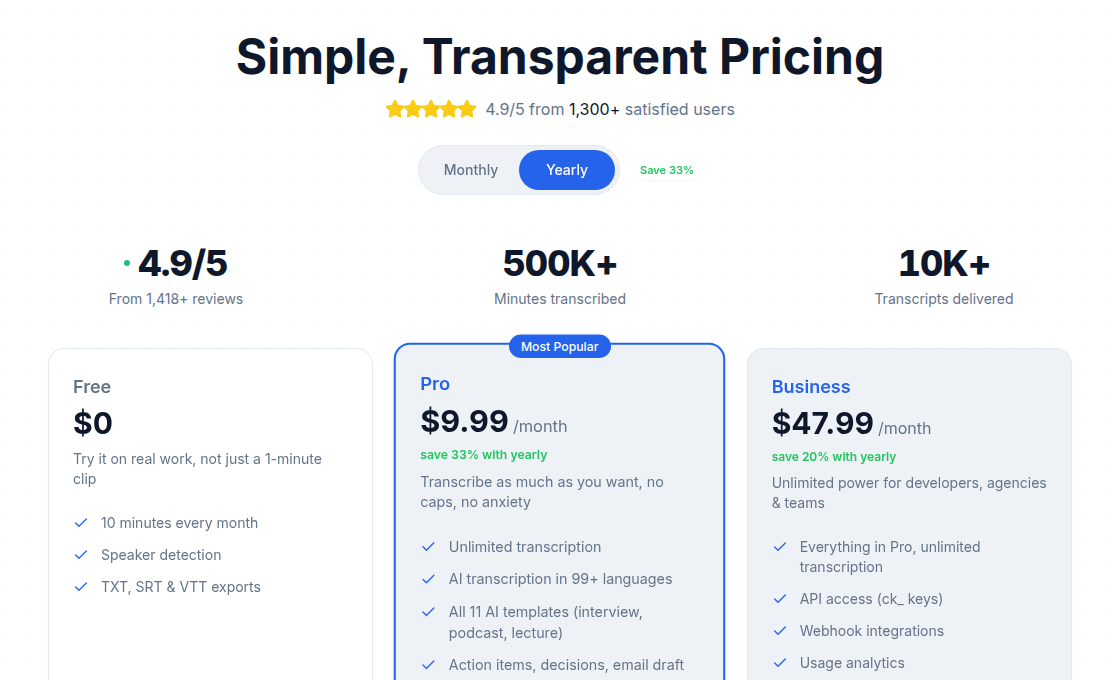 A subscription model with the tiers stated plainly
The real trap is not the headline price. It is choosing a model that does not match how you actually work.
Model 1: Per-Minute Pricing
You pay a fixed rate for every minute of audio you submit. No subscription, no commitment, no minimum spend. The total bill is audio length times rate, period.
How it works
Per-minute pricing is still the default for human transcription services, where skilled transcriptionists do the work manually. Rev charges $1.99 per audio minute for human transcription with a 99% accuracy guarantee. Happy Scribe's human-proofreading add-on starts at roughly $1.75 per minute for Business subscribers.
AI-tier per-minute rates are much lower. Deepgram's Nova-3 API runs at $0.0077 per minute pre-recorded (pay-as-you-go), which is roughly $0.46 per hour. That is developer-facing pricing, not a consumer product, but it illustrates how thin the underlying cost really is.
Note that Rev's AI tier has migrated away from pure per-minute billing toward a subscription model (Essentials at $29.99 per month for 5,000 AI minutes). Per-minute is now mostly the province of human services and raw API access.
When it wins
Use per-minute when your transcription is unpredictable or occasional. A researcher who submits one 30-minute interview every month or two has no reason to carry a subscription. Even at $1.99 per minute, that is $59.70 for the interview, far below any monthly plan.
The ceiling problem
Per-minute pricing has no cap. Volume growth translates directly into bill growth, with no discount for loyalty or scale. Once you exceed 8 to 10 hours per month at AI per-minute rates, a flat subscription almost always wins. See transcription pricing models and their break-even points for the math.
Model 2: Flat Subscription
One monthly (or annual) fee buys a fixed allowance, or in some cases genuinely unlimited processing. Subscription is now the dominant model for consumer AI transcription tools.
Capped versus unlimited
The critical distinction is not the price. It is whether the plan has a hard ceiling.
Capped subscriptions lock your account or charge overage once you hit the monthly limit. Otter Pro at $16.99 per month gives 1,200 minutes for individuals. Sonix's Core plan at $25 per month includes 5 hours, with overages billed at $10 per hour. Happy Scribe's Basic plan at $17 per month covers 120 AI minutes before you hit pay-as-you-go rates of $0.20 per minute. The subscription gives you a predictable floor, but a variable ceiling.
Unlimited subscriptions carry no minute ceiling for the subscription fee, though file-size limits and fair-use policies may still apply. TurboScribe's Unlimited plan runs $10 per month on annual billing (or $20 month-to-month) with no cap on the number of transcriptions. Files up to 10 hours long and 5 GB are supported.
My take: "unlimited" claims deserve skepticism. Read the plan's fine print for any language like "fair use limits apply" before counting on it.
When subscription wins
Subscription pricing wins when your usage is consistent and exceeds roughly 10 to 15 hours per month. A journalist running weekly two-hour interviews pays less on a flat plan than on per-minute rates, and the month-end bill never surprises them. For a deeper comparison of subscription versus metered costs, the cost of transcription per hour breakdown is useful.
What capped plans hide
Unused minutes almost never roll over. Pay for a 600-minute Pro plan, use 200 minutes in a slow month, and those 400 minutes evaporate. In a busy month, you hit the wall at minute 601. The pricing page rarely highlights this.
Many plans also gate features by tier rather than just minutes: speaker labels, export formats like SRT and VTT, and AI summaries may be reserved for higher tiers. Always verify which features are included before committing.
If you just need a clean transcript without a monthly seat or plan commitment, ConvertAudioToText offers a free tier to test before you subscribe to anything.
Model 3: Credit and Pack Pricing
Credits are prepaid per-minute (or per-file) units you draw down as you use the service. Some vendors call them tokens, credits, or packs. The mechanic is essentially pay-as-you-go, but you buy in advance rather than paying after the fact.
How it works in practice
Sonix charges $10 per hour on its pay-as-you-go tier, billed by the second. Happy Scribe tops up credits at $0.20 per minute beyond your monthly plan allowance, and those topped-up credits carry forward indefinitely. Deepgram gives $200 in free API credits to new accounts at $0.0077 per minute for Nova-3, which is roughly 430 hours of audio before your first invoice.
When it wins
Credit pricing suits burst workloads with long idle periods between them. A documentary editor who needs 60 hours of transcription for a single project, then nothing for four months, buys a credit pack, uses it, and stops. A subscription would charge $12 to $25 per month across those idle months.
Credits also work well as an overflow safety valve on capped subscription plans, which is why Happy Scribe, Sonix, and others sell them as add-ons rather than standalone products.
The credit trap
The key variable is expiry policy. Topped-up Happy Scribe credits persist across billing cycles. Other vendors apply 12-month expiry to credit packs, which can burn you if a project drags. Always check before buying a large block upfront.
Also watch for minimum top-up quantities. Some services require you to buy 5 or 10 hours at once, which inflates the effective cost if you only needed 90 minutes.
Model 4: Per-Seat Pricing
Seat pricing charges per user, per month, regardless of how much each seat transcribes. It is the standard model for team and enterprise products where collaboration features (shared notes, meeting bots, integrations) are the primary value.
How it compounds
Otter Business runs $30 per user per month (or $19.99 billed annually). A five-person team pays $100 to $150 monthly before a single minute of audio is processed. Trint's plans start around $80 per seat per month. Fireflies Business is $19 per user per month on annual billing.
Seat pricing is not inherently expensive if every seat actively transcribes. It becomes expensive when you buy seats for casual readers, managers who just review transcripts, or team members with occasional one-off needs. Those users are effectively subsidizing the heavy users on the plan.
When it wins
Seat pricing makes sense when the team collaboration layer (shared workspace, linked action items, meeting summaries pushed to Slack or CRM) justifies the premium over a plain transcription subscription. If you just need the raw transcript and do not need the workflow integration, per-seat plans tend to overprice the underlying service significantly.
See enterprise transcription pricing considerations for a fuller breakdown of seat pricing at scale.
Most Vendors Mix Models
The four models above are not mutually exclusive in practice. Most vendors layer them.
- Rev offers human transcription per-minute, plus an AI subscription with a monthly minute cap, plus subscriber discounts on the human tier.
- Happy Scribe runs a subscription with a monthly minute allowance, pay-as-you-go top-ups that carry forward, and human-proofreading per-minute add-ons.
- Sonix sells either pay-as-you-go credits at $10 per hour, or a subscription plan that includes a base allowance with overages billed at the same $10 per hour rate, plus a per-seat add-on for additional team members.
- Deepgram is API-only (metered per-minute) with a volume discount tier for prepaid annual spend, and a free credit block to start.
Understanding this layering matters when you compare two services at face value. A "subscription" at Service A may have unlimited minutes. A "subscription" at Service B may be a capped monthly allowance with per-minute overages past the cap, which is functionally per-minute pricing with an upfront payment.
For a broader look at which model suits which use case, the guide to hidden costs of transcription services covers the fee structures most users miss before they sign up.
Comparison Table
| Model | How you are billed | Best for | Watch out for |
|---|---|---|---|
| Per-minute | Audio length x rate, post-use | Occasional or irregular use, human transcription | No ceiling: costs scale linearly with volume |
| Flat subscription | Monthly fee, fixed allowance or unlimited | Consistent 10+ hours per month | Caps, no rollover, gated features on lower tiers |
| Credits / packs | Prepaid balance drawn down per minute or file | Burst projects with idle gaps between them | Expiry policies, minimum top-up sizes |
| Per-seat | Fixed monthly charge per user | Team workflows with collaboration features | Costs scale with headcount, not usage |
Picking the Right Model
Match the model to your usage pattern, not the other way around.
Light or irregular use: Freemium first, per-minute for overflow. Most free tiers cover evaluation and occasional work.
Steady monthly volume above 10 hours: Unlimited subscription wins on cost and predictability. Verify there is a real unlimited cap, not a "fair use" ceiling in the footer.
Bursty project work: Credit packs, checked for expiry policy before purchase.
Teams that need collaboration features, not just transcripts: Per-seat plans, but count only active transcribers when estimating cost.
High volume developer or API use: Metered API pricing from providers like Deepgram. The $200 free credit covers hundreds of hours before your first charge at $0.0077 per minute.
One useful calibration: calculate your cost per accurate minute rather than cost per minute billed. If a cheaper service produces transcripts that require two hours of editing per hour of audio, it is the most expensive option in the room. The guide to when to pay for transcription covers that threshold in detail.
FAQ
What is the cheapest transcription pricing model for light users?
Freemium or per-minute pricing wins for light use. Most services offer 300 to 600 free minutes per month on their free tier, which covers a handful of short recordings. Once you exceed roughly 10 to 15 hours per month, a flat subscription almost always costs less than per-minute or credit rates.
What does 'unlimited transcription' actually mean?
It depends on the vendor. Some plans are genuinely unlimited with no file count or minute ceiling. Others advertise unlimited but apply a "fair use" cap in the fine print, which can be anywhere from 1,200 minutes to several thousand minutes per billing cycle. Always check the plan's detail page for any cap, overage rate, or file-size restriction before subscribing.
Do transcription credits expire?
It varies. Happy Scribe's topped-up pay-as-you-go credits persist across billing cycles, while plan credits reset monthly. Some services put a hard 12-month expiry on purchased credit packs. Always read the expiry policy before buying a large block of credits upfront.
When does per-seat pricing become expensive?
Per-seat pricing scales linearly, so cost grows with headcount, not usage. A five-person team on Otter Business at $30 per user per month pays $150 monthly, even if only two people transcribe regularly. Before buying seat-based plans, count only the users who will actively transcribe, not everyone who might glance at a transcript.
How do API-tier pricing models differ from consumer subscriptions?
API pricing from providers like Deepgram charges per second of audio processed, typically at fractions of a cent per minute. There is no seat count and no monthly minimum once you exhaust the free trial credit. Consumer subscriptions charge a flat monthly fee for a fixed allowance, which is simpler but often more expensive per minute at high volume.
Sources
Try transcription free
Convert any audio or video to clean, unwatermarked text — speaker labels, timestamps, and AI summaries included. First 30 minutes free, no account.
Related Articles

Best Transcription Tool Alternatives, Honestly Compared (2026)
Leaving Otter, Descript, Transkriptor, Rev, or TurboScribe? Honest, sourced comparisons of every major transcription tool: real limits, verified pricing, and where each one genuinely wins.

Otter AI Pricing Explained: Plans and Limits
Otter AI pricing explained: Pro from $8.33 per user a month billed annually, Business, the free plan's limits, and a file-first alternative for uploads.