Fix Foreign Words in Your Transcription (2026 Guide)
Summarize this article with:
When a transcription model is set to English, it renders foreign borrowings phonetically as English sounds. The fix depends on how predictable those words are: use a Whisper-based tool for one-pass accuracy on common loanwords, keyterm prompting (Deepgram Nova-3) or prompt priming (OpenAI Whisper API, AssemblyAI Universal-3 Pro) for domain-specific terms, and a find-and-replace list for recurring phrases your tool still gets wrong. For content where more than 10% of speech is in another language, treat it as code-switching rather than foreign borrowings.
The problem has a one-sentence diagnosis: your transcription tool was told to listen for English, so it spelled "schadenfreude" as "shadow in frood" and "croissant" as "crossant." The fix you need depends on whether those foreign words are predictable or not.
Why English-Mode Tools Mangle Foreign Words
When a transcription model is configured for a single language, it maps every incoming sound to the nearest candidate in that language's phoneme inventory. Foreign words land outside that inventory. The model picks the closest-sounding English string and moves on.
This is different from full code-switching, where speakers alternate between languages across entire sentences. Foreign words in an otherwise English transcript are isolated borrowings: a French phrase, a German compound noun, a Japanese food term. The model is set to English and renders the foreign phonemes in English script.
The good news is that Whisper Large-v3, trained on roughly 680,000 hours of multilingual audio covering 99 languages, recognizes common loanwords on the first pass without any extra configuration. "Bonjour," "schadenfreude," "croissant," "anime," and "karaoke" typically come out correctly. The failures cluster around less common terms, proper nouns, and regional place names.
Fix 1: Pick a Multilingual-Trained Tool
The single highest-leverage change is moving to a tool built on Whisper Large-v3. Because the model has seen foreign words in multilingual training data, it has seen correct spellings rather than phonetic guesses.
- Whisper-based tools (the OpenAI Whisper API and self-hosted Whisper): common foreign borrowings in English audio typically survive intact. "Düsseldorf" comes through with the umlaut; "je ne sais quoi" lands as French rather than phonetic English.
- Deepgram Nova-3 in English-only mode: applies stricter monolingual modeling, so foreign loanwords fare worse without extra configuration (see Fix 3 below).
- Browser Web Speech API tools: single-language per session by design. Foreign words mangle badly and there is no override short of switching the session language entirely.
- Older Google Cloud STT v1: limited multilingual awareness; superseded by v2 with phrase sets.
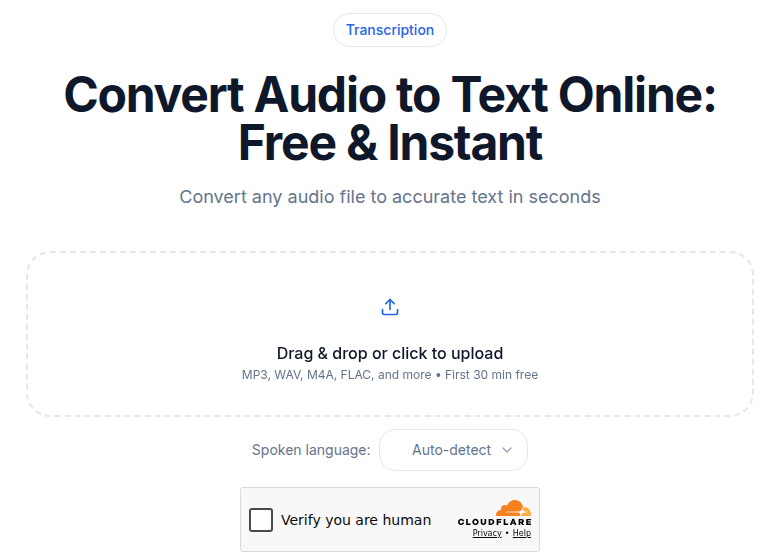 ConvertAudioToText audio upload tool
To test your own recording, run it through ConvertAudioToText's audio-to-text tool and set the language explicitly.
Fix 2: Find-and-Replace for Recurring Foreign Words
For foreign words that appear repeatedly across your work, a substitution list is the most reliable fix regardless of which tool you use.
Build the list after your first transcript of a new topic:
bone jure        → bonjour
say la vee       → c'est la vie
jaw da veever    → joie de vivre
shadow in frood  → schadenfreude
doosseldorf      → Düsseldorf
moon ick         → Munich
The list compounds in value. After transcribing a dozen episodes of a food podcast, you have covered the French culinary terms, the Italian preparation names, and the Japanese dish names that recur. Apply the list as a bulk find-and-replace step at the end of every transcript in that series.
This is the right tool for:
- Podcasts that regularly reference specific foreign cuisines, places, or expressions
- Business meetings that reference international offices or partners by name
- Academic content that draws on Latin (medicine, law), German (philosophy), or Italian (music)
Fix 3: Keyterm Prompting and Vocabulary Lists
Several transcription APIs let you supply expected terms before the audio is processed. This is more powerful than post-processing because the model is primed to produce specific spellings, not random phonetic approximations.
Deepgram Nova-3 keyterm prompting (verified via Deepgram documentation, checked July 2026): pass up to 500 tokens per request, roughly 100 words. The feature works for both monolingual and multilingual Nova-3 models. A vocabulary list for an English podcast with international guests might look like:
bonjour, croissant, déjà vu, faux pas, je ne sais quoi,
schadenfreude, zeitgeist, wanderlust, kindergarten,
karaoke, ramen, sayonara, piñata, tortilla
Deepgram reports that keyterm prompting can improve keyword recall rate up to 90% for listed terms.
OpenAI Whisper API prompt parameter: pass the expected foreign words and proper nouns in the optional prompt field. The model considers the final 224 tokens of that prompt, which is enough for 30 to 50 foreign terms. For larger lists, the OpenAI documentation recommends a GPT-4 post-processing pass over the finished transcript instead.
AssemblyAI Universal-3 Pro: the model defaults to transcribing in the dominant language of the audio. If your English audio contains French phrases, the unprompted model may translate them into English. Pass the explicit instruction: "Preserve the original language(s) and script as spoken, including code-switching and mixed-language phrases." According to AssemblyAI's prompt engineering documentation, specificity matters. The more explicit the instruction, the less the model interprets on its own.
Google Cloud STT v2: phrase sets let you supply a weighted list of expected words with a boost score. Higher boost increases the probability of matching the listed phrase; the documentation notes that very high boost values can increase false positives, so moderate values work best for foreign proper nouns.
Fix 4: Manual Correction with a Reference
For unpredictable foreign words (a guest who references obscure place names, regional dishes, or dialect-specific expressions), the manual correction pass is the practical choice.
The process: listen to the foreign word in context, look up the correct spelling in Wikipedia, Google Translate, or a language-specific dictionary, and substitute the mangled text. About 30 seconds per word for common cases. For audio heavy with unpredictable foreign references, this is slow but accurate. For the occasional mis-rendered term in a mostly-English transcript, it is the right call.
How This Breaks Down by Language Family
The pattern of failures is predictable enough that you can prepare in advance.
Romance Languages (French, Spanish, Italian, Portuguese)
Mangling is phonetically systematic. "Bonjour" becomes "bone jure," "gracias" becomes "graceous," "pasta carbonara" becomes "pasta carbon era." The sounds exist in English; the model just picks the wrong English word. Find-and-replace covers these well because the errors are consistent across recordings.
German
Umlauts (a-umlaut, o-umlaut, u-umlaut) are the main failure point. "Düsseldorf" loses the umlaut or becomes "doosseldorf." Compound nouns may be split into separate words. Add the correct Unicode spellings to your custom vocabulary or find-and-replace list.
Japanese
High-frequency loanwords in English (sushi, ramen, anime, manga, karaoke, sayonara) appear extensively in Whisper's training data and usually come through correctly. Less common Japanese terms, specific regional place names, and dish names beyond the familiar canon mangle more. Custom vocabulary handles this tier.
Chinese
Multiple romanization systems (Pinyin and Wade-Giles) mean the same word has multiple correct spellings. "Beijing" and "Shanghai" work because they are ubiquitous. "Chongqing," "Xiao long bao," and similar terms mangle more. Pinyin spellings are safer to use in vocabulary lists than Wade-Giles because they are more common in modern training data.
Hindi and South Asian Languages
Common borrowings (curry, masala, naan, samosa, biryani, dharma, karma) are reliably handled by Whisper-based tools. Technical Sanskrit terms and regional specifics need custom vocabulary.
Arabic
High-frequency borrowings (falafel, hummus, baklava) come through fine. Place names romanized in different ways (Al Jazeera vs. Aljazeera) may produce inconsistent output. Adding the preferred romanized spelling to your vocabulary list pins the output.
A Practical Workflow for Mostly-English Content
If your content is primarily English with occasional foreign references:
- Transcribe with a Whisper-based tool. Common loanwords come out correctly on the first pass.
- Skim the transcript for mangled strings. They tend to cluster around specific foreign-language sources.
- Run find-and-replace for any recurring mangled terms.
- Add the correct spellings to your keyterm/vocabulary list for that tool. The list carries forward to every future transcript in the same project.
- Handle unpredictable one-off terms manually using a reference.
My take: the vocabulary list is the highest-leverage investment here. The first transcript takes the most cleanup; by the fifth, the tool is outputting the correct spellings for your domain's foreign terms automatically.
For content where foreign words are dense or unpredictable, ask whether the audio is actually multilingual rather than English-with-borrowings. If more than about 10% of the speech is in another language, the code-switching fix applies different techniques: per-segment language detection, multilingual mode, and diarization-aware language tagging.
Tools That Make This Worse
Some tools handle foreign words especially poorly:
- Browser Web Speech API implementations: one language per session, strict. Foreign words mangle severely with no fix short of switching the session language.
- Tools with aggressive language detection: if the tool detects too many foreign words, it may flip the entire transcript into the foreign language, breaking the English portions. This is rare with Whisper-based pipelines but common with some cloud STT implementations.
- Real-time captioning tools optimized for English fluency: batch tools handle foreign borrowings better than live captioning tools because they process the full utterance rather than fragments.
For mixed-language work, batch transcription with a Whisper-based pipeline is the correct starting point. Pair this post with the mistranscribed names fix when the foreign words in question are proper nouns specifically.
Common Questions
Why does my transcription tool spell French words phonetically instead of correctly?
When a tool is configured for a single language (English), it maps every sound to the nearest match in that language's vocabulary. French phonemes have no direct English equivalent, so the model produces the closest-sounding English string. Switching to a multilingual-trained model like Whisper Large-v3, or using keyterm prompting on Deepgram Nova-3, gives the model the spelling it should output instead.
Does Deepgram Nova-3 handle foreign words in otherwise English audio?
Deepgram Nova-3 in standard English mode does not automatically recognize foreign loanwords. The fix is Nova-3's keyterm prompting feature: you pass up to 500 tokens (roughly 100 words) of expected terms per request, and the model boosts recognition for those exact spellings. For real-time code-switching across English, Spanish, French, German, Hindi, Russian, Portuguese, Japanese, Italian, and Dutch, use Nova-3 Multilingual mode instead.
Can I use the OpenAI Whisper API prompt parameter for foreign word lists?
Yes. The prompt parameter accepts a list of the foreign words or proper nouns you expect in the audio, and the model tries to match those spellings. The practical limit is 224 tokens per request, which is enough for 30 to 50 foreign terms. For larger vocabularies, the Whisper documentation recommends running a GPT-4 post-processing pass over the transcript instead.
When does occasional foreign vocabulary cross into code-switching territory?
A useful threshold: if more than 10% of the audio is in a language other than the primary one, treat the file as multilingual rather than English-with-borrowings. The foreign-word fixes in this post (find-and-replace, custom vocabulary, prompt priming) work well for isolated loanwords and set phrases. Sustained multilingual content needs a different approach covered in the code-switching fix post.
Sources
- Deepgram Nova-3 Keyterm Prompting documentation (checked July 2026)
- Deepgram Nova-3 Multilingual language expansion (checked July 2026)
- OpenAI Whisper API speech-to-text guide (checked July 2026)
- AssemblyAI Universal-3 Pro prompt engineering (checked July 2026)
- AssemblyAI code-switching documentation (checked July 2026)
- Google Cloud STT phrase sets and model adaptation (checked July 2026)
- OpenAI Whisper GitHub repository multilingual discussion (checked July 2026)
Try transcription free
Convert any audio or video to clean, unwatermarked text — speaker labels, timestamps, and AI summaries included. First 30 minutes free, no account.
Related Articles

Fixing Code-Switching Errors in Transcription
Hinglish, Spanglish, and Taglish break most transcription tools. Here are the real failure modes and the specific engine settings that fix them, verified for 2026.

Fix Missing Punctuation in Your Transcript (2026 Guide)
Your transcript is a wall of text with no periods or commas. This guide explains why punctuation goes missing and how to fix it fast, with per-engine honesty.