Hausa Transcription: Engine Support, Script, and Accuracy in 2026
Summarize this article with:
The Short Answer
Hausa has production-grade AI transcription support in 2026, but only from a handful of engines. Whisper Large-v3 and Google Cloud's Chirp models handle it. AssemblyAI lists it but flags accuracy as "fair" (above 50% word error rate on typical audio). The rest of the major consumer tools, Otter, Trint, Descript, simply do not support Hausa at all. If your audio is in Hausa, engine choice is the first decision.
Why Hausa Transcription Matters Right Now
Hausa has roughly 50 million first-language speakers and 30 million more who use it as a second language, concentrated in northern Nigeria and Niger, with significant communities in Ghana, Cameroon, Chad, and Sudan. It is the dominant Sahel trade language. In March 2025, Niger made Hausa its official language, replacing French. That shift amplifies demand for Hausa-language digital tools across government, media, and education.
Kannywood, the Hausa-language film industry based in Kano, produces around 50 films per month during peak seasons and employs more than 30,000 people. International broadcasters including BBC Hausa, Deutsche Welle Hausa, and Voice of America Hausa maintain dedicated Hausa services. The content volume is real. The tooling, until recently, was not.
Boko vs Ajami: The Script Question
Before you transcribe, it helps to know which writing system applies to your content.
Boko is the Latin-based script and the modern standard. Nigerian newspapers, digital content, broadcast transcripts, and most educational material use Boko. It includes four characters that do not exist in standard Latin:
- ɓ: bilabial implosive (distinct from the plain English "b")
- ɗ: alveolar implosive (distinct from the plain English "d")
- ƙ: voiceless ejective velar stop (distinct from the plain English "k")
- ʼy: glottalized palatal approximant
These are not decorative. Swapping plain "b" for "ɓ" changes word meaning. An engine that outputs plain Latin letters for these is producing a lossy transcript.
Ajami is the Arabic-script tradition, used historically for religious texts, Islamic scholarship, and classical Hausa literature. Ajami has no standardized spelling system across writers, which makes it much harder to model. AI transcription engines are trained predominantly on Boko, so Ajami-heavy audio (Sufi devotional recitation, older Islamic manuscripts read aloud) will produce unreliable output regardless of which engine you use. If your content is Ajami, treat AI as a rough first pass only.
Whisper Large-v3 outputs standard Boko including ɓ, ɗ, and ƙ. Google Cloud STT via Chirp also targets the ha-NG locale. Check any other tool's output on a short clip with these characters before committing to a workflow.
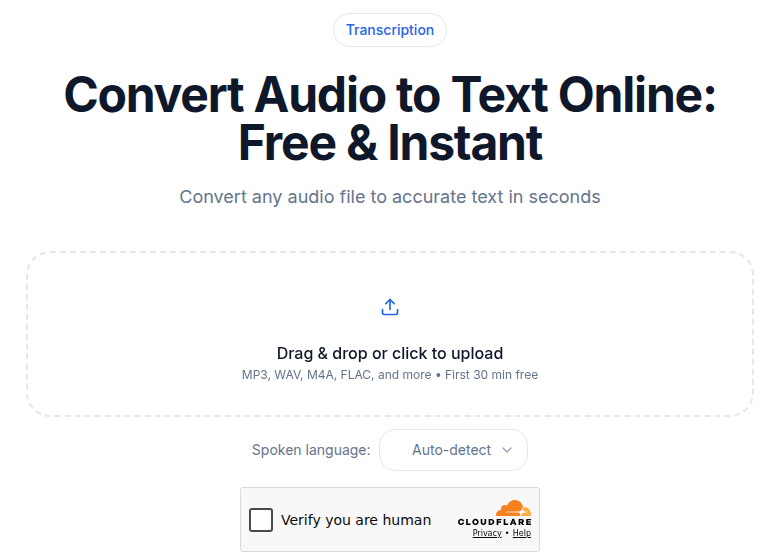 Audio upload tool for Hausa transcription
Hausa Phonology: What Makes It Hard for ASR
Hausa is a tonal language with three pitch contrasts: high, low, and falling. Tone marks grammatical function and lexical meaning, but standard written Hausa does not use tone diacritics. That is actually fine for transcription: speakers do not write tone marks, and neither do transcription engines. The output will be un-toned text, which is what a Hausa reader expects.
The harder problem is the consonant inventory. Hausa has 32 consonants, including contrasts between plain, palatalized, and labialized stops, plus the implosive and ejective series. These are phonemes that distinguish words. Training data scarcity amplifies the risk: Mozilla Common Voice has roughly 10 validated hours of Hausa, and even larger curated sets like NaijaVoices include around 600 hours. Compare that to thousands of hours for English or French, and the accuracy gap is structural, not a software bug.
Additionally, Hausa vowel length is contrastive: short and long vowels carry different meanings. Engines trained on limited Hausa data may miss length distinctions, particularly in informal or fast speech.
Which Engines Support Hausa (Honestly)
| Engine | Hausa Support | Accuracy Tier | Notes |
|---|---|---|---|
| Whisper Large-v3 | Yes | Mid-range for African languages | Boko output incl. ɓ ɗ ƙ |
| Google Cloud STT (Chirp 3) | Yes, ha-NG | Not published | API, dev setup required |
| AssemblyAI Universal-2 | Yes | "Fair" (>50% WER flagged) | Lower expected accuracy |
| Deepgram Nova-3 | No confirmed Hausa | N/A | Not on supported language list |
| Otter.ai | No | N/A | 6 languages only |
| Trint | Not confirmed | N/A | No Hausa in verified language list |
| Descript | No | N/A | English-centric tooling |
| Rev | No | N/A | Human reviewers may work; AI does not |
My take: AssemblyAI's self-reported "fair accuracy" bracket is honest but discouraging. For Hausa content where you need clean Boko output with the hooked consonants intact, Whisper Large-v3 is the practical choice given what is publicly verifiable. Google Cloud's Chirp 3 is worth testing if you have API access, but it requires more setup than a consumer transcription tool.
For a broader look at how engines compare on less common languages, see why AI struggles with low-resource languages.
Accuracy by Audio Type
Whisper Large-v3 accuracy on Hausa is lower than its accuracy on English, French, or even Arabic, because the training corpus is smaller. Rough expectations based on audio conditions:
- Studio-recorded Hausa news or radio (NTA Hausa, DW Hausa service): 85 to 90 percent.
- Formal political speech or Friday sermon in clean audio: 82 to 88 percent.
- Hausa podcast, two speakers, minimal noise: 78 to 85 percent.
- Urban Nigerian Hausa with English code-switching: close to the above range; Whisper handles the mix reasonably.
- Field recordings with ambient noise (markets, outdoor events): 65 to 78 percent. Background noise hurts Hausa accuracy more than it hurts English, because there is less model capacity to recover from it.
- Niger Hausa (Nigerien dialect, Kananci-adjacent but with distinct vocabulary): 78 to 85 percent, no special settings required.
These are estimates based on the acoustic and training-data factors above, not published benchmarks. No public Hausa ASR leaderboard tracks these specific conditions. Treat them as planning ranges, not guarantees, and always run a test clip on your actual content before committing to a high-volume workflow.
Dialects: Kano, Sokoto, Zaria, Niger
Standard Hausa for transcription purposes is Kananci, the Kano dialect. It is the broadcast standard, the education standard, and what most digital Hausa content uses.
Sakkwatanci (Sokoto dialect) is the western variety, considered classical in Hausa literary tradition. It has conservative features that diverge from Kananci in vocabulary and some phonological forms.
Zazzaganci (Zaria dialect) is a southern variety with differences in gender marking and vowel treatment.
Niger Hausa is Kananci-adjacent but shares some overlap with Sakkwatanci. After Niger's 2025 adoption of Hausa as its official language, there is growing demand for transcription of government and media content produced in Niamey. The dialect differences are real but do not prevent mutual intelligibility, and a model trained primarily on Nigerian Hausa data will handle Niger Hausa with modest accuracy reduction.
No current consumer engine offers a dial-level adjustment for Hausa dialect. If your audio is from a specific region and accuracy on a test clip is not meeting your needs, providing a glossary of locally distinctive vocabulary is the most practical fix.
Code-Switching with English
Nigerian urban Hausa in Kano, Kaduna, and Abuja mixes English freely, especially in business, tech, and youth content:
"Ina son kawo wani idea, but kafin in fara, mu yi short break."
Whisper outputs Hausa segments in Boko and English segments in standard English. The mix reflects how these speakers actually write, which is exactly what you want for podcast show notes, YouTube descriptions, or social-media captions. No special configuration is needed.
Rural Hausa and Niger Hausa include far less English. That audio stays in Boko throughout, which also works correctly.
Practical Workflow for Hausa Content
For Kannywood producers, radio editors, and journalists, this is the sequence that works:
- Record in the quietest environment available. Outdoor ambient noise degrades Hausa accuracy more than it degrades high-resource language accuracy, because the model has less margin to compensate.
- Set the transcription language to Hausa explicitly. Auto-detect can confuse Hausa with Arabic (due to shared loanwords and intonation patterns) or with other West African languages in noisy recordings.
- Upload via the audio to text tool. For video content, including Kannywood clips and YouTube interviews, the video to text tool handles extraction automatically.
- Enable speaker labels if you have more than one speaker. Expect diarization to be reliable for two-speaker clean audio and less so for call-in radio with multiple overlapping voices.
- Add a glossary of proper nouns before review: Hausa person names (which have many spelling variants), Nigerian and Nigerien place names, and any brand or organization names that appear in your content.
- Review specifically for the hooked consonants. A mismatch like "barka" vs "ɓarka" changes meaning. This is where the low-resource accuracy ceiling shows up in practice.
- Export to SRT for YouTube subtitles or TXT for article drafting.
For Kannywood distribution specifically, Hausa SRT subtitles expand reach to diaspora audiences and to Hausa speakers in Ghana and Cameroon who may not catch all the Kano-dialect vocabulary at film speed.
NGO and Development Sector Use
Organizations working across northern Nigeria, Niger, Chad, and the broader Sahel frequently conduct field interviews in Hausa. A community health worker explaining vaccine uptake resistance, a farmer describing crop failures, a market trader on fuel price impact: this content is where Hausa transcription has the most institutional value, and where audio quality is often the biggest challenge.
For NGO field recordings, accept that accuracy will be lower than broadcast-quality audio and budget time for post-review. The transcript is still dramatically faster to review than a raw audio file, even at 75 percent accuracy. Multilingual workflows that include Hausa alongside English, French, and Arabic are fully supported on the same plan.
Where CATT Fits
If you just need a clean Hausa transcript without API configuration or cloud infrastructure, ConvertAudioToText transcribes Hausa with speaker labels on the premium engine. On a free account your first file runs on the premium engine (up to an hour), then it keeps transcribing free: up to 30 files a day, up to 30 minutes each. Reading and copying transcripts is free. The Pro plan, $14.99/month, is unlimited and covers Hausa alongside every other supported language. For journalists and podcast producers working across both Hausa and English, that means one plan covers everything.
For context on how per-minute API pricing stacks up against flat-rate tools, see transcription pricing comparison 2026.
Common Questions
Which AI transcription engines support Hausa in 2026?
Whisper Large-v3 and Google Cloud Speech-to-Text via Chirp models both support Hausa. ConvertAudioToText also transcribes Hausa. AssemblyAI also lists Hausa under its Universal-2 model but places it in the "fair accuracy" bracket, meaning word error rates above 50% on typical audio. Otter.ai, Trint, and Descript do not support Hausa at all.
Does Hausa transcription output Boko script with the correct hooked consonants?
It depends on the engine. Whisper Large-v3 outputs standard Boko (Latin-based) script and handles the implosive and ejective markers ɓ, ɗ, and ƙ. If a tool returns plain "b", "d", "k" instead of the hooked forms, it is stripping phonologically meaningful distinctions that change word meaning in Hausa.
How does code-switching between Hausa and English affect transcription?
Urban Nigerian Hausa speakers in Kano, Kaduna, and Abuja frequently mix English into Hausa conversation. Whisper handles this well in practice: Hausa words come back in Boko script and English words in English. The output reflects how these speakers actually write, which is useful for podcast and social-media content. Rural or Niger Hausa audio with little English shows negligible code-switching and stays in Boko throughout.
Is Hausa a tonal language and does that affect AI transcription?
Yes. Hausa has three pitch contrasts: high, low, and falling tone. Tone changes meaning and grammatical category. Standard written Hausa does not mark tone with diacritics (outside of specialized linguistic texts), so transcription output will also be tonally unmarked, which is normal and expected. The bigger accuracy risk comes from the implosive and ejective consonants, not tone, since those are marked in writing and can be dropped by a poorly calibrated engine.
Sources
- OpenAI Whisper Large-v3 model card: huggingface.co/openai/whisper-large-v3
- AssemblyAI supported languages (Universal-2 accuracy tiers): assemblyai.com/docs/supported-languages
- Google Cloud Speech-to-Text V2 supported languages (ha-NG, Chirp models): cloud.google.com/speech-to-text/docs/speech-to-text-supported-languages
- Otter.ai supported languages: help.otter.ai
- Niger adopts Hausa as official language (March 2025): globalvoices.org
- HausaNLP: Current Status, Challenges and Future Directions (2025): arxiv.org/abs/2505.14311
- Hausa language overview: en.wikipedia.org/wiki/Hausa_language
- Kannywood industry data: wifitalents.com/kannywood-industry-statistics
- Survey of speech resources for Hausa (NaijaVoices, CommonVoice hours): arxiv.org/pdf/2605.22828
- Hausa Boko orthography notes: r12a.github.io/scripts/latn/ha.html
Try transcription free
Convert any audio or video to clean, unwatermarked text — speaker labels, timestamps, and AI summaries included. First 30 minutes free, no account.
Related Articles

Amharic Transcription: Ge'ez Script and Engine Reality
Honest guide to Amharic (Ge'ez/Fidel) transcription in 2026: engine support reality, why ASR struggles with Amharic script, and the best available options today.
Best Transcription for African Languages in 2026: Honest Rankings
Which engines actually support Swahili, Hausa, Yoruba, Amharic, Wolof, and Zulu in 2026? Verified support matrices, honest WER context, and the tools that genuinely work.