
Amharic Transcription: Ge'ez Script and Engine Reality
Summarize this article with:
Amharic is a supported language on paper for several major ASR engines, but support quality varies dramatically. AssemblyAI's Universal-2 model covers it with a vendor-rated "Fair accuracy" warning (above 50% WER). Google Cloud's Chirp family and AWS Transcribe both carry am-ET, but Whisper large-v3 shows character error rates reported above 100% on clean Amharic audio, indicating severe hallucination or insertion behavior. If your work depends on correct Fidel output, plan a significant editing pass or consider research-grade Ethiopian models for Amharic-first workflows.
Amharic has around 32 million native speakers and is the working language of the Ethiopian federal government. For AI transcription, it is one of the hardest Semitic languages to get right. The core problem is not that tools ignore Amharic, it is that the tools that claim to support it frequently perform far worse than their marketing implies. This post goes through what each major engine actually does with Amharic, why Fidel script creates specific failure modes, and what practical workflows look like in 2026.
The Ge'ez Script and Why It Breaks ASR Differently
Amharic is written in Ge'ez script, called Fidel in Amharic. Fidel is not an alphabet; it is a syllabary. Each of the 33 base characters represents a full consonant-vowel pair, and each base character has seven vowel-variant forms, giving more than 200 distinct characters in everyday use. The syllable ሀ (ha) becomes ሁ (hu), ሂ (hi), ሃ (haa), ሄ (he), ህ (the consonant alone), and ሆ (ho). A single character substitution is not a spelling mistake: it is a whole-word error.
This is why Ge'ez-script languages show structurally higher word error rates than Latin-script languages at comparable training data volumes. Research comparing ASR across African languages has found Ge'ez-script languages averaging around 43.5% best fine-tuned WER versus around 36.2% for Latin-script African languages, even when test conditions are otherwise matched. The script architecture is part of the penalty, not just data scarcity.
Three script-level features make Amharic particularly hard:
Gemination is invisible in the writing. In spoken Amharic, consonant length is phonemic: alä means "he said," allä means "there is." The script marks neither. An ASR system trying to produce Fidel output cannot infer gemination from the audio-character mapping alone; it needs phonological context that most models are not trained to handle.
Multiple characters share the same sound. The ha-group, the a-group, and the sa-group each contain characters that are phonetically identical in modern Amharic speech. When a model hears the same phone, it has to guess which Fidel character to write. Homophone ambiguity creates a floor of error even when phoneme recognition is accurate.
Labialized consonants use multi-character sequences. Twenty labiovelar and eighteen labialized graphemes in Amharic are represented as combinations of two or three consonant-vowel syllables. Models that do not handle these sequences explicitly tend to produce fragmented or wrong output.
For context on why these patterns show up across African low-resource languages, see why AI struggles with low-resource languages.
What the Major Engines Actually Support
The comparison below is based on verified documentation as of July 2026.
| Engine | Amharic Support | Language Code | Accuracy Tier | Notes |
|---|---|---|---|---|
| Google Cloud STT | Yes | am-ET | Not published | Chirp, Chirp 2, Chirp 3 models |
| AWS Transcribe | Yes | am-ET | Not published | Batch and streaming |
| AssemblyAI | Yes (Universal-2 only) | am | Fair (above 50% WER) | Not on Universal-3 Pro |
| Whisper large-v3 | Nominal | am | Poor | CER reported above 100% on benchmarks |
| Deepgram Nova-2/Nova-3 | No | n/a | n/a | Not in supported language list |
| Ethio-ASR (research) | Yes | am | ~30% WER (reported) | Open research model, WAXAL corpus |
Google Cloud Speech-to-Text (am-ET) is available on the Chirp model family and includes automatic punctuation support. Google does not publish language-specific accuracy benchmarks for Amharic, so quality on your specific audio type is something you will need to benchmark independently.
AWS Transcribe (am-ET) supports both batch and streaming transcription but does not support advanced features like custom language models, PII redaction, or Call Analytics for Amharic. It is a baseline transcription path.
AssemblyAI's Universal-2 model is the only major commercial API that publishes an accuracy tier for Amharic. They classify it as "Fair accuracy," meaning greater than 50% word error rate. That is a significant handicap for any workflow where output quality matters. The higher-tier Universal-3 Pro model, which covers most other languages on AssemblyAI, does not include Amharic as of this writing.
Whisper large-v3 lists Amharic among its supported languages, but benchmark results tell a different story. Research has found character error rates reported above 100% for Whisper large-v3 on clean Amharic audio from FLEURS, meaning the model inserts, repeats, or hallucinates more characters than the reference text contains. This is likely a hallucination pattern exacerbated by limited Amharic training data and the model's difficulty with Fidel character assignment. Whisper large-v2 does not share this regression to the same degree. Fine-tuned Whisper variants, trained specifically on Amharic datasets (FLEURS, Mozilla Common Voice, and domain-specific corpora), perform meaningfully better. The March 2025 paper "Whispering in Amharic" shows that homophone normalization and combined FLEURS training significantly reduces WER over the base model.
Deepgram (Nova-2 and Nova-3) does not include Amharic in its supported language list. Neither model tier covers the language.
For a broader look at how pricing and feature depth vary across these engines, see the transcription pricing comparison and the AWS Transcribe pricing guide.
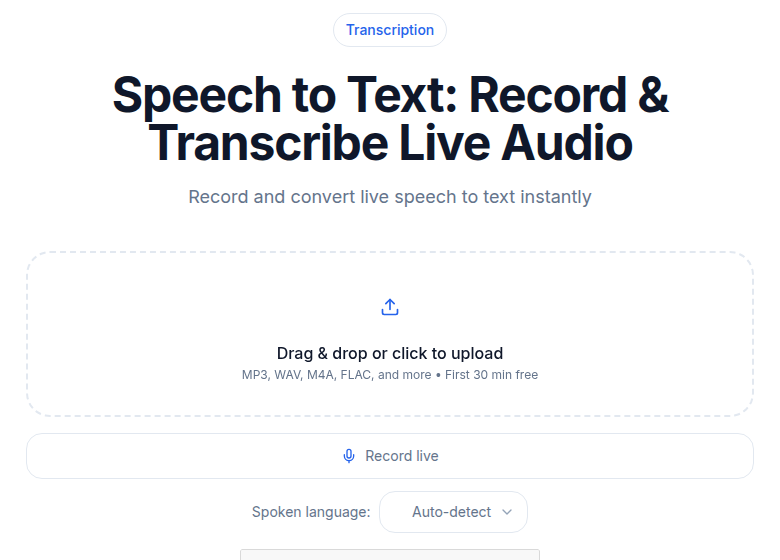 CATT speech-to-text tool interface showing audio upload and language selection
Amharic in Ethiopia: The Real-World Use Cases
The demand for Amharic transcription is real and concentrated in specific sectors. Understanding the use case shapes which tool is appropriate.
The Ethiopian Broadcasting Corporation (EBC) is the country's oldest and largest broadcaster, based in Addis Ababa. Its primary output language is Amharic, with additional coverage in Oromo, Somali, Tigrinya, and Afar. Journalists, researchers, and media monitors working with EBC content face the full Amharic ASR challenge: newsroom Amharic with multiple speakers, regional accents, technical and political vocabulary, and fast speech rates.
Federal government documentation is conducted in Amharic. Legal proceedings, policy documents, and official meetings generate Amharic audio that needs transcription for record-keeping, accessibility, and archiving. The accuracy bar here is high, and "Fair accuracy" or above-50%-WER outputs are not usable without significant review.
The Ethiopian diaspora creates demand for transcription of family and community content: interviews, podcast recordings, religious programming, cultural events. This audio tends to include code-switching between Amharic and English (diaspora communities in the US and Europe) or Amharic and Arabic (communities in the Gulf and Middle East). Code-switching disrupts any single-language model.
Research and journalism tracking Ethiopian political and social events increasingly produces Amharic audio that needs indexing and translation. Academic institutions and international NGOs operating in Ethiopia face this problem regularly.
For related African language transcription workflows, the sibling guides on Swahili transcription in Kenya and Tanzania, Hausa transcription in Nigeria, and the broader overview of best transcription for African languages cover the same ASR-quality landscape from different language angles.
What a Practical Amharic Workflow Looks Like Today
Given the accuracy landscape, a production-quality Amharic transcript requires a human editing pass regardless of which engine you use. The question is which engine gives you the best starting point.
If you are on Google Cloud or AWS infrastructure, start with those native Amharic endpoints. They give you Fidel output without any model porting overhead, and they integrate into existing cloud pipelines. Benchmark on a 5-to-10-minute sample of your actual audio before scaling.
If you need an API endpoint with a known accuracy floor, AssemblyAI's Universal-2 model is the most transparent commercial option: it declares its accuracy tier, and you are not guessing. The above-50%-WER classification means plan for a fluent Amharic speaker to review every transcript before use.
If you are running your own infrastructure and have time to fine-tune, a Whisper-small model fine-tuned on combined FLEURS and Common Voice Amharic data outperforms the off-the-shelf large-v3 model for Amharic. The Ethio-ASR research model, trained on the WAXAL corpus across five Ethiopian languages, shows around 30% average WER as a research baseline.
One thing to check in any output: confirm the model is producing Fidel script, not Latin transliteration. If you receive "ena alle" instead of "እና አለ," the output is unusable for Amharic readers and represents a script-generation failure, not just an accuracy issue.
For workflows that involve multiple African languages in the same recording, or Amharic combined with English, note that code-switching accuracy on every available engine today is weaker than monolingual Amharic performance. This is an open research problem, not a configuration issue.
If you need a transcription tool for other audio files, ConvertAudioToText handles a wide range of languages with strong accuracy. For Amharic specifically, the honest position is that no tool delivers production-grade output today without a review step, and that is a gap you should build into your workflow and budget regardless of which engine you use.
The Research Trajectory
Amharic ASR has moved meaningfully forward between 2022 and 2026, largely through academic and research effort rather than commercial investment. Three developments are worth watching:
The Ethio-ASR project (March 2026) is the most current multilingual Ethiopian ASR work, covering Amharic alongside Tigrinya, Oromo, Sidaama, and Wolaytta using the WAXAL corpus. It beats larger multilingual models like OmniASR with fewer parameters by focusing on the language family. Models like this are likely to be incorporated into commercial APIs as the research matures.
Meta's Massively Multilingual Speech (MMS) project covers Amharic in its 1,100-language speech-to-text model. MMS is available as an open-source checkpoint on Hugging Face. It is not polished for production use, but it is one of the broadest coverage options available for low-resource languages including Amharic.
Google's Chirp 3 model now includes Amharic with am-ET support across multiple regions. Chirp 3 represents Google's latest foundation model for speech, and its Amharic inclusion suggests commercial investment in the language that was absent from earlier Google STT offerings.
The trend is positive, but the gap between "listed as supported" and "production-ready without review" remains wide for Amharic in 2026. Plan accordingly.
Common Questions
Does Whisper support Amharic?
Whisper lists Amharic among its 99+ supported languages, but real-world performance is poor. Research benchmarks show character error rates reported above 100% for Whisper large-v3 on clean Amharic audio, meaning the model inserts, repeats, or hallucinates more than it transcribes correctly. Fine-tuned Whisper variants (trained on FLEURS and Common Voice Amharic data) perform meaningfully better, but the base model is not reliable for production Amharic transcription.
Can Google Cloud Speech-to-Text or AWS Transcribe handle Amharic?
Both carry Amharic. Google Cloud Speech-to-Text supports am-ET on its Chirp, Chirp 2, and Chirp 3 models. AWS Transcribe supports am-ET for both batch and streaming transcription. Neither service publishes Amharic-specific accuracy figures, so you should benchmark on a representative sample of your audio before committing to a workflow.
Why does Fidel script make Amharic ASR harder than Latin-script languages?
Fidel is a syllabary where each character encodes a full consonant-vowel pair. This means a single wrong character substitution is counted as a complete word error, not a partial spelling mistake. On top of that, Amharic orthography does not mark gemination (doubled consonants that distinguish meanings, like alä "he said" versus allä "there is"), and multiple distinct Fidel characters share the same pronunciation (the ha-group, the a-group, the sa-group). These ambiguities compound ASR errors in ways that Latin-script languages do not face at the same rate.
What is the most accurate Amharic ASR option available today?
The research model Ethio-ASR, trained jointly on Amharic and four other Ethiopian languages using the WAXAL corpus, achieved a reported average WER of around 30% in March 2026 benchmarks, which represents the academic state of the art. Among commercial services, AssemblyAI's Universal-2 model supports Amharic and is the only major API with a published accuracy tier for the language, though it flags it as "Fair accuracy" (above 50% WER). For production workflows where accuracy is critical, expect a significant human editing pass with any current commercial engine.
Sources
- Google Cloud Speech-to-Text Supported Languages: https://docs.cloud.google.com/speech-to-text/docs/speech-to-text-supported-languages
- AWS Transcribe Supported Languages: https://docs.aws.amazon.com/transcribe/latest/dg/supported-languages.html
- AssemblyAI Supported Languages: https://www.assemblyai.com/docs/supported-languages
- Deepgram Models and Languages Overview: https://developers.deepgram.com/docs/models-languages-overview
- "Whispering in Amharic: Fine-tuning Whisper for Low-resource Language" (arXiv 2503.18485): https://arxiv.org/abs/2503.18485
- "Ethio-ASR: Joint Multilingual Speech Recognition and Language Identification for Ethiopian Languages" (arXiv 2603.23654): https://arxiv.org/abs/2603.23654v1
- Ethiopian Broadcasting Corporation overview: https://statemediamonitor.com/2026/04/ethiopian-broadcasting-corporation-ebc/
- Meta MMS Amharic TTS on Hugging Face: https://huggingface.co/facebook/mms-tts-amh
Try transcription free
Convert any audio or video to clean, unwatermarked text — speaker labels, timestamps, and AI summaries included. First 30 minutes free, no account.
Related Articles
Hausa Transcription: Engine Support, Script, and Accuracy in 2026
Hausa transcription: tones, boko script context, Nigeria and Niger media use, and honest engine support in 2026.

Wolof Transcription: Where Support Stands in 2026
Wolof ASR support honestly: very low-resource, French code-switching dominates urban speech, and the workarounds that exist.