Swahili Transcription for Kenya and Tanzania: What Works in 2026
Summarize this article with:
Swahili is better-supported by AI transcription tools than most African languages, thanks to its Latin script, large speaker base, and growing training datasets. Standard Tanzanian Swahili (Kiswahili sanifu) gets the most reliable results; Kenyan urban Swahili with English code-switching performs nearly as well. Heavy Sheng audio is the hardest case and warrants a review pass. Tools including Happy Scribe, Trint, and Google Cloud STT all support Swahili, with varying accuracy on dialects and code-switched content.
Swahili is the most widely spoken African language by total user count, with over 200 million speakers across East and Central Africa counting both native and second-language users. In November 2025 it became the seventh official language of the UNESCO General Conference, joining Arabic, Chinese, English, French, Russian, and Spanish. For transcription, that scale matters: more speakers means more audio online, more research investment, and better training data than most other sub-Saharan languages get.
The short answer to whether Swahili transcription works in 2026: yes, for standard and broadcast Swahili. For Sheng, expect rough edges.
Why Swahili Is Easier to Transcribe Than Most African Languages
Three structural advantages set Swahili apart from lower-resource African languages.
Latin script, no diacritics. Swahili is written entirely in the standard Latin alphabet, with no tonal marks, special characters, or right-to-left rendering. The output from any transcription engine displays correctly in any text environment without encoding issues.
Large speaker base drives training data. More spoken content is publicly available for Swahili than for most other African languages. Researchers have achieved a 3.24% word error rate on Common Voice Swahili using fine-tuned models, compared to WERs of 25 percent or more for many lower-resource languages on the same clean benchmark audio. That gap is entirely a function of available labeled data, and Swahili benefits more than its neighbors do.
Standardization. Kiswahili sanifu, the formal standard promoted by Tanzania's national institutions, gives ASR models a consistent phonology and vocabulary to anchor on. Languages without a de facto written standard are harder to model.
That said, real-world audio is not Common Voice. For transcription accuracy explained in practical terms, clean read speech on a benchmark and spontaneous conversation with background noise are entirely different tasks.
Kenyan Swahili vs Tanzanian Swahili: What Changes for ASR
Tanzanian Swahili is the base for almost everything. Kiswahili sanifu, codified primarily in Dar es Salaam, is what national media (TBC, ITV) uses, what schools teach, and what most training corpora index. If your audio is a Tanzanian newsroom interview or a formal speech, you are working in the sweet spot of current Swahili ASR.
Kenyan standard Swahili, as heard on KTN and Citizen TV, performs close behind. The differences are real but not dramatic: Kenyan speakers tend to use more English loanwords directly rather than adapting them phonologically, and vowel quality shifts slightly under English influence. ASR engines handle this because the code-switching is predictable.
Coastal Swahili (Mombasa, Zanzibar, the older Kiunguja and Kingare dialects) carries heavier Arabic vocabulary, which is the historical influence from centuries of Omani trade. These Arabic-root words are well-established in the lexicon and appear in training data, so coastal audio is generally not a problem. Where you see errors, they tend to cluster around specialized Arabic-derived vocabulary that is underrepresented outside coastal content.
Ugandan Swahili is a distinct case. Spoken as a simplified contact language rather than a mother tongue in most urban areas, it diverges more sharply from Kiswahili sanifu. Treat it cautiously and test before committing to a production workflow.
The Sheng Problem
Sheng is not simply a dialect of Swahili. It is a creole-like urban sociolect that originated in Nairobi's Eastlands neighborhoods and now reaches across Kenya's youth culture. The name is an acronym: Swahili-English, with heavy additional borrowing from Gikuyu, Dholuo, and Kamba.
What makes Sheng genuinely hard for ASR:
- No standardized orthography. The same slang word may appear spelled five different ways in the training data, if it appears at all.
- Rapid vocabulary evolution. Terms that were current two years ago are already dated; new ones are coined constantly.
- Three-way switching. Standard code-switching moves between two languages; Sheng can move between three or four within a single sentence.
A sentence like "Niko stuck na hii project, na deadline ni next week, lakini bado niko on track" is manageable because the English portions are common high-frequency words. But heavy Sheng that draws on Gikuyu roots or recent slang will produce errors that no engine currently handles well. Plan for a manual review pass if your content is Sheng-dominant.
For more background on why some African varieties are structurally harder for AI systems, see why AI struggles with low-resource languages.
Bantu Morphology: The Quiet ASR Challenge
One thing rarely discussed in tool reviews: Swahili's noun class system creates combinatorial complexity that English-centric ASR models are not designed to handle well. Swahili has 15 or more noun classes, each triggering its own agreement prefixes on verbs, adjectives, possessives, and demonstratives. A single verb root can carry subject agreement, tense, object agreement, and derivational suffixes before the mood vowel.
This matters for transcription because the model must correctly assign word boundaries and prefix/suffix structures that have no parallel in Indo-European languages. Clean standard Swahili gets away with this because the morphological patterns are regular and well-represented in training data. Spontaneous speech, where speakers elide or modify prefix forms, is harder to decode correctly.
Which Tools Support Swahili in 2026
Happy Scribe is the most explicitly Swahili-optimized consumer tool in this comparison. It self-reports approximately 85% accuracy for AI Swahili transcription and also detects code-switching between Swahili and English within a single recording. Human transcription is available at 99% accuracy with native Swahili proofreaders. Pricing is tiered from €17/month (Basic, 120 AI minutes) to €89/month (Business, 6,000 AI minutes), with additional minutes at €0.20/minute.
Trint lists Swahili among its 40-plus supported transcription languages, alongside translation support.
Google Cloud Speech-to-Text supports Swahili across both its V1 and Chirp-powered V2 APIs. Pricing is per-minute metered, currently around $0.016/minute on the standard tier, with a Dynamic Batch option at approximately $0.004/minute for non-real-time work. There is a 60-minute free monthly tier. Google's API does not bundle a Swahili-language AI summary; summaries require a separate LLM call.
AssemblyAI Universal-2 supports Swahili in a moderate-accuracy tier (greater than 25% and up to 50% WER on its internal benchmarks). That means significantly lower accuracy than formal benchmarks suggest, and it reflects real-world spontaneous speech on a diverse audio base. AssemblyAI's Universal-3 Pro focuses on a narrower set of languages and does not include Swahili at this time.
Otter.ai does not support Swahili. It covers English, Spanish, French, German, Japanese, and Chinese (Simplified) only.
Deepgram Nova-3 does not currently list Swahili among its supported languages.
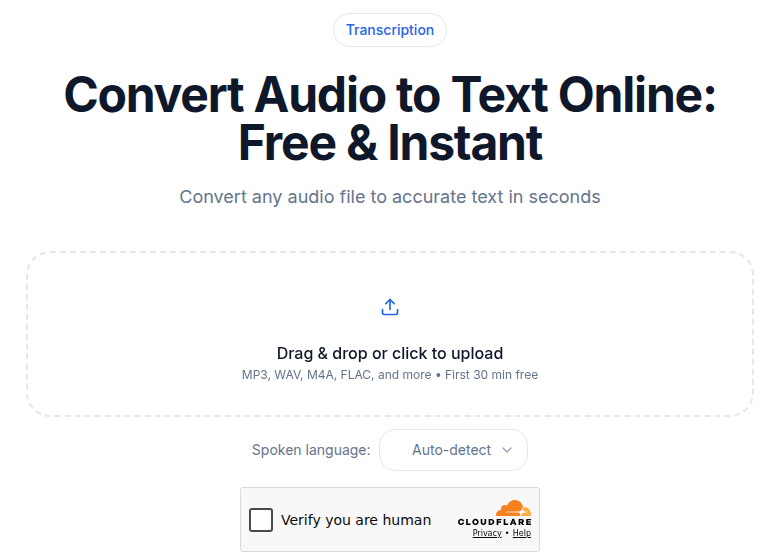 ConvertAudioToText audio upload tool for Swahili files
| Tool | Swahili support | Code-switching | AI summary in Swahili | Pricing model |
|---|---|---|---|---|
| Happy Scribe | Yes (AI + human) | Yes, auto-detected | Yes | From €17/month |
| Trint | Yes | Not specified | Not specified | Subscription |
| Google Cloud STT | Yes (V1 + V2) | Limited | No (separate LLM) | ~$0.016/min metered |
| AssemblyAI Universal-2 | Yes (moderate tier) | Not specified | Not specified | Per-minute metered |
| Otter.ai | No | N/A | N/A | N/A |
| Deepgram Nova-3 | No | N/A | N/A | N/A |
My take: for standard Swahili content, several tools work and the differences come down to whether you need AI summaries, human fallback, or a flat-rate subscription. For Sheng-heavy audio, none of the current tools eliminates the need for a review pass.
Setting Up a Swahili Transcription Workflow
A few practical points that apply regardless of which tool you use.
Set the language explicitly. Auto-detect can misidentify heavily code-switched Kenyan Swahili as English, or occasionally tag it as another Bantu language. Specifying sw (Swahili) locks the model to the right vocabulary prior.
Supply a glossary for proper nouns. Kenyan and Tanzanian place names, personal names, and brand names are often transcribed phonetically in ways that require correction. Most professional tools accept a custom vocabulary or glossary list; use it.
Segment Sheng-heavy sections. If your recording mixes formal Swahili passages with heavy Sheng segments, you may get better accuracy by running them as separate jobs and editing the Sheng sections manually.
Speaker diarization works best in structured conversations. A formal two-speaker interview in standard Swahili will diarize well. A radio call-in show with phone audio, background noise, and three or more speakers will produce more label errors regardless of the underlying accuracy on the transcript text.
For speaker diarization explained in detail, including what to expect from multi-speaker audio in non-English languages, that guide covers the underlying mechanics.
Cross-Links for Related Workflows
If you need transcription for other African languages alongside Swahili, see the Hausa transcription guide for Nigeria and the best transcription tools for African languages. For understanding how training data scarcity shapes accuracy across the continent, why AI struggles with low-resource languages is the reference post.
For podcast-specific workflows where your episodes mix Swahili and English, the best transcription for podcasts guide covers file format choices, speaker label setups, and subtitle export.
If you just need clean Swahili transcripts without a meeting bot or subscription seat count, ConvertAudioToText accepts any audio or video format, runs on a flat $14.99/month Pro plan with no per-minute charges, and produces SRT and VTT exports alongside the transcript text.
FAQ
Does Whisper support Swahili?
Yes. Swahili is among the 99 languages in Whisper's language list. Standard Swahili achieves solid results on clean read speech, but spontaneous speech, heavy code-switching, and Sheng increase error rates substantially. Academic benchmarks using specialized fine-tuning have hit sub-4% WER on Common Voice Swahili, but general-purpose Whisper on real-world audio falls in a wider range, especially for non-standard speech.
What is the difference between Kenyan and Tanzanian Swahili for transcription?
Tanzanian Swahili (Kiswahili sanifu) is the standardized form used in schools and broadcast media, with clearer vowel quality and more conservative vocabulary. AI engines trained on standard Swahili text and audio perform best on this variant. Kenyan Swahili has heavier English code-switching and local phonological influences, which adds complexity but remains well within what current tools handle. Sheng, the Nairobi urban creole, is the hardest case because its vocabulary evolves rapidly and lacks a standardized orthography.
Which transcription tools support Swahili?
Happy Scribe, Trint, and Google Cloud Speech-to-Text all support Swahili. Happy Scribe self-reports around 85% accuracy for AI Swahili transcription and also offers human transcription at 99% accuracy. Trint includes Swahili in its 40-plus language list. Google Cloud STT supports Swahili across both its V1 and V2 APIs. Otter.ai does not support Swahili (it covers only six languages). Deepgram Nova-3 does not currently list Swahili among its supported languages.
How does code-switching between Swahili and English affect accuracy?
Light to moderate code-switching, the kind common in Kenyan standard media, is handled reasonably well by multi-language models like Whisper. English words are transcribed in Latin script, consistent with normal Swahili orthography, so the output reads naturally. Heavy Sheng is different: its rapidly evolving slang and three-way mixing of Swahili, English, and Nairobi vernaculars (Gikuyu, Dholuo, Kamba) make it genuinely difficult for any current ASR system, and a manual review pass should be expected.
Sources
- AssemblyAI Supported Languages documentation
- Happy Scribe Swahili Transcription page
- Happy Scribe Pricing
- Trint supported languages help center
- Google Cloud Speech-to-Text supported languages (V2)
- Google Cloud Speech-to-Text pricing
- Otter.ai supported languages help center
- Deepgram Models and Languages overview
- OpenAI Whisper language list (Hugging Face)
- Continued Pretraining for Low-Resource Swahili ASR (arxiv 2603.11378)
- UNESCO recognizes Kiswahili as official language of General Conference
- African Union adopts Swahili as official working language
- Sheng language and code-switching in Kenya (Cambridge)
Try transcription free
Convert any audio or video to clean, unwatermarked text — speaker labels, timestamps, and AI summaries included. First 30 minutes free, no account.
Related Articles

Arabic Transcription: MSA vs Dialects in ASR (2026 Guide)
How diglossia shapes Arabic speech-to-text accuracy. MSA vs Egyptian, Gulf, Levantine, and Maghrebi dialects: WER data, engine support, and script mechanics explained.
Best Transcription for African Languages in 2026: Honest Rankings
Which engines actually support Swahili, Hausa, Yoruba, Amharic, Wolof, and Zulu in 2026? Verified support matrices, honest WER context, and the tools that genuinely work.