Wolof Transcription: Where Support Stands in 2026
Summarize this article with:
Where Wolof Support Stands
Wolof is not supported by most mainstream AI transcription tools in 2026, and the tools that do claim support produce high error rates. Whisper Large-v3, which powers most services that advertise broad language coverage, does not include Wolof in its 99-language list at all. Deepgram Nova-3 and AssemblyAI Universal also do not list Wolof. For the majority of Wolof content, the practical path in 2026 is not waiting for native support but understanding why the gap exists and using the French-track workaround that works for urban Dakar audio.
This is not a deficiency in the tools for languages they were built on. It is a training-data problem: the largest public Wolof speech corpora, including the ALFFA project dataset and the OpenSLR Wolof collection, range from about 5 to 55 hours of transcribed audio. Common Voice has no Wolof corpus at all. English training data for Whisper runs into hundreds of thousands of hours. The gap explains the WER gap.
What the Research Actually Shows
A 2025 paper on Wolof ASR ("Speech Language Models for Under-Represented Languages: Insights from Wolof," arXiv:2509.15362) is the clearest published benchmark on where things stand. The study curated 860 hours of high-quality spontaneous Wolof audio, continued pretraining HuBERT on it, and integrated the resulting speech encoder into a Wolof language model. Even with that dedicated effort, Wolof ASR results were in the approximately 68-72% WER range under multilingual training conditions. That is a word error rate, so roughly 1 in 3 words comes out wrong on average.
For comparison, Whisper Large-v3 achieves under 5% WER on English and French benchmarks. Wolof is not in the same tier.
My take: any service advertising sub-15% WER for Wolof in 2026 without citing a verified benchmark should be read skeptically. The academic evidence points to the 30-70% WER range depending on dataset and method.
The Two Tools That Actually List Wolof
Google Cloud Speech-to-Text V2 supports Wolof (wo-SN) in its documented language list. This is real, verified support at the API level. The quality is another question. Google does not publish per-language WER benchmarks, and Wolof is not among the languages Google highlights for quality. It uses a V2 standard model with per-minute metered pricing (free for the first 60 minutes, then $0.004 per 15 seconds at standard scale). That is roughly $0.016 per minute or about $0.96 per hour at base rates, dropping at volume. Feature support for Wolof in V2 is basic: transcription, not diarization or advanced confidence scoring.
ElevenLabs Scribe lists Wolof among its 99 supported languages. Their own per-language benchmark page places Wolof in the "Moderate" WER tier, at approximately 40.7% WER for Scribe v1. That is meaningfully better than the current academic baseline but still means 4 errors per 10 words on average. At Scribe's pricing of $0.22 per hour via API ($0.40 per hour pay-as-you-go), Wolof transcription is affordable, but the output will need significant editing for anything formal. Scribe at 40% WER beats HuBERT at 68-72% WER, which reflects the benefit of scale from ElevenLabs' broader training corpus.
Neither tool produces publication-ready Wolof transcripts without a review pass.
The Urban Wolof Reality: French Is Half the Signal
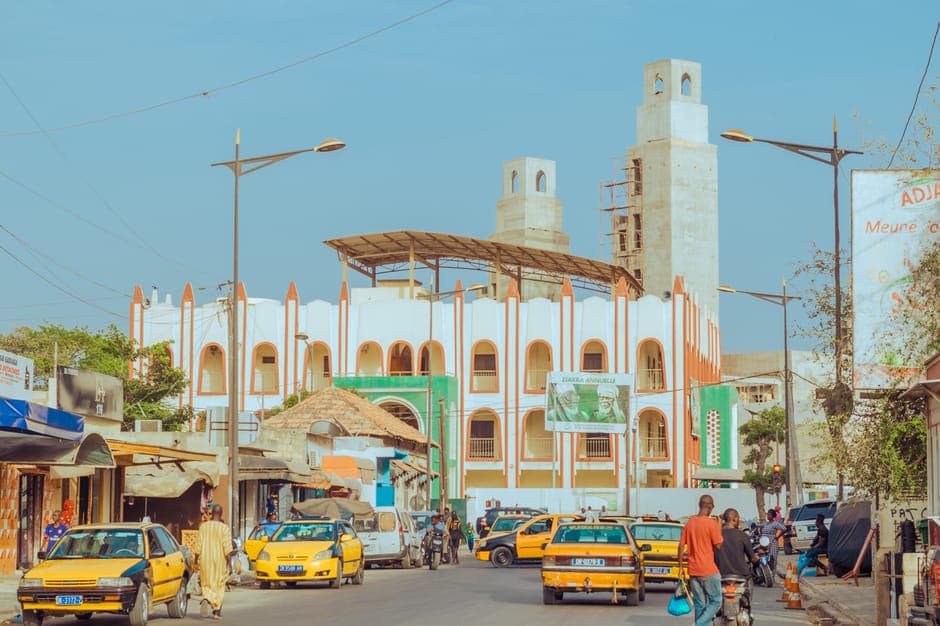
Linguists who study Dakar speech describe urban Wolof as a contact variety so thoroughly mixed with French that encountering pure Wolof or pure French in casual Dakar conversation is unusual enough to be noticeable. This is not code-switching in the traditional sense of alternating between two codes. Researchers have characterized urban Dakar speech as a third code, sometimes called "Dakarois," in which Wolof grammar and French vocabulary co-occur within single utterances.
A representative sentence might be: "Damay dem au bureau, mais avant ñu warna passer chez le marabout." Approximately half the lexical content there is French.
For recordings of this type, transcribing on the French track captures the majority of content correctly. The Wolof grammatical particles, pronouns, and verbs come out wrong or blank, but the French nouns, verbs, and phrases that carry most of the propositional content are transcribed accurately. The result is a hybrid transcript that needs Wolof-literate editing on the grammatical scaffold but has the content words right.
This is not a perfect solution. It is the honest one. If your audio is Dakar radio, urban interviews, or Senegalese podcast content where speakers are educated and bilingual, French-track transcription will give you a working first draft faster than native Wolof transcription at 40-70% WER would.
If you need a clean French-primary transcript of Senegalese audio, ConvertAudioToText's audio-to-text tool handles French accurately and captures Wolof-French code-switched speech without the engine confusion that comes from forcing a language code the model wasn't trained on.
Gambian Wolof: A Separate Dialect Problem
Gambian and Senegalese Wolof carry separate ISO 639-3 codes (wof and wol, respectively) and diverge meaningfully in their vocabulary. Because Gambia is a former British colony, Gambian Wolof borrows from English where Senegalese Wolof borrows from French. A Gambian Wolof speaker's natural code-switch is into English, not French.
The practical implication: the French-track workaround that helps with Dakar urban content does not work for Gambian Wolof content. A sentence of Gambian Wolof with English borrowings would misfire on a French model just as badly as on a Wolof model. For Gambian Wolof, the honest answer in 2026 is manual transcription, with AI used only for the English-dominant passages.
Both dialects are mutually intelligible in speech but differ in their orthographic conventions and loanword inventory. Wolof ASR training data is overwhelmingly Senegalese, so even tools like ElevenLabs Scribe that claim Wolof support will perform worse on Gambian input.
Script and Orthography
The official Latin orthography for Wolof in Senegal was standardized in 1974 under government decree, with the Centre de linguistique appliquée de Dakar (CLAD) as the authoritative body. The alphabet includes:
- Ñ for the palatal nasal (as in Spanish ñ)
- Ŋ for the velar nasal
- À, É, Ë, Ó as vowels with diacritics
- Geminate (doubled) consonants for length: kk, bb, tt
A parallel Arabic-based script, Wolofal, exists and has historical religious use, but was never formally adopted by government decree. Digital Wolof content today uses the Latin orthography almost exclusively.
AI transcription output in Wolof should produce the Latin script. If you are reviewing output from Google STT or ElevenLabs Scribe, check that ñ is rendering correctly and that geminate consonants are being preserved rather than collapsed. These are common failure modes on low-resource African language output.
 Audio file being processed for transcription
Comparing Wolof Transcription Options in 2026
| Tool | Wolof Listed | Actual WER | Notes |
|---|---|---|---|
| Whisper Large-v3 | No | N/A | Not in language list |
| AssemblyAI Universal | No | N/A | Not listed |
| Deepgram Nova-3 | No | N/A | Not listed |
| Google STT V2 | Yes (wo-SN) | Unpublished | Basic V2 model, metered |
| ElevenLabs Scribe | Yes | ~40.7% WER | Scribe v1 benchmark, "Moderate" tier |
| Human transcription | N/A | Near 0% | Slow, requires Wolof-French bilingual |
The table shows a market with no production-grade option. "Moderate" WER at 40% means roughly 4 wrong words per 10 words, which is a heavy editing burden for professional use.
For a broader look at how low-resource African languages fare against current ASR models, see the why AI struggles with low-resource languages post. The Wolof situation is not unique: similar gaps exist for Hausa, Amharic, and several other languages with tens of millions of speakers but thin digital text and audio corpora.
What Wolof Podcasters and Journalists Should Do Now
The Wolof podcast scene is growing. Wolof Tech on Spotify and Apple Podcasts covers technology in Wolof. The "Xam sa démb, xam sa tey" project has published 50 episodes of Wolof and French history content in partnership with Senegal's National Archives. Academic researchers are using field recordings to study oral tradition.
For these producers, the practical 2026 workflow depends on content type:
Urban Wolof-French podcasts (Dakar audience): Transcribe on French. Review the output, then fill in the Wolof grammatical elements manually. Export as SRT for subtitles after the editing pass. This is slower than ideal but produces usable output.
Formal or rural Wolof (minimal French): Use ElevenLabs Scribe with Wolof selected and budget for a full editing pass. At 40% WER, treat it as a first draft, not a transcript. For important archival recordings, a bilingual human transcriber is the more honest choice.
Gambian Wolof: Use human transcription or English-track for English-dominant passages. No AI tool produces usable Wolof output for Gambian content specifically.
Journalistic use: Senegalese journalists writing in French often need to pull quotes from Wolof-language interviews. The French-track approach captures the French passages accurately. Wolof quotes that need exact reproduction require manual transcription.
For content that is primarily French with Wolof insertions, the best transcription for African languages post covers which engines handle the French-African accent landscape most accurately.
What Will Change (and When)
Research published in 2025 has made measurable progress. The curated 860-hour Wolof corpus and the HuBERT-based speech language model from arXiv:2509.15362 show that dedicated pretraining moves Wolof WER from the academic baseline into a more workable range. ElevenLabs Scribe at 40.7% WER is itself a meaningful improvement over where Wolof ASR was two years ago.
The next step that would change the practical landscape is one of the major hosted providers (Deepgram, AssemblyAI, OpenAI) training a Wolof-capable model and deploying it at production scale. None of them has announced this. The Wolof community's contribution to Common Voice and similar public corpora would accelerate that timeline, since commercial ASR labs use those datasets as benchmarks and training signals.
Until then, the honest answer is: Wolof transcription in 2026 is a low-accuracy-AI or manual-human problem, and the French-track workaround is the most practical path for the content that most users actually have.
FAQ
Does Whisper Large-v3 support Wolof?
No. Wolof is not in Whisper Large-v3's language list. The model supports 99 languages, and the African languages it covers include Swahili, Yoruba, Hausa, Amharic, Somali, Afrikaans, Lingala, and Shona, but not Wolof. Any service built on Whisper does not have Wolof support as a result.
Which AI tools actually support Wolof transcription in 2026?
Google Cloud Speech-to-Text V2 lists Wolof (language code wo-SN) in its documented language support. ElevenLabs Scribe also lists Wolof, with a published benchmark showing approximately 40.7% word error rate. Both options exist, but neither produces clean output without a review pass. No major meeting-bot or team-collaboration tool (Otter, Fireflies, Trint, Descript) lists Wolof support.
Why is Wolof ASR accuracy so much worse than French or English?
Training data scarcity. The largest public Wolof speech datasets have 55 to 860 hours of audio depending on the project. English ASR training runs into hundreds of thousands of hours. Common Voice, the largest multilingual crowdsourced corpus, has no Wolof collection. Without training data, models generalize poorly to Wolof phonology, tonal patterns, and the specific sound inventory of the language.
What is the French code-switching workaround and when does it apply?
Urban Wolof speakers in Dakar produce speech that is heavily mixed with French, to the point where researchers describe it as a distinct contact variety. If your audio comes from educated Dakar speakers, setting the transcription language to French will correctly transcribe all the French content (often a majority of the lexical content) and produce blank or garbled output for the Wolof grammatical particles. The resulting draft needs editing for the Wolof elements but captures the propositional content accurately. This workaround does not apply to rural Senegalese Wolof or to Gambian Wolof, where the non-Wolof code is English rather than French.
Sources
- Google Cloud Speech-to-Text V2 supported languages: https://cloud.google.com/speech-to-text/docs/speech-to-text-supported-languages
- ElevenLabs Scribe Wolof benchmark page: https://elevenlabs.io/speech-to-text/wolof
- ElevenLabs Scribe pricing: https://elevenlabs.io/pricing/api
- OpenAI Whisper language list (tokenizer.py): https://github.com/openai/whisper/blob/main/whisper/tokenizer.py
- arXiv: Speech Language Models for Under-Represented Languages: Insights from Wolof (2509.15362): https://arxiv.org/abs/2509.15362
- Wolof orthography and standardization (Janga Wolof): https://jangawolof.org/wolof-orthography-a-guide-to-writing-the-wolof-language/
- Urban Wolof code-switching research (ResearchGate): https://www.researchgate.net/publication/254333661_Two_Codes_or_One_The_Insiders'_View_and_the_Description_of_Codeswitching_in_Dakar
- Wolof language speakers and dialect geography (Wikipedia): https://en.wikipedia.org/wiki/Wolof_language
- AssemblyAI supported languages: https://assemblyai.com/docs/Concepts/supported_languages
- Wolof Tech podcast (Spotify): https://open.spotify.com/show/6repqMDxu0d5eq7U3BaZFq
Try transcription free
Convert any audio or video to clean, unwatermarked text — speaker labels, timestamps, and AI summaries included. First 30 minutes free, no account.
Related Articles

Amharic Transcription: Ge'ez Script and Engine Reality
Honest guide to Amharic (Ge'ez/Fidel) transcription in 2026: engine support reality, why ASR struggles with Amharic script, and the best available options today.
Best Transcription for African Languages in 2026: Honest Rankings
Which engines actually support Swahili, Hausa, Yoruba, Amharic, Wolof, and Zulu in 2026? Verified support matrices, honest WER context, and the tools that genuinely work.