Formatos de audio compatibles: la tabla de compatibilidad
Summarize this article with:
La tabla de compatibilidad
Todas las herramientas de transcripción importantes aceptan MP3, WAV, M4A y MP4. Las diferencias aparecen en los formatos menos comunes, los límites de tamaño de archivo y las restricciones de códec. Usa la tabla de abajo para comprobar tu formato antes de subirlo y luego lee las secciones siguientes para entender los casos límite que causan fallos reales.
| Formato | Tipo | CATT | Otter.ai | TurboScribe | Descript | Rev.com | Trint | Fireflies | Happy Scribe | AWS Transcribe | OpenAI Whisper API |
|---|---|---|---|---|---|---|---|---|---|---|---|
| MP3 | Audio | Sí | Sí | Sí | Sí | Sí | Sí | Sí | Sí | Sí | Sí |
| WAV | Audio | Sí | Sí | Sí | Sí | Sí | Sí | Sí | Sí | Sí | Sí |
| M4A | Audio | Sí | Sí | Sí | Sí | Sí | Sí | Sí | Sí | No* | Sí |
| FLAC | Audio | Sí | No | Sí | Sí | Sí | No | No | Sí | Sí | No |
| AAC | Audio | Sí | No | Sí | Sí | Sí | Sí | No | Sí | No | No |
| OGG | Audio | Sí | Sí | Sí | No | No | No | No | Sí | Sí | No |
| Opus | Audio | Sí | No | Sí | No | No | No | No | Sí | Sí (vía OGG/WebM) | No |
| WMA | Audio | Sí | Sí | Sí | No | No | Sí | No | Sí | No | No |
| AIFF | Audio | No | No | Sí | Sí | No | No | No | Sí | No | No |
| MP4 | Vídeo | Sí | Sí | Sí | Sí | Sí | Sí | Sí | Sí | Sí | Sí |
| MOV | Vídeo | Sí | Sí | Sí | Sí | Sí | Sí | No | Sí | No | No |
| AVI | Vídeo | Sí | Sí | Sí | No | No | Sí | No | Sí | No | No |
| MKV | Vídeo | Sí | Sí | Sí | No | No | No | No | Sí | No | No |
| WebM | Vídeo | Sí | No | Sí | No | No | No | Sí | Sí | Sí | Sí |
*AWS Transcribe batch admite el contenedor MP4 (que puede llevar audio AAC), pero no archivos M4A independientes por nombre según su documentación. Comprueba tu caso de uso concreto.
Verificado: julio de 2026. Fuentes listadas al final.
Límites de tamaño de archivo y duración
This is where people get surprised. Format support matters less than whether your file physically fits inside the service's upload gate.
| Service | File Size Limit | Duration Limit | Notes |
|---|---|---|---|
| ConvertAudioToText | 100 MB | No hard cap | Minutes-based quota applies per plan |
| Otter.ai | 5 GB | No stated cap | 3 imports/lifetime free; 10/mo Pro |
| TurboScribe | 5 GB | 10 hours | Up to 50 files at once on Unlimited |
| Descript | 50 GB per project | 15 hours for auto-transcription | 3+ audio channels downmixed to stereo |
| Rev.com | 2 GB (API upload), 5 TB (URL) | 17 hours | Legal transcription: 20 GB total |
| Trint | 3 GB (recommended) | 3 hours (recommended) | Larger files accepted but error-prone |
| Fireflies | 200 MB | 150 minutes | Free tier capped at 100 MB |
| Happy Scribe | No stated limit | No stated limit | 31 audio + 16 video formats |
| AWS Transcribe | 2 GB | 4 hours | Files must be in S3 for batch jobs |
| OpenAI Whisper API | 25 MB | No stated cap | Affects WAV most: a 25 MB WAV is roughly 25 minutes of audio |
| Deepgram (API) | 2 GB | No stated cap | 100+ formats; audio extraction from video |
| AssemblyAI (API) | 2.2 GB (upload), 5 GB (URL) | 10 hours | Recommends submitting in native format |
The OpenAI Whisper API 25 MB cap is the most common source of confusion. A 2-hour interview as a WAV file is typically 1+ GB. The cap is on file size, not duration, so a 2-hour MP3 at 96 kbps (roughly 86 MB) will fail too. The workaround is to compress to a lower bitrate or use a service built around your file size.
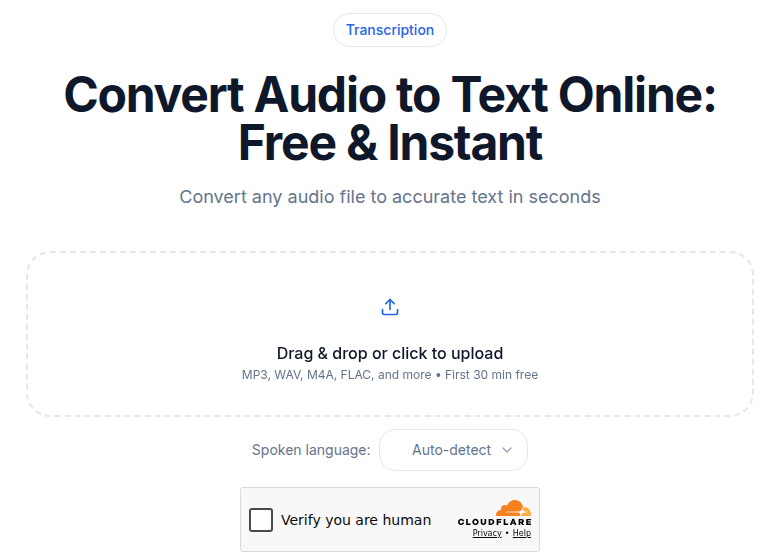 Audio upload tool at ConvertAudioToText
The ConvertAudioToText uploader accepts MP3, WAV, M4A, FLAC, AAC, OGG, Opus, WMA, and all major video containers. The 100 MB per-file cap applies to uploads; URL-sourced jobs (YouTube, Vimeo, direct links) are not subject to this limit.
Audio upload tool at ConvertAudioToText
The ConvertAudioToText uploader accepts MP3, WAV, M4A, FLAC, AAC, OGG, Opus, WMA, and all major video containers. The 100 MB per-file cap applies to uploads; URL-sourced jobs (YouTube, Vimeo, direct links) are not subject to this limit.
Audio Formats: What Each One Actually Means
MP3
MP3 is the safe default. It is universally accepted, small, and at 128 kbps or higher there is no measurable accuracy penalty compared to WAV. Below 64 kbps, compression artifacts begin to degrade speech clarity. Old voicemail recordings at 32 kbps are the most common offender.
Practical file sizes: roughly 1 MB per minute at 128 kbps. A 2-hour recording is about 115 MB, which exceeds the Whisper API cap but fits everywhere else.
WAV
WAV is lossless, which matters for archiving, not for transcription accuracy. A WAV and a 128 kbps MP3 of the same speech recording produce virtually identical transcription output from any modern AI model. The meaningful difference is file size: WAV runs roughly 10 MB per minute at CD quality (44.1 kHz, 16-bit stereo).
If you are hitting file size limits, convert to MP3 before uploading. You will not lose any accuracy.
M4A
iPhone Voice Memos exports as M4A. It uses AAC compression inside an MP4 container, which is more efficient than MP3. Files are slightly smaller than equivalent-quality MP3s, and all major consumer transcription tools support it.
AWS Transcribe does not list M4A as a named supported format in its batch documentation; if you are using the AWS API directly, convert to MP3 or WAV first. Consumer tools (CATT, TurboScribe, Otter, Descript, Rev) handle it natively.
FLAC
FLAC is lossless compression. File sizes are 50 to 70 percent smaller than WAV while preserving every bit of the original audio. For transcription purposes it offers no accuracy advantage over a well-encoded MP3, but it is useful when you need to archive the original and upload a single file.
Not all services support it: Otter.ai, Fireflies, and Trint do not accept FLAC. Check before uploading.
OGG / Opus
OGG Vorbis and Opus are open-source formats common in Android recordings and web apps. Opus in particular is used in WebRTC (browser recordings, voice calls, Discord exports). Support is patchy at the consumer level: Descript, Rev, and Fireflies do not support OGG directly. AWS Transcribe and Deepgram handle both via their respective containers.
If your source is an Android recording in OGG, convert to MP3 first for maximum compatibility.
WMA
Windows Media Audio is fading from production use but still appears in older Windows Voice Recorder exports and legacy call-center recordings. TurboScribe, Otter.ai, and Trint accept it; Descript, Fireflies, and Rev do not.
AIFF
AIFF is Apple's uncompressed format, commonly produced by GarageBand and Pro Tools. File sizes are similar to WAV. Only TurboScribe and Descript accept AIFF among the services in this table; if your DAW exports AIFF, check your target service before uploading.
Video Formats and Audio Extraction
All the services in this table extract the audio track from video automatically. You do not need to pre-process a video file before uploading.
MP4 works everywhere. MOV works at most consumer services but not at AWS Transcribe or Fireflies. MKV has limited support (CATT, Otter, TurboScribe, Happy Scribe). If your source is MKV or AVI and you are using a service that does not support it, extract the audio to MP3 with FFmpeg: ffmpeg -i input.mkv -vn -ab 192k output.mp3.
For more detail on subtitle output from video files, see SRT vs VTT vs TTML: which subtitle format to use.
When Format Affects Accuracy (and When It Does Not)
In almost every real-world case, format does not affect accuracy. Modern AI transcription models process audio waveforms after decoding, so the container format and compression codec make no meaningful difference at normal quality settings.
The three cases where format genuinely matters:
Very low bitrate MP3 (under 64 kbps). Compression artifacts in sub-64 kbps audio can degrade speech intelligibility for both human listeners and AI models. This shows up in very old podcast archives, compressed voicemail exports, and aggressively small streaming audio.
Multi-generation re-encoding. Converting WAV to MP3 to OGG back to MP3 stacks lossy compression and loses quality at each step. Work from the original source file whenever possible.
Corrupted or truncated files. A partially downloaded file or an interrupted recording may pass format validation but fail mid-transcription. Re-download or re-export the source.
For a deeper look at what sample rates and channel counts affect accuracy at the API level, see the transcription accuracy explained post.
Codec Quirks Worth Knowing
A few specifics that cause silent failures:
AWS Transcribe OGG requires Opus codec. The service accepts OGG and WebM containers, but only with Opus audio inside. An OGG Vorbis file will fail. This is documented in their input requirements.
Google Cloud STT requires encoding declaration. Unlike Deepgram, Google's API requires you to specify the audio encoding in your request. Sending an MP3 without declaring MP3 in the encoding field will fail. Their V2 API can auto-detect some formats, but V1 does not.
Multi-channel audio (more than 2 channels). AWS Transcribe does not support audio with more than two channels. Descript automatically downmixes files with 3 or more channels to stereo on import. If you are recording in multi-channel (4-channel conference recorder, ambisonic microphone), downmix to stereo before uploading to any API-based service.
PCM encoding inside WAV. Most WAV files use PCM encoding and work everywhere. WAV files with unusual encodings (GSM, ADPCM) may fail at some services even though the container is recognized. FFmpeg's ffprobe can tell you which encoding is inside your WAV file.
Para una visión más amplia sobre la elección de formato a lo largo del proceso, desde la grabación hasta el archivo, consulta explicación de los formatos de archivo de transcripción y WAV frente a MP3 para transcripción.
Conversión a un formato compatible
Si tienes un archivo en un formato no compatible o necesitas reducir su tamaño antes de subirlo, la herramienta de audio a texto acepta el archivo directamente y gestiona la conversión internamente. Para flujos de trabajo programáticos, la línea de comando siguiente cubre la mayoría de los casos:
ffmpeg -i input.anyformat -vn -ar 16000 -ac 1 -ab 64k output.mp3
Esto extrae el audio, fija una frecuencia de muestreo de 16 kHz (suficiente para voz), lo convierte a mono y lo codifica a 64 kbps, lo que reduce un WAV de una hora de unos 600 MB a aproximadamente 30 MB sin pérdida de precisión en la transcripción.
Si prefieres conservar el original y solo necesitas una copia más pequeña para subir, el mismo comando funciona: -ab 128k ofrece más margen y sigue estando muy por debajo de cualquier límite del servicio.
Si solo necesitas una transcripción limpia sin un bot de reuniones ni un editor de vídeo, ConvertAudioToText acepta todos los formatos de esta tabla (excepto AIFF) y procesa la mayoría de los archivos en menos de un minuto.
Preguntas frecuentes
¿Cuál es el mejor formato de audio para la precisión de la transcripción?
Cualquier formato sin pérdida (WAV, FLAC) o con pérdida de alta calidad (MP3 a 128 kbps o más, M4A con calidad estándar) producirá la misma precisión de transcripción con cualquier modelo de IA moderno. El entorno de grabación y la calidad del micrófono importan mucho más que el formato de audio. Guarda WAV o FLAC para archivar; sube MP3 para mantener los tamaños de archivo manejables.
¿Por qué la API de OpenAI Whisper rechaza mi archivo cuando otros servicios lo aceptan?
La API de Whisper impone un límite de tamaño de archivo de 25 MB, mucho más bajo que el de otros servicios. Un MP3 de 1 hora a 128 kbps pesa unos 57 MB y fallará. La solución es comprimir a una tasa de bits más baja (64 kbps es suficiente para voz), dividir el archivo en fragmentos, o usar un servicio sin ese límite de 25 MB.
¿Puedo subir un archivo de video directamente o necesito extraer el audio primero?
Puedes subir video directamente a todos los servicios de esta tabla. Ellos extraen la pista de audio automáticamente. El MP4 funciona en todas partes; el MOV y el MKV tienen soporte irregular en servicios a nivel de API como AWS Transcribe. Si usas una API directamente y tu formato de video no está en la lista de compatibles, extrae el audio con FFmpeg primero.
¿Funcionan las grabaciones multicanal (sonido envolvente)?
La mayoría de las herramientas de transcripción reducen a estéreo automáticamente o no admiten explícitamente más de dos canales. AWS Transcribe documenta un límite estricto de dos canales. Descript reduce la mezcla al importar. Para obtener resultados fiables, convierte cualquier grabación multicanal a mono o estéreo antes de subirla.
Fuentes
- Formatos de audio compatibles con Deepgram: developers.deepgram.com/docs/supported-audio-formats (consultado en julio de 2026)
- Requisitos de entrada de Amazon Transcribe: docs.aws.amazon.com/transcribe/latest/dg/how-input.html (consultado en julio de 2026)
- Documentación de la API de OpenAI Whisper: help.openai.com/en/articles/7031512-audio-api-faq (consultado en julio de 2026)
- Codificaciones de Google Cloud Speech-to-Text: docs.cloud.google.com/speech-to-text/docs/encoding (consultado en julio de 2026)
- Ayuda de importación de Otter.ai: help.otter.ai (consultado en julio de 2026)
- Soporte de TurboScribe: turboscribe.ai/support (consultado en julio de 2026)
- Tipos de archivo compatibles con Descript: help.descript.com (consultado en julio de 2026)
- Formatos de archivo aceptados por Rev.com: support.rev.com (consultado en julio de 2026)
- Especificaciones de archivo compatibles con Trint: info.trint.com/knowledge/supported-file-specifications (consultado en julio de 2026)
- Guía de subida de Fireflies: guide.fireflies.ai (consultado en julio de 2026)
- Formatos de Happy Scribe: happyscribe.com/formats (consultado en julio de 2026)
- Límites de archivo de AssemblyAI: assemblyai.com/docs/faq (consultado en julio de 2026)
Try transcription free
Convert any audio or video to clean, unwatermarked text — speaker labels, timestamps, and AI summaries included. First 30 minutes free, no account.
Related Articles
Spotify Transcript Extractor: How to Copy and Download Episode Text
Get a Spotify podcast transcript you can copy and download: paste a public episode link, 30 minutes free with no signup, TXT or SRT files on eligible plans.
Call Transcription for Customer Support QA: A Practical CATT Workflow
Use call transcription for customer support QA to review calls faster and coach agents. Upload audio or a meeting URL, get speaker labels and AI summaries.