
Accessibility Laws by Country: A 2026 International Reference
Summarize this article with:
Web accessibility law has converged on WCAG 2.1 AA as the operative technical floor across most major jurisdictions, with several now moving to WCAG 2.2 AA. The US, EU, UK, Canada, and Australia all have enforceable frameworks with real deadlines in 2025-2028, and the EU's European Accessibility Act reached its private-sector enforcement date on June 28, 2025. For audio and video content, the practical requirement in almost every jurisdiction is captions for video and transcripts for audio. This post maps the legal landscape, verifies current standards and deadlines, and flags what is still contested or changing.
This post is informational only and is not legal advice. Laws change, enforcement patterns differ by jurisdiction, and specific situations require qualified legal counsel in the relevant country.
Most major jurisdictions have enforceable web accessibility laws today, and nearly all of them point to WCAG 2.1 Level AA as the operative technical floor. What differs between countries is who is covered, what the penalties look like, which deadlines are approaching, and how aggressively enforcement actually moves. This reference maps the key frameworks, verifies current deadlines, and flags where things are still shifting.
Quick Comparison
| Jurisdiction | Primary Law | Technical Standard | Key 2026 Status |
|---|---|---|---|
| United States (federal) | ADA (Title II + III), Section 508 | WCAG 2.1 AA (Title II); WCAG 2.0 AA (508) | Title II deadline extended: large entities April 2027; small April 2028 |
| European Union | European Accessibility Act (2019/882) | EN 301 549 v3.2.1 (= WCAG 2.1 AA) | Enforceable since June 28, 2025; active enforcement underway |
| United Kingdom | Equality Act 2010; PSBAR 2018 | WCAG 2.2 AA (public sector); WCAG 2.1 AA (private) | WCAG 2.2 now required for public sector bodies |
| Canada | Accessible Canada Act 2019; AODA (Ontario) | CAN/ASC-EN 301 549 (= WCAG 2.1 AA); AODA still WCAG 2.0 AA | Digital Tech Regs registered Dec 2025; compliance 2027-2028 |
| Australia | Disability Discrimination Act 1992 | WCAG 2.2 AA (government guidance, 2025) | WCAG 2.2 is recommended benchmark; not yet legislated |
The Global Standard: WCAG
Before going country by country, the common thread:
WCAG 2.1 AA (2018) added requirements for mobile, low vision, and cognitive disabilities. It is the most-cited standard across regulations worldwide. Almost every jurisdiction discussed in this post points to it either explicitly or by reference to EN 301 549.
WCAG 2.2 AA (2023) added further criteria for cognitive accessibility, mobile interaction, and minimum target sizes. The UK now requires it for public sector bodies. Australia's Human Rights Commission recommends it. The EU's updated EN 301 549 v4.1.1 (incorporating WCAG 2.2) is expected to be referenced in the Official Journal of the EU around October 2026.
WCAG 3.0 remains in draft. It is years from regulatory adoption anywhere; treat it as future reading, not a compliance target.
For audio and video content, the actionable WCAG criteria are in Section 1.2 (Time-based Media): transcripts for audio, synchronized captions for video, and audio description or a full media alternative for video with meaningful visuals. See our post on WCAG compliance with transcripts for the detailed criteria mapping.
United States
The US has layered federal and state frameworks, and private lawsuits are the primary enforcement engine for private businesses.
ADA Title II: State and Local Government
The DOJ finalized a Title II rule in April 2024 requiring WCAG 2.1 AA for state and local government web content and mobile apps. The original compliance dates were subsequently extended by an Interim Final Rule published April 20, 2026:
- State and local entities serving populations of 50,000 or more: April 26, 2027
- Public entities serving populations under 50,000, or special district governments: April 26, 2028
Limited exceptions apply for archived content, pre-existing third-party content, and some other categories. The DOJ has stated it will enforce when deadlines arrive.
ADA Title III: Private Businesses
No federal rule has formally codified a specific technical standard for private sector web accessibility under Title III, but courts have consistently found that business websites and mobile apps are covered by the public accommodations provisions. WCAG 2.1 AA is the de facto standard in Title III litigation.
The filing numbers are not small. In 2025, plaintiffs filed over 3,100 federal website accessibility lawsuits under Title III, a 27% increase from 2024, with e-commerce sites making up 69% of targets. New York and California account for the majority of filings. For every federal case filed, defense attorneys report many more demand letters settled privately.
Section 508 of the Rehabilitation Act
Applies to federal agencies and federal contractors. The formal legal floor under the 2018 ICT Refresh is WCAG 2.0 AA. Many agencies voluntarily target WCAG 2.1 AA for alignment with the DOJ Title II standard and modern expectations, but the binding procurement standard has not yet been updated. An update is under discussion but no final rule has been issued.
Section 504 of the Rehabilitation Act
Covers recipients of federal funding, including most universities and many healthcare entities. Courts and enforcement agencies apply an equivalent-access standard, typically interpreted as WCAG 2.1 AA. The Department of Health and Human Services published a final rule in May 2024 requiring WCAG 2.1 AA for federally funded healthcare entities, with an original compliance deadline that has since been subject to further regulatory activity.
State Laws Worth Knowing
California Unruh Civil Rights Act: Provides statutory damages of $4,000 per offense for accessibility violations where an ADA violation is also established. California accounts for roughly 37% of all federal Title III website accessibility filings nationally. The active plaintiff bar here means California-based businesses face meaningful litigation risk.
Colorado HB21-1110 and New York State Human Rights Law extend accessibility requirements for state entities and covered businesses respectively. Massachusetts, Pennsylvania, and Illinois have civil rights frameworks that courts have applied to digital accessibility claims.
Practical position for US businesses
Private companies should treat WCAG 2.1 AA as the minimum target. WCAG 2.2 AA is an increasingly common ask in enterprise procurement. For state and local governments, the April 2027 / April 2028 compliance dates are confirmed, but waiting until then to start remediation is not advisable given both the audit time required and the fact that private lawsuits can proceed against non-compliant sites regardless of the compliance deadline extension.
European Union
European Accessibility Act (Directive 2019/882)
The EAA became enforceable on June 28, 2025, marking a significant shift: for the first time, a binding EU accessibility law applies broadly to private sector products and services, not just public bodies.
Covered products include computers, smartphones, tablets, self-service terminals (ATMs, ticketing machines), and e-readers. Covered services include e-commerce, banking, audiovisual media platforms, airline and transit booking, email, videoconferencing, and broadband internet.
The technical standard is EN 301 549 v3.2.1, which incorporates WCAG 2.1 AA for web and software content. EN 301 549 v4.1.1, incorporating WCAG 2.2 AA, is expected to be published and referenced in the Official Journal of the EU around October 2026. Once that happens, it will replace v3.2.1 as the harmonized standard.
Enforcement is already active. France issued formal legal notices to major retailers in July 2025, and the first EAA-related lawsuits were filed in French Commercial Court in November 2025. Sweden launched market surveillance in October 2025. The Dutch consumer and market authority (ACM) is actively pursuing e-commerce and electronic communications companies.
Each EU member state designates its own competent authority and sets its own penalties, so enforcement intensity and fine structures vary across the 27 countries.
EU Web Accessibility Directive (2016/2102)
This predecessor directive covers public sector bodies (government websites, public institutions) across all EU member states. It has been in effect since 2018-2019 depending on each country's transposition. Requirements include WCAG 2.1 AA compliance, published accessibility statements, and feedback mechanisms for users to report barriers.
Member State Additions
Germany's BITV 2.0, France's RGAA, Italy's Stanca Act, Spain's Real Decreto 1112/2018, and the Netherlands' Tijdelijk Besluit Digitale Toegankelijkheid all implement the public sector directive nationally. Private-sector obligations now flow through the EAA transpositions.
United Kingdom
Equality Act 2010
The UK's principal anti-discrimination law covers goods and services providers. Web content of covered entities must be accessible to people with disabilities. The standard courts and the Equality and Human Rights Commission apply is WCAG 2.1 AA, though the public sector has moved to 2.2 AA (see below).
Enforcement proceeds through private legal action and EHRC investigations. The UK private sector enforcement pattern is less litigious than the US, but the legal obligation is real.
Public Sector Bodies Accessibility Regulations 2018
Implements the EU Web Accessibility Directive, continued post-Brexit. A key post-Brexit change: the 2022 amendment modified the regulations to reference WCAG without locking a version number. This means as new WCAG versions are published, the requirement automatically advances.
WCAG 2.2 was published in October 2023, and a 12-month grace period then applied. UK public sector bodies are now expected to meet WCAG 2.2 AA. Accessibility statements and user feedback mechanisms remain required.
Public sector bodies should note that WCAG 2.2 adds nine new success criteria at levels A and AA compared to WCAG 2.1, including criteria for focus appearance, target size, accessible authentication, and consistent help.
Canada
Canada has two interacting layers: federal law and strong provincial frameworks.
Accessible Canada Act (2019)
Covers federally regulated entities: the federal government itself, banks, airlines, telecommunications carriers, and broadcasters. In December 2025, the federal government registered the Digital Technologies Accessibility Regulations, which specify CAN/ASC-EN 301 549 (a direct adoption of EN 301 549 v3.2.1, incorporating WCAG 2.1 AA) as the technical standard.
Compliance deadlines for the digital regulations:
- Federal public-sector entities: December 5, 2027
- Large federally regulated private-sector entities (500+ employees): December 5, 2028
- Smaller federally regulated private-sector entities (100-499 employees): December 5, 2028
The scope covers public-facing websites and web apps, mobile apps, and digital documents. The Accessibility Commissioner holds investigatory and ordering authority.
Separately, organizations that published initial ACA accessibility plans in 2022 are now filing progress updates in 2025-2026, and those updates are required to show measurable results, not just continued intentions.
Ontario AODA (Accessibility for Ontarians with Disabilities Act)
The AODA is one of the most detailed provincial accessibility frameworks anywhere. The web accessibility standard under AODA currently requires WCAG 2.0 AA, not 2.1 or 2.2. An update to WCAG 2.1 is expected but has not been formally enacted as of mid-2026.
Key compliance dates for WCAG 2.0 AA under AODA:
- Designated public sector organizations: December 31, 2025
- Businesses and non-profits with 20 or more employees: December 31, 2026
Many Ontario organizations voluntarily target WCAG 2.1 AA to align with federal ACA expectations and modern audit standards, even though the legal requirement has not yet been updated.
Other provinces with accessibility frameworks include Manitoba (Accessibility for Manitobans Act), Nova Scotia (Accessibility Act), and others at various stages of development.
Australia
Disability Discrimination Act 1992
Australia's federal anti-discrimination law covers goods and services providers. Web accessibility cases are litigated under the DDA. The foundational case, Maguire v SOCOG (2000), established that web content falls within DDA coverage and remains one of the most-cited early web accessibility decisions internationally.
Australia's Human Rights Commission updated its guidelines in 2025 to recommend WCAG 2.2 Level AA as the applicable standard. This replaced the 2014 advisory notes and is the benchmark the Commission applies when assessing accessibility complaints. The Australian Government Digital Service Standard and procurement frameworks also reference WCAG 2.2. However, WCAG 2.2 has not been explicitly legislated; it is the standard courts and the Commission use in practice.
Enforcement proceeds through the Australian Human Rights Commission (conciliation/mediation) and Federal Court for formal litigation.
Beyond These Five Jurisdictions
Most jurisdictions beyond the five above are converging on similar principles without the same level of enforcement infrastructure. Japan's JIS X 8341-3:2016 aligns with WCAG 2.0 and its update to incorporate WCAG 2.2 (via the newly revised ISO/IEC 40500:2025) is expected in Japanese fiscal year 2026. Brazil, India, and South Africa have national disability rights frameworks with web accessibility provisions, generally pointing toward WCAG equivalence for public sector content. Enforcement is lighter and less predictable in these markets.
For a business with exposure beyond the five jurisdictions covered here, target WCAG 2.1 AA as a minimum and get local legal review for any jurisdiction where you have significant revenue, a legal entity, or significant regulatory exposure.
What Accessibility Laws Require for Audio and Video
Across all major jurisdictions, the core requirements for audio and video content trace back to WCAG 1.2 (Time-based Media):
- Pre-recorded audio: a text transcript published with the audio
- Pre-recorded video: synchronized captions, plus audio description or a media alternative for video content that relies on visuals
- Live audio/video: real-time captions
These requirements are consistent whether the legal hook is ADA, the EAA, the Equality Act, or the DDA. The technical work is the same regardless of geography.
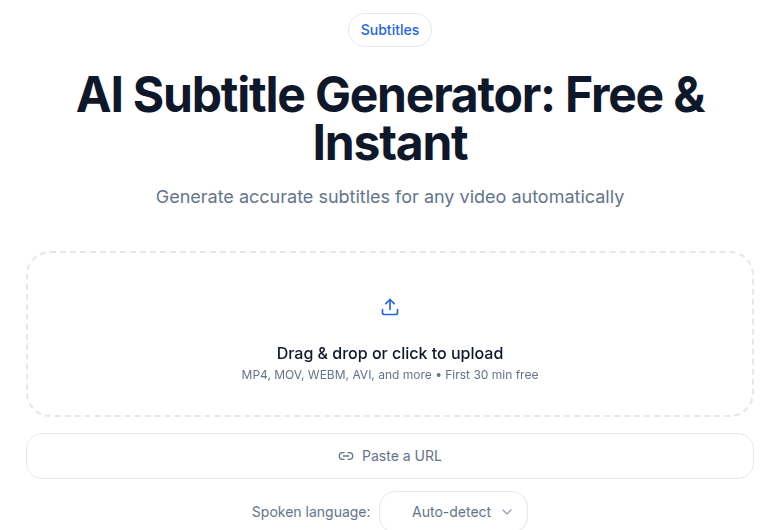 The ConvertAudioToText subtitle generator, producing SRT and VTT caption files for accessibility compliance
If you just need to generate transcripts and caption files without setting up a complex workflow, ConvertAudioToText's subtitle generator produces SRT and VTT exports directly from your audio or video. The audio-to-text tool handles the transcript side, covering 99+ languages for multilingual content.
For the specific WCAG criteria that map to each requirement, our post on WCAG compliance with transcripts goes through the success criteria in detail. Our ADA compliance post for audio content covers the US-specific implementation.
Where Regulations Meaningfully Differ
A few divergence points that matter for practical planning:
Statutory damages vs. remedial orders. California Unruh provides $4,000 per offense in statutory damages, which is unusual globally. Most other jurisdictions (UK, EU, Canada, Australia) are primarily remedial: the enforcement outcome is typically an order to fix the problem, with fines for persistent non-compliance rather than per-incident damages.
Private lawsuit volume. The US (especially California, New York, and Florida) has a high volume of private accessibility lawsuits. The EU, UK, Canada, and Australia rely more on regulatory enforcement. This difference in litigation culture affects where smaller businesses face the most immediate practical risk.
Accessibility statements. Required in EU member states (both EAA and Web Accessibility Directive) and UK public sector. Best practice everywhere, but not universally mandated for private sector.
Public vs. private sector scope. Section 508, PSBAR 2018, the EU Web Accessibility Directive, and most provincial frameworks focus on public sector. The ADA, EAA, DDA, and ACA apply beyond it to federally regulated private entities and public accommodation providers.
Version of WCAG required. Section 508 is formally WCAG 2.0 AA; AODA is formally WCAG 2.0 AA; ADA Title II and EAA are WCAG 2.1 AA; UK public sector and Australian government guidance now point to WCAG 2.2 AA. This creates a tiered picture even though convergence is the long-run trend.
Trends Worth Tracking
EN 301 549 v4.1.1 and WCAG 2.2 adoption. The EU's updated harmonized standard incorporating WCAG 2.2 is expected in the Official Journal around October 2026. Once published, it becomes the formal EAA compliance standard. Organizations investing in WCAG 2.2 now will not need to repeat the work when the standard moves.
Section 508 update. A refresh to incorporate WCAG 2.1 (or 2.2) is under discussion but has not been finalized. The current legal floor remains WCAG 2.0 AA. This is a contested area: disability rights organizations have pushed for an accelerated update, and the issue remains open.
AI-generated content and captions. Several jurisdictions are beginning to examine accuracy disclosure requirements for AI-generated captions and transcripts. No major regulation has yet codified specific accuracy thresholds, but this is an emerging area. Accuracy in captions matters independently of whether a regulator requires it.
Mobile accessibility focus. The EAA and various national implementations give mobile apps explicit coverage that older web-only frameworks did not. WCAG 2.1 addressed some mobile gaps; WCAG 2.2 goes further. Treating web and mobile as a single accessibility audit scope is now standard practice.
Procurement as a faster driver than legislation. Major public-sector buyers in the US, EU, and Canada now require accessibility compliance in contracts. Procurement enforcement is often faster and more predictable than litigation for businesses primarily serving government clients.
A Practical Position
For a global business serving users in the US, EU, UK, Canada, and Australia, the practical target is WCAG 2.1 AA minimum, with WCAG 2.2 AA as the working goal where resources allow. Add jurisdiction-specific administrative requirements (accessibility statements in the EU and UK public sector, ADA compliance documentation in the US) and you have a defensible position across all five major markets.
The technical work is geography-agnostic: captions for video, transcripts for audio, accessible navigation, sufficient color contrast, keyboard operability. Build the production workflow once, and it serves users and satisfies regulators across jurisdictions automatically.
For specific compliance obligations, consult qualified legal counsel in the relevant jurisdiction. The framework here gives orientation; local counsel gives the answer that applies to your specific situation.
FAQ
Which countries have legally enforceable web accessibility requirements for private businesses?
The US (Title III ADA), EU member states (European Accessibility Act, enforceable since June 28 2025), Canada (Accessible Canada Act for federally regulated private entities), and Australia (Disability Discrimination Act) all impose enforceable obligations on private sector organizations. The UK Equality Act 2010 covers private sector service providers. The specific scope, standard, and penalty structures vary by jurisdiction.
What technical standard does most accessibility law actually require?
WCAG 2.1 Level AA is the most widely cited standard globally. The EU's EN 301 549 v3.2.1, Canada's CAN/ASC-EN 301 549, the UK public sector regulations, DOJ Title II final rule, and Australia's Human Rights Commission guidelines all reference WCAG 2.1 AA. The UK public sector and Australia now point to WCAG 2.2 AA. Section 508 (US federal procurement) formally requires WCAG 2.0 AA though many agencies target 2.1.
Does the ADA require private company websites to be accessible?
Yes, under Title III of the ADA, which covers places of public accommodation. Courts have consistently held that business websites and mobile apps are covered. WCAG 2.1 AA is the de facto standard applied in Title III litigation, even though no federal rule has codified it for private entities. In 2025, over 3,100 federal website accessibility lawsuits were filed under Title III, a 27% increase from 2024.
What do accessibility laws require for audio and video content specifically?
Under WCAG 2.1 Section 1.2 (Time-based Media), which is the basis for requirements across all major jurisdictions: pre-recorded audio needs a text transcript; pre-recorded video needs synchronized captions plus audio description or a media alternative; live audio/video needs real-time captions. These requirements apply consistently whether the legal hook is ADA, the EAA, the Equality Act, or the DDA.
When do the EAA and Canada's new digital accessibility rules actually take effect?
The EAA became enforceable on June 28, 2025, for new products and services sold in the EU. Enforcement is active: France issued formal legal notices to retailers in July 2025, and the first EAA lawsuits were filed in November 2025. Canada's Digital Technologies Accessibility Regulations, registered in December 2025, require compliance for federal public-sector entities by December 5, 2027, and for large federally regulated private-sector entities by December 5, 2028.
Sources
- DOJ Title II final rule, April 2024 and April 2026 extension (Federal Register)
- ADA.gov Title II web rule fact sheet
- ADA Title III website lawsuit statistics 2025 (ADA Title III blog)
- EAA enforcement, Davis Wright Tremaine, July 2025
- EAA enforcement post-June 2025 deadline (Pivotal Accessibility)
- EN 301 549 v4.1.1 and WCAG 2.2 timeline (Level Access)
- Canada Digital Technologies Accessibility Regulations (Canada Gazette, December 2025)
- AODA compliance 2026 (Level Access)
- Australian Human Rights Commission, Standards and guidelines for digital accessibility (2025)
- UK PSBAR and WCAG 2.2 (DWP Accessibility Manual)
- Section 508 current standards (Section508.gov)
- California Unruh Act and web accessibility (CASp California)
- Japan JIS X 8341-3 and WCAG 2.2 update status (accessibilityassistant.com)
Try transcription free
Convert any audio or video to clean, unwatermarked text — speaker labels, timestamps, and AI summaries included. First 30 minutes free, no account.
Related Articles
How to Redact Sensitive Information from a Transcript
Learn how to redact sensitive information from a transcript safely. Follow this step-by-step guide to protect personal data while keeping your content accurate.
Accessibility Captions and ADA Compliance: A 2026 Guide
How to caption video for ADA compliance: the real WCAG levels, the DOJ Title II deadlines after the 2026 extension, Section 508, the EU Accessibility Act, and the AI-plus-human workflow that actually