
Auto-Delete Transcription Files: How Long Your Audio Is Kept
Summarize this article with:
Retention in Your Control
Most transcription tools default to keeping your files indefinitely. That means months of audio recordings sit in someone else's storage, containing client conversations, internal meetings, or private voice notes, available to anyone who gains access to your account or the provider's systems. Auto-deletion changes the default: files have a defined lifespan and disappear on schedule, no action required.
This post covers how major transcription services handle retention today (verified July 2026), how to configure deletion to match your actual risk, and the compliance angle without the usual hand-waving.
The Default-Keep Problem
When you upload audio to a transcription service, the typical default is:
- Audio stored indefinitely until you delete it
- Transcript stored on the same indefinite schedule
- Backups with their own, often longer, retention window
- Job metadata persisting as long as the files do
This creates problems most users notice too late.
Privacy accumulates over time. After a year of weekly uploads you have 50-plus recordings containing things said in confidence. Each one is potential exposure in a breach or a legal discovery request.
GDPR Article 5(1)(e) explicitly requires storage limitation. The regulation states that personal data must be "kept in a form which permits identification of data subjects for no longer than is necessary for the purposes for which the personal data are processed." Indefinite storage with manual cleanup does not satisfy this. You need a defined, documented, enforced retention period.
Breach impact scales with data held. A provider that holds three years of every customer's audio exposes vastly more in an incident than one that holds thirty days.
Auto-deletion addresses all three by turning retention into a configured default rather than a manual chore.
How Retention Actually Works Across Major Services
The table below summarizes what each service does by default and what control you have, based on vendor documentation checked in July 2026.
| Service | Default audio retention | Configurable auto-delete? | Notes |
|---|---|---|---|
| CATT | Free tier: auto-delete, usually after 7 days; paid: user-configured, from 7 days to a year or no time limit | Yes, per account on paid plans (no per-file setting) | Source audio deleted from storage on schedule; transcripts are not auto-deleted |
| Otter.ai | Indefinite (deleted items sit in Trash for 30 days) | Enterprise only | Custom retention for audio, transcript, or both; requires account manager setup |
| Rev (AI API) | Up to 90 days, then auto-purge | Configurable via support ticket | Manual deletion also available at any time |
| Fireflies | Indefinite; manual deletion is immediate | Enterprise only | "Summary Only" mode deletes audio after summary is generated; auto-delete old meetings is Enterprise feature |
| TurboScribe | Indefinite until you delete | No built-in auto-delete | Account deletion purges active data within 7 days, backups within 90 days |
| Happy Scribe | Indefinite; 10-day recovery window after deletion | No scheduled auto-delete | EU-based infrastructure; deletion is user-initiated |
| Trint | Indefinite; files delete within 48h of cancellation | Enterprise custom options | Backup metadata retained for up to 1 year |
| AWS Transcribe | 90 days if using service-managed bucket | Customer controls their own S3 | Bring-your-own-bucket = you own the retention entirely |
The pattern is consistent: auto-delete as a default is rare. Most services rely on the user to remember to clean up.
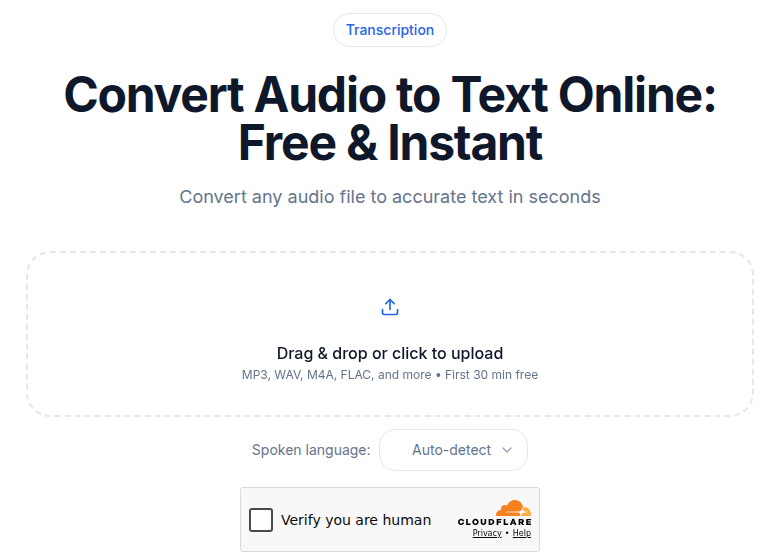 ConvertAudioToText audio upload tool showing the retention setting
What "Deleted" Actually Means
Before configuring retention, it helps to understand the two-phase reality of cloud deletion.
Logical deletion is when the file disappears from your dashboard and returns "not found" from the API. This happens quickly, often immediately.
Physical deletion is when the actual bytes are removed from storage and backup systems. This happens later. For most S3-compatible systems including Cloudflare R2, objects marked for deletion are irreversibly removed, but backup propagation takes hours to days. Trint is explicit that backup metadata can persist for up to a year after a file is deleted.
For content where you need documented unrecoverability, ask the vendor specifically:
- What is the SLA between logical and physical deletion?
- Are backups on the same schedule as primary storage?
- Is there a "secure erase" or cryptographic shredding option?
For most business use cases, standard logical-then-physical deletion is adequate. For content covered by legal hold obligations or attorney-client privilege, consult your legal team before assuming any tool's deletion is forensically irreversible. See transcription and attorney-client privilege for specifics on that scenario.
Configuring Retention to Match Your Risk
The right retention period is not "as long as possible for convenience" or "as short as possible for privacy." It is the minimum that satisfies your workflow, your compliance obligations, and your realistic re-processing needs.
A useful exercise: for each type of recording your team handles, answer five questions.
- Why do I need the audio in the first place?
- How long could I plausibly need to re-process or re-download it?
- How long does the transcript need to stay available?
- What is the applicable compliance requirement?
- What is the breach or discovery exposure if this file leaked?
The retention period should be the minimum that satisfies all five. For most teams:
- Customer calls: 14 to 30 days audio, 90 days transcript
- Internal meetings: 7 to 14 days audio, 30 days transcript
- Voice memos and one-off notes: 7 days audio, 30 days transcript
- Journalism and research source material: indefinite for both, with separate consent documentation
For sensitive content (therapy, legal consultations, confidential strategy), the answer for audio is usually "delete immediately after transcript is confirmed." The audio served its purpose. The transcript is what you needed.
CATT's Retention Controls
Among the tools in the table, CATT is one of the few that deletes source audio on a schedule instead of keeping it until you clean up. On the free plan, source audio is deleted automatically after a limited time, usually 7 days. Paid users choose a retention period for their account in Settings, from 7 days to a year or no time limit. The setting applies to the whole account; there is no per-file override.
Transcripts are handled separately. They are not deleted automatically, and deleting a file moves it to the Trash, where you can restore it for 30 days. Once a file's source audio has been deleted, its audio player stops working and the transcript stays. To check this yourself, upload a non-sensitive file and open it again after the retention window.
If you want straightforward transcription without a meeting bot, without onboarding, and with source audio that is deleted on a schedule rather than accumulating, CATT's audio to text tool is a simple place to start.
The Compliance Angle Without Overclaiming
GDPR Article 5 gives two relevant principles:
Data minimisation (Article 5(1)(c)): Collect only what you need. Storage limitation (Article 5(1)(e)): Keep it no longer than necessary.
Auto-deletion turns the second principle from a manual process into a technical control. That matters because GDPR enforcement expects documented, enforced retention, not "we intended to clean up."
What you cannot do: point to a vendor's auto-delete feature and call yourself GDPR-compliant. Compliance is a property of your deployment, your processes, and your agreements, not a feature badge. You need:
- A Data Processing Agreement with your transcription vendor (covering their sub-processors and their own retention)
- Documented retention periods in your Records of Processing Activities
- Evidence that the technical control (auto-delete) is tested and working
CCPA in California, LGPD in Brazil, and PIPEDA in Canada contain analogous minimization concepts. The practical implementation is the same: define it, document it, enforce it technically. See GDPR-compliant transcription for the full compliance workflow and is AI transcription private for what privacy actually requires of a vendor relationship.
When Longer Retention Makes Sense
There are legitimate cases for keeping audio beyond the short windows above.
Journalism and research archives. Source material supporting published work may need to be retained for years to defend against legal challenges. This requires separate consent documentation and a justified retention period, not simply leaving the default on.
Regulated industries with mandatory retention. Financial services often require 5 to 7 years for certain communications. Healthcare record-keeping has its own schedule. In these cases, set retention to match the regulatory requirement, document the citation, and use a vendor whose DPA supports that retention model.
Educational content libraries. Lecture recordings, training materials, and conference talks where the value is archival. These belong in a dedicated archive system, not in a general transcription service's default storage.
For these cases, set retention deliberately and document why. The compliance position you want is "we chose this retention based on this documented requirement," not "we never configured a retention period."
Testing That Deletion Actually Works
Do not trust the marketing. Run a test.
- Upload a non-sensitive file with the shortest retention window your plan offers.
- Wait past the window.
- Try to access the file through the normal interface and via the direct storage URL if you have it.
- Confirm it returns "not found" or equivalent.
If a provider claims auto-deletion but the file is still accessible past the configured window, the implementation is broken. This test costs you ten minutes and tells you more than the privacy page does.
FAQ
Does deleting a file from a transcription service guarantee it is gone immediately?
Not always. Most services use logical deletion first (the file disappears from your interface) followed by physical purge from backups over days or weeks. Trint, for example, retains backup metadata for up to a year after deletion. For genuinely sensitive content, check the vendor's backup and disaster-recovery retention terms, not just the user-facing delete button.
Is GDPR satisfied just by using a service with auto-delete?
No. GDPR Article 5(1)(e) requires that you, as the data controller, document a justified retention period and enforce it. Using a tool with auto-delete helps you enforce it technically, but you still need to define the period, document the rationale in your records of processing, and ensure any sub-processors (the transcription vendor) are bound by a Data Processing Agreement. Auto-delete is a mechanism, not a compliance certificate.
Which transcription services offer auto-delete and which require manual cleanup?
Auto-delete or configurable retention exists in: CATT (free tier auto-deletes source audio, usually after 7 days; paid plans choose the window), Rev AI API (90-day max, configurable via support), Otter.ai Enterprise (custom retention policies), and Fireflies Enterprise (auto-delete old meetings). Manual-only cleanup as default: Happy Scribe (indefinite storage, 10-day recovery window), TurboScribe (manual only, 90-day backup purge on account delete), Trint (manual, enterprise gets custom options). AWS Transcribe deletes output from its service-managed bucket after 90 days; if you use your own S3 bucket, retention is entirely up to you.
What retention period should I use for audio files containing sensitive conversations?
For therapy sessions, legal consultations, medical discussions, or confidential business strategy: delete the audio file immediately after the transcript is confirmed, or within 24 hours at most. The transcript itself can have a longer window (30 to 90 days) if you need it for review. Match the audio retention to the realistic window where re-processing could ever be needed, not to general convenience. Most people never re-process audio once the transcript is confirmed.
Sources
- Otter.ai custom data retention help article: https://help.otter.ai/hc/en-us/articles/19500988656279-Set-a-custom-Data-Retention-policy
- Rev.com privacy and security support: https://support.rev.com/hc/en-us/articles/29708931771661-Privacy-And-Security
- Rev AI API FAQ (30-day job retention): https://docs.rev.ai/faq
- Fireflies recording modes for compliance: https://guide.fireflies.ai/articles/3598930706
- TurboScribe privacy policy: https://turboscribe.ai/privacy
- Happy Scribe data retention help: https://help.happyscribe.com/en/articles/6087162-how-long-does-happyscribe-keep-my-data
- Trint data security and compliance: https://trint.com/security
- AWS Transcribe data input and output docs: https://docs.aws.amazon.com/transcribe/latest/dg/how-input.html
- Cloudflare R2 delete objects docs: https://developers.cloudflare.com/r2/objects/delete-objects/
- GDPR Article 5 text: https://gdpr-info.eu/art-5-gdpr/
- ConvertAudioToText privacy policy: https://convertaudiototext.com/privacy
Try transcription free
Convert any audio or video to clean, unwatermarked text — speaker labels, timestamps, and AI summaries included. First 30 minutes free, no account.
Related Articles
Is AI Transcription Private? What Providers Really Do
What AI transcription services really do with your audio: retention, training use, encryption, and the right questions to ask before uploading sensitive recordings.

On-Device vs Cloud Transcription: The Real Tradeoff
On-device transcription is finally production-ready. Here is when it beats cloud, when it does not, and the real privacy, accuracy, and cost tradeoffs in 2026.