
Transcription and Attorney-Client Privilege: Waiver Risks
Summarize this article with:
The Privilege Question
A transcript of a privileged communication is itself privileged, the medium does not change the analysis. The harder question is whether sending that audio to an AI transcription vendor destroys the privilege you were trying to preserve. That question does not have a clean universal answer, and the recent case law suggests most lawyers are not asking it carefully enough.
Not legal advice. This article provides general information about privilege doctrine and transcription technology. Privilege rules are jurisdiction-specific and fact-specific. Consult your jurisdiction's professional responsibility authorities and your firm's general counsel for any specific matter.
The Basic Framework (and Where It Gets Complicated)
Attorney-client privilege requires: a confidential communication, between attorney and client or their agents, made for the purpose of obtaining or providing legal advice, with the intention that it remain confidential, and without subsequent waiver.
That last element is where AI transcription creates real exposure.
The general rule is that voluntary disclosure to a third party waives the privilege. The doctrine has exceptions, most importantly the necessary-agent carve-out: disclosure to someone working at the lawyer's direction to facilitate legal representation does not waive the privilege, as long as that person is bound by confidentiality and does not use the information for independent purposes.
Human stenographers, paralegals, and translators fit comfortably inside that carve-out. The legal analysis for AI vendors is less settled, and more than one bar ethics opinion has noted that an AI transcription application "is not an agent of the attorney in any legal sense." It typically does not act under the attorney's direct control, owes no fiduciary duty to the client, and may operate under terms of service that expressly reserve the right to store or process data in ways outside the lawyer's supervision.
That does not mean AI transcription waives privilege automatically. It means the lawyer has to do more work to establish that the vendor fits inside the agent carve-out. Courts have not produced a clean consensus rule yet, so treat any vendor relationship with privileged audio as requiring active vetting.
The Vendor-as-Agent Test
Courts ask roughly four questions when deciding whether a third-party vendor preserves privilege:
1. Is the vendor necessary to the legal representation? Routine transcription of client meetings and witness interviews probably qualifies. Sending the audio to a general-purpose tool for convenience likely does not clear the necessity bar as reliably.
2. Is the vendor acting at the lawyer's direction? This means the lawyer selected the tool, controls how the audio is submitted, and has the ability to direct what happens to the output. An AI notetaker that joins calls autonomously, routes audio through third-party servers, and creates its own data logs is harder to characterize as acting under the lawyer's direction.
3. Is the vendor bound by a documented confidentiality obligation? Terms of service alone may not suffice. A written data processing agreement or NDA naming the specific engagement and restricting the vendor to transcription-only use of the audio is the cleaner documented basis.
4. Is the vendor using the content for independent purposes? This is the most common failure point. Vendors that train AI models on uploaded audio, retain audio beyond the transaction, or share derived data with third parties for their own purposes fall outside the agent carve-out by definition.
If a vendor fails on any of these, the analysis shifts to whether you can still argue that privilege survived. That is harder terrain, and in contested discovery you would rather not be there.
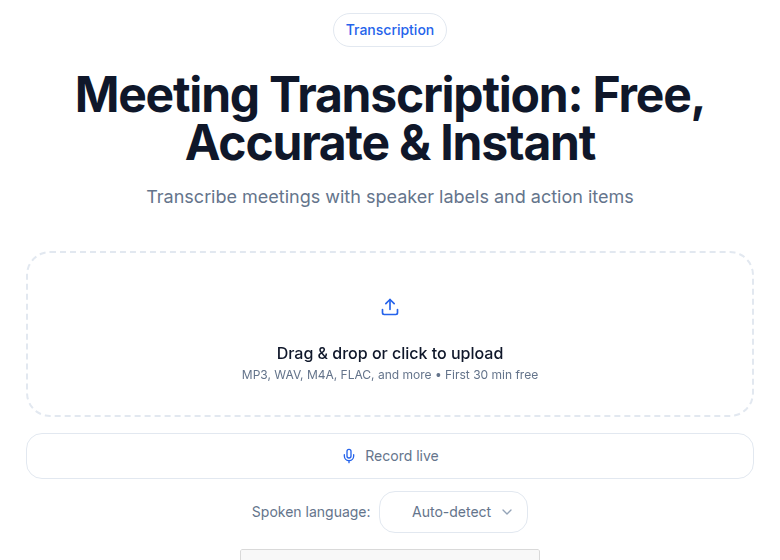 A lawyer uploads a client interview recording for transcription using the meeting transcription tool
What to Verify Before Uploading Privileged Audio
Before sending any privileged audio to an AI vendor, confirm the following in writing:
Training and retention. Does the vendor use uploaded audio to train its models? What is the retention schedule after delivery of the transcript? Ask for documentation, not just a marketing statement.
Sub-processors. Does the audio pass through additional third parties (cloud providers, annotation vendors, quality reviewers)? Each additional party is another potential gap.
Data location. Some jurisdictions and clients require data residency. Know where the audio is processed and stored.
Contractual confidentiality. Request a data processing agreement or equivalent written instrument that names your firm, restricts use to transcription services for your engagement, and prohibits training or sharing.
Audit logs. Can the vendor demonstrate who accessed the file and when? Useful if inadvertent disclosure ever comes up in litigation.
This is not a formality checklist. The K&L Gates summary of United States v. Heppner (S.D.N.Y., Feb. 2026, per K&L Gates' analysis) found no privilege protection where materials were created using a public AI tool without counsel's direction and without a reasonable expectation of confidentiality, before being shared with a lawyer after the fact. The lesson is that privilege is not retroactive: the platform conditions at the time of creation matter.
The Duane Morris survey from February 2026 makes the same point from an ethics angle: Rule 1.6(c) requires a lawyer to "make reasonable efforts to prevent the inadvertent or unauthorized disclosure of" client information. Sending privileged audio to a vendor without vetting its data handling likely fails that standard, even if no actual disclosure occurs, because "reasonable efforts" include pre-engagement diligence.
The Kovel Doctrine and Its Limits
The best analog in established doctrine is United States v. Kovel, 296 F.2d 918 (2d Cir. 1961), which extended privilege to an accountant working under a tax attorney's supervision. Judge Friendly's reasoning was that the accountant was functioning as a translator of complex financial information necessary for the attorney to give legal advice, not as an independent advisor.
Courts applying Kovel ask whether the third party was retained to help the lawyer understand information the client provided, or whether the third party was providing independent services of a different character. Transcription fits better under Kovel than most AI tools, because it is genuinely ministerial (converting audio to text) rather than advisory.
The conditions for Kovel protection are strict in most circuits. The consultant must be:
- Retained by the attorney (or clearly acting under the attorney's umbrella)
- Working specifically to facilitate the attorney's legal advice to this client
- Bound by confidentiality through the attorney-client relationship
- Not using the content for purposes outside that scope
A transcription vendor that satisfies all four is in reasonable Kovel territory. One that processes audio through a general cloud pipeline, retains it for undefined periods, or applies it to model improvement sits outside.
See also how AI tools compare to human transcription on the privacy dimension and what "opting out of AI training" actually means in vendor agreements.
Rule 1.6 vs. Evidentiary Privilege: Different Standards
A frequent source of confusion is conflating the ethical confidentiality duty under Rule 1.6 with the evidentiary attorney-client privilege. These are related but not the same, and they can reach different outcomes for the same vendor relationship.
Rule 1.6 (ethics). A lawyer can use a third-party vendor if the disclosure is impliedly authorized to carry out the representation and the lawyer takes reasonable precautions. A well-vetted transcription vendor with appropriate contractual protections satisfies Rule 1.6. The ABA's Rule 1.6(b)(3) comment makes clear that using outsourced services for client work is permissible with appropriate safeguards.
Evidentiary privilege (waiver). Whether that same disclosure waives the privilege in litigation is a separate, harder question decided by the court under the applicable privilege rules. A vendor relationship that is ethically permissible can still be a waiver argument for opposing counsel if the agent-carve-out conditions are not met.
The practical consequence: you can use an AI transcription vendor without violating Rule 1.6 and still face a colorable privilege waiver challenge in discovery if the vendor relationship was not properly structured. Do not assume ethical compliance means privilege is preserved.
Engagement Letter Language
Several bar ethics opinions and law firm guidance documents now recommend addressing AI transcription use in engagement letters. The substance is more important than the exact form, but the clauses that matter are:
Disclosure of tool use. Name the categories of AI tools (transcription, summarization) and the basic data handling controls (no training on client data, confidential processing). Clients have an interest in knowing their privileged conversations are being processed by software.
No-training commitment. State whether the vendor has committed, in writing, that it will not train models on the audio. This protects you and gives the client a basis to evaluate the risk.
Opt-out provision. For sensitive matters (regulatory investigations, M&A, high-stakes litigation), consider giving the client an explicit right to opt out of AI transcription for specific communications.
Incident notification. If the vendor experiences a breach affecting client audio, the engagement letter should specify your notification obligations. Most clients expect prompt notice; stating it explicitly avoids disputes.
WilmerHale's 2026 guidance on privilege and AI recommends that updated engagement letters cover "AI use by the firm, client, and third parties, specifically covering confidentiality, retention, no-training commitments, and incident notification obligations." That is a reasonable template.
Work Product Doctrine
Beyond attorney-client privilege, work product doctrine protects materials prepared in anticipation of litigation. Transcripts of internal strategy discussions, witness preparation sessions, and case planning calls often qualify as work product even when not strictly attorney-client communications.
Work product has two tiers:
Ordinary work product. Discoverable upon a showing of substantial need and undue hardship.
Opinion work product. Reflects attorney mental impressions or strategy. Nearly never discoverable.
A transcript of a witness preparation session may contain both. Work product protection is not automatically waived by disclosure to a vendor, but the analysis is similar: the vendor should be acting at the attorney's direction and should not independently use the materials.
The February 2026 ruling in Warner v. Gilbarco (E.D. Mich., per Paul, Weiss analysis) found that work-product protection applied to materials generated by a third-party AI tool where the work was done at the party's direction for litigation purposes. That extends the doctrine usefully to AI-assisted work, but note the requirement: direction and purpose, not mere access to an AI tool.
For a deeper look at where work product interacts with speaker attribution in transcripts, see speaker diarization explained.
Common Scenarios
Recording a client meeting where a family member is present. The family member's presence may waive privilege depending on jurisdiction. Several states have a limited family-member exception; many do not. Decide before the meeting whether the family member's presence is necessary, and document the reasoning.
Recording an interview with a corporate client's former employee. The Upjohn analysis (449 U.S. 383, 1981) governs. Privilege may extend to the former employee if the interview concerns matters within their prior employment scope and they are informed the lawyer represents the corporation. Give the Upjohn warning before recording, and note it in the transcript.
Recording a meeting with the client's accountant or financial consultant. Privilege may extend under Kovel if the accountant is helping the attorney understand financial information for the purpose of legal advice. If the accountant is providing independent financial advice, the privilege is likely not available for those portions of the conversation.
Transcribing a settlement negotiation. Settlement communications may be separately protected under FRE 408 and state equivalents. Recording is typically permitted in most jurisdictions, but the transcript will eventually be accessible to opposing counsel through ordinary discovery rules if FRE 408 protection is waived or inapplicable. Be thoughtful about what you transcribe.
Inadvertent disclosure during discovery. If a privileged transcript is inadvertently produced, FRE 502(b) provides conditional protection: the disclosure is not a waiver if it was inadvertent, the producing party took reasonable steps to prevent it, and the party promptly moved to rectify it. A Rule 502(d) order in the case eliminates the need to prove inadvertency at all. Neither protection is automatic. The strongest position is prevention, not after-the-fact clawback.
Privilege Markings and Documentation
Standard practice for marking transcripts of privileged communications:
- "ATTORNEY-CLIENT PRIVILEGED COMMUNICATION" on the header of every page
- "ATTORNEY WORK PRODUCT" added where the transcript reflects litigation strategy or mental impressions
- Storage in the firm's matter management system with restricted access (case team only)
- Privilege log entry when withheld in discovery: date, parties, subject matter, and privilege claimed
These markings do not create privilege. They document it and help prevent inadvertent disclosure. A transcript missing the header markings can still be privileged, but an unmarked transcript in a crowded production set is a more likely inadvertent disclosure target.
In-House Counsel Considerations
In-house lawyers face additional complexity:
Mixed legal and business advice. When in-house counsel gives both types of advice, only the legal portions are privileged. A transcript of a meeting covering regulatory response strategy and ordinary business planning will need to be analyzed section by section.
Employee interviews. The Upjohn conditions must be satisfied. Not every employee conversation is privileged, and the recording and transcript only inherit privilege if the underlying communication qualifies.
Subsidiary communications. Privilege between corporate parent and subsidiary is jurisdiction-specific and sometimes fragile. Multi-entity transcripts need entity-specific review.
International privilege. Foreign legal systems define privilege differently. US privilege rules may not be recognized in foreign proceedings; foreign privilege may not be recognized in US courts. For cross-border matters, flag the transcript's jurisdictional exposure to outside counsel.
For straightforward, non-privileged transcription work (earnings call recordings, HR training sessions, internal communications without legal advice content), a tool like ConvertAudioToText offers fast AI transcription without a sign-up requirement. For privileged content, do the vendor vetting described above regardless of which tool you use.
A Practical Decision Framework
Before uploading privileged audio to any AI transcription service, work through three questions:
-
Is the communication clearly privileged or work product? If the privilege analysis is uncertain, treat it as privileged and proceed accordingly.
-
Does the vendor satisfy the agent-carve-out conditions? Acting at the lawyer's direction, bound by documented confidentiality, no independent use of the audio.
-
Is the transcript handled with appropriate access controls and markings after delivery?
If any answer is no, address the gap before proceeding. The cost of fixing a vendor agreement or adding a privilege log entry is trivial compared to a contested waiver argument in discovery.
Common Questions
Does using an AI transcription service automatically waive attorney-client privilege?
Not automatically, but it creates real risk that most lawyers do not fully evaluate. The key question is whether the vendor qualifies as an agent under the attorney's direction, bound by confidentiality, and restricted to transcription-only use of the audio. Consumer AI tools that train on user data or route audio through undefined cloud pipelines are unlikely to meet that test. Enterprise vendors with written data processing agreements and explicit no-training commitments are in a better position, but you should verify the specific terms rather than rely on marketing language.
What should a data processing agreement with a transcription vendor include?
At minimum: a restriction on using the audio for any purpose other than delivering the transcript to you, a prohibition on model training on client audio, a defined retention period after delivery, identification of any sub-processors who touch the audio, and a breach notification obligation. These are not novel provisions, most enterprise vendors offer them for legal and healthcare customers. If a vendor declines to provide them for privileged matters, that tells you something about where you stand.
What engagement letter language should lawyers use when they plan to use AI transcription?
The clause should disclose the category of tool (AI transcription), name the basic data handling controls (no training on client data, access-controlled processing), give the client a right to opt out for specific sensitive communications, and identify your notification obligation if a breach affects their audio. Do not write that the tool is "fully secure" or "HIPAA compliant" as blanket assurances. Compliance is a property of the deployment and the agreements in place, not a vendor badge.
Does the work product doctrine give stronger protection than attorney-client privilege when using AI transcription?
On the waiver question, yes: work product protection is not waived by disclosure to any third party, only where disclosure would substantially increase the likelihood of an adversary obtaining the material. That is a higher bar than the attorney-client privilege waiver rule. But work product protection only applies to materials prepared in anticipation of litigation. Most client meetings and routine legal consultations are not work product, so attorney-client privilege is the relevant doctrine, and its waiver rules are stricter. Do not rely on work product protection as a fallback for material that is privileged but not litigation-related.
Sources
- Federal Rule of Evidence 502: https://www.law.cornell.edu/rules/fre/rule_502
- ABA Model Rule 1.6, Confidentiality of Information: https://www.americanbar.org/groups/professional_responsibility/publications/model_rules_of_professional_conduct/rule_1_6_confidentiality_of_information/
- Duane Morris, AI Transcription Tools: Privacy, Privilege and Ethical Pitfalls (Feb. 2026): https://www.duanemorris.com/articles/ai_transcription_tools_privacy_privilege_ethical_pitfalls_0226.html
- WilmerHale, Protecting Legal Professional Privilege in the Age of AI (Mar. 2026): https://www.wilmerhale.com/en/insights/client-alerts/20260320-protecting-legal-professional-privilege-in-the-age-of-ai
- K&L Gates, Litigation Minute: Generative AI Data, Attorney-Client Privilege, and the Work-Product Doctrine (Feb. 2026): https://www.klgates.com/Litigation-Minute-Generative-AI-Data-Attorney-Client-Privilege-and-the-Work-Product-Doctrine-2-23-2026
- Paul, Weiss, Federal Courts on AI-Generated Materials and Work Product Protection: https://www.paulweiss.com/insights/client-memos/federal-courts-reach-different-outcomes-on-whether-ai-generated-materials-warrant-work-product-protection
- United States v. Kovel, 296 F.2d 918 (2d Cir. 1961): https://scholarship.law.marquette.edu/mulr/vol102/iss2/8/
- Upjohn Co. v. United States, 449 U.S. 383 (1981): https://www.law.cornell.edu/supremecourt/text/449/383
- Baker McKenzie, Sharing Documents with Third Parties: https://resourcehub.bakermckenzie.com/en/resources/global-attorney-client-privilege-guide/north-america/united-states/topics/04---sharing-documents-with-third-parties
Try transcription free
Convert any audio or video to clean, unwatermarked text — speaker labels, timestamps, and AI summaries included. First 30 minutes free, no account.
Related Articles

Spotify Transcript Extractor: How to Copy and Download Episode Text
Get a Spotify podcast transcript you can copy and download: paste a public episode link, 30 minutes free with no signup, TXT or SRT files on eligible plans.
Focus Group Transcription for UX Researchers: Turn Multi-Speaker Audio Into Usable Evidence
A practical guide to focus group transcription for UX and insights teams. See how CATT handles speaker labels, timestamps, AI summaries, and clean export.