
Best Transcription for Asian Languages in 2026
Summarize this article with:
For Mandarin and Cantonese, SenseVoice (Alibaba's open model) beats Whisper on CER; for Japanese and Korean, Whisper Large-v3 and Naver CLOVA Speech lead; for Indian languages, Azure Speech is the strongest specialized option. No single engine wins across all Asian languages. Whisper-based tools handle multilingual breadth best at low cost, while language-specific vendors win on depth for their target tongue.
No single transcription engine leads across all Asian languages. The right choice depends on which language you need, how accurate you need to be, and whether you are building a product or processing files manually. This post maps each major Asian language to the engine that performs best for it, with CER/WER figures from verifiable benchmarks.
Why Asian Language Accuracy Is a Different Problem
Accuracy benchmarks for Asian languages use different metrics than English. For Chinese, Japanese, and Korean, CER (character error rate) is the correct measure because those scripts do not use spaces between words. WER (word error rate) would require defining "words" in a way that does not map cleanly to how these scripts work.
Keep that distinction in mind when comparing vendor claims. A vendor reporting "95% accuracy" for Japanese without specifying whether it is WER or CER is probably using a softer definition. The transcription accuracy explained post covers this in more detail.
Mandarin and Cantonese: SenseVoice Leads
For Mandarin, SenseVoice (the open model from Alibaba's FunAudioLLM team) achieves 10.78% CER vs 12.55% CER for Whisper Large-v3 on standard benchmarks. On Cantonese the gap widens: SenseVoice hits 7.09% CER, Whisper Large-v3 reaches 10.41%. Speed-wise, SenseVoice runs 52-118 times faster than real time on Apple Silicon, compared to 13-14 times for Whisper on equivalent hardware.
The important distinction: SenseVoice is an open-source model, not a SaaS product. Alibaba's commercial speech API is available through the Alibaba Cloud Model Studio (Fun-ASR 1.5, launched April 2026) and is the right choice for production Mandarin workflows with the Chinese ecosystem. Documentation is available in English via alibabacloud.com.
iFlytek is a separate company that has served specialized Mandarin domains (medical, legal, finance) for over a decade with domain-tuned vocabulary models. Pricing is opaque and requires direct contact; for non-Chinese developers, the documentation friction is real.
For Mandarin workflows outside China, OpenAI Whisper or Google Cloud STT Chirp are more accessible fallbacks with similar accuracy tiers.
Japanese and Korean: Whisper Holds Up, CLOVA Wins Korean Depth
Whisper Large-v3 achieves 8-12% CER on both Japanese and Korean, and beats SenseVoice on these two languages (SenseVoice's strength is specifically Mandarin/Cantonese). For Japanese, Whisper's weakness is spontaneous conversational speech with heavy dialect variation; formal speech transcribes cleanly.
For Korean, Naver CLOVA Speech is the dedicated option backed by NAVER's own research data. It supports Korean, English, Japanese, and Simplified Chinese, with real-time streaming for Korean, English, and Japanese added in 2024. Korean-specific honorifics and formal/informal register handling are better in CLOVA than in Whisper. Access is via NAVER Cloud Platform with English documentation available.
My take: for Japanese transcription, Whisper Large-v3 via the OpenAI API or a Whisper-based service is the easiest starting point. For Korean, Whisper is fine for general use; CLOVA is worth evaluating if you need specialized domain vocabulary or native Korean product integration.
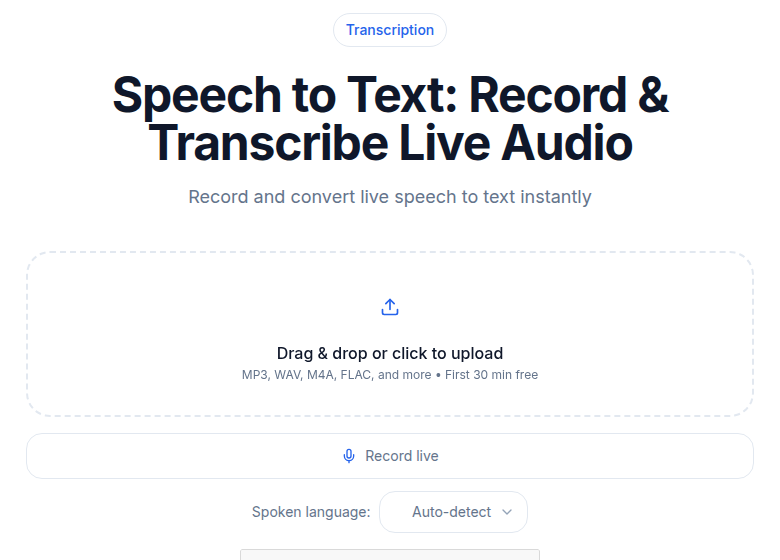 ConvertAudioToText speech-to-text tool interface
Indian Languages: Azure Speech Covers the Breadth
Microsoft Azure Speech has invested specifically in Indian language training data and supports Hindi (hi-IN), Tamil (ta-IN), Telugu (te-IN), Bengali (bn-IN/bn-BD), Marathi (mr-IN), Gujarati (gu-IN), Punjabi, Assamese, and Oriya, covering over 90% of the Indian language market by speaker count. Whisper handles Hindi at 9-14% WER and manages the other major Indian languages, but Azure's specialized training for Indian language phonology and accent variation gives it an edge for production use.
Azure Speech real-time STT costs $1.00/hr standard, $0.36/hr for fast transcription, and $0.18/hr for batch processing (per vendor documentation as of mid-2026). The free tier includes 5 audio hours per month.
Google Cloud STT Chirp also covers Hindi, Tamil, Telugu, and Bengali (Chirp 2 only for Bengali), with pricing at $0.016/min real-time or $0.004/min for batch. See the Google Cloud Speech-to-Text pricing breakdown for the full comparison.
Southeast Asian Languages: Google Cloud Chirp and Whisper
For Vietnamese, Thai, Indonesian, Tagalog/Filipino, and Malay, the landscape is thinner. Google Cloud STT Chirp (V2) covers all of them: Thai (th-TH), Vietnamese (vi-VN), Indonesian (id-ID) are fully supported; Tagalog and Malay are available through V2 as well.
Whisper accuracy drops noticeably for tonal languages with less training data. Thai benchmarks at 18-26% WER and Vietnamese at 15-22% WER, reflecting both tonal complexity and lower training data volume compared to Mandarin or Japanese. These are usable numbers for many workflows but the gap from English is real.
AssemblyAI's Universal model (confirmed in documentation: Japanese, Korean, Mandarin, Hindi, Thai, Vietnamese, Indonesian are all supported) prices at $0.15/hr for Universal-2 and $0.21/hr for Universal-3.5 Pro. The advantage is that you get speaker diarization, sentiment, and topics through the same API call; the disadvantage is that per-language accuracy for the SEA languages has not been specifically benchmarked publicly.
Language-by-Language Quick Reference
| Language | Best general option | Best specialized option | Whisper Large-v3 accuracy |
|---|---|---|---|
| Mandarin | Google Cloud STT Chirp, OpenAI Whisper | Alibaba Cloud Model Studio (Fun-ASR) | 12.55% CER |
| Cantonese | OpenAI Whisper | SenseVoice (self-hosted) | 10.41% CER |
| Japanese | OpenAI Whisper | OpenAI Whisper | 8-12% CER |
| Korean | OpenAI Whisper | Naver CLOVA Speech | 8-12% CER |
| Hindi | Azure Speech | Azure Speech | 9-14% WER |
| Thai | Google Cloud STT Chirp | Google Cloud STT Chirp | 18-26% WER |
| Vietnamese | Google Cloud STT Chirp | Google Cloud STT Chirp | 15-22% WER |
| Indonesian | OpenAI Whisper | Google Cloud STT Chirp | Not published |
| Tamil | Azure Speech | Azure Speech | Not published |
| Bengali | Azure Speech | Azure Speech | Not published |
| Tagalog/Filipino | Google Cloud STT Chirp | Google Cloud STT Chirp | Not published |
CER figures sourced from VexaScribe benchmarks (verified June 2026). WER figures from the same source. "Not published" means no independent benchmark was found as of this writing.
What Actually Works for Code-Switching
Code-switching is the norm in many Asian conversations: Hinglish (Hindi-English), Singlish (Singaporean English with Malay and Mandarin), Taglish (Tagalog-English), and Manglish (Malaysian English with Malay) all involve mid-sentence switches.
The tools that handle code-switching without manual configuration:
- OpenAI Whisper: set the dominant language; the model handles switches automatically without declaring both language codes. This is the most reliable approach for Hinglish and Taglish.
- Google Cloud STT v2: has explicit code-switching configuration options in the API, useful when you know the two languages in advance.
- AssemblyAI Universal: automatic language detection covers code-switched content to some degree.
The tools that struggle: engines requiring a strict single-language declaration and enforcing it through confidence filtering will hallucinate or drop switched segments.
Practical Workflow for Asian Language Transcription
- Identify your language and check the table above to set realistic accuracy expectations before committing to a tool or workflow.
- For Mandarin: Alibaba Cloud Model Studio or OpenAI Whisper; for Japanese/Korean: OpenAI Whisper; for Indian languages: Azure Speech; for SEA: Google Cloud STT Chirp.
- After transcription, verify proper nouns, brand names, and place names first. These are the highest-error category across every Asian language engine, regardless of overall CER.
- For code-switched content, let the model detect automatically rather than splitting files. Splitting often creates boundary errors where one chunk ends mid-word.
- For published content, have a native speaker do a final pass. AI gets you most of the way; the human pass closes the gap to publication quality.
See also the speaker diarization explained guide if you need multi-speaker separation in these languages. Diarization is an orthogonal capability to language support and varies by tool.
APIs Versus End-User Tools for Asian Languages
For developers building products, the choice is between OpenAI Whisper ($0.003-0.006/min), Google Cloud STT Chirp ($0.004-0.016/min depending on batch vs real-time), AssemblyAI Universal ($0.15/hr), and Azure Speech ($0.18-1.00/hr depending on mode). See the speech-to-text API pricing comparison for the full developer-facing breakdown.
For end users who want to transcribe files without building anything, the main choices are: tools with a web interface that support these languages out of the box. If you want to run a file through without creating an account, ConvertAudioToText supports major Asian languages with instant upload. The first 30 minutes of any file are free with no account, a free account transcribes up to 30 files a day, up to 30 minutes each, the Pro plan runs $14.99/month for unlimited transcription.
Tools to Skip for Asian Languages
Several otherwise-capable tools have weak Asian language support that makes them the wrong choice for this use case.
- Otter, Rev, Trint: English-first tools. Their Asian language support exists but is not a primary focus per vendor documentation; accuracy is generally weaker than Whisper-based alternatives.
- Deepgram Nova-3: strong for English and European languages; per Deepgram's public documentation, Asian language coverage is limited compared to the options above. Check Deepgram vs AWS Transcribe for the API comparison.
- AWS Transcribe: supports a limited set of Asian languages; community benchmarks place accuracy below Whisper-based tools for most Asian languages, though AWS has not published CER comparisons.
For parallel context on a different language family, the best transcription for African languages post covers the same engine-versus-language tradeoffs for a different set of underserved languages.
FAQ
Which transcription engine works best for Mandarin Chinese?
SenseVoice (Alibaba FunAudioLLM's open model, available via Alibaba Cloud Model Studio) achieves 10.78% CER on Mandarin vs 12.55% CER for Whisper Large-v3, and processes audio 52-118 times faster than real time. For developers outside China, OpenAI Whisper or Google Cloud STT Chirp are strong fallbacks with straightforward API access.
Does Whisper handle Asian languages well?
Yes for the major ones. Whisper Large-v3 achieves 8-12% CER on Japanese and Korean, 9-14% WER on Hindi, and 12.55% CER on Mandarin. CER (character error rate) is the right metric for CJK languages because word boundaries are not written with spaces, making WER misleading. Performance drops for Thai (18-26% WER) and Vietnamese (15-22% WER).
What is the cheapest API option for Asian language transcription?
OpenAI's gpt-4o-mini-transcribe costs $0.003/min (about $0.18/hr) and supports major Asian languages. Whisper-1 and gpt-4o-transcribe run at $0.006/min. Google Cloud STT Chirp costs $0.016/min for real-time or $0.004/min for batch (within-24hr delivery). AssemblyAI starts at $0.15/hr for Universal-2 but effective production costs with diarization and other add-ons typically run higher.
Why does my transcription fail on code-switched audio like Hinglish or Taglish?
Most engines expect one declared language and fail when speakers switch mid-sentence. Whisper Large-v3 handles code-switching automatically without needing both language codes declared; set it to the dominant language and it handles the rest. Google Cloud STT v2 has explicit code-switching configuration options. If your tool requires a single language declaration, setting the dominant language and letting the model handle the rest performs better than splitting audio files.
Are Naver CLOVA Speech and iFlytek accessible outside Asia?
Both have international APIs, but practical access differs. Naver CLOVA Speech is available via NAVER Cloud Platform with English documentation and supports Korean, English, Japanese, and Simplified Chinese. iFlytek's global platform (global.xfyun.cn) lists APIs for 15+ languages including English, but pricing is opaque and typically requires a developer account to get started. For production use outside Korea or China, Whisper-based tools or Google Cloud STT are more straightforward.
Sources
- OpenAI API pricing (Whisper, gpt-4o-transcribe, gpt-4o-mini-transcribe rates)
- Google Cloud Speech-to-Text V2 supported languages (Chirp language list confirmed)
- Google Cloud Speech-to-Text pricing ($0.016/min real-time, $0.004/min batch)
- AssemblyAI pricing (Universal-2 $0.15/hr, Universal-3.5 Pro $0.21/hr)
- AssemblyAI supported languages (Japanese, Korean, Mandarin, Hindi, Thai, Vietnamese, Indonesian confirmed)
- SenseVoice GitHub (FunAudioLLM) (model description, training data)
- SenseVoice vs Whisper CJK benchmark (CER figures, speed comparisons verified June 2026)
- Whisper accuracy by language (CER/WER figures by language tier)
- Alibaba Cloud Model Studio ASR (Fun-ASR 1.5 API)
- Naver CLOVA Speech overview (Korean/English/Japanese/Simplified Chinese support confirmed)
- Azure Speech pricing ($1/hr real-time, $0.18/hr batch confirmed)
- iFlytek Global platform (language list, pricing model)
Try transcription free
Convert any audio or video to clean, unwatermarked text — speaker labels, timestamps, and AI summaries included. First 30 minutes free, no account.
Related Articles

Mandarin Transcription: Simplified, Traditional, and Tones
Mandarin Chinese transcription: Simplified vs Traditional output, tone homophones, Cantonese honesty, and engine support in 2026.

Japanese Transcription with Kanji: A 2026 Guide
How AI handles kanji output, no-space tokenization, homophone disambiguation, keigo registers, and dialect accuracy in Japanese transcription. Tool comparison included.