Deposition Transcription Guide: Who Makes the Record (2026)
Summarize this article with:
Who Makes the Record
In a deposition, a certified court reporter makes the official record. That is the transcript admissible at trial, cited in briefs, and used to impeach a witness. AI transcription cannot replace it. What AI can do is produce a working draft within minutes of the deposition ending, feed post-deposition analysis tasks, and help litigation teams move faster while waiting for the certified transcript to arrive. Understanding the boundary between those two functions is the core of any rational deposition transcription workflow.
This guide is not legal advice. Jurisdiction-specific rules govern how depositions may be recorded and what an attorney must do to remain within privilege protections.
The Certified Reporter's Role
Under Federal Rule of Civil Procedure 30(f)(1), the officer presiding at a deposition must certify in writing that the witness was duly sworn and that the deposition accurately records the witness's testimony. That certificate must accompany the record. No AI product carries that certification.
The certification process involves attending the proceeding, capturing testimony stenographically or digitally, producing a verbatim transcript, and signing a certificate that typically attests to accuracy, the absence of any financial interest in the matter, and compliance with applicable court reporting standards.
The certified transcript is the only document that serves as the official deposition record for impeachment, trial designation, and summary judgment briefing.
After the certified transcript is delivered, the witness has 30 days under Rule 30(e) to review it and submit changes. Those changes, along with the stated reasons, go to the court reporter and become part of the official record. The original answers remain in the record alongside them.
The Working Transcript Workflow
The certified transcript takes time. Depending on jurisdiction, complexity, and expedite options, the final certified version may arrive anywhere from several days to a couple of weeks after the proceeding. Rough drafts (unedited, uncertified) can arrive within hours of a deposition ending, and reporters typically charge $2.00 to $3.50 per page for that service.
The working transcript fills the gap. Here is the workflow:
Step 1: Confirm the recording method. Rule 30(b)(3)(A) allows testimony to be recorded by audio, audiovisual, or stenographic means. A party who wants to use an additional recording method must give prior notice under Rule 30(b)(3)(B). Any private working recording beyond the official method requires the consent of the other parties. Confirm this before the deposition starts. Do not assume most jurisdictions "permit it" without checking, because party consent is generally required for secondary recordings.
Step 2: Capture clean audio. If you have consent and have provided notice, use dedicated recording equipment separate from the court reporter's. Room acoustics, overlapping speakers, and distance from microphones all affect AI accuracy. A lapel microphone near the witness produces a noticeably cleaner working transcript than a phone set on the table.
Step 3: Upload immediately after. With current AI engines, a 6-hour deposition typically transcribes in 20 to 30 minutes. The team can begin reviewing testimony while the reporter is still preparing the rough draft.
Step 4: Use the working transcript as a search and analysis layer. The AI version is not the record. It is a searchable, taggable, quotable working document for internal use. When the certified transcript arrives, it supersedes the AI version for any citation purposes.
Step 5: Track meaningful discrepancies. If the AI working transcript and the certified transcript diverge significantly on a key passage, that is a signal to scrutinize the certified version carefully, not to trust the AI version over the reporter.
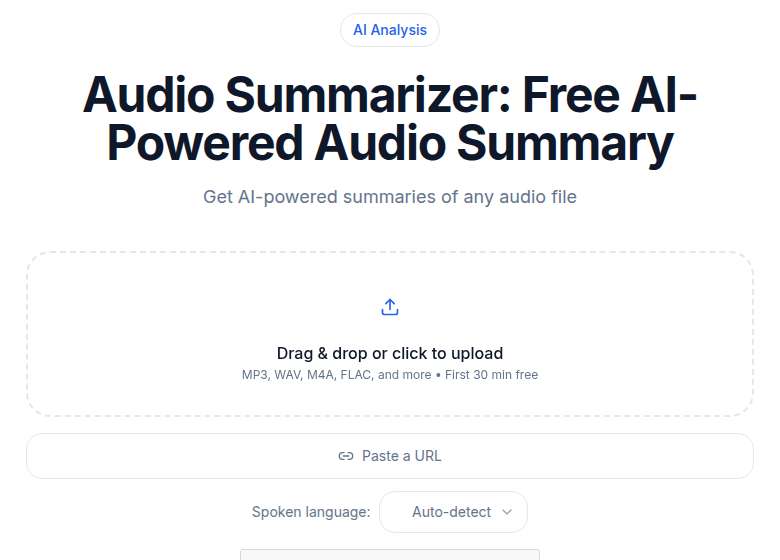 Transcript summary output after a long deposition
AI summarization turns a 6-hour deposition into a structured theme summary within minutes of upload.
Post-Deposition Analysis: Where AI Earns Its Place
The most defensible use of AI in deposition work is analysis, not record production. Three patterns that work consistently:
Theme extraction. Run the full transcript through an AI summarization tool to identify what the witness established, where they hedged, and what they did not address. Output is a structured summary that feeds brief drafting and case strategy without requiring an associate to read 400 pages before forming a view.
Inconsistency detection. Load the AI transcript alongside the witness's prior written discovery responses, prior declarations, or transcripts from related matters. Search both documents for the same factual claims and flag where the accounts diverge. Manual comparison across 1,000-page transcript pairs is slow; a search layer makes it practical.
Quote extraction for briefing. Generate a list of the strongest quotes by topic, each annotated with a rough location in the testimony. When the certified transcript arrives, an associate verifies the exact page and line before it goes into the brief. The AI layer cuts the extraction work; the certified transcript supplies the citable reference.
For a complex commercial dispute with 14 depositions, the difference in associate hours can be significant. The AI analysis layer does not change the court reporter cost. It changes how efficiently the team converts the certified record into usable litigation strategy.
Costs: Court Reporter vs. Working Transcript
For a 6-hour deposition, per-page rates and total costs vary significantly by jurisdiction. Based on 2026 vendor data:
| Cost item | Typical range |
|---|---|
| Court reporter appearance fee | $150 to $400 |
| Certified transcript (per page, ~75 pages/hr) | $4.50 to $7.00/page |
| Certified transcript total (6 hrs, ~450 pages) | $2,025 to $3,150 |
| Rough draft (per page, optional) | $2.00 to $3.50/page |
| Video recording | $250 to $600 |
| Real-time captioning (Realtime feed from reporter) | Per-page fee, per hook-up |
| Human transcription via Rev (AI working copy alternative) | $1.99/minute; ~$716 for 6 hours |
| AI working transcript | Near-zero marginal cost on a flat monthly plan |
The court reporter cost is fixed regardless of what else you add to the workflow. The AI working transcript adds essentially no cost if you already pay a monthly transcription subscription. If you use a human transcription service like Rev as your working copy (human reviewed, not certified), budget roughly $1.99 per minute per Rev's published rate. That is not the certified record; it is just a higher-accuracy working draft than a pure AI output.
For the formal record, the three national providers most litigation teams encounter are:
Veritext is the largest US deposition services firm by scope. They combine stenographic reporters, digital reporters, real-time transcript feeds, video, and exhibit management. Pricing is per-page for transcripts and hourly for video, with Realtime charged per hook-up. Rates are not publicly listed; quote through a local Veritext office.
US Legal Support offers similar scope to Veritext with nationwide coverage.
Magna Legal Services expanded significantly through 2025 acquisitions and now has more than 4,000 court reporters across 31 US locations. They offer both stenographic and 100% remote deposition services.
Independent court reporters remain common in smaller markets and often provide competitive rates and direct relationships that national vendors cannot match.
Privilege and Data Handling: What Changed
The privilege section is where AI in legal work got significantly more complicated in 2026. A Southern District of New York ruling in United States v. Heppner held that materials processed through a public consumer AI tool were not protected by either attorney-client privilege or the work product doctrine. The court found that when a platform's privacy policy allows user inputs to be used for model training or disclosed to third parties, sharing privileged content through it destroys the confidentiality expectation that privilege requires.
The ruling leaves open a narrower path: AI tools with enterprise-grade data handling, clear no-training commitments, and direction from counsel may receive different treatment. But there is no guarantee. Per commentary from multiple law firm alerts on Heppner:
- Use enterprise AI tools that do not train on your inputs and commit to deletion after processing.
- Treat AI interaction logs as potentially discoverable from the moment litigation is reasonably anticipated.
- Store working transcripts only in privileged sections of your matter management system, with access limited to the case team.
- Do not produce the working transcript in discovery unless specifically required.
- Involve counsel before adopting any new AI transcription workflow.
The AI-generated working transcript is typically attorney work product when prepared in anticipation of litigation under attorney direction. The concern is not the work product label itself; it is whether using a third-party AI platform that stores, processes, or trains on the input could undermine confidentiality arguments. Enterprise platforms with documented data-deletion practices are a materially better posture than consumer-grade public tools.
If your firm has strict client confidentiality requirements, check the vendor's data processing terms before uploading any deposition recording. See also our post on transcription and attorney-client privilege.
What the AI Transcript Cannot Do
Three limits that do not bend:
Be the official record. The certified court reporter transcript is the only document admissible as the deposition record. Nothing about AI output quality changes this; it is a structural requirement of the certification process.
Be used for impeachment. To impeach a witness with their deposition testimony, you cite the certified transcript by specific page and line. The AI working transcript is not usable for this purpose.
Substitute for the errata sheet process. A witness's right to correct the official transcript runs through Rule 30(e) and the court reporter. The 30-day correction window, the reasons requirement, and the transmission back to the reporter are all part of the official record chain. The AI transcript has no parallel process.
Coordination With Court Reporters
A few practical notes:
Tell the court reporter and opposing counsel about any supplemental recording before the deposition begins, not during it. Confirm that all parties consent. The reporter's certified transcript is their professional work product; any secondary recording should be framed clearly as a working tool, not an alternative to the certified record.
Do not assume the reporter's audio is available to you. Court reporters do not always make an audio recording, and when they do, it serves as their backup, not yours. Make your own arrangement if you want an audio file to feed an AI tool.
Exhibit handling is where AI transcripts typically diverge most from the certified version. When a witness handles an exhibit, the reporter logs it with formal exhibit markings. Your AI transcript will have only the spoken words. Plan for manual annotation to track exhibit references in the working document.
AI Transcription as a Working Tool for Depositions
If you just need a fast, searchable working draft of a deposition recording, ConvertAudioToText handles long audio files on paid plans (links and videos up to 24 hours). It is not the official record and should never be used as one. The platform does not train on uploaded files, and it deletes source audio automatically on the free plan (usually after 7 days) and on paid plans keeps it only for the retention period the account chooses, which addresses the Heppner confidentiality concern more directly than consumer-grade AI tools. One caution: even with enterprise-grade handling, a firm's outside counsel should evaluate any AI transcription vendor against its specific privilege and confidentiality obligations before adoption. That is not a generic disclaimer; it is the practical lesson from Heppner.
Starting With Your Next Deposition
The AI working transcript workflow is low-risk to pilot. Get party consent per Rule 30(b)(3)(B), bring recording equipment, upload the file after the deposition, and compare the AI output with the certified transcript when it arrives. If the working transcript would have accelerated your case prep, the value case is clear. If it would not have, you have learned something specific about this matter type.
The certified reporter's work stays exactly what it is: the record. The AI layer adds analysis speed on top of it.
Common Questions
Does AI transcription replace a court reporter for depositions?
No. A certified court reporter's transcript is required as the official deposition record under the Federal Rules of Civil Procedure. The officer must certify that the witness was duly sworn and that the transcript accurately records the testimony. AI transcription can produce a useful working draft for internal analysis, but it carries no certification and is not admissible as the deposition record or usable for impeachment at trial.
Can I record a deposition separately for AI transcription?
Under FRCP Rule 30(b)(3)(B), a party who wants to use an additional recording method beyond the stated official method must give prior notice. Any private secondary recording generally requires the consent of all parties. Do not assume your jurisdiction permits it without confirming with the other parties and the court reporter before the deposition begins.
Is the AI working transcript protected as work product?
It may be, if prepared under attorney direction in anticipation of litigation. The more significant risk, after the SDNY ruling in United States v. Heppner, is whether using a third-party AI platform that stores or trains on inputs could undermine the confidentiality expectation that privilege requires. Enterprise tools with no-training commitments and clear deletion policies are a better posture than consumer AI tools. Consult outside counsel before adopting any AI transcription workflow for litigation files.
When does the witness get to correct the deposition transcript?
Under Rule 30(e), the deponent has 30 days from notification that the certified transcript is available to review it and submit changes, along with the reasons for those changes. The changes go to the court reporter and become part of the official record. The original answers remain in the record alongside the corrections.
Sources
- FRCP Rule 30, Cornell LII (verified July 2026)
- Certified Court Reporter Cost Guide 2026, CourtScribes (verified July 2026)
- Cost of Deposition, U.S. Legal Support (verified July 2026)
- Deposition Services, Veritext (verified July 2026)
- An Overview of Deposition Transcripts, Magna Legal Services (verified July 2026)
- Rev Pricing and Plans, Rev.com (verified July 2026; human transcription $1.99/min)
- AI Tools and Attorney-Client Privilege, National Law Review (verified July 2026)
- SDNY AI Privilege Ruling, Gibson Dunn (verified July 2026)
- ConvertAudioToText Pricing (verified July 2026)
Try transcription free
Convert any audio or video to clean, unwatermarked text — speaker labels, timestamps, and AI summaries included. First 30 minutes free, no account.
Related Articles

Court Hearing Transcription: Official Records vs AI Copies 2026
Official court transcripts need certified reporters under 28 U.S.C. 753; AI serves the case-prep lane. The two-lane system explained.
Transcription for Legal Discovery: Audio Evidence at Scale
How litigation teams handle audio in discovery: collecting recordings as ESI, privilege screening, defensibility of AI transcripts, and when certified transcription is required.