
Rev vs Trint: Human Accuracy vs Newsroom Workflow (2026)
Summarize this article with:
Rev is a human-plus-AI transcription service built for legal, medical, and broadcast work: $1.99/min for 99%-guaranteed human output, subscription AI tiers from $29.99/mo. Trint is an AI editorial platform for newsrooms: Story Builder lets journalists drag quotes from multiple transcripts into article drafts, with Vocab Builder for custom terminology. Trint costs roughly 3x more per seat and has no human transcription service. Pick Rev when accuracy guarantees or compliance matter; pick Trint when multi-source article assembly is your daily workflow.
Rev and Trint look like competitors but serve almost entirely different buyers. Rev is a human-plus-AI transcription service used by law firms, medical practices, and broadcast media. Trint is an AI editorial platform built specifically for newsrooms. Choosing between them is less a feature comparison and more a question of what category of work you do.
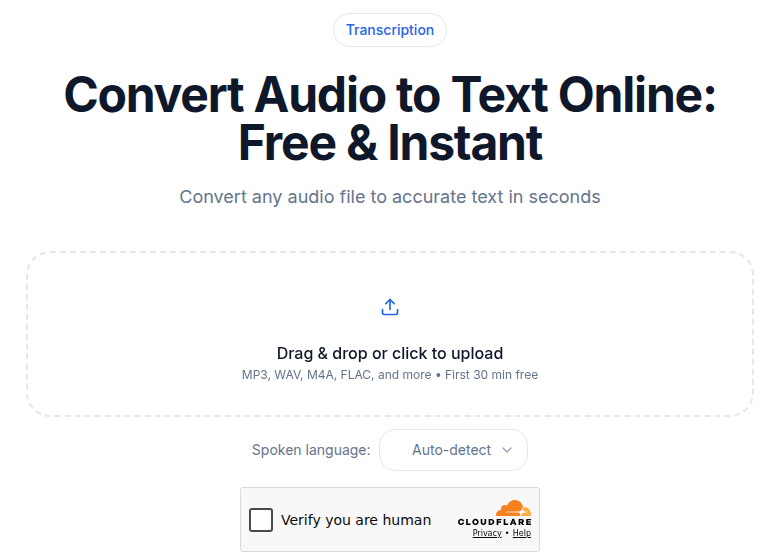 Upload-based AI transcription: the third option next to human services and newsroom platforms
What Problem Does Each Tool Actually Solve?
Rev's core promise is accuracy with accountability. When a deposition transcript, HIPAA-regulated medical record, or broadcast caption has to be right, Rev puts a human reviewer on it and guarantees 99% accuracy in writing. The AI tier handles volume; the human tier handles stakes.
Trint's core promise is speed from raw audio to published story. Story Builder lets journalists highlight quotes from multiple interview transcripts and drag them into a shared article workspace, collapsing the hours spent copy-pasting quotes from disparate files into a single editorial pass. Vocab Builder lets teams pre-load custom terminology, proper nouns, and jargon so the AI stops mangling names.
These are not the same product category. One is a transcription service with a compliance posture. The other is an editorial workflow tool that happens to transcribe.
What Does Rev Actually Cost?
Rev runs two separate pricing tracks that often confuse buyers.
Subscription AI plans bundle monthly AI minutes:
| Plan | Monthly Price | Annual Price | AI Minutes/Month |
|---|---|---|---|
| Free | $0 | $0 | 45 min (English only) |
| Essentials | $29.99/seat | $25.49/seat | 5,000 min (English + Spanish) |
| Pro | $59.99/seat | $47.99/seat | 10,000 min (37+ languages) |
| Unlimited | Custom | Custom | Unlimited |
Human transcription is a separate pay-per-minute service layered on top: $1.99/min for standard delivery (99%+ accuracy, under 12 hours). Rush options are available at an added premium. Subscription holders get a discount on human rates: 10% off on annual Essentials, 15% off on annual Pro.
So a legal team running both AI drafts and human-reviewed finals pays the subscription fee plus per-minute charges on human work. Budget accordingly.
What Does Trint Actually Cost?
Trint does not publish a free tier. There is a 7-day trial, then you pay.
| Plan | Price | File Limit | Notes |
|---|---|---|---|
| Starter | ~$80/seat/mo | 7 files/month | Annual billing required |
| Advanced | ~$100/seat/mo | Unlimited | Single-user, all features |
| Enterprise | Custom | Custom | SSO, SCIM, audit logs, custom retention |
The 7-file cap on Starter is a meaningful constraint. If you do 2-3 interviews per week, you hit it by the third week. There is no metered overage: you either upgrade or wait for reset. Annual billing is required on most paid tiers, so a $100/seat/mo Advanced plan commits you to $1,200/seat upfront.
For a newsroom team of 10 reporters, that is approximately $800-$1,000/month total versus roughly $300/month for 10 Rev Pro seats. Trint costs about 3x more per head. Whether Story Builder and Vocab Builder justify that gap depends entirely on how central multi-source article assembly is to daily output.
Which One Is More Accurate?
For AI transcription, both tools produce comparable results on clean audio: roughly 94-97% word accuracy on well-recorded interviews in English. Trint's Vocab Builder can push accuracy higher on content with lots of proper nouns, technical terms, or geographic names. If you cover a specific beat (local politics, medical research, sports) and pre-load relevant names, Trint's AI can outperform Rev's by several percentage points on terminology-heavy passages.
Rev's human tier is the only 99%-guaranteed option between the two. Trint has no equivalent. For depositions, court reporting, medical dictation, or any context where a transcript will be used as a legal record, Rev Human is the answer regardless of cost.
See transcription accuracy explained for a deeper look at how AI and human accuracy claims are measured.
What About Languages?
Rev Essentials covers English and Spanish. Rev Pro and Unlimited expand to 37+ languages. Rev.ai (the API product) offers 58 languages on its Reverb models.
Trint transcribes in 40+ languages and handles subtitle translation into 50+ languages, making it the stronger option for subtitle-heavy international productions. If your newsroom produces content in multiple languages or exports localized subtitle packages regularly, Trint's subtitle workflow is meaningfully better.
For deeper context on the API side of speech-to-text language coverage, see best speech-to-text APIs in 2026.
How Do the Workflows Compare?
Rev's workflow is straightforward: upload or paste URL, select AI or Human, receive output, edit inline or export. Integrations include Zoom auto-sync and a mature API for batch processing. The experience is designed around reliability, not assembly.
Trint's workflow is editorial-first:
- Upload audio or video
- AI transcribes in minutes
- Apply Vocab Builder dictionary to the output
- Review transcript in the editor with synchronized media playback
- Highlight key quotes as you listen
- Drag highlights into Story Builder alongside quotes from other interviews
- Build article structure, export to Word, Google Docs, or a CMS
- Or export SRT/VTT subtitle packages in your target language
That sequence is purpose-built for investigative journalism and multi-source reporting. No other mainstream transcription tool replicates it. The question is whether your workflow fits that shape.
Trint's integrations include Adobe Premiere (for subtitle import), WordPress, Slack notifications, and SSO on Enterprise. Rev's integrations are stronger for broadcast caption workflows.
Speaker Identification
Both tools attempt automatic speaker labeling. On 2-3 speaker interviews with good audio separation, accuracy is comparable: generally 80-90%. On more than 4 speakers, degradation is similar. Rev's human service produces correct speaker attribution because a human labels each speaker manually. Trint's AI-only path means speaker errors on complex recordings require manual correction.
For interviews with many voices, see speaker diarization explained for what to realistically expect from any AI tool.
Who Should Pick Rev?
- Law firms processing depositions, discovery audio, or court reporting
- Medical practices with HIPAA documentation requirements (Rev offers BAAs on Enterprise)
- Broadcast operations needing closed captions with legal defensibility
- Anyone who needs 99% accuracy on at least some files
- Podcast teams wanting both volume AI and occasional human review on high-stakes interviews
- Users who want English plus Spanish coverage at entry-level price
Who Should Pick Trint?
- Newsrooms where reporters regularly publish from multiple interview sources
- Investigative journalists building long-form pieces from 10+ interviews
- Editorial teams that need Vocab Builder for proper noun accuracy on specific beats
- Media organizations exporting subtitle packages in multiple languages
- Teams where shared editorial states (reviewed, published, archived) matter
My take: the price gap is real and the workflow gap is real. If Story Builder would touch every story you write, $100/seat is defensible. If you are evaluating Trint mainly for AI transcription quality and hoping the price is worth it, it is not.
What If You Need Neither?
If you are a solo journalist, freelancer, or content creator without newsroom workflow needs, both tools are likely over-engineered for your situation.
Rev's Essentials at $29.99/mo is reasonable if you want a reliable file-based tool with occasional human review access. But Trint at $80+/seat is hard to justify if you will not use Story Builder.
If you just need clean transcripts without a meeting bot or an editorial assembly layer, ConvertAudioToText handles unlimited audio in 99 languages at $14.99/mo. The audio-to-text tool is available without an account for one-off files. For journalists specifically, see the comparison of free vs paid transcription services to calibrate how much infrastructure you actually need.
For context on metered vs unlimited pricing models more broadly, unlimited vs metered transcription pricing breaks down when each model benefits you.
Rev vs Trint: Quick Decision Guide
Deposition or medical dictation (99% required): Rev Human at $1.99/min. Non-negotiable if accuracy is a legal requirement.
Major newsroom, 20+ reporters, multi-source investigative output: Trint Enterprise. The Story Builder and team workflow pay for themselves if they are genuinely in daily use.
Solo investigative journalist, 10-30 interviews per story: Trint Advanced at $100/seat. The Vocab Builder and Story Builder combination is unique.
Beat reporter doing 4-6 interviews per month: Rev Essentials at $29.99/mo or a simpler file-based tool. Neither tool's premium features are relevant at this volume.
Podcast network producing 50+ episodes per month: Rev AI subscription (10,000 min/mo on Pro) plus occasional Human review for high-stakes episodes.
Broadcast media with caption compliance requirements: Rev, specifically for their human caption service and turnaround guarantees.
Corporate L-and-D or marketing producing internal video content: Neither. Both are over-engineered for this use case. A simpler transcription pricing comparison will show lighter-weight options.
Common Questions
Is Rev cheaper than Trint?
Yes, at every tier. Rev's Essentials AI plan is $29.99/seat per month for 5,000 minutes. Trint Starter is roughly $80/seat per month for just 7 files. Even on pure AI cost, Rev wins by a wide margin. The price gap narrows only if Trint's Story Builder and newsroom workflow features are genuinely core to your daily work.
Is Trint better for journalists?
If your work involves assembling articles from multiple interview transcripts, yes. Story Builder is the only tool of its kind: highlight quotes across different transcripts, drag them into a shared workspace, and export an article draft. If you are doing single-interview Q-and-A or routine beat reporting, that feature provides no advantage and the premium price is hard to justify.
Can Rev do what Trint does for newsrooms?
No. Rev has no Story Builder equivalent, no Vocab Builder for custom terminology, and its collaboration layer is minimal compared to Trint's permissioned editorial workflow. Rev's strength is verified human accuracy and legal-grade compliance, not multi-source content assembly.
Does Trint offer human transcription?
Not as a product. Trint is AI-only for transcription itself. You can manually review and edit the AI output inside their editor, but there is no human-reviewed service comparable to Rev's. For files where 99% accuracy is non-negotiable and legal or medical stakes are involved, Rev Human is the only option between these two.
Sources
- Rev subscription plans and pricing - verified July 2026
- Rev human transcription service page - $1.99/min confirmed
- Rev.ai API pricing - Reverb model rates
- Trint pricing overview via Sonix - Starter/Advanced plan details
- Trint newsroom features page - Story Builder and collaboration confirmed
- Trint language support help center - 40+ transcription, 50+ subtitle languages
Try transcription free
Convert any audio or video to clean, unwatermarked text — speaker labels, timestamps, and AI summaries included. First 30 minutes free, no account.
Related Articles
Rev vs Otter.ai (2026): Two Very Different Tools, Compared Honestly
Rev sells transcription with a human safety net at $1.99/min. Otter sells a meeting bot from $8.33/user/month. Verified 2026 pricing, the consent question, and the third option file-upload users actually need.

Happy Scribe vs Rev: Which Hybrid Service Wins in 2026?
Happy Scribe vs Rev on pricing, AI accuracy, human transcription, subtitle workflows, and compliance. Which hybrid service fits your work in 2026.