Speechmatics Alternative for Non-Developers: Web Transcription Without Code
Summarize this article with:
Speechmatics is a top-tier transcription API with 56 languages, 50 hours free per month, on-premises deployment, and ISO 27001/HIPAA/SOC 2 compliance. It is built for developers and teams that write code. If you need to upload an audio file, get an SRT, and pay a flat monthly price with no API keys, ConvertAudioToText is a different product for a different buyer. This post explains what Speechmatics genuinely does better, where it does not fit, and which one to use.
Speechmatics is a strong transcription API. If you are evaluating it, you have probably already seen the numbers: 56-plus languages, on-premises deployment, ISO 27001 and SOC 2 Type II compliance, and a 50-hour-per-month free developer tier. Those are real strengths and this post is not going to minimize them.
What this post is about is the buyer mismatch. Speechmatics is built for developers and engineering teams. ConvertAudioToText is built for people who need transcripts without writing code. The two products target different jobs. Once you understand that distinction, choosing between them is straightforward.
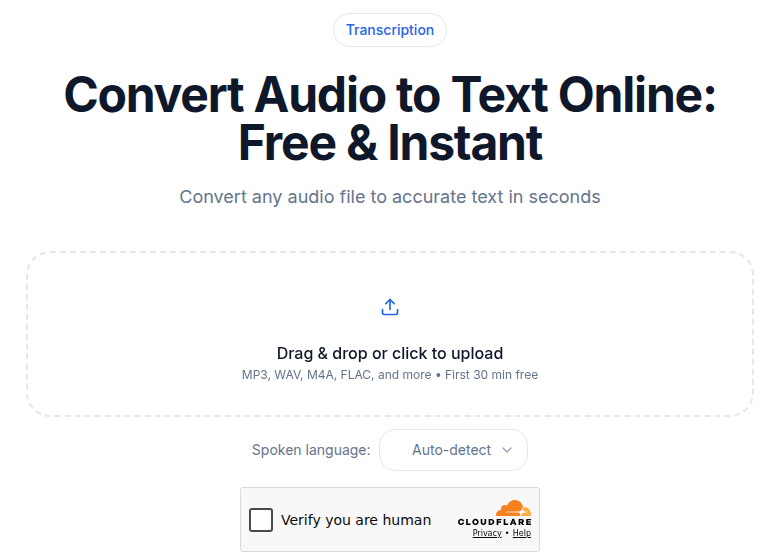 Upload audio or video and get a transcript, SRT, or VTT without API keys
What Speechmatics Actually Is
Speechmatics is an API-first transcription platform. Their core product is a set of REST endpoints: send audio, receive structured JSON with words, timestamps, confidence scores, and speaker labels. The engineering is strong. Their Melia model claims 35% better code-switching performance versus the nearest competitor (self-reported). Their Ursa 2 model reports an 18% word error rate reduction across 55 languages compared to Ursa 1 (self-reported).
For developers building transcription into a product, those are meaningful claims. You get batch and real-time endpoints, word-level timestamps, speaker diarization, a translation API covering 30-plus languages, and an optional NLP layer with sentiment analysis, topic extraction, and chapter generation.
Their web portal is a developer sandbox. You can test a live microphone or play with sample clips. There is no file upload queue, no batch processing interface, no URL input field, and no SRT download button. The portal's purpose is to demonstrate the API, not replace it.
Where Speechmatics Genuinely Wins
Speechmatics is ahead in the areas below, and this comparison would be dishonest if it glossed over them.
| Speechmatics Strength | Honest Assessment |
|---|---|
| 50 hours/month free, no credit card | Larger than almost any competitor's free developer tier. CATT's free tier is the first file on the premium engine (up to an hour), then up to 30 files a day, up to 30 minutes each. |
| 56-plus languages with code-switching | Multilingual and mixed-language audio is a real differentiator. |
| On-premises and on-device deployment | Air-gapped, Docker container, or virtual appliance. CATT is cloud-only. |
| ISO 27001, HIPAA, SOC 2 Type II | Full enterprise compliance stack, relevant for regulated industries. |
| Real-time sub-500ms latency | Sub-1 second initial transcription for live streaming use cases. |
| Dedicated medical model | Clinical terminology model with 96% medical term recall (self-reported). |
| No data retention by default | No audio logging on the API path. |
| Pay-as-you-go, no commitment | Starting from $0.129/hr with automatic 20% volume discount above 500 hours/month. |
Speechmatics gives developers 3,000 minutes (50 hours) per month at no cost with no credit card. That is for API-level testing and development, and it is a generous starting point for engineers evaluating the engine. It is a developer API tier, not a consumer web app, so do not pick a transcription tool just because its free tier is bigger.
Where Speechmatics Does Not Fit
Speechmatics' product design creates real gaps for non-developer users.
No production web UI for file transcription. If you record a podcast, interview, or meeting and want to upload it and download an SRT, the Speechmatics portal does not support that workflow. You would need to either build a script, use a third-party wrapper, or find a different product.
Usage-based pricing requires math. The pay-as-you-go model is flexible for engineering teams but creates unpredictability for individual users or small teams with variable monthly volume. A flat $14.99 per month is simpler to budget for a non-technical user who transcribes occasionally.
No native integrations. Speechmatics does not have a Zapier connection, a Notion export, or a Zoom recording hook. Building integrations requires code.
No built-in "meeting notes" product. The API has summarization and sentiment features, but there is no packaged meeting assistant product. You get building blocks, not an end product.
What ConvertAudioToText Actually Is
ConvertAudioToText is a web application. You upload a file or paste a URL, choose a language if needed, and receive a transcript with speaker labels. Paid plans include SRT, VTT, DOCX, PDF, and JSON downloads; free accounts can read, edit and copy every transcript, download it as TXT, and download their first file in every format. There is no API integration required.
Engines: Paid plans and a new account's first file run on our premium engine, with speaker labels. No-signup previews (the first 30 minutes) and later free files (up to 30 minutes each) are free.
The honest free tier: anyone can transcribe the first 30 minutes of a file with no account. A free account runs your first file on the premium engine with speaker labels, up to an hour. After that, free accounts keep transcribing: up to 30 files a day, up to 30 minutes each. Reading, editing and copying transcripts is free; TXT downloads are free, and DOCX, PDF, SRT, VTT and JSON downloads after the first file need the Weekly Pass, a minutes top-up or a paid plan. There is no credit card required. For a developer doing volume testing, Speechmatics' 50-hour free API tier is more useful. For a non-developer who transcribes one meeting recording per week, the free tier is a working allowance, not a trial gate.
Pricing: $14.99 per month month-to-month, or $99.99 a year billed annually, for the Pro plan, flat. A Weekly Pass is $9.99 one-time for 1,200 minutes (20 hours), valid 7 days, no subscription. No per-minute math, no metered billing.
Side-by-Side Comparison
| Speechmatics | ConvertAudioToText | |
|---|---|---|
| Product type | Transcription API | Web application |
| Free tier | 3,000 min/month (API) | Up to 30 files a day, up to 30 min each on standard (app) |
| Paid pricing | From $0.129/hr PAYG | $14.99/mo flat |
| Requires code | Yes (production use) | No |
| File upload UI | No (demo sandbox only) | Yes |
| SRT / VTT download | Via API output | Yes, in the UI (TXT free) |
| Speaker diarization | Yes (included) | Yes (included) |
| Languages | 56-plus | 99 languages |
| On-premises | Yes | No |
| HIPAA / SOC 2 | Yes | Not advertised |
| Real-time streaming | Yes (sub-500ms) | No |
| Custom vocabulary | Keyword bias list | Not advertised |
| Translation | 30-plus languages | Not advertised |
| Native integrations | None (build your own) | None |
Pricing Math for Different Buyers
Each pricing model wins in a different case.
Speechmatics is cheaper for infrequent API use. If you are processing 2 hours of audio per month through the API, at Speechmatics' starting rate that is roughly $0.26 or less (under $0.129/hr). That is cheaper than $14.99/month flat. The trade-off is that you still need to write the integration code.
Flat pricing wins on predictability. For someone transcribing 10-20 hours of audio per month through a web UI without thinking about per-second billing, $14.99/month is a predictable cost with no surprise invoices.
Developer free tier comparison is misleading for consumers. Speechmatics' 50-hour free tier is specifically for API access. If you are not integrating via API, that free tier is not available to you in any practical sense. Comparing it to CATT's consumer free tier is comparing two different things.
Which One to Choose
Choose Speechmatics if:
- You are a developer or your team has engineering capacity to build and maintain an API integration.
- You need on-premises deployment for data residency or security requirements.
- You need real-time streaming transcription with sub-500ms latency.
- You need the dedicated medical model for clinical terminology.
- You are processing high volumes where per-minute rates matter more than flat pricing.
- You need languages or code-switching behavior that require Speechmatics' specific multilingual models.
- You want enterprise compliance (ISO 27001, HIPAA, SOC 2) from the transcription layer itself.
Choose ConvertAudioToText if:
- You need to transcribe audio or video files without writing code.
- You want SRT or VTT files you can download directly from a browser.
- You want flat monthly pricing with no per-minute calculation.
- You are an individual, journalist, researcher, content creator, or small team with a variable number of files per month.
- You want to try a file before signing up.
These are not close calls on the developer versus non-developer axis. Speechmatics is not a consumer product and does not pretend to be. ConvertAudioToText is not an API platform. The choice follows from what you need to do.
A Note on Accuracy
Several comparison posts make confident claims about which engine is more accurate. We are not going to do that here.
Speechmatics' Ursa 2 model is competitive. Our premium engine is also competitive. The only independent 2026 benchmark we found (Coval.ai) did not include a direct head-to-head between the two on a shared test set. Speechmatics publishes self-reported improvements, and self-reported numbers are not the same as an independent evaluation.
The practical answer: if accuracy on your specific audio matters, test both on a sample of your real files. Most serious comparison decisions should involve a trial on your own content, not trust in a third-party blog post.
Frequently Asked Questions
Does Speechmatics have a free tier?
Yes, and it is unusually generous. Speechmatics offers 3,000 minutes (50 hours) of Speech-to-Text free per month with no credit card required. That free tier includes 56-plus languages and 2 concurrent real-time sessions. ConvertAudioToText transcribes the first 30 minutes of any file with no account at all, and a free account then transcribes up to 30 files a day, up to 30 minutes each, with no monthly cap. For volume testing as a developer, Speechmatics' free API tier is larger.
Is Speechmatics cheaper than ConvertAudioToText?
It depends on your usage. Speechmatics' pay-as-you-go starts from $0.129 per hour with no monthly commitment. At low volume (a few hours per month), it may cost less than CATT's $14.99/mo flat plan. At higher volume (3-plus hours per month regularly), flat pricing wins on predictability even if the raw per-minute rate is comparable. The more important point is that Speechmatics requires API integration to use in production, which has an engineering cost that does not appear in the per-minute rate.
Does Speechmatics support speaker diarization?
Yes. Speaker and channel diarization is listed as a core Speechmatics feature at no add-on charge. ConvertAudioToText also labels speakers on its premium engine.
Can I use Speechmatics without writing code?
Speechmatics has a web portal that lets you run a live microphone test and try sample clips in a sandbox environment. It is not a production transcription UI: there is no file upload queue, no batch export, no SRT download button, and no URL input. For production use, Speechmatics expects API integration. If coding is not an option, a tool like ConvertAudioToText or a consumer app is the more honest choice.
Which is more accurate, Speechmatics or ConvertAudioToText?
We do not know, and you should be skeptical of any comparison post that claims certainty here. Speechmatics' Ursa 2 model reports an 18% word error rate reduction across 55 languages compared to their previous generation. ConvertAudioToText runs your file on its premium engine. No independent head-to-head benchmark between Speechmatics and our premium engine on a shared test set was available at the time this post was written. The best benchmark is your own audio.
Sources
- Speechmatics Pricing - Official - 3,000 min/month free, pay-as-you-go from $0.129/hr, 50+ languages
- Speechmatics Features and Deployments - Official - on-prem, diarization, compliance
- Speechmatics Speech-to-Text - Official - portal described as developer sandbox
- Speech-to-Text APIs in 2026: Independent Benchmarks - Coval.ai - third-party 2026 benchmark landscape
- Speechmatics Alternatives for Meeting Notes - SpeakWise - usage-based pricing pain points, no native integrations
Try transcription free
Convert any audio or video to clean, unwatermarked text — speaker labels, timestamps, and AI summaries included. First 30 minutes free, no account.
Related Articles
Best Transcription Tools with API Access (2026)
Which transcription SaaS tools actually give you API keys, and on which plan? Verified pricing and plan gates for Descript, Sonix, Fireflies, Happy Scribe, AssemblyAI, and more.
Best Speech-to-Text APIs in 2026 (Real Prices)
A current, honestly-priced comparison of the best speech-to-text APIs in 2026: Deepgram, AssemblyAI, OpenAI, Google, AWS, Rev, Speechmatics, and Cloudflare. Real per-minute and per-hour prices from ea