
Acoustic Models vs Language Models in Speech Recognition
Summarize this article with:
For three decades, speech recognition split the problem into two components: an acoustic model that mapped audio frames to phonemes, and a language model that scored which word sequences made sense. End-to-end neural models absorbed both jobs into a single network from around 2017 onward, making the boundary nearly invisible in modern production systems. The distinction still matters because it explains two distinct error categories you encounter in real transcripts: acoustic failures like homophones and noise confusion, and language failures like mangled proper nouns and domain jargon.
The acoustic model answered "what sounds are in this audio," and the language model answered "which word sequence makes sense." For three decades, that division was the organizing principle of every speech recognition system. Modern end-to-end neural models absorbed both jobs into a single network, making the boundary largely invisible in production. Understanding where it used to sit still explains the error patterns you see in real transcripts today.
The Classical Division of Labor
Pre-2017 speech recognition decomposed the problem cleanly. Each component had a specific job, and the pieces were tuned independently.
The Acoustic Model
The acoustic model took a short slice of audio, typically 10 to 30 milliseconds, and produced a probability distribution over phonemes. Early acoustic models used Gaussian Mixture Models layered on Hidden Markov Models (GMM-HMM). The GMMs handled the acoustic-to-phoneme mapping; the HMMs handled the temporal sequencing, modeling how phonemes chain into words over time.
Later systems replaced the GMMs with deep neural networks, producing DNN-HMM hybrids. The architecture remained partly statistical, but accuracy improved substantially. The acoustic model's job was purely acoustic-phonetic: it had no concept of vocabulary or grammar.
The Language Model
The language model took a sequence of words produced so far and scored how likely the next word was. Early language models were n-grams: statistical models trained on large text corpora that estimated probabilities from word-count sequences. A trigram model used the previous two words; a 5-gram used the previous four.
Later language models used neural networks, first feedforward, then recurrent (RNN language models around the early 2010s), then transformers from around 2018. The language model's job was purely linguistic: it had no concept of sound, only of which word sequences appear in text.
The Pronunciation Dictionary
A third component mediated between the two. The pronunciation dictionary, sometimes called a lexicon, mapped each word to its phoneme sequence. "Transcription" maps to something like /t r ae n s k r ih p sh ah n/. This bridge was essential because the acoustic model spoke the language of phonemes while the language model spoke the language of words.
Building these dictionaries by hand was expensive and error-prone, especially for languages with irregular spelling.
How the Pieces Fit
The decoder in a classical system combined all three components. Given audio, it found the word sequence that maximized:
P(words | audio) ∝ P(audio | words) × P(words)
The first term came from the acoustic model through the pronunciation dictionary. The second term came from the language model. A beam search algorithm explored candidate sequences and kept the most probable ones.
This Bayesian framing was elegant and produced reasonable accuracy for the era, given enough training data and careful tuning.
Why the Division Made Sense Historically
A few factors made the classical decomposition natural.
Training data for audio with transcripts was scarce and expensive to collect. Text alone was plentiful: newspapers, books, the web. The language model could be trained on billions of words while the acoustic model was trained on tens or hundreds of hours of audio pairs. Each component got the data it could realistically access.
The components were interpretable. You could inspect the acoustic model's phoneme predictions and the language model's word probabilities separately. Debugging a failure was a tractable problem of isolating which component was at fault.
Different teams had different expertise. Acoustics specialists tuned acoustic models; computational linguists tuned language models. The decomposition matched the division of labor in research labs.
Compute was limited. A small acoustic model plus a small language model plus a hand-built lexicon ran on the hardware of the era. A single end-to-end model trained on hundreds of thousands of hours would not have been feasible.
Why End-to-End Models Took Over
Starting around 2017, end-to-end neural models began beating hybrid systems on benchmark accuracy. By 2020, the gap was wide enough that most new production systems were end-to-end. By 2026, the hybrid approach is largely historical in production contexts.
Several reasons drove the shift.
Single-objective training. An end-to-end model is trained directly to produce the right transcript from audio. It learns whatever internal representations help with that goal without being constrained to use phonemes as the intermediate step.
Bidirectional information flow. In hybrid systems, the acoustic and language components had a hard time sharing information in both directions. An end-to-end model can use acoustic signals like intonation and stress to disambiguate words, and use linguistic context to improve decoding of ambiguous sounds, all within the same forward pass.
Bigger models, bigger data. Modern training infrastructure handles billion-parameter models trained on hundreds of thousands of hours of audio. The classical components were not designed to scale at this level.
Better generalization. End-to-end models trained on diverse data tend to generalize better to unseen accents, recording conditions, and domains. Hybrid systems were often brittle outside their training distribution.
For the architectural details of how modern end-to-end systems work internally, the sibling post on how AI speech recognition works covers the encoder-decoder structure, CTC, and attention mechanisms in depth.
What Remains of the Distinction Inside Modern Models
The boundary did not disappear; it moved inside the network.
Probing studies on Whisper's encoder layers show a non-monotonic organization. Middle encoder layers carry the most phonetic and acoustic information. Later layers shift toward text encoding and linguistic disambiguation. The pattern is not a clean early-acoustic, late-linguistic split: there is an encoding bottleneck in the mid-layers where acoustic representation peaks before the network transitions toward symbolic text.
Practically, this means:
- Middle encoder layers respond most to phoneme-level contrasts, prosodic patterns, and acoustic variation by speaker and noise.
- Later encoder layers and the decoder do most of the linguistic work: word identity, context, and domain-specific patterns.
The same model handles both jobs, but they happen at different depths of the network. This is an active area of research rather than settled architecture, but it is consistent with how the probing literature describes supervised encoder models like Whisper. Our post on neural networks and transcription covers what this means for model behavior at an architectural level.
Why the Split Still Explains the Errors You See
This is where the acoustic-versus-language distinction still has real practical value. Even in a jointly trained end-to-end model, errors tend to cluster into two recognizable categories.
Acoustic-side failures happen when the model mishears a sound:
- Homophones transcribed wrong: "their" becomes "there," "to" becomes "too"
- Words in background noise or crosstalk misread as phonetically similar alternatives
- Strong accents the model was not trained on produce consistent substitution errors
- Overlapping speakers (diarization failures often compound acoustic confusion)
Language-side failures happen when the acoustic signal is clear but the model picks the wrong word because the context is unfamiliar:
- Rare proper nouns: a speaker says "Anthropic" and the model writes "Antarctic"
- Domain jargon: medical, legal, and finance terminology with unusual phoneme patterns
- Product names and brand terms with non-standard spelling
- Code-switching between languages the model handles separately
Knowing which type of error you have tells you where to look for a fix. Acoustic failures call for a noise-robust model, a cleaner recording environment, or a model trained on similar speaker demographics. Language failures call for vocabulary biasing. Deepgram calls this keyterm prompting; Whisper supports it through an initial prompt that conditions the decoder toward preferred vocabulary and spellings.
This is not a theoretical distinction. If a transcript consistently misspells the same proper noun across a clean recording, that is a language-side problem and vocabulary biasing will fix it without switching models. If a transcript degrades whenever two people speak at once, that is an acoustic-side problem and no amount of prompting will fully resolve it.
Specialized Cases Where Hybrid Approaches Persist
A few production contexts still benefit from keeping the acoustic and language components partially separate.
Low-resource languages where audio-text training pairs are scarce can use a hybrid approach that brings in an external language model trained on text alone. Neural models with multilingual pretraining achieve a similar effect at scale, but dedicated low-resource pipelines sometimes still use the classical trick.
Forensic and high-stakes transcription where interpretability is required can benefit from systems where you can inspect the phoneme-level intermediate. End-to-end models are harder to audit when a transcript is challenged in a legal proceeding.
Real-time edge inference on constrained hardware sometimes uses smaller hybrid models because the compute budget does not support a full end-to-end model. This is narrowing as efficient inference techniques improve.
For most production use cases, end-to-end models like Whisper Large-v3 (99 languages) and Deepgram Nova-3 (60+ languages and expanding) are the right choice. The Whisper Large-v3 explainer and Deepgram Nova-3 explainer cover the practical trade-offs between them.
What This Means When Choosing a Tool
The acoustic-versus-language split does not map onto a feature you select in a transcription tool's UI. Modern services handle both inside their models. What does map onto practical tool choice:
Vocabulary biasing. Can you tell the model to expect specific terms? Deepgram exposes keyterm prompting per request. Whisper accepts an initial prompt. Tools that expose this are worth more for domain-specific work.
Custom training. For domains where both acoustic and language patterns differ from general speech (medical dictation, legal depositions, financial earnings calls), the option to fine-tune on your data can close the remaining gap. This is usually an enterprise-tier feature.
Language coverage. Whisper Large-v3 covers 99 languages. Deepgram Nova-3 covers 60+ with continued expansion. For multilingual workloads, the model has to have seen your target language.
Latency profile. Models trained for streaming behave differently from batch models. The underlying architecture is often the same family; the deployment configuration differs.
My take: the classical framework is worth knowing not because you will configure an acoustic model directly, but because the error taxonomy it produced is still the most useful mental model for diagnosing what went wrong in a transcript. Acoustic side or language side is a better first question than "why is the AI bad at this."
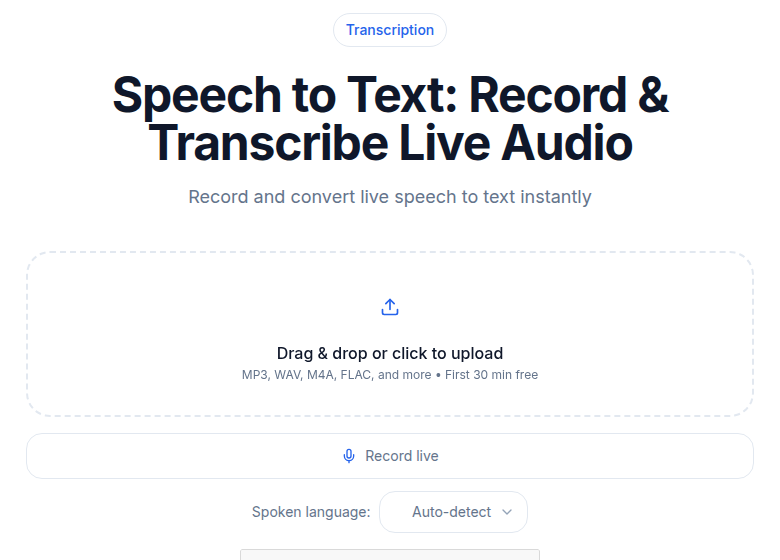 ConvertAudioToText speech-to-text tool interface
If you just need a clean transcript without a meeting bot or a per-seat subscription, ConvertAudioToText's speech-to-text tool transcribes on upload with no account required for short files.
Common Questions
What is an acoustic model in speech recognition?
An acoustic model maps short audio frames (typically 10 to 30 milliseconds each) to a probability distribution over phonemes. In classical systems this was a Gaussian Mixture Model layered on a Hidden Markov Model (GMM-HMM). Later systems replaced the GMM with a deep neural network (DNN-HMM) while keeping the HMM for temporal sequencing. The acoustic model handled sound; it knew nothing about words or grammar.
What is a language model in speech recognition?
A language model scores how likely a given word sequence is in the language. Classical language models were n-grams, estimating next-word probabilities from word-count statistics over large text corpora. Neural language models followed, first feedforward, then recurrent, then transformer-based. The language model knew nothing about acoustics; it operated purely on text sequences.
Do modern transcription tools still use separate acoustic and language models?
Most modern production tools use end-to-end neural models that handle both tasks inside a single network. Systems like Whisper and Deepgram Nova-3 are trained directly to map audio to text without a separate pronunciation dictionary or standalone language model. The internal encoder layers still do acoustic-like work and the decoder does language-like work, but the components are jointly trained and cannot be swapped out independently.
Why does the acoustic vs language model distinction still matter today?
It helps explain two distinct categories of transcription errors. Acoustic failures occur when the model mishears a sound: homophones (their/there), words in background noise, or strong accents the model was not trained on. Language failures occur when the acoustic signal is clear but the model picks the wrong word because the context is unfamiliar: rare proper nouns, product names, domain jargon, or unusual code-switching. Knowing which kind of error you have tells you whether to reach for vocabulary biasing (a language-side fix) or a noise-robust model (an acoustic-side fix).
Sources
- Deepgram Models and Languages Overview: https://developers.deepgram.com/docs/models-languages-overview
- Deepgram Nova-3 announcement and keyterm prompting: https://deepgram.com/learn/introducing-nova-3-speech-to-text-api
- OpenAI Whisper Large-v3 model card (Hugging Face): https://huggingface.co/openai/whisper-large-v3
- Probing Whisper for Dysarthric Speech (layer analysis): https://arxiv.org/abs/2510.04219
- End-to-End Speech Recognition: A Survey (IEEE/ACM TASLP 2023): https://dl.acm.org/doi/10.1109/TASLP.2023.3328283
- Layer-wise Probing of Whisper for phonetic features: https://arxiv.org/pdf/2606.23948
- Deepgram changelog (multilingual keyterm prompting, November 2025): https://developers.deepgram.com/changelog/2025/11/26
Try transcription free
Convert any audio or video to clean, unwatermarked text — speaker labels, timestamps, and AI summaries included. First 30 minutes free, no account.
Related Articles
How Speech Recognition Works: A History From 1952 to Now
From Bell Labs' Audrey to transformer-based neural networks, this foundational guide traces how speech recognition evolved from digit recognizers to near-human accuracy over 70 years.
Deepgram Nova-3 Pricing 2026: $0.0043/min Batch, $0.0077 Streaming
Deepgram Nova-3 costs $0.0043/min for batch and $0.0077/min for streaming in 2026. Honest accuracy vs Whisper, 50+ language coverage, keyterm prompting, and when Nova-3 beats cheaper alternatives like AssemblyAI.