Whisper Large-v3 Explained: Architecture, WER, and Limits (2026)
Summarize this article with:
Whisper Large-v3 is OpenAI's 1.55B-parameter encoder-decoder transformer, trained on 5 million hours of audio and supporting 99 languages under a permissive open license. It hits 2.7% WER on LibriSpeech test-clean and cut errors 10-20% versus Large-v2. Its main weaknesses are hallucination during silence, no native speaker diarization, and poor fit for real-time streaming. The October 2024 Turbo variant trims the decoder from 32 layers to 4, dropping to 809M parameters and running 2-5x faster with minimal accuracy loss.
Whisper Large-v3 is OpenAI's open-weight speech recognition model released in November 2023. It has 1.55 billion parameters, supports 99 languages, and sits at the center of a large share of the transcription tooling built in 2024 and 2025. This post covers the architecture, the training data story, verified benchmark numbers, and the real failure modes you will encounter in production.
Architecture: Encoder-Decoder Transformer
Whisper is a sequence-to-sequence transformer with two halves connected by cross-attention.
The encoder converts raw audio into a compact representation. Audio is first transformed into a log-Mel spectrogram using 128 frequency bins (Large-v3 increased this from the 80 bins used in earlier versions). The spectrogram feeds into a stack of transformer blocks that produce a high-dimensional encoding of the audio content over time. The encoder processes audio in 30-second windows.
The decoder is autoregressive: it generates output tokens one at a time, attending to the encoder output and to its own previous tokens. That single generative process handles transcription, translation, language identification, and voice activity detection through special token routing. The same model produces French text from French audio, English text from English audio, and English text from foreign audio when running in translation mode.
For Large-v3 specifically, the architecture has 32 encoder layers and 32 decoder layers, a model width of 1,280, and 20 attention heads. These numbers are unchanged from Large-v2; what changed in v3 was the training data and the Mel bin count.
The Training Data Behind v3
The original Whisper (2022) trained on 680,000 hours of weakly labeled web audio. Large-v3 expanded that substantially.
The v3 training mixture is:
- 1 million hours of weakly labeled audio (human-transcribed or paired from the web)
- 4 million hours of pseudo-labeled audio generated by running Large-v2 over unlabeled data
That is 5 million hours total, trained for 2 epochs. The pseudo-labeling approach, using an existing model to annotate new data, is the main reason v3 shows 10-20% error reduction versus v2 across a wide range of languages. The quality of the pseudo-labels is bounded by Large-v2 itself, which is both the strength and the ceiling of the approach.
The original 680K-hour breakdown from the 2022 paper gives a sense of the language distribution: roughly 438,000 hours of English paired with English transcripts, 117,000 hours of non-English audio paired with native-language transcripts, and 125,000 hours of non-English audio paired with English translations. That last category is what gives Whisper its translation capability out of the box.
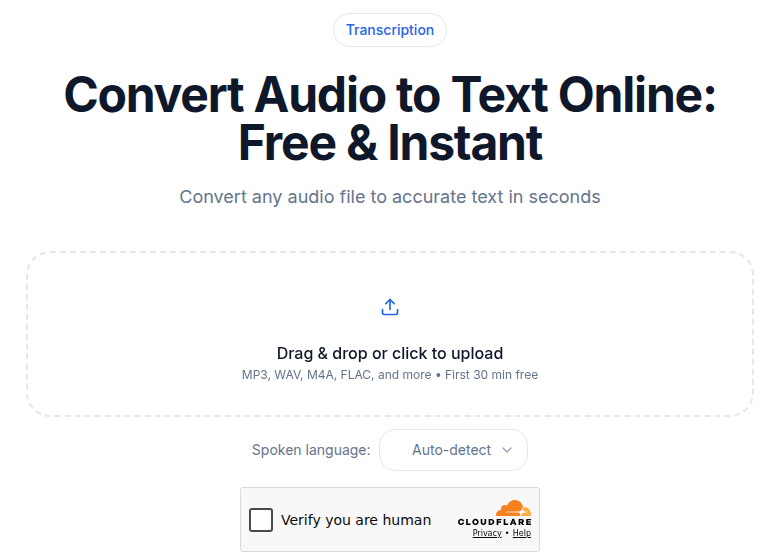 The ConvertAudioToText audio upload interface
Verified WER Benchmarks
Numbers pulled from the official model card and the Hugging Face Open ASR Leaderboard, evaluated on Common Voice 15 and Fleurs.
| Benchmark | WER |
|---|---|
| LibriSpeech test-clean (read English) | 2.7% |
| LibriSpeech test-other (varied English) | 5.2% |
| Open ASR Leaderboard mean | 7.44% |
| AMI corpus (meeting audio) | 15.95% |
| Hindi (ARTPARK-IISc Vaani) | 26.8% |
Real-world audio, meetings, podcasts, phone calls, interviews, typically runs in the 8-12% WER range. LibriSpeech test-clean is read audiobook audio with near-ideal recording conditions, so the 2.7% figure represents the ceiling, not the average.
For context, newer open-source models like NVIDIA's Parakeet and Canary now beat Whisper on LibriSpeech test-clean (around 1.6-1.7% WER). Whisper's dominant position in deployed tooling comes from its ecosystem maturity, language coverage, and the range of optimized runtimes around it, not from top-of-leaderboard accuracy.
Language Coverage: 99, but Uneven
Whisper Large-v3 officially supports 99 languages, with Cantonese added as a new language token in v3. Performance is heavily concentrated in the languages with the most training data.
Best-supported languages include English, Spanish, French, German, Italian, Japanese, Korean, Portuguese, and Russian. Performance on lower-resource languages, many African languages, regional South Asian languages, can reach 25-35% WER or worse. The Hindi benchmark above (26.8%) gives a concrete data point on where even a moderately high-resource language lands on challenging audio.
For low-resource language use cases, see our breakdown of why AI struggles with low-resource languages.
What Large-v3 Improved Over Large-v2
The architecture is essentially the same between v2 and v3. The gains come from:
- Increased Mel frequency bins (128 vs 80), giving the encoder finer frequency resolution.
- A 5 million-hour training set versus the original 680K hours, with pseudo-labeling from Large-v2.
- 10-20% error reduction across languages, especially on lower-resource ones.
- Improved timestamp accuracy.
- Better handling of code-switching, speakers mixing two languages mid-sentence.
The reduced hallucination claim that circulated after v3's release is partially accurate: v3 hallucinates less than v2 in some conditions, but the problem is not solved. It remains a known weakness in production.
The Turbo Variant (October 2024)
OpenAI released Whisper Large-v3-Turbo in October 2024. The key change is decoder pruning: 32 decoder layers reduced to 4, dropping the parameter count from 1.55B to 809M. The encoder is unchanged.
The result is 2-5x faster inference with what OpenAI describes as "minor quality degradation." On NVIDIA GPUs, real-time factor measurements show Turbo processing audio significantly faster than real-time. The trade-off is that Turbo excludes translation tasks from its fine-tuning, so it handles transcription only.
For most production batch transcription use cases, Turbo is now the default choice when you control the infrastructure. The accuracy difference is small enough that the throughput gain usually outweighs it.
Known Weaknesses in Production
Hallucination during silence. Whisper's decoder keeps generating tokens even when no speech is present, particularly at temperature 0. The output is often plausible-sounding text that was never spoken. The standard fix is VAD (voice activity detection) preprocessing to strip silent segments before they reach the model. A temperature fallback schedule, providing a tuple of increasing temperature values rather than a fixed float, also reduces looping. Our post on how VAD works covers the technique.
No native speaker diarization. Whisper produces a continuous transcript with no speaker labels. The standard solution is WhisperX, which chains Whisper (via the faster-whisper backend), forced phoneme-level alignment using wav2vec2, and pyannote.audio diarization into one pipeline. Each stage can also be run independently. For more on diarization, see speaker diarization explained.
Poor fit for real-time streaming. The 30-second processing window and autoregressive decoder make low-latency streaming difficult. Models built for streaming use a different architecture, typically streaming CTC or chunked-attention with partial-hypothesis output. Deepgram's Nova series is the most common alternative for real-time use cases. The Deepgram Nova-3 post covers the comparison.
No cross-chunk context. A 60-minute audio file is processed as 120 sequential 30-second chunks. The model has no memory of chunk 1 when processing chunk 5. A name, acronym, or term introduced early can be transcribed inconsistently later in the same file.
Specialized vocabulary. Whisper has no vocabulary biasing mechanism. Medical, legal, or financial terminology that did not appear frequently in training will produce errors even on clean audio. Fine-tuning on domain-specific data is the correct fix for high-stakes specialized use cases.
Running Whisper Yourself
Three practical paths for local deployment:
OpenAI's reference implementation (Python). The canonical code, slowest inference. Useful for testing or debugging model behavior but not for production throughput.
Whisper.cpp (C++). Runs on CPU, Apple Silicon (Metal), CUDA, and Vulkan. The best option for Mac deployments or embedded systems. No Python dependency.
Faster-Whisper (Python, via CTranslate2). Runs 4x faster than the reference implementation on NVIDIA GPUs, with INT8 quantization reducing VRAM usage by roughly 40%. This is the standard choice for Linux GPU servers.
All three produce equivalent output from the same model weights. The difference is inference speed and resource usage.
License
The Whisper code and weights are released under the MIT License per the official OpenAI GitHub repository. The Hugging Face model card lists Apache 2.0. Both are permissive licenses permitting commercial use without royalty. If your use case requires a specific license, check the GitHub repository directly rather than relying on the Hugging Face listing.
When Whisper Fits, and When It Does Not
Whisper Large-v3 is a strong default for:
- Batch transcription of pre-recorded audio.
- Multilingual content or unknown source language.
- Translation tasks (non-English audio to English text).
- Use cases that require an open-weight model you can run on your own infrastructure.
It is the wrong choice for:
- Real-time or low-latency streaming, use a streaming-optimized model instead.
- Meeting transcription with speaker attribution, add a diarization layer or use a service that bundles it.
- Highly specialized vocabulary without fine-tuning, domain adaptation is needed.
For a broader comparison of transcription approaches and their costs, see the transcription pricing comparison and the best speech-to-text APIs overview.
If you want to compare engines on your own audio without setting up any infrastructure, you can also run a sample through ConvertAudioToText's free tier and compare the output against your benchmark before committing to any implementation path.
Frequently Asked Questions
How many parameters does Whisper Large-v3 have?
Whisper Large-v3 has 1,550 million parameters (1.55B). The October 2024 Turbo variant cuts this to 809M by reducing the decoder from 32 layers to 4, delivering 2-5x faster inference with minor accuracy trade-off.
What word error rate does Whisper Large-v3 achieve?
On LibriSpeech test-clean (read English audiobook audio), Whisper Large-v3 reaches 2.7% WER. On the harder test-other split it reaches 5.2%. The mean WER across the Open ASR Leaderboard benchmark mix is 7.44. Real-world audio with noise, accents, or phone quality typically lands in the 8-12% range.
Does Whisper Large-v3 support speaker diarization?
No. Whisper does not natively label who is speaking. The standard approach is to run Whisper for the transcript, then run pyannote.audio separately for speaker boundaries, and align the two outputs using word-level timestamps. The WhisperX library packages this three-stage pipeline into a single tool.
Why does Whisper hallucinate text during silence?
Whisper's autoregressive decoder continues to generate tokens even when there is no speech, particularly with deterministic decoding (temperature 0). The most reliable fix is to apply voice activity detection (VAD) preprocessing to strip silent segments before they reach the model. Using a temperature fallback schedule instead of a single fixed value also helps by triggering re-sampling when the model loops.
What is the difference between Whisper Large-v3 and Large-v3-Turbo?
Both share the same encoder. Turbo prunes the decoder from 32 layers to 4 and fine-tunes the result, dropping the total parameter count from 1.55B to 809M. The speed gain is 2-5x depending on hardware. OpenAI describes the accuracy difference as "minor quality degradation." Turbo does not support translation tasks because that fine-tuning excluded translation data.
Sources
- openai/whisper model card (GitHub)
- openai/whisper-large-v3 on Hugging Face
- openai/whisper-large-v3-turbo on Hugging Face
- large-v3 release discussion (GitHub)
- turbo model release discussion (GitHub)
- OpenAI Whisper MIT License (GitHub)
- Whisper hallucination on silence (Whisper GitHub Discussion #1606)
- WhisperX: Whisper + pyannote diarization pipeline (GitHub)
- SYSTRAN/faster-whisper (GitHub)
Try transcription free
Convert any audio or video to clean, unwatermarked text — speaker labels, timestamps, and AI summaries included. First 30 minutes free, no account.
Related Articles
OpenAI Whisper API Pricing 2026: $0.003–$0.006/min
OpenAI Whisper API pricing in 2026: whisper-1 is still $0.006/min but gpt-4o-mini-transcribe cuts that to $0.003/min. Real per-hour math, file limits (25MB/25-min), and how it stacks up against Deepgram Nova-3 and AssemblyAI.

Acoustic Models vs Language Models in Speech Recognition
What acoustic models and language models do in ASR, why the split mattered historically, how end-to-end systems absorbed it, and why it still explains the errors you see today.