
AI Medical Scribes Explained: How the Technology Works in 2026
Summarize this article with:
AI medical scribes (also called ambient clinical documentation tools) listen passively to patient encounters, transcribe the conversation, and use a large language model to produce a structured clinical note ready for physician review and sign-off. The market now spans self-serve tools at $39-$119/month for solo practitioners to enterprise contracts at $400+ per clinician per month for health-system deployments with deep EHR integration. A 2026 multi-site JAMA study confirmed real but modest time savings: about 16 fewer documentation minutes per 8-hour shift, with the largest gains going to high-frequency users. Physician review and explicit patient consent (required in all-party-consent states) remain non-negotiable steps in any compliant workflow.
AI medical scribes are software that listens passively to a clinician-patient conversation, transcribes it, and produces a structured clinical note ready for the physician to review and sign. The clinician talks to the patient as normal. No dictation. No post-visit typing. The AI handles the first draft.
The category is formally called ambient clinical documentation. "Ambient" is the operative word: the tool listens in the background rather than requiring the physician to change how they speak or conduct the visit.
What an AI Medical Scribe Actually Does
The workflow unfolds in three stages. The clinician opens the scribe app (or it activates via EHR integration) at the start of the visit. The tool records the conversation. After the encounter ends, it pushes a structured note into the EHR for review.
Deployment models vary:
- A phone or tablet app the clinician opens at the start of each visit.
- A dedicated exam-room microphone, often paired with a presence sensor.
- A telehealth integration that records the video session directly via the platform.
- A native EHR module (Epic launched its own AI Charting feature in February 2026, folding ambient documentation directly into the EHR without a third-party vendor).
The note output typically follows a SOAP format (Subjective, Objective, Assessment, Plan), though most platforms support specialty-specific templates and let practices customize the structure.
Physician review and sign-off are not optional. Every commercial product, every health-system deployment, and current regulatory guidance treats the AI output as a draft. The licensed clinician must review, correct as needed, and sign. That signature makes the note legally theirs. No ambient scribe product operates in autonomous sign-off mode.
The Two Halves of the System
Every AI medical scribe combines two AI components that often get conflated.
The Speech Recognition Layer
The first job is converting audio into accurate text. This is the same underlying technology used in general transcription tools, including engines like Whisper and Deepgram Nova-3. What medical applications add is a vocabulary layer biased toward clinical language: drug names (generic and brand), dosing units, anatomy, and specialty-specific abbreviations.
Speaker separation is the other distinct demand. The patient and clinician must be correctly identified so that dialogue maps into the right sections of the SOAP note. This speaker diarization capability is standard in medical-grade products; general consumer tools handle it less reliably in the acoustic conditions of an exam room.
Most medical scribe vendors do not train their own acoustic models from scratch. They license a general-purpose engine and add a clinical fine-tune on top of it.
The Note Generation Layer
Raw transcript is not a clinical note. The second component is a large language model fine-tuned to read a clinical conversation and extract the medically relevant content, discard the small talk, and structure the output for the EHR template.
This layer also handles ICD-10 code suggestions, problem list updates, and follow-up task generation. It is where clinical pilots spend most of their evaluation time, because accuracy here varies significantly between vendors, specialties, and visit types.
The note generation layer is also where errors tend to concentrate. Long, complex histories can be summarized too aggressively. Multi-participant visits (caregiver plus patient, parent plus child) create attribution confusion. Rare diagnoses may have limited training representation in the LLM. Transcription accuracy explained covers why raw word accuracy and clinical note quality are two separate problems.
Why HIPAA Changes the Stack
A consumer transcription tool can stream audio to any endpoint, store the result indefinitely, and move on. An ambient clinical scribe cannot.
Clinical encounter recordings and resulting transcripts are protected health information (PHI) under HIPAA. The practical consequences shape every vendor relationship:
- The vendor must sign a Business Associate Agreement (BAA) with the covered entity before any PHI is transmitted. No BAA means no legal data transfer.
- Audio and transcripts must be encrypted at rest and in transit.
- Most vendors offer a "no audio retention" mode that deletes recordings immediately after the note is generated. Ask explicitly whether subprocessors (the STT engine, the cloud storage layer) are also covered under a BAA.
- Some health systems require deployment inside their own cloud tenancy for data residency reasons.
The BAA requirement is a hard gate. It also explains most of the price premium over general transcription tools. Our deeper post on HIPAA-compliant transcription covers what to audit before sending any PHI to a third-party API.
The Patient Consent Layer
A compliance dimension that received less attention in early deployments is patient consent for the recording itself.
The U.S. has no single federal recording-consent law. About 13 states (California, Florida, Pennsylvania, Illinois, Washington, Massachusetts, and others) require all parties in a conversation to consent before it can be recorded. Violating those statutes can carry civil and criminal penalties. A January 2026 class-action lawsuit filed against Sharp HealthCare in California involves a patient who says his routine physical was recorded via an ambient AI scribe without his knowledge. The case illustrates what can happen when consent workflows are not airtight.
The Canadian Medical Protective Association's December 2025 guidance makes the professional expectation explicit: informed consent is required before recording any patient encounter using an AI scribe, regardless of local wiretapping law.
Written consent per patient, per encounter, is the safest posture in 2026.
What the Research Actually Shows
The highest-quality evidence now available is a 2026 study published in JAMA, which tracked 8,581 ambulatory clinicians (1,809 AI scribe users and 6,772 non-users) across five major academic health systems over two years. The systems used Ambience, Nuance DAX Copilot, and Abridge, all integrated with Epic.
The results were positive but more measured than vendor marketing typically suggests:
- Scribe users saved about 16 minutes of documentation time per 8-hour shift.
- Total EHR time fell by about 13 minutes per shift.
- Visit volume increased by 0.49 visits per week, generating roughly $167 per clinician per month in marginal revenue.
- After-hours EHR time did not change significantly, challenging the claim that AI scribes fix physician burnout from evening charting.
The power-user gap was substantial: only 32% of adopters used the tool at 50% or more of visits. That group saved 27 minutes of documentation per shift. Average adopters saw far less.
My read: the technology works, but it works most for clinicians who commit to using it consistently, not those who deploy it intermittently.
Results also varied by specialty. The study confirms what earlier pilots suggested: primary care, internal medicine, and behavioral health see the strongest fit. Surgical and procedural specialties, where most documentation comes from what was done rather than what was said, remain weaker use cases.
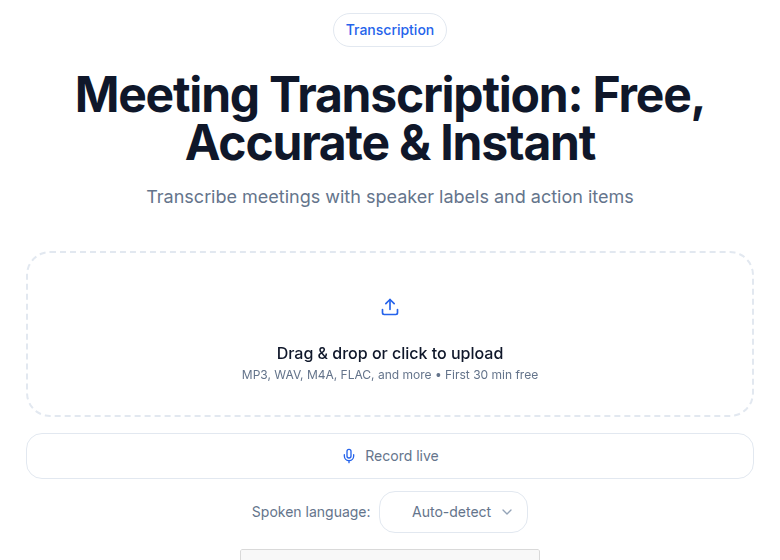 Recording a patient encounter with CATT's meeting transcription tool for non-clinical use cases like research or CME
Vendor Landscape in 2026
The market has stratified into three tiers: self-serve tools for individual and small-group clinicians, mid-market platforms with deeper EHR integration, and enterprise deployments at health-system scale. A fourth player, Epic itself, entered the ambient documentation space directly with AI Charting in February 2026, creating pressure on standalone vendors.
| Tier | Representative vendors | Pricing model (per clinician/month) | EHR integration depth |
|---|---|---|---|
| Self-serve | Freed, Heidi | $39-$119 (published, verified at vendor sites) | Copy-paste or limited push |
| Mid-market | Suki | Quote-based; third-party reporting puts typical contracts at $299-$399 | Epic, Oracle Health, athenahealth, MEDITECH |
| Enterprise | Microsoft Dragon Copilot (DAX), Abridge, DeepScribe, Augmedix | Quote-only (not published); third-party estimates range from $370 to $830+ for Dragon Copilot; Abridge and Augmedix are health-system contract pricing | Deep native Epic/Oracle integration, governance tooling |
| EHR-native | Epic AI Charting | Bundled with Epic (launched Feb 2026) | Native Epic only |
Abridge holds Best in KLAS for Ambient AI for both 2025 and 2026, deployed at Mayo Clinic, Duke Health, Johns Hopkins, and more than 250 health systems. DeepScribe scored 98.8/100 in the 2025 KLAS Emerging Company Spotlight for specialty ambulatory. Microsoft Dragon Copilot (the merged successor to DAX Copilot and Dragon Medical One) targets large Epic-infrastructure deployments. Freed is the only vendor with fully transparent published pricing; I verified the tiers directly at getfreed.ai/pricing.
Note: for any enterprise vendor, published pricing from aggregator sites should be treated as directional. Contact the vendor for a current contract figure.
For context on how medical-grade pricing compares to general API options, the transcription pricing comparison for 2026 shows the cost differential for the raw audio layer.
Where AI Scribes Work and Where They Do Not
After several years of broad deployment, the specialty fit picture has clarified.
Strong fit:
- Outpatient primary care, family medicine, internal medicine, where visit narratives are long and documentation is mostly conversational.
- Psychiatry and behavioral health, where the conversation is the entire clinical encounter.
- Endocrinology, rheumatology, and other specialties with complex longitudinal case discussions.
- Urgent care, where throughput matters and documentation templates are relatively standard.
Weaker fit:
- Surgical specialties, where most documentation is procedure-driven, not conversation-driven.
- Radiology and pathology, where structured dictation templates or templated reporting tools often outperform generative output.
- Procedure-heavy visits with multiple interventions, where the record derives from actions taken rather than words spoken.
Adjacent use cases that suit general transcription instead:
Tumor board meetings, M&M conferences, grand rounds, and departmental presentations where you want an accurate record but not a clinical note. Research interviews under an IRB-approved protocol. Medical education recordings, lectures, and CME content.
For those cases, a general transcription tool is faster, cheaper, and does not require clinical fine-tuning. If you just need an accurate transcript of a medical meeting or education session without EHR routing, ConvertAudioToText's meeting transcription tool handles audio and video files with no account required to get started. It is not a clinical charting tool; it is for the adjacent work that sits outside the EHR.
The Adoption Reality
Nearly two-thirds of U.S. hospitals using Epic had adopted some form of ambient AI documentation by mid-2025, according to an AJMC nationwide study. The technology is approaching table-stakes in academic medical centers.
That said, the JAMA 2026 research is a useful corrective to the hype cycle. A working AI scribe is not automatically a finished workflow. The clinicians who get consistent time back tend to use the tool at every encounter, learn their EHR's editing shortcuts for the generated note, and work with their EHR analysts to refine templates. Practices that deploy it and expect passive improvement tend to see inconsistent adoption and abandon the tool within months.
The consent workflow is also operational infrastructure now, not an afterthought. Whether your state requires all-party consent or not, documented patient disclosure before recording is the standard to meet in 2026.
FAQ
Do AI medical scribes replace the physician's responsibility for the note?
No. Every major vendor, every health-system deployment, and current regulatory guidance treats the AI-generated note as a draft that the licensed clinician must review, edit where needed, and sign. The physician's signature makes the note legally theirs. No ambient scribe product operates in autonomous sign-off mode.
Do patients have to consent before an AI scribe records their visit?
This depends on your state and how your practice handles disclosure. Under the U.S. patchwork of wiretapping laws, about 13 states (including California, Florida, and Pennsylvania) require all parties in a conversation to consent before it can be recorded. Even in one-party states, professional best-practice and emerging guidance from bodies like the CMPA (December 2025) calls for informed consent before activating ambient recording. A January 2026 class-action against a California health system (Sharp HealthCare) involves a patient who says a visit was recorded via an AI scribe without his knowledge. Written consent per patient, per visit, is the safest posture.
What is a Business Associate Agreement and why does it matter for AI scribes?
A Business Associate Agreement (BAA) is a HIPAA-required contract between a healthcare provider and any third-party vendor that handles protected health information (PHI) on their behalf. An AI scribe vendor processes the audio and transcript of clinical encounters, making them a business associate under HIPAA. No BAA means no legal transfer of PHI to that vendor. Before sending any audio to a scribe platform, confirm the vendor will sign a BAA and ask specifically about subprocessors (transcription engine, cloud storage) that also need to be covered.
What does the latest research say about time savings from AI scribes?
A large 2026 study published in JAMA tracked 8,581 ambulatory clinicians across five academic health systems (Mass General Brigham, Emory, UCSF, Yale New Haven, and UC Davis). Clinicians who adopted an AI scribe saved roughly 16 minutes of documentation time and 13 minutes of total EHR time per 8-hour shift. However, only 32% of adopters used the tool frequently enough (at least half of all visits) to see those gains. After-hours charting time did not change significantly, which challenges claims that scribes fix physician burnout. Results varied by specialty and usage pattern.
Can general-purpose transcription tools be used for clinical documentation?
Not for EHR charting. General transcription services lack the BAA, clinical LLM layer, and EHR integration that a dedicated scribe provides. They also do not produce SOAP-structured notes or ICD-10 code suggestions. What they are well-suited for: tumor board meetings, medical education recordings, research interviews under an approved IRB protocol, and CME content, all of which need accurate transcripts but not a clinical chart entry. For those adjacent use cases, a general tool is faster and cheaper.
Sources
- Freed AI pricing, verified July 2026: https://www.getfreed.ai/pricing
- JAMA study on AI scribe EHR time savings (2026): https://hitconsultant.net/2026/04/01/jama-ai-scribe-study-ehr-time-savings-burnout-reality-check/
- AJMC study on Epic ambient adoption (two-thirds of Epic hospitals by mid-2025): https://www.ajmc.com/view/subjective-and-objective-impacts-of-ambulatory-ai-scribes
- STAT News on Epic AI Charting launch, February 2026: https://www.statnews.com/2026/02/04/epic-ai-charting-ambient-scribe-abridge-microsoft/
- PrivaPlan HIPAA compliance guide for ambient scribes, 2026: https://privaplan.com/ai-ambient-scribes-is-your-health-care-clinic-ready/
- American Bar Association: ambient scribe privacy and cybersecurity risks, 2026: https://www.americanbar.org/groups/health_law/news/2026/ambient-ai-scribes-privacy-cybersecurity/
- Sharp HealthCare patient consent lawsuit and consent state-by-state: https://www.medicaldaily.com/ai-medical-scribe-recording-patient-consent-2026-privacy-rights-475588
- Suki pricing, third-party reporting: https://www.scribing.io/blog/suki-ai-pricing-breakdown
- DAX Copilot / Dragon Copilot pricing, third-party reporting: https://www.marvix.ai/blog/dax-copilot-pricing-review
- Abridge KLAS Best in KLAS 2025, 2026: https://www.abridge.com/
- DeepScribe KLAS score, third-party: https://www.deepcura.com/resources/deepscribe-review
- Commure ambient scribe pricing overview: https://www.commure.com/blog-scribe/scribe-pricing
Try transcription free
Convert any audio or video to clean, unwatermarked text — speaker labels, timestamps, and AI summaries included. First 30 minutes free, no account.
Related Articles
Medical Transcription for Clinical Notes: A Practical AI Workflow for Clinicians
Learn how clinicians use AI transcription for clinical notes. A practical CATT workflow for audio upload, speaker labels, summaries, and TXT or DOCX export.
Medical Transcription vs. AI: An Honest 2026 Comparison
Human medical transcriptionists vs AI tools in 2026: accuracy on clinical terms, HIPAA requirements, real pricing ranges, and which model fits which workflow.