Medical Transcription vs. AI: An Honest 2026 Comparison
Summarize this article with:
Human medical transcription services (MTSs) still lead on specialty accuracy and have decades of HIPAA compliance infrastructure behind them. AI tools, from dictation software to ambient scribes, have closed the gap significantly on routine encounters and win decisively on speed and cost. Most practices in 2026 end up with a hybrid: AI handles high-volume routine documentation, human MTs handle complex specialty reports and medico-legal work. The choice depends less on which is generically better and more on which note type you are producing.
For most routine clinical encounters in 2026, AI transcription is fast enough, accurate enough, and cheap enough to replace traditional human transcription services. For complex specialty documentation and medico-legal work, human medical transcriptionists (MTSs) still hold real advantages. The choice is not a binary one; the practices that benefit most from AI are the ones that match the tool to the document type rather than applying one approach to everything.
A note on scope first: ConvertAudioToText does not hold a Business Associate Agreement (BAA) and is not appropriate for audio containing patient PHI. It is suitable for non-PHI medical content: continuing medical education lectures, conference recordings, research interviews with de-identified data, and administrative meetings. For clinical content, the tools discussed in this post all operate under BAA arrangements with covered entities.
What Traditional Medical Transcription Provides
Human MTSs have been the backbone of clinical documentation for decades. The standard service takes dictated audio from a physician and returns a formatted note ready for the EHR.
Accuracy is the headline advantage. Quality MTSs achieve 99% or better on clinical content, including specialty vocabulary, drug names, and unusual abbreviations. Senior transcriptionists with subspecialty training handle cardiology, neurology, GI, and surgical dictation at a level current AI cannot reliably match.
Format expertise matters too. MTSs know the standard structure for SOAP notes, H&Ps, operative reports, and discharge summaries. They handle dictation conventions cleanly: "new paragraph," "slash," "delete that last sentence." AI tools handle these inconsistently unless specifically configured for them.
Turnaround typically runs 4-24 hours, with premium rush options for shorter windows. That is the main structural disadvantage: AI completes the same work in minutes.
Pricing, per vendor documentation checked July 2026, runs roughly $0.09-0.18 per line (approximately 65 characters) or $1.75-4.50 per audio minute, with complex specialties and rush work at the higher end. A primary care practice generating 50-60 encounter notes per provider per day can spend $2,000-3,500 per month per provider.
HIPAA compliance is established. Reputable MTSs have operated under BAAs for decades and have mature audit log, encryption, and breach-notification processes.
What AI Medical Transcription Provides
AI tools for clinical documentation have evolved into three distinct categories, each with different use cases and price points.
Generic speech-to-text (OpenAI Whisper, Deepgram, Google Cloud STT) handles medical vocabulary moderately well. Accuracy on clinical content typically lands in the 90-95% range. These tools are appropriate for non-PHI medical content and for practices willing to invest in post-processing and editing. See the transcription accuracy explained post for a breakdown of how accuracy figures are measured.
Medical-specific AI dictation includes tools like Dragon Medical One, Suki AI, and Heidi Health. These models are trained or fine-tuned on clinical vocabulary and reach 96-98% accuracy on routine encounters. Dragon Medical One costs roughly $79-99 per user per month depending on contract length (one-year at $99, three-year at $79), plus a one-time implementation fee of around $525, per vendor pricing checked July 2026. Suki AI runs approximately $299-399 per provider per month. Heidi Health offers a free tier for individual clinicians, with a paid Clinician plan at $150 per user per month; BAAs are available at the Practice tier and above.
Ambient AI documentation is the most transformative category. Microsoft Dragon Copilot (launched March 2025, merging Dragon Medical One with what was previously called Nuance DAX) captures the full patient-clinician conversation and generates a structured clinical note without any dictation step at all. As of mid-2026, more than 600 healthcare organizations use Dragon Copilot, including large systems like Mount Sinai. List pricing runs roughly $369-830+ per provider per month, though large-system blended rates reported by KLAS Research sit closer to $215 per provider per month. Abridge, another ambient platform, operates on enterprise contracts with pricing roughly in the range of $208-500 per provider per month; it targets health systems rather than small practices. For any PHI-containing content, all three categories require HIPAA-compliant tools with signed BAAs.
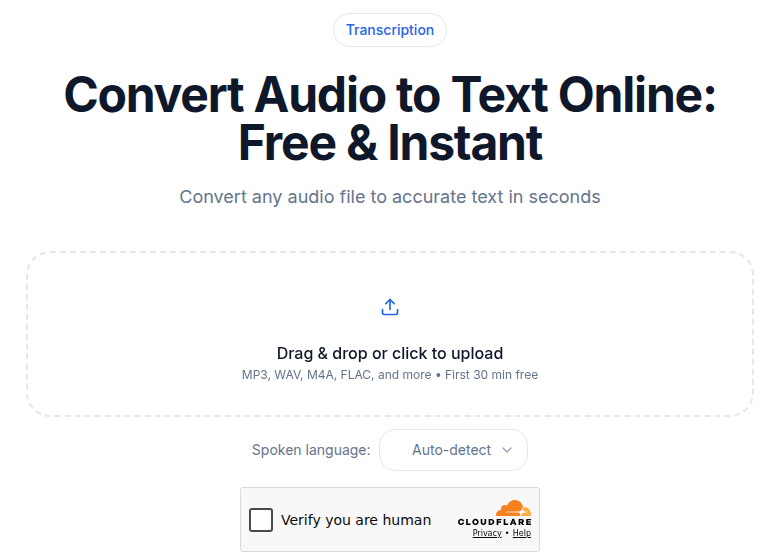 Audio transcription tool on ConvertAudioToText
ConvertAudioToText processes non-PHI medical audio like CME lectures and de-identified research recordings. For clinical content, use a HIPAA-certified tool with a signed BAA.
Head-to-Head: The Comparison That Matters
| Factor | Human MTS | Medical-Specific AI | Ambient AI |
|---|---|---|---|
| Accuracy (routine) | 99%+ | 96-98% | 96-98% |
| Accuracy (complex specialty) | 99%+ | 92-96% | 92-96% |
| Turnaround | 4-24 hours | 2-5 minutes | Real-time |
| Hallucination risk | Negligible | Low to moderate | Low to moderate |
| Cost per provider per month | $2,000-3,500 (high volume) | $79-399 | $215-830+ |
| BAA availability | Standard | Yes (all major vendors) | Yes (all major vendors) |
| EHR integration | Manual copy-paste typical | Available | Native in most platforms |
| Dictation convention handling | Excellent | Good with configuration | N/A (no dictation) |
| Multi-speaker complex encounters | Best option | Poor to moderate | Moderate |
Where AI Has the Structural Advantage
Speed is the clearest win. AI returns transcripts in minutes. MTSs return in hours. For primary care, internal medicine, and family medicine practices running high patient volume, near-real-time documentation has direct value for workflow and physician wellbeing. A 2025 survey by Freed found that 57% of clinicians lose more than 44 hours per month to documentation. That is roughly a full work week every month spent on paperwork.
Cost at scale is the second structural win. A dictation AI tool at $99/provider/month versus a human MTS bill of $2,000-3,500/provider/month for the same volume is a 20-35x difference. Even after accounting for physician review and editing time, the math strongly favors AI for routine encounters.
EHR integration and searchability compound the advantage over time. Ambient AI tools that auto-populate structured EHR fields eliminate copy-paste steps that cost physician time. AI transcripts are searchable databases; MTS output is typically static text.
Where Human Transcriptionists Still Win
Accuracy on hard cases. A 2024 study published in npj Digital Medicine found that AI clinical note generation carries a 1.47% hallucination rate, with 44% of those hallucinations classified as major errors that could affect diagnosis or management if left uncorrected. The same research body has documented systematically higher error rates for AI on speakers with strong regional accents and for African American speakers. Senior human MTSs with subspecialty training handle these edge cases better.
Complex specialty vocabulary. Rare disease consultations, complex operative reports, and highly specialized subspecialty dictations (interventional cardiology, neurosurgical procedures, reproductive endocrinology) still push current AI models toward their accuracy floor. Human specialists in these fields deliver 99% accuracy where AI tools may deliver 93-95%.
Medico-legal documentation. For worker's compensation evaluations, independent medical examinations, expert witness reports, and depositions, the accountability chain of a human transcriber with an established quality assurance process is still preferred by many institutions and attorneys. The AI hallucination risk, while statistically small, carries outsized consequences in legal settings.
Dictation conventions and voice commands. MTSs handle physician dictation habits cleanly, including macro commands, corrections, and formatting instructions. AI tools are improving here, but inconsistency remains common without careful configuration.
My take: the "replace everything with AI" pitch undersells the real risk on complex documentation, and the "AI is not ready" position undersells how good routine-encounter accuracy has become. The honest answer is that these tools operate on different accuracy curves for different note types.
A Decision Framework by Document Type
High-volume routine encounters (follow-ups, annual physicals, standard consultations in primary care, internal medicine, family medicine): AI dictation or ambient AI wins on speed and cost. Quality is sufficient for most practices.
Complex specialty encounters (rare disease, complex surgical reports, highly technical subspecialty work): human MTSs with subspecialty training remain the stronger choice for accuracy.
Medico-legal exposure (worker's comp evaluations, IME reports, expert witness reports): human MTSs with established processes and quality assurance are typically preferred.
Research documentation with de-identified data: AI is typically faster and cheaper, and accuracy meets the requirement.
CME, lectures, and educational recordings: AI is the natural choice. For non-PHI content at high volume, tools like ConvertAudioToText handle these without clinical compliance overhead.
Mixed workflow: the majority of practices land here. AI for routine high-volume work; MTS for the documentation where errors carry the highest clinical or legal consequences.
The Cost Comparison in Practice
For a primary care practice generating 60 encounter notes per provider per day:
Traditional MTS at $0.12/line on a typical 50-line encounter: approximately $360 per day, or around $87,000 per year per provider.
Dragon Medical One (dictation, AI): $79-99 per user per month, or $948-1,188 per year per provider, plus the one-time $525 setup fee. Physician dictation and review time is additional.
Microsoft Dragon Copilot (ambient, no dictation required): varies by contract, but $215-830 per provider per month at list. At blended large-system rates of roughly $215/provider/month, that is $2,580 per year per provider, with potential time savings on the physician side that can be substantial.
The AI economics favor adoption for high-volume practices. The exception is practices where accuracy on complex documentation or medico-legal risk justifies the higher MTS cost.
HIPAA: The Non-Negotiable Gate
Any vendor handling clinical audio containing PHI must execute a BAA with the covered entity. This is a statutory requirement under HIPAA, not a feature to check for. The BAA should explicitly prohibit the vendor from using PHI to train or improve AI models without explicit authorization, and it should name any sub-processors with access to the data.
The Office for Civil Rights collected over $9.9 million in HIPAA settlements across 22 enforcement actions in 2024, with BAA deficiencies cited in numerous cases.
Established MTSs have operated under BAAs for decades with mature processes. AI tool vendors vary: Dragon Copilot, Suki, Abridge, and Heidi Health (from the Practice tier upward) all offer BAAs. Free consumer-facing AI tools, including general-purpose assistants, do not.
For details on what a HIPAA-compliant workflow requires, see the HIPAA compliant transcription guide.
What Is Driving the Shift Toward AI
Documentation burden and physician burnout are the primary drivers. Physicians currently spend roughly 1.5-2 hours on documentation for every hour of direct patient care. With burnout rates running at approximately 42-50% depending on the survey, tools that reduce documentation time have direct value for practice retention.
Cost pressure is the second driver. AI documentation costs a fraction of human MTS at scale, and health systems under margin pressure are paying attention.
Ambient AI adoption is accelerating faster than expected. As of 2025, nearly two-thirds of US hospitals on Epic EHR systems had deployed some form of ambient AI tool, according to American Journal of Managed Care research. More than 100,000 clinicians now use Microsoft Dragon Copilot.
What Could Slow the Shift
Hallucination risk in high-stakes documentation. The 1.47% hallucination rate with 44% of those classified as major errors in the npj Digital Medicine study is a real data point. Small probabilities matter when the output becomes a patient's medical record.
Specialty complexity. Some subspecialties have vocabulary and context specificity that current AI accuracy cannot reliably match. Human specialists with deep specialty training will remain useful for these cases for the foreseeable future.
Accuracy disparities. AI models show higher error rates on accented speech and for African American speakers, a documented concern that some health systems are weighing before full deployment.
Vendor immaturity. Some AI scribe tools have short operating histories. Practices comfortable with MTSs they have worked with for a decade may be cautious about entrusting documentation to newer platforms.
For Non-PHI Medical Content
Medical content that does not involve PHI operates under different calculus. Continuing medical education lectures, conference recordings, de-identified research interviews, and administrative meetings do not require HIPAA-certified tools and do not require BAAs.
For these use cases, AI transcription at general-purpose accuracy levels is typically sufficient and costs far less than a clinical MTS. For the transcription workflow for content creators pattern applied to medical education teams, or for de-identified research interview work, the how to transcribe interview recording guide covers practical workflows. For clinical notes specifically, see transcription for doctors and medical notes and the AI medical scribes explained post for a comparison of ambient scribe platforms.
If you are a clinician producing non-PHI audio content and want a fast, no-setup transcript, ConvertAudioToText handles that without a clinical compliance layer. For anything containing patient PHI, use a HIPAA-certified tool with a signed BAA.
A Practical Adoption Path
The most common failure mode is applying AI to documentation types where it is not yet reliable enough, then abandoning it entirely when errors occur.
A more durable path: start with one provider who volunteers to pilot AI on routine encounters. Run for 30 days with a physician review step in place. Evaluate accuracy, time savings, and editing burden before expanding. Most practices that stick with this phased approach land on a hybrid model: AI for routine high-volume work, human MTS for complex specialty documentation and medico-legal content.
Revisit the tool mix annually. The AI accuracy curve is still improving, and the right split in 2026 may look different in 2028.
Common Questions
Is AI transcription accurate enough for clinical documentation?
For routine clinical encounters, medical-specific AI tools from vendors like Dragon Copilot and Heidi Health reach 96-98% accuracy on standard vocabulary. Generic models (Whisper, Deepgram) perform in the 90-95% range. A 2024 study in npj Digital Medicine found a 1.47% hallucination rate in AI-generated clinical notes, with 44% of those hallucinations classified as major errors that could affect diagnosis or management. Senior human medical transcriptionists consistently achieve 99% or better accuracy, including on rare terminology. For complex specialty work, human MT still sets the benchmark.
Do AI transcription tools need to be HIPAA-compliant?
Yes. Any vendor that creates, receives, maintains, or transmits protected health information (PHI) on behalf of a covered entity is a business associate under HIPAA and must execute a Business Associate Agreement (BAA) before PHI flows to them. This applies to AI scribes and AI transcription tools just as it does to human transcription services. Consumer-facing AI tools, including general-purpose assistants, do not offer BAAs and inputting PHI into them is a HIPAA violation. Verify that any tool you use for clinical content offers a signed BAA, not just a general HIPAA-compliant terms of service.
What does AI medical transcription actually cost compared to traditional services?
Human medical transcription services run roughly $0.09-0.18 per line or $1.75-4.50 per audio minute, depending on specialty and turnaround requirements. A single-provider primary care practice generating 50-60 notes per day can spend $2,000-3,500 per month on a traditional MTS. Medical-specific AI dictation tools like Dragon Medical One cost roughly $79-99 per user per month (plus a ~$525 onboarding fee), while ambient AI like Microsoft Dragon Copilot runs $369-830+ per provider per month at list price (with large-system blended rates reported at roughly $215/provider/month). At high volume, the AI math is substantially better. The caveat: AI savings calculations should include physician time for review and editing that MTSs do not require.
When should a practice still use human medical transcriptionists?
Human MTSs remain the stronger choice for complex specialty encounters (rare disease consultations, complex operative reports), medico-legal documentation where liability and precision are paramount, and situations where audio quality is poor or involves multiple speakers in uncontrolled settings. Practices with specialized subspecialties, like interventional radiology or highly technical surgical dictations, often find that human MTs with specialty training deliver better output than current AI on their specific vocabulary. Many practices run a hybrid: AI for routine high-volume work and MTS for the documentation where errors carry the highest clinical or legal consequences.
Sources
- Microsoft Dragon Copilot announcement (March 2025): https://news.microsoft.com/source/2025/03/03/microsoft-dragon-copilot-provides-the-healthcare-industrys-first-unified-voice-ai-assistant/
- Dragon Medical One pricing, VoiceAutomated (checked July 2026): https://voiceautomated.com/blog/dragon-medical-one-cost/
- Nuance DAX Copilot pricing, Lime Health (checked July 2026): https://getlimeai.com/blog/nuance-dax-pricing-reviews-roi/
- Suki AI pricing, Healos (checked July 2026): https://healos.ai/blog/suki-pricing-features-cost-and-the-best-alternatives-in-2026
- Heidi Health pricing (checked July 2026): https://www.heidihealth.com/pricing
- Abridge pricing, Elion Health (checked July 2026): https://elion.health/products/abridge
- Human MT pricing, Ditto Transcripts (checked July 2026): https://www.dittotranscripts.com/medical-transcription-pricing/
- AI hallucination in clinical notes, npj Digital Medicine (2024-2025): https://www.nature.com/articles/s41746-025-01895-6
- Physician burnout and documentation burden, Freed 2025 Survey: https://www.getfreed.ai/resources/physician-burnout-statistics
- Ambient AI adoption in US hospitals, AJMC: https://www.ajmc.com/view/ambient-ai-tool-adoption-in-us-hospitals-and-associated-factors
- HIPAA BAA requirements, HIPAA Journal (checked July 2026): https://www.hipaajournal.com/hipaa-business-associate-agreement/
- Medical transcription pricing guide, PriceItHere (checked July 2026): https://priceithere.com/medical-transcription-price/
Try transcription free
Convert any audio or video to clean, unwatermarked text — speaker labels, timestamps, and AI summaries included. First 30 minutes free, no account.
Related Articles
Medical Transcription for Clinical Notes: A Practical AI Workflow for Clinicians
Learn how clinicians use AI transcription for clinical notes. A practical CATT workflow for audio upload, speaker labels, summaries, and TXT or DOCX export.

Transcription for Doctors: Ambient AI, Dictation, or Manual Notes?
A practical guide for physicians comparing ambient AI scribes, voice dictation, and manual EHR entry, with HIPAA BAA requirements and verified 2026 pricing.