
Transcription for Doctors: Ambient AI, Dictation, or Manual Notes?
Summarize this article with:
Physicians have three realistic paths for clinical documentation: ambient AI scribes (which listen to the patient encounter and generate a note automatically), traditional voice dictation (narrating a structured note into software like Dragon Medical One or Dragon Copilot), and manual EHR entry. Each requires a HIPAA-signed Business Associate Agreement from the vendor before any protected health information touches it. Ambient AI is now the dominant choice for primary care and behavioral health; dictation remains the low-overhead default for surgeons and specialists. For non-PHI content, such as CME lectures, de-identified case discussions, and administrative meetings, a general-purpose transcription tool is appropriate instead.
For most clinical encounters involving patient PHI, you need a HIPAA-certified ambient AI scribe or dictation tool with a signed Business Associate Agreement in place before you transcribe a single word. The right tool depends on your practice setting and workflow. This post breaks down the three paths, what each actually costs, and where the HIPAA line sits.
The Three Paths to Clinical Documentation
Physicians today use one of three approaches, or a combination:
Manual EHR entry. The baseline most physicians are trying to escape. Studies put average EHR time at over 16 minutes per patient encounter, with documentation alone taking roughly 3 hours per clinic day in primary care. Typing under time pressure produces sparse, templated notes that can hurt billing and continuity.
Voice dictation. You narrate the note out loud, usually after the encounter, in a structured format. The software transcribes it in near-real time. Dragon Medical One (now folded into Microsoft Dragon Copilot as of March 2025) is the standard here. Accuracy is high after voice training, but you still compose every sentence yourself. It trades keyboard time for speaking time.
Ambient AI scribes. The tool listens passively to the patient conversation and generates a draft note from that conversation. You interact with the patient naturally, then review and sign the draft afterward. This approach is now the dominant choice in primary care and behavioral health, where the documentation volume is high and post-encounter review is workable.
My take: for a high-volume outpatient practice, ambient AI is the highest-leverage change available right now. For surgeons or specialists whose documentation is heavy on procedural detail, dictation holds its own.
The BAA Requirement: Non-Negotiable
Any vendor whose software receives, creates, stores, or transmits protected health information is a business associate under HIPAA and must sign a Business Associate Agreement before you use their tool. This is not optional, and the OCR has settled enforcement actions where the only violation was a missing BAA.
What the BAA must address for AI scribes:
- How long audio recordings and transcripts are retained after each encounter and after contract termination
- Whether the vendor's AI trains on patient data (reputable vendors prohibit this explicitly)
- Which subcontractors process the audio, and whether they each carry a BAA with the vendor
Ask your vendor directly: "Do you use any third-party services to process patient audio?" If they do, those services need their own BAAs in place. Cloud providers like AWS and Azure offer HIPAA BAAs, but the vendor must have activated them.
The Clinical Tools: What's Verified
The market has consolidated around a handful of tools. Below is what I could verify from vendor pages and checked sources as of mid-2026.
| Tool | Type | Pricing model | BAA | Best fit |
|---|---|---|---|---|
| Microsoft Dragon Copilot | Ambient AI + dictation | Enterprise, per-provider/month, annual contracts | Yes | Health systems, Epic shops |
| Dragon Medical One | Voice dictation | Approx. $79-99/user/month (per pricing trackers, 1-3 yr terms) + one-time setup fee | Yes | Dictation-only users |
| Suki AI | Ambient AI + voice | Per published reports: from approx. $299/month for Compose, $399/month for Assistant | Yes | Mid-size practices, EHR integration |
| Abridge | Ambient AI | Enterprise, quote-only, per-provider/month | Yes | Health systems (Mayo, Duke, Kaiser) |
| Freed | Ambient AI | $39-119/month per plan, BAA on all plans | Yes, all plans | Solo physicians, small practices |
| Heidi Health | Ambient AI | Free tier available; paid tiers by quote | Yes | International and budget-sensitive |
| Human scribe | Human | Approx. $35,000-65,000/year fully loaded (per industry data) | Yes (as employee or contractor) | High-complexity specialties |
Dragon Copilot (the March 2025 merger of DAX ambient capture and Dragon Medical One dictation) is the enterprise standard. It is sold through health system contracts, not individual subscriptions, and carries the full Microsoft HIPAA BAA infrastructure. For a large health system on Epic, the integration depth is unmatched.
Freed is the clearest starting point for a solo or small-group physician who wants ambient AI without an enterprise sales process. The BAA is included automatically on all plans upon signup, including the free trial.
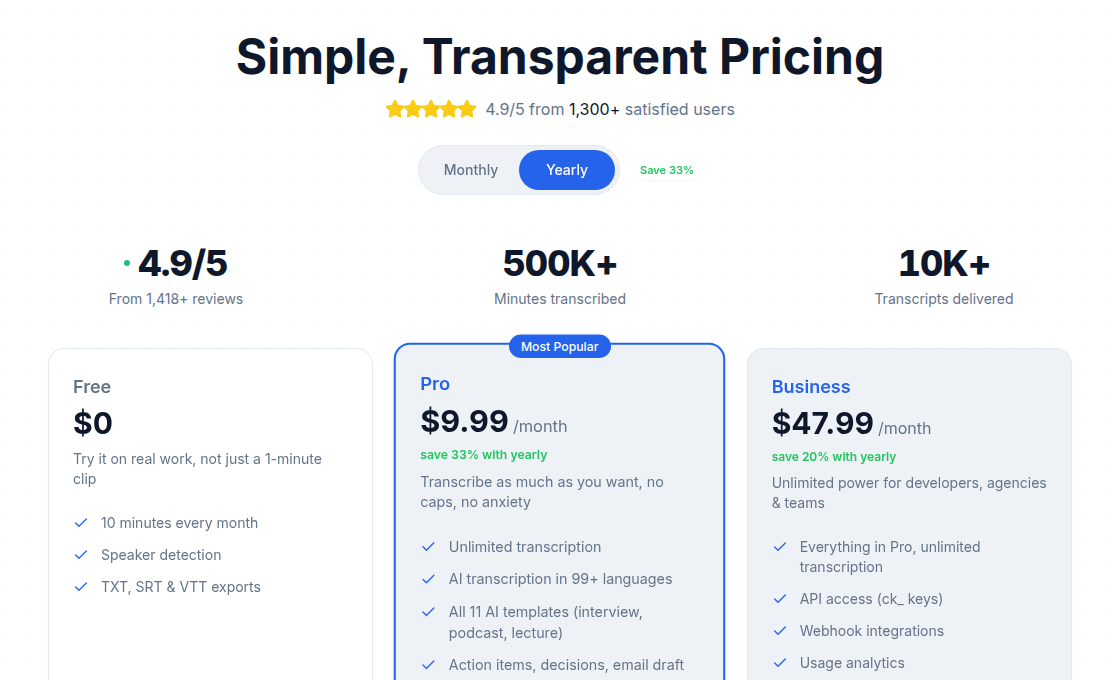 Freed AI scribe pricing tiers from vendor page, verified July 2026
Abridge is deployed at over 250 health systems and does not publish pricing. If your hospital system is evaluating it, expect a per-provider/month model with multiyear contracts.
Human scribes still make sense for specialties with highly variable or complex documentation (cardiothoracic surgery, complex neurology). The cost is much higher, but a well-trained human scribe catches errors, interprets non-verbal cues, and handles edge cases that ambient AI still misses.
How Dictation Differs From Ambient AI in Practice
The workflow distinction matters more than the marketing language:
Dictation (Dragon Medical One, Dragon Copilot dictation mode): After seeing the patient, you speak the note in a structured format: "Chief complaint: the patient presents with three days of worsening right knee pain. History of present illness: the patient is a 52-year-old male..." You narrate every section. The software transcribes in real time. You then edit and sign. Accuracy after voice training runs 97-99% per the vendor, but you are still composing the note, just by voice.
Ambient AI (Abridge, Freed, Suki, Heidi): You have a normal conversation with the patient. The tool records and processes it after the encounter, or in some cases in real time. You review a generated draft rather than composing one. The cognitive load is lower. A 2025 study found a 61% reduction in cognitive load (NASA-TLX index) with one ambient tool compared to manual entry.
The tradeoff: ambient AI accuracy depends on audio quality, how clearly the clinical conversation maps to the note format, and how specialized the terminology is. Error rates in ambient AI of 1-3% compare favorably to automated speech recognition for dictation at 7-11%, according to a 2025 commentary in npj Digital Medicine, but both require physician review before signing.
For Non-PHI Work: A Separate Tool Fits Better
Clinical encounter notes, operative reports, discharge summaries, and any recording where a patient's identity or health information is present require a HIPAA-certified tool with a BAA. Full stop.
But physicians have a large second category of audio that does not involve PHI:
- CME lecture recordings and grand rounds (where no identifiable patient is discussed)
- Medical podcasts and continuing education content
- Department meetings and quality improvement sessions without patient case review
- De-identified administrative interviews and research sessions
For this content, a general-purpose transcription tool works well. If you just need a clean transcript of your CME recording or your team's admin meeting, ConvertAudioToText handles the upload without an account requirement and returns a formatted transcript within minutes; the first 30 minutes of any file are free without signup. It is not appropriate for PHI, and it does not offer a BAA.
For research interviews with formally de-identified data, see patient interview transcription for more on how to structure that workflow compliantly.
Time and Cost Reality Check
The documentation burden is real and well-documented. Physicians spend an average 4.5 hours per day on EHR tasks (Medical Economics, 2024 data), with documentation as the leading driver of burnout according to the AMA's 2024 survey.
What the tools actually deliver:
- Microsoft reports 7 minutes saved per encounter with Dragon Copilot. Across 20 daily encounters, that's over 2 hours.
- A 2026 longitudinal study found ambient AI users completed notes faster and carried less after-hours documentation.
- Human medical scribes cost $35,000-65,000 per year fully loaded (salary plus benefits, training, workspace), per industry cost data.
- Freed runs $79/month for unlimited ambient notes. The math is straightforward.
The ROI is clear even at the high end of AI scribe pricing. A physician hour has a billing value that dwarfs any tool subscription.
An Adoption Sequence That Works
For a physician starting from scratch:
Step 1: Check what your health system has already licensed. Many large systems now have enterprise contracts with Dragon Copilot, Abridge, or Suki that individual providers may not know about. Ask your IT or CMO office first.
Step 2: If you are in a solo or small group practice, start with Freed's free trial (no credit card, 7 days). Use it on 10-15 encounters and evaluate the draft quality and your editing time.
Step 3: Verify the BAA is in place before your first PHI encounter. With Freed this is automatic at signup; with other vendors you may need to request a signed copy.
Step 4: For dictation-heavy specialties (surgery, procedural), evaluate Dragon Medical One or Dragon Copilot in dictation mode specifically. The voice training takes a few sessions; accuracy improves meaningfully.
Step 5: For non-PHI professional content (lectures, podcasts, admin meetings), set up a separate general-purpose tool so you are not routing educational audio through your clinical compliance infrastructure unnecessarily.
For a deeper look at how ambient AI scribes work and where the technology is heading, see AI medical scribes explained. For a comparison of human vs. AI transcription accuracy across medical and general content, see AI vs human transcription.
If speaker attribution matters (for multi-clinician rounds discussions or dictated case conferences), speaker diarization explained covers how that feature works and which tools implement it reliably.
Common Questions
Do I need a BAA before using an AI scribe for patient encounters?
Yes, and not having one is a HIPAA violation even if nothing goes wrong. Any vendor whose tool receives, creates, or stores protected health information is a business associate under HIPAA and must sign a BAA before you go live. Major clinical tools like Dragon Copilot, Suki, Abridge, Freed, and Heidi Health all offer BAAs; the terms differ, so read what they cover around audio retention and model training before signing.
What is the difference between ambient AI scribes and dictation software?
Dictation software (Dragon Medical One, Dragon Copilot in dictation mode) requires you to narrate the note directly, usually after the encounter. Ambient AI scribes (DAX, Abridge, Freed, Heidi) listen to the natural patient-clinician conversation and generate a draft note from that conversation. Ambient tools do not change how you speak with patients; dictation tools require a structured narration habit.
How much time can an AI scribe actually save?
Microsoft cites roughly 7 minutes saved per encounter for Dragon Copilot. A 2026 longitudinal study at a large health system found ambient AI users completed notes faster and with less after-hours carryover. Across a clinic day of 20-plus encounters, that accumulates to 2-3 hours. The gains are real but not uniform: complex cases, unusual specialties, and poor audio environments all reduce them.
Is ConvertAudioToText appropriate for clinical notes?
No. ConvertAudioToText does not offer a Business Associate Agreement and is not appropriate for any audio containing protected health information. It is appropriate for content without PHI: CME lecture recordings, medical podcasts, de-identified administrative meetings, and research interviews with formally de-identified data. For clinical encounter notes, use a HIPAA-certified tool with a BAA.
What is the most affordable HIPAA-compliant AI scribe for a solo physician?
Freed AI is the clearest verified answer: $39/month billed annually for up to 40 notes per month, $79/month for unlimited notes, $119/month for EHR push integration. A BAA is included on all plans. Heidi Health offers a free tier with unlimited transcription (no dollar figure publicly listed for paid tiers). Both are accessible without enterprise contracts, unlike Dragon Copilot or Abridge which are sold to health systems.
Sources
- Freed AI: Cost of AI Scribes Guide (verified July 2026)
- Freed Scribe BAA Help Article (verified July 2026)
- Heidi Health Pricing Page (verified July 2026)
- Scribeberry: Dragon vs AI Scribes vs Manual Typing 2026
- Microsoft Dragon Copilot announcement, March 2025
- TryTwofold: Do You Need a BAA for Your AI Notes Tool?
- Medical Economics: Physicians Spend 4.5 Hours a Day on EHRs
Try transcription free
Convert any audio or video to clean, unwatermarked text — speaker labels, timestamps, and AI summaries included. First 30 minutes free, no account.
Related Articles
Medical Transcription vs. AI: An Honest 2026 Comparison
Human medical transcriptionists vs AI tools in 2026: accuracy on clinical terms, HIPAA requirements, real pricing ranges, and which model fits which workflow.
Medical Transcription for Clinical Notes: A Practical AI Workflow for Clinicians
Learn how clinicians use AI transcription for clinical notes. A practical CATT workflow for audio upload, speaker labels, summaries, and TXT or DOCX export.