
Patient Interview Transcription: PHI-Safe Workflow
Summarize this article with:
Patient interviews in clinical research generate some of the most sensitive audio data you will handle. Getting transcription right means navigating IRB consent requirements under the 2018 Common Rule, choosing verbatim or clean-verbatim conventions your analysis software can use, de-identifying transcripts against the HIPAA Safe Harbor 18-identifier list before coding, and selecting a service that will sign a BAA when the audio still carries identifiable patient information. This guide walks the full workflow from recording setup to CAQDAS import, with honest notes on when each tool type fits and when it does not.
Patient interview transcription for clinical research sits at the intersection of research ethics, data compliance, and qualitative methodology. The audio from a patient interview is Protected Health Information from the moment recording starts, and the transcript inherits that status until it is formally de-identified. Getting this right is a prerequisite for IRB compliance, not a post-processing nicety.
This guide covers the research workflow specifically: patient-experience studies, qualitative components of clinical trials, health services research, and similar contexts where patients are research subjects. If you need transcription for clinical care documentation (ambient AI for EHR notes, SOAP-note generation), that is a separate workflow with different tooling.
Why Patient Research Interviews Are Transcribed Differently
Transcription for patient research is not just "upload and download." Three things make it distinct from most audio transcription work:
The content is doubly sensitive. Patients disclose health history, symptoms, treatment experiences, and sometimes financial or family information. The categories that receive heightened protection under HIPAA (mental health, substance use, HIV status, reproductive health) frequently appear in patient interviews.
Methodology constrains format. Qualitative analysis methods such as thematic analysis, grounded theory, and framework analysis have conventions for how transcripts should look. A verbatim transcript and a clean-verbatim transcript produce different analytical artifacts. The distinction matters before transcription begins, not after.
De-identification is a formal process, not a casual edit. Removing a patient's first name from a transcript does not de-identify it. HIPAA Safe Harbor requires removing all 18 identifier categories from the text.
Consent and IRB Compliance Before You Record
The 2018 revision of the Common Rule (45 CFR 46) made explicit consent for audio recording a standard requirement in research. Your consent form and IRB protocol must disclose that you are recording, state the purpose, describe what happens to the recording and derived transcript, and give participants the option to withdraw consent for use of their recording after the fact.
Three things IRBs commonly flag in patient interview protocols:
Separable recording consent. Many IRBs require that consent to participate and consent to be recorded be separable, so a participant who declines recording can still participate (if feasible). If your methodology requires verbatim transcription, note this dependency in your protocol.
Limits of confidentiality. Under the 2018 Common Rule, consent documents must include a concise front-matter statement. For patient interviews, that statement needs to address the recording, the potential for quoted text in publications, and the limits of confidentiality (mandatory reporting obligations, data breach scenarios).
Third-party voices. If a caregiver or family member is present during the interview, their voice is also captured. Their consent or appropriate notice is needed under most IRB frameworks.
Document consent before recording starts. Some IRBs accept verbal consent with a verbal-consent audio record at the beginning of the interview; most require written documentation.
The Transcription Workflow Step by Step
Step 1: File security from the start. Transfer recordings through encrypted channels. Email is not acceptable for PHI. Use a secure file-transfer service or the vendor's encrypted upload portal. Label files with a participant ID code (P001, P002), not with names or dates of birth. The file name is part of the data, and PHI in a file name can travel through systems that do not carry the same protections as the file itself.
Step 2: Choose your transcription convention before you start. Decide whether you need verbatim (every "um," false start, and repeated word captured) or clean-verbatim (readable prose, filler removed, content preserved). For grounded theory and discourse analysis, verbatim is standard. For content analysis and most thematic analysis, clean-verbatim is sufficient. Specify this to your service or tool before transcription. Retrofitting after the fact requires re-listening.
Step 3: Speaker labeling conventions. Define a consistent label format before transcription. "Interviewer:" and "P1:" work well. Role-based labels import cleanly into all major qualitative analysis software (CAQDAS) and enable auto-coding by speaker in NVivo. Inconsistent labels (sometimes "Participant," sometimes "Patient," sometimes a first name) require cleanup before import and break auto-coding.
Step 4: Timestamp intervals. For patient interviews longer than 20 minutes, timestamps at each speaker turn (or every 60 seconds) let analysts navigate back to the audio segment from a coded passage. ATLAS.ti and MAXQDA support direct audio-to-transcript linking when timestamps are present in the transcript file.
Step 5: De-identification. After transcription and before sharing, coding, or archiving transcripts, apply the HIPAA Safe Harbor process. Remove or pseudonymize all 18 identifier categories, including:
- Names (replace with role labels or pseudonyms)
- Geographic subdivisions smaller than a state
- All dates other than year (including ages over 89, which must be recoded as "90+")
- Phone numbers, email addresses, URLs, IP addresses
- Medical record numbers, account numbers, Social Security numbers
- Biometric identifiers, including any description the speaker gives that could identify their voice characteristics
- Any other unique identifiers
The audio file itself cannot be de-identified under Safe Harbor (the voice is a biometric identifier). Handle it under PHI protocols regardless of what you do to the transcript.
Step 6: CAQDAS import. Export the transcript as DOCX with consistent speaker labels. NVivo 14, ATLAS.ti, MAXQDA, and Dedoose all accept DOCX. Run a test import on one transcript before processing your full dataset. Verify that auto-coding by speaker works correctly before coding the first real transcript.
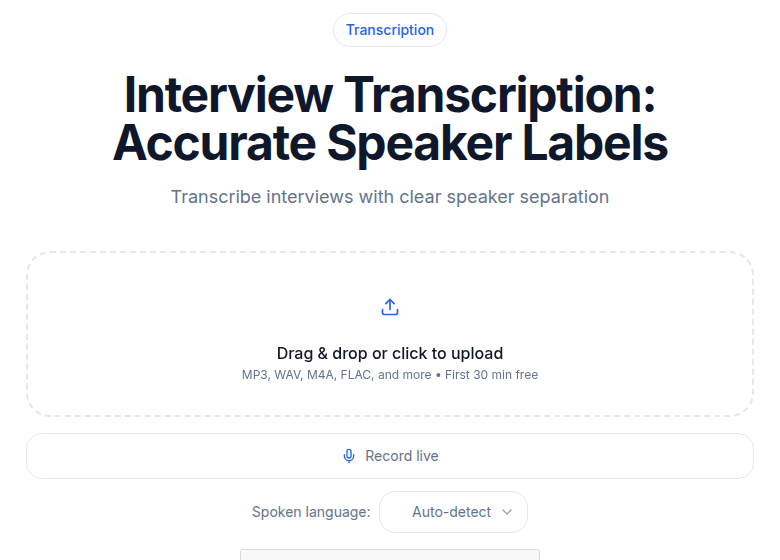 Interview transcription tool with speaker labels and timestamps
Selecting a Transcription Service for Patient Interviews
The choice of transcription method turns on one question: does the audio still contain PHI at the time it is processed?
If the audio contains PHI (which it almost always does before de-identification), you need a service that will sign a HIPAA Business Associate Agreement. The vendor's infrastructure must meet HIPAA Security Rule requirements: encryption in transit and at rest, access controls, audit logging, and a contractual prohibition on using patient audio for model training.
Two options with documented BAA availability:
Sonix Medical Enterprise signs BAAs and is SOC 2 Type II certified. HIPAA compliance is exclusive to the Enterprise plan; the Medical Pro plan ($880/year) does not include a BAA and is explicitly for non-PHI content (training materials, research with formally de-identified data). Contact their sales team for Enterprise pricing.
Rev.ai (the API platform) offers a HIPAA BAA through a separate agreement and account setup process. Activation requires signing a BAA and a new Master Service Agreement, and creating a designated HIPAA account. Per their documentation, PHI should not appear in file names or URLs.
Human transcription services such as Verbalscripts offer per-project BAA workflows with IRB-protocol adherence, quality review, and CAQDAS-ready delivery. Human transcription costs substantially more than AI per audio hour, but some IRBs and institutional data management policies require it for PHI audio.
If the audio has been formally de-identified (rare, because de-identification usually happens at the transcript level, not the audio level) or if your IRB protocol covers the audio as exempt or minimal risk, you have more options. For research that uses de-identified patient interview recordings, or for training content and educational materials derived from de-identified cases, a general-purpose AI transcription tool works well.
If you just need a clean transcript without PHI concerns, ConvertAudioToText handles audio and video in 99+ languages with speaker labels, timestamps, and DOCX export at $14.99/month for unlimited transcription. It is appropriate for non-PHI research audio (de-identified interviews, patient educator recordings, faculty teaching material) but does not offer a HIPAA BAA and should not be used for audio that still contains patient identifiers.
See our dedicated guide on HIPAA-compliant transcription for a fuller comparison of services across the care and research contexts.
Transcript Quality for Qualitative Analysis
Accuracy matters differently in patient research than in most other transcription uses. Three accuracy problems that affect qualitative coding:
Negation errors. "No history of" and "history of" are opposite meanings. AI transcription errors on negation are not rare, and they affect clinical content analysis directly. Review negation-heavy passages against the audio before coding.
Medication and condition names. Drug names, diagnostic terms, and anatomy are frequently mistranscribed. For health services research or PRO (patient-reported outcome) interviews, these errors affect the validity of the data. Speaker adaptation (some tools let you add a custom vocabulary) reduces this but does not eliminate it.
Overlapping speakers. When caregivers or family members are present, overlapping speech creates diarization errors. Most AI tools handle two-speaker interviews well but struggle with three or more speakers in proximity.
For FDA-regulated studies with patient interviews (such as PRO measure development under the FDA's patient-focused drug development guidance), transcription accuracy is part of the data quality record. Human transcription with senior review is standard in those contexts, per vendor documentation from specialized services in the space.
See transcription accuracy explained for a breakdown of how accuracy is measured and what the numbers mean in practice.
Speaker Diarization in Patient Interviews
Diarization, the automatic separation of "who said what," matters for patient interviews because interviewer and participant utterances need to be distinguishable for most analysis methods.
For standard two-speaker patient interviews (one interviewer, one patient), most current AI tools achieve clean diarization. Problems appear when:
- Three or more people are present (patient plus caregiver plus interviewer)
- The interview is by phone, where audio quality degrades speaker separation
- The patient speaks very quietly or very slowly (common in illness or fatigue contexts)
- The interviewer and patient speak the same language with similar accents
Test diarization on a sample interview before committing a large dataset. Check three things: are speaker turns clean at transitions, are short patient responses (one or two words) correctly attributed, and are back-channel responses ("mm-hm," "I see") attributed to the right speaker.
Our post on speaker diarization explained covers the technical approach and accuracy limits in more detail.
Non-English Patient Interviews
Health equity research and international clinical trials frequently involve patient interviews in languages other than English. Accuracy varies substantially by language and tool. For common languages (Spanish, French, Portuguese, Mandarin), major AI transcription tools perform reasonably well. For less-common languages and for dialects, accuracy drops.
Two practical points for multilingual research:
First, test the tool on a sample from your target language before processing the dataset. Do not assume that a tool's stated language support translates to acceptable accuracy for your speakers' specific dialect or accent.
Second, back-translation for IRB purposes (translating consent forms and instruments back to English to verify translation accuracy) is a separate task from transcription. Do not conflate them.
For patient interview studies in diverse languages, human transcription with native-speaker transcribers is often required by IRB protocol or institutional data management standards. Some specialized services offer native-speaker transcribers across 40+ languages with BAA coverage.
Data Management and Retention
Patient interview transcripts become part of the research record. Typical institutional requirements:
Retention period. Most IRBs require research records (including audio and transcripts) to be retained for at least three years after the end of the study. FDA-regulated studies may require longer retention. Confirm with your IRB and sponsor.
Storage location. PHI must be stored on systems that meet HIPAA Security Rule requirements. Institutional secure storage (encrypted research drives, HIPAA-compliant cloud storage with BAA) is standard. Consumer cloud storage (Google Drive, Dropbox on personal accounts) is not appropriate for PHI transcripts.
Destruction. When retention periods end, secure destruction is required. For digital files, this means verified deletion, not just moving to the recycle bin.
Audit trail. Some IRBs require logging who accessed transcripts and when. If your data management plan includes an audit trail requirement, verify your storage and transcription tools support this before you start.
What ConvertAudioToText Is and Is Not For in Research Contexts
To be clear about scope: ConvertAudioToText does not offer a HIPAA BAA and is not appropriate for patient interview audio that contains PHI.
It works well for the non-PHI layer of patient research work:
- Faculty teaching materials derived from de-identified case examples
- Research team training recordings and methodology discussions
- Patient educator content and CME materials
- Qualitative interviews with research participants who are NOT patients (e.g., provider interviews about patient care, caregiver interviews in contexts where caregiver PHI is not at issue)
- Administrative and coordination recordings for research teams
For the PHI-containing patient interview audio itself, use a service with a signed BAA. The compliance overhead is different, and so is the price. For a broader look at how costs compare across transcription contexts, see the cost of transcription per hour.
FAQ
Do I need a BAA for patient interview transcription in research?
Yes, if the audio or transcript contains Protected Health Information (PHI), any vendor that processes it is a Business Associate under HIPAA and must sign a BAA before receiving the files. PHI in audio includes the patient's voice, name, dates of service, geographic identifiers, and other elements from the 18-identifier Safe Harbor list. A signed BAA alone does not ensure compliance; confirm the vendor's security practices (encryption in transit and at rest, access controls, no-training-on-data commitment) match your IRB protocol.
What is the difference between verbatim and clean-verbatim transcription for patient interviews?
Verbatim transcription captures everything the speaker says: false starts, filler words, repetitions, laughter, pauses marked with ellipses or brackets. Clean-verbatim removes those elements and produces readable prose while keeping the full content of what was said. For thematic analysis and grounded theory, verbatim is standard because the patient's exact phrasing is data. For content analysis where the goal is what was communicated rather than how, clean-verbatim is often sufficient. Specify which convention you need before transcription begins, because retrofitting a clean-verbatim transcript into a verbatim format requires re-listening to the audio.
When is patient interview audio considered de-identified under HIPAA?
HIPAA Safe Harbor de-identification requires removing all 18 identifier categories from the transcript: names, geographic subdivisions smaller than a state, all dates other than year, telephone and fax numbers, email addresses, Social Security numbers, medical record numbers, health plan numbers, account numbers, certificate and license numbers, vehicle identifiers, device identifiers, URLs, IP addresses, biometric identifiers (including voiceprints), full-face photographs, and any other unique identifying number or code. The audio file itself is never de-identified under Safe Harbor because the patient's voice is a biometric identifier. De-identification applies to the derived transcript after these elements are removed or pseudonymized.
Which CAQDAS tools import research transcripts and what format do they need?
NVivo (version 14), ATLAS.ti, MAXQDA, and Dedoose all accept DOCX, RTF, and TXT formats. For NVivo's auto-coding by speaker feature to work, speaker labels must follow a consistent pattern at the start of each turn, for example 'Interviewer:' and 'P1:'. ATLAS.ti and MAXQDA support timestamped imports via SRT or RTF with timecodes, which lets analysts jump to the audio segment from the coded passage. DOCX with consistent speaker labels is the most portable single format across all four tools. Export your transcript from whatever service you use in DOCX, verify speaker-label consistency before import, and do a test import on one transcript before processing a full dataset.
Sources
- Rev.ai HIPAA documentation: https://docs.rev.ai/api/hipaa (checked 2026-07-02)
- Sonix Medical pricing page: https://sonix.ai/medical/pricing (checked 2026-07-02)
- ConvertAudioToText pricing: https://convertaudiototext.com/pricing (checked 2026-07-02)
- Verbalscripts patient interview transcription: https://www.verbalscripts.com/solutions/patient-interview-transcription (checked 2026-07-02)
- UCSF HRPP de-identification guidance: https://irb.ucsf.edu/content/de-identification-and-confidentiality-of-research-data
- HIPAA Safe Harbor 18 identifiers: https://www.accountablehq.com/post/complete-list-of-the-18-hipaa-identifiers-for-de-identification-safe-harbor
- HHS 2018 Common Rule (45 CFR 46): https://www.hhs.gov/ohrp/regulations-and-policy/regulations/45-cfr-46/index.html
- Qualtranscribe NVivo/ATLAS.ti import guide: https://docs.qualtranscribe.com/guides/nvivo-atlas
- TransPerfect on patient interviews in clinical trials: https://www.transperfect.com/blog/role-qualitative-interviews-ensuring-patient-centered-approach-clinical-trials
- FDA patient-focused drug development guidance: https://www.fda.gov/about-fda/oncology-center-excellence/project-patient-voice
Try transcription free
Convert any audio or video to clean, unwatermarked text — speaker labels, timestamps, and AI summaries included. First 30 minutes free, no account.
Related Articles
Spotify Transcript Extractor: How to Copy and Download Episode Text
Get a Spotify podcast transcript you can copy and download: paste a public episode link, 30 minutes free with no signup, TXT or SRT files on eligible plans.
Focus Group Transcription for UX Researchers: Turn Multi-Speaker Audio Into Usable Evidence
A practical guide to focus group transcription for UX and insights teams. See how CATT handles speaker labels, timestamps, AI summaries, and clean export.