
AI vs Human Summary Quality: An Honest Comparison (2026)
Summarize this article with:
The Honest Comparison
AI summaries are faster, cheaper, and more consistent than human summaries for most structured content. Humans still win on nuance, editorial judgment, and voice. The right choice depends on the five dimensions below, and the honest answer in 2026 is that neither is universally better.
This post uses a 60-minute recorded interview as the running example, because it is the format where both AI and human summarizers have established baselines.
The Five Dimensions
A summary is not one thing. Five qualities determine whether a summary is useful:
- Coverage: Does the summary capture all the major points?
- Emphasis: Does it surface what actually matters to the reader?
- Attribution: Does it correctly record who said what?
- Voice: Does it sound like a human wrote it for a human?
- Judgment: Does it make the right editorial calls?
AI and humans score very differently on each. The composite outcome depends on which dimensions you care about most.
Where AI Wins: Coverage and Speed
AI dominates on raw coverage and structural consistency across many summaries. A well-prompted frontier LLM fed a clean transcript will produce a summary that captures every topic raised in the conversation, organized into a predictable structure, in under two minutes.
For high-volume workflows, this is decisive. AI produces the same structure across every summary: same sections, same bullet patterns, same organization. A human summarizer's quality varies by day, brief, and workload. For internal documentation, research notes, action item extraction, and same-day publication, AI's consistency is the main reason to choose it.
Speed is the other clear win. Professional human summarizers work on schedules measured in hours or days. AI returns a draft in seconds. For workflows where the summary feeds a downstream task (a newsletter, a report, a filing), that speed difference is often worth accepting AI's limitations.
Where AI Fails: Nuance, Emphasis, and Overgeneralization
This is where the research catches up with the marketing. A 2025 study analyzed nearly 5,000 AI-generated summaries of academic journal articles and found that ChatGPT-4o was nine times more likely than the original source to make overgeneralized claims. Llama 3.3 was 39 times more likely. The problem is not fabrication of new facts, but the removal of qualifiers: a finding that a drug was "better than placebo" got reframed as an "effective and safe treatment." The hedge that made the original finding true got dropped.
This pattern shows up in non-academic content too. The Dropbox Dash team documents a related failure mode: AI assigns importance by frequency and density, meaning how many times a topic came up, how many words were spent on it. A guest's sharpest one-line observation gets less coverage than a five-minute discussion of something less interesting. The model reads the script; a skilled summarizer reads the room.
For content where the emphasis call is the whole job, such as curating soundbites, writing newsletter introductions, or picking the one quote that captures what someone meant, human judgment still wins.
My take: the nuance failure is not about model capability in isolation. The 2025 Peters and Chin-Yee study found that instructing the model to "stay faithful" and "not introduce inaccuracies" doubled the likelihood of overgeneralization, a counterintuitive ironic rebound. Prompting harder to fix the problem can make it worse.
Where AI Fails: Attribution and Hallucinated Speakers
Attribution errors are one of the most underreported failure modes in AI summarization. They come from two separate mechanisms.
The first is upstream diarization error. Speaker diarization, the process of labeling who spoke when, has error rates of 11 to 13% on real-world recordings, with accuracy dropping further on crosstalk. When a diarization error tags Speaker A's statement as Speaker B's, the transcript is wrong before the summarizer even sees it. The summary inherits that error and presents it as fact. You can learn more about how diarization works and fails in speaker diarization explained.
The second mechanism is the LLM itself. Even when the transcript is correctly labeled, models can misattribute who said what across long exchanges, especially when two speakers return to the same topic multiple times. On news-article citation tasks, Grok-3 showed a 94% citation hallucination rate in adversarial testing. Meeting summaries are a different task, but the underlying mechanism, the model confabulating an attribution rather than retrieving one, is the same.
For high-stakes content where attribution matters (legal proceedings, journalism, any context where a quoted source will be contacted), AI attribution must be verified against the source transcript.
Where Humans Win: Judgment and Voice
Judgment and voice are the two dimensions where human summarizers have the clearest sustained advantage.
Judgment is the editorial call about which 30-second exchange in a 60-minute interview is the one that deserves emphasis. That call reflects an understanding of the audience, the publication, and what is actually interesting, not just what was said most. AI cannot replicate this. It lacks a reader.
Voice is the writing quality that makes a summary worth reading for its own sake. Newsletter content, branded podcast notes, editorial summaries, and personal content all depend on a writer's voice being present. AI summaries default to a flat institutional register: grammatically correct, information-dense, characterless. Recent frontier models write better than their predecessors, but the writing still has the quality of competent-but-anonymous.
For summaries that are published artifacts rather than working documents, professional voice matters and human writing still sets the standard.
The Comparison by Dimension
| Dimension | AI | Human | Edge |
|---|---|---|---|
| Coverage | Comprehensive on clear source material | Varies by summarizer skill | AI |
| Speed | Seconds to two minutes | Hours to days | AI (decisively) |
| Structural consistency | Same structure every time | Variable | AI |
| Nuance and qualifiers | Drops hedges; overgeneralizes | Preserves context | Human |
| Emphasis | Frequency-weighted, not insight-weighted | Editorial judgment | Human |
| Speaker attribution | Inherits diarization errors; confabulates | Catches errors on review | Human |
| Voice | Flat and institutional | Range: mediocre to excellent | Human at the high end |
| Cost (per summary) | Very low; flat-rate plans available | Professional hourly rates | AI |
When Each Approach Fits
AI wins when:
- You produce 10 or more summaries per week.
- The summary is a working document, not a published piece.
- Structure and coverage matter more than voice.
- Speed is critical: same-day delivery, real-time meeting notes.
- Consistency across many similar summaries is the goal.
Humans win when:
- Voice is the product: newsletters, branded show notes, editorial writing.
- Attribution precision matters: journalism, legal records, formal proceedings.
- Judgment is the whole job: selecting the soundbite, curating the moment.
- The summary is the final published artifact.
Hybrid wins when:
- Both quality and volume matter.
- AI handles the first draft; a human handles voice, emphasis, and attribution review.
- The summary feeds published downstream content.
Verification Habits That Actually Work
The most important finding from the 2025 overgeneralization research is that telling AI to "be more careful" can backfire. A generic faithfulness instruction did not reduce errors; it increased them in one study.
More reliable approaches:
Check the most specific claims. Numbers, percentages, and named findings are where overgeneralization hides. If the summary says a drug "works," check whether the source said "better than placebo at a specific dose." If it says "most users," check whether the source said "a majority of survey respondents."
Verify speaker attribution on multi-speaker content. Skim the transcript for any attributed quote in the summary. This takes two to three minutes for a typical meeting summary and catches the errors that matter most.
Compare the summary's structure to the source. If the source spent 40 minutes on topic A and 5 minutes on topic B, and the summary treats them as equal, the emphasis is wrong. Adjust, or note the proportion for the reader.
Treat emphasis as your job. AI identifies coverage; you identify what matters. The hybrid model works best when the human treats their job as editorial judgment rather than proofreading.
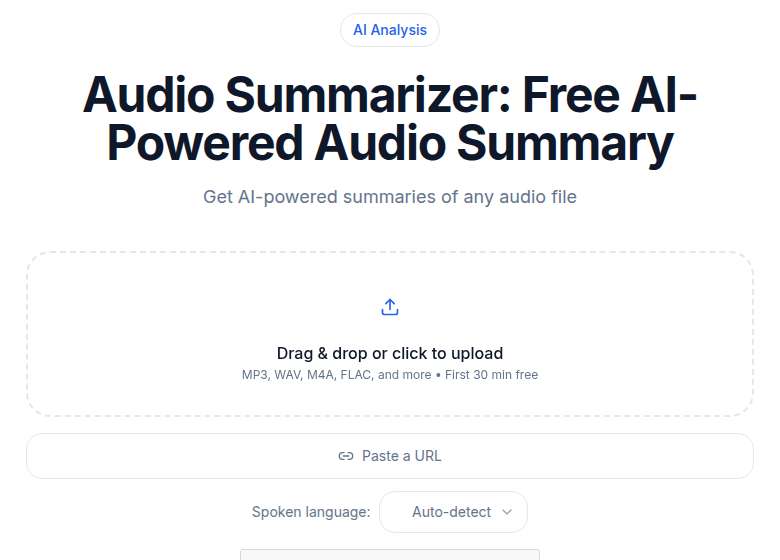 CATT's AI summarizer generates structured output you can verify and edit
A Note on Trust
The question "should I trust AI summaries?" has the same answer as any first draft: verify before publishing or acting on it. The verification cost is lower than writing from scratch, which is why AI summaries are useful even when they need review.
The useful framing is not "AI versus human" but "AI first draft plus human review." That hybrid reduces the work a human summarizer has to do without removing the judgment, voice, and attribution check that AI cannot reliably provide.
If you need a clean, structured first draft to start from, ConvertAudioToText's meeting transcription tool produces an AI summary alongside the full transcript so you can verify claims against the source in the same view. The first 30 minutes of any file are free without an account, and a free account runs your first file on the premium engine (up to an hour, with the AI summary), then keeps transcribing free (up to 30 files a day, up to 30 minutes each); the Pro plan is $14.99/month for unlimited transcription.
For a deeper look at the accuracy side, see transcription accuracy explained and AI vs human transcription.
FAQ
How accurate are AI summaries compared to human summaries?
On clearly structured, short-form source material, frontier AI models achieve very low hallucination rates on grounded summarization benchmarks (Gemini 2.0-Flash reaches 0.7% on Vectara's leaderboard). However, on longer enterprise-length content, error rates rise to 3 to 20% on the same benchmark. The pattern most relevant to summaries is not outright fabrication but overgeneralization: a 2025 study found ChatGPT-4o was nine times more likely than the source text to make claims without the original's qualifiers. Human summarizers make different errors, mostly paraphrase drift and missed points, but they preserve hedges more reliably.
Can AI summaries misattribute who said what?
Yes, through two separate mechanisms. First, upstream speaker diarization errors of 11 to 13% propagate through the pipeline before the summarizer sees the text. Second, the LLM itself can confuse attribution when two speakers revisit the same topic across a long recording. For any content where correct attribution matters, verify attributed statements against the source transcript.
When is a human summarizer worth the cost over AI?
When the summary is the final published artifact and voice is part of its value: newsletter writing, branded show notes, editorial content. Also when judgment is the core job: selecting the specific moment or quote that defines what the conversation was about. Human summarizers at the professional level charge at professional writing hourly rates; for high-volume or working-document use, that cost is hard to justify versus AI. For a single, well-crafted, voice-dependent piece, it often is.
Does instructing AI to 'be more careful' reduce summarization errors?
Not reliably, and sometimes the opposite. A 2025 study by Peters and Chin-Yee found that instructing AI to "stay faithful" and "not introduce inaccuracies" doubled the likelihood of overgeneralization in the output. More reliable than a faithfulness prompt is targeted post-hoc verification: check specific claims, especially hedged findings and attributed quotes, directly against the source.
Sources
- Vectara Hallucination Leaderboard and FaithJudge benchmark: https://www.mayhemcode.com/2026/04/vectara-hallucination-leaderboard.html
- AI research summaries exaggerate findings (Peters and Chin-Yee, Times Higher Education, 2025): https://www.timeshighereducation.com/news/ai-research-summaries-exaggerate-findings-study-warns
- AI hallucination rates and benchmarks 2026: https://suprmind.ai/hub/ai-hallucination-rates-and-benchmarks/
- 4 mistakes to avoid when summarizing with AI (Dropbox Dash): https://dash.dropbox.com/resources/4-mistakes-when-asking-ai-to-summarize
- How AI meeting notes work (Circleback): https://circleback.ai/blog/how-ai-meeting-notes-work
- ConvertAudioToText pricing: https://convertaudiototext.com/pricing
Try transcription free
Convert any audio or video to clean, unwatermarked text — speaker labels, timestamps, and AI summaries included. First 30 minutes free, no account.
Related Articles

AI Key Takeaways From Podcasts: A Listener's Workflow (2026)
How to extract, structure, and save key takeaways from podcast episodes you consume. Covers capture tools, extraction prompts, note formats, and PKM sync for listeners.

AI Translation vs Human Translator: When Each One Is Right
A stakes-based decision guide for AI vs human translation in 2026. Covers legal, marketing, and subtitle use cases with verified costs and the PEMT hybrid workflow.