
AI Translation vs Human Translator: When Each One Is Right
Summarize this article with:
For internal use, bulk content, and subtitles, AI translation (DeepL, Google NMT, GPT-4o) is fast and cheap enough to use today without apology. For legal documents, marketing copy, and anything representing your public brand, a human still catches what the machine flattens. The practical middle ground is post-editing machine translation (PEMT): AI generates the draft, a professional corrects it, and you pay 30-70% of full human rates at 50-70% less time.
Use AI translation when speed and cost matter more than perfection; use a human when an error has a price tag larger than the cost of the translation. For most audio-to-text workflows in 2026, the answer is a hybrid: machine draft, human edit.
This guide breaks down the decision by content type, verifies the real cost numbers, and shows where the hybrid workflow (called post-editing machine translation, or PEMT) makes the economics work.
The Decision, by Stakes
Not all content carries the same risk. The right translation tier maps to what happens if a word is wrong.
Low stakes: Internal notes, research reading, rough subtitles for personal use, early-stage blog translations for SEO reach. AI-only output is fine. A 90-95% accurate translation costs fractions of a cent per word and arrives in seconds.
Medium stakes: Published blog posts, product descriptions, customer-facing documentation, video subtitles for a general audience. AI first draft plus a light human edit is the standard practice at professional translation agencies in 2026. DeepL wins independent head-to-head comparisons against Google Translate, Microsoft Translator, and GPT-4o in 65% of language pairs tested, according to 2026 benchmark data, with the strongest margins for English into German, French, and Spanish.
High stakes: Legal contracts, patents, court filings, certified immigration documents, regulated marketing disclosures, literary publication. Human translation is not optional here, and for official submissions, a certified or sworn translator is required by law in most jurisdictions. AI output does not satisfy that requirement.
Where AI Translation Works Well
Bulk content where near-accuracy is sufficient. YouTube subtitles, blog localization, social media captions, internal wikis. The translation does not represent your legal position or your brand voice in a high-pressure context.
Cost via the DeepL API: approximately $25-28 per million characters at current pricing (per-character metered model). Google Cloud Translation NMT charges $20 per million characters. For context, a 1-hour interview transcript runs roughly 8,000-10,000 words, or about 55,000 characters, which puts AI-only translation well under a dollar per hour of audio.
Real-time scenarios. Live captioning, chat translation, meeting summaries. Speed is the constraint, not perfection. Free tools (Google Translate browser integration, DeepL's free tier at 50,000 characters per month) handle these adequately.
Reference and research. Understanding a foreign-language document without publishing it. No accuracy bar beyond "good enough to understand." Use free tools.
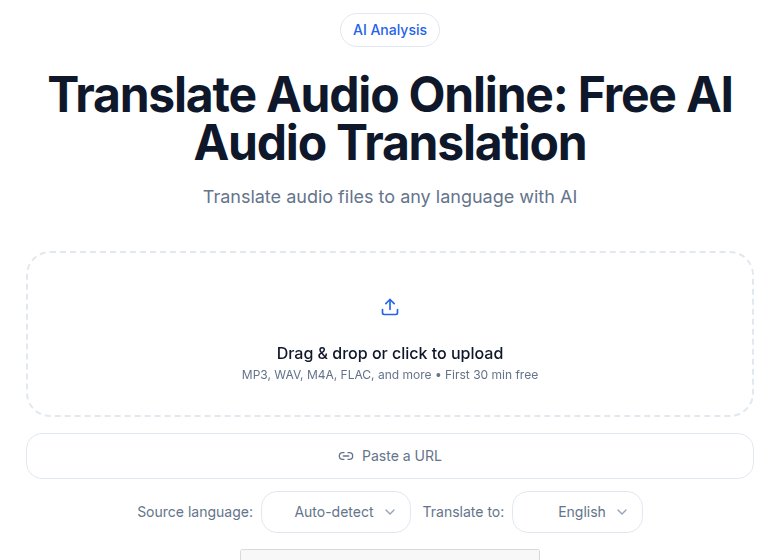 ConvertAudioToText audio translation tool showing language selection and output options
Where Human Translators Win
Legal documents. Contracts, patents, immigration filings, court documents. Certified legal translation runs $0.10 to $0.40 per word per 2026 market data, with complex intellectual property or court documents at the higher end. Notarization, if required, adds $10-20 per document. A 10-page contract (roughly 2,500 words) costs $250 to $1,000 from a sworn translator, with 1-5 business days turnaround.
The economics make sense: if a mistranslated clause voids a contract or delays a patent approval, the $600 you saved on AI translation was not a bargain.
Marketing copy. Headlines, taglines, ad campaigns. AI translation is technically accurate but rarely captures brand voice, idiomatic flair, or cultural resonance. A literal translation of an English idiom into French is often grammatically correct and completely wrong in feel. Marketing translators, who work more like copywriters than linguists, charge $0.15 to $0.50 per word.
Literary and cultural content. Books, scripts, song lyrics, poetry. Rhythm, voice, and cultural implication are not preserved by neural networks trained on parallel corpora. This is the territory where translation is genuinely a craft, and AI is a sketch pad at best.
Low-resource language pairs. Of the more than 2,000 languages spoken across Africa, only 49 appear on major translation platforms. For Hausa, IsiZulu, and most Indigenous languages, AI translation quality drops materially, and human correction is not optional, it is necessary. The research community (Masakhane, Google's WAXAL dataset) is actively closing the gap, but the gap is real in 2026.
The Hybrid Workflow: PEMT
For most professional published content, the practical answer is post-editing machine translation (PEMT). The workflow:
- Generate an AI first draft (DeepL, Google NMT, or an LLM).
- A professional translator reviews and corrects the draft.
This is now the dominant workflow at professional translation agencies. The verified numbers: PEMT projects cost 30-70% of full human translation, with delivery 50-70% faster than human-from-scratch. Post-editors charge $25-75 per hour depending on language and domain expertise.
My take: for anything going to a non-English audience that you would proofread in English before publishing, budget for a light PEMT pass. The AI saves 60-80% of the time the human would spend on a cold draft. The human catches what the AI flattened.
Where human editors consistently add value over AI
- Idioms that translate literally but read as nonsense in the target language.
- Tone shifts (informal source becoming formal AI output, or vice versa).
- Proper nouns across writing systems.
- Brand voice and terminology consistency across a long document.
- Domain vocabulary nuances in medical, legal, and technical content.
The Transcription Step Matters
If your content starts as audio, the quality of the transcript you feed into translation directly affects the translation output. A clean original-language transcript, with diacritics intact and speaker labels, translates measurably better than a stripped or error-prone one.
A Spanish transcript with proper accents (á, é, ó, ú, ñ) preserves the semantic meaning that drives translation. A transcript where "año" became "ano" is already wrong before the translation step starts. See the transcribe and translate workflow for the full pipeline, and how to translate video to English for the video-specific version.
For subtitles specifically, the stakes are different from document translation. Netflix's documented localization pipeline uses AI for initial translation passes and requires human linguist review before any content is distributed. For self-published video content aimed at a broad audience, AI subtitles with a light review are the practical standard. For broadcast or platform distribution, human QA is expected. See subtitle translation workflow for the technical steps.
If you just need a clean transcript in the original language before you send it to a translation tool, ConvertAudioToText handles 99+ languages with speaker labels and diacritics intact. The first 30 minutes of any file are free with no account, and a free account transcribes up to 30 files a day, up to 30 minutes each.
Cost Comparison: 60-Minute Interview Translated to English
A concrete example: 60-minute Spanish podcast interview, ~9,000 words, needs an English version.
| Approach | What it involves | Approximate cost |
|---|---|---|
| AI-only (NMT API: Google or DeepL) | Transcript plus API translation | Under $2 |
| AI-only (LLM: GPT-4o) | Transcript plus LLM translation | $5-15 |
| Hybrid (AI draft + human post-edit) | AI draft plus 2-4hr post-editor at $25-75/hr | $50-300 |
| Full human translation | Human translator from scratch | $900-2,700 at $0.10-0.30/word |
| Sworn/certified translation | Sworn translator plus notarization | $1,200-3,600 |
For most non-legal published content, hybrid is the sweet spot. AI-only is appropriate for internal use. Sworn translation is non-negotiable for legal submissions.
Tools for Each Tier
AI-only: DeepL (strongest for European language pairs, plans from $8.74/month for Individual or per-character API access), Google Cloud Translation (NMT at $20 per million characters), GPT-4o-mini (inexpensive, flexible on nuance). Total cost for a moderate volume: under $30/month for most teams.
Hybrid: Any of the above for the AI draft, then a post-editor sourced through Smartcat, Bureau Works, or ProZ. Budget $0.06-0.12 per word for the editing step on top of negligible AI costs.
Human-only: Specialized human translator via an agency or a platform like ProZ. Required for legal, certified, literary, and high-stakes marketing content.
For multilingual podcast workflows, translate podcast to Spanish covers the audio-first pipeline in more detail. For content teams working across languages, transcription for international teams addresses the tooling and workflow questions.
When to Pay for Human Translation
Pay for a human when:
- The cost of an error exceeds the cost savings of AI translation.
- A regulatory, legal, or government authority requires certified translation.
- The content will represent your brand in a high-visibility context.
- The language pair is low-resource and AI output quality is unreliable.
- The content type (literary, campaign copy) requires cultural creativity, not just accuracy.
For everything else, AI translation in 2026 is a serious professional tool, not a shortcut.
FAQ
Is AI translation good enough to publish without human review?
It depends on the stakes. For subtitles, blog posts translated for SEO reach, and internal documentation, AI output is routinely used without review at major companies in 2026. For anything legally binding, brand-facing, or literary, unreviewed AI output is not publish-ready. Netflix, for example, uses AI for initial translation passes and requires human linguist sign-off before distribution.
What does post-editing machine translation actually cost?
Professional post-editors charge $25 to $75 per hour, and PEMT projects typically run 30-70% of a full human translation quote for the same content. A 5,000-word document that would cost $1,000 from a human translator might cost $350-$700 in AI-plus-edit, with delivery 50-70% faster.
Which AI translation tool is most accurate in 2026?
DeepL leads independent benchmarks in 65% of language pairs, with a particularly strong margin for English into German, French, and Spanish. For Asian languages, LLMs like GPT-4o are competitive or better. For low-resource languages (many African and Indigenous languages), all AI tools produce materially lower quality and require more human editing.
When do I legally need a certified or sworn human translator?
Any document submitted to a government agency, court, immigration authority, or regulatory body in most countries requires a certified or sworn translation. AI output does not satisfy this requirement. Certified translation costs roughly $0.10 to $0.40 per word depending on language pair and document complexity, with notarization as a separate add-on.
How does transcription quality affect translation quality?
Significantly. A transcript with diacritics intact (Spanish accents, French cedillas) translates better than a stripped one. A clean speaker-labeled transcript lets you preserve attribution through translation. Errors in the transcript compound at the translation step: a misheard word in the source becomes a wrong word in the target.
Sources
- DeepL Pro Pricing 2026 (CheckThat.ai) - checked July 2026
- AI Machine Translation Cost Comparison: DeepL, Google, OpenAI (SimpleLocalize, 2026) - checked July 2026
- Machine Translation Accuracy 2026: DeepL vs Google vs ChatGPT (IntlPull) - checked July 2026
- Translation Services Pricing Per Word 2026 (Translators USA) - checked July 2026
- How Much Does Professional Translation Cost in 2026? (Smartling) - checked July 2026
- How Much Does Legal Translation Cost? (Espresso Translations) - checked July 2026
- Machine Translation Post-editing Rates (Bayan Tech) - checked July 2026
- Netflix AI-Powered Multilingual Content Localization (Localization Institute) - checked July 2026
- Not Lost in Translation: Training AI to Speak African Languages (African Business, June 2026) - checked July 2026
- Google Cloud Translation Pricing - checked July 2026
Try transcription free
Convert any audio or video to clean, unwatermarked text — speaker labels, timestamps, and AI summaries included. First 30 minutes free, no account.
Related Articles

AI vs Human Summary Quality: An Honest Comparison (2026)
AI summaries win on speed, coverage, and consistency. Humans win on nuance, emphasis, and judgment. Here's exactly where each fails and how to verify AI output.

The Future of Real-Time Translation: What's Actually Coming
Sub-second speech translation is real in 2026. Here's what the technology actually does today, where it still breaks, and which trajectories are worth tracking through 2026.