
How to Translate Video to English: The Three-Step Path
Summarize this article with:
The Three-Step Path
Translating a video to English means three things in sequence: pull the spoken words out of the audio (transcription), convert them into English (translation), then attach the result to the video or hand it to your audience (delivery). Every method in this guide follows that spine. The differences are how much of the work you hand to software versus how much you review yourself.
Before picking a method, be clear on what you actually need. A written English transcript is the simplest goal: plain text, no timing, ready to read or search. Translated subtitles add timing so the text appears in sync with the video as an SRT or VTT file you upload to YouTube, Vimeo, or burn into the frames. Dubbed audio replaces the original voice track with English speech, which is a separate, more complex process this guide does not cover. If you want captions that stay with the video permanently, the subtitle translation workflow post covers that path in depth.
Method 1: Upload to an AI Tool That Handles All Three Steps
The fastest approach is an all-in-one AI tool where you drop in the video and download an English transcript or SRT file minutes later. The pipeline is invisible: the tool feeds the audio to a speech recognition engine, routes the recognized text through a translation model, and re-attaches timestamps.
How it works in practice:
- Upload the video file, or paste a URL if the tool accepts links.
- Specify the source language, or let the tool auto-detect it.
- Select English as the target language.
- Wait for processing. A 10-minute video typically finishes in two to five minutes on a modern AI backend.
- Download the transcript (plain text) and the SRT subtitle file.
The translation quality is highest when the source audio is clean and the language pair is well-resourced. For Spanish, French, German, Japanese, and Mandarin Chinese into English, modern AI translation consistently reaches 90 to 95 percent accuracy on conversational content. Accuracy drops for accented speech, domain-specific vocabulary, and lower-resource languages.
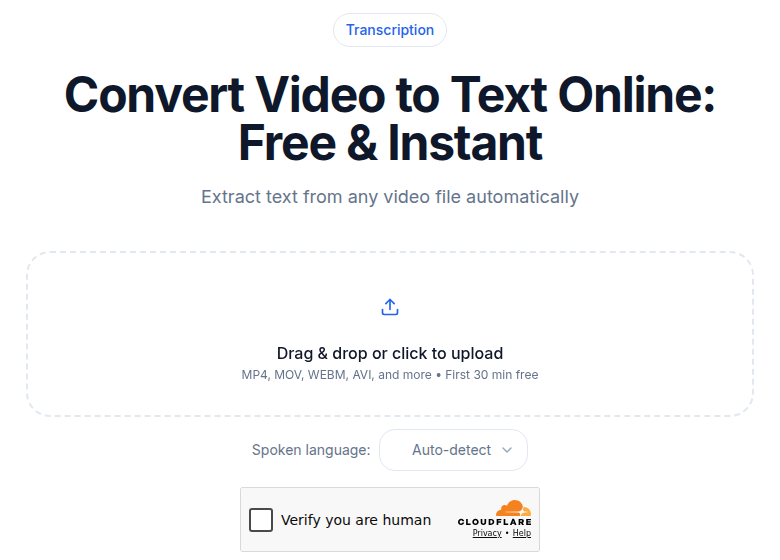
If you need just the source-language transcript to feed into a separate translation tool, ConvertAudioToText's video-to-text tool pulls clean text from video files without requiring an account for short clips.
Method 2: Translating a YouTube Video to English
YouTube-hosted content has its own shortcuts. YouTube can auto-translate an existing caption track into English through the player settings, but only when the video already has captions available.
Steps on desktop:
- Open the video and click the CC button to enable captions.
- Click the gear icon (Settings) next to CC.
- Select Subtitles/CC.
- Click Auto-translate.
- Choose English from the language list.
This is instant and free. The catch: if the creator never uploaded captions and YouTube's auto-captions failed, the auto-translate option will not appear. Translation quality also depends on the source caption quality. Errors in the original captions get amplified in the translated output.
For a full walkthrough of the YouTube-specific path, including how to get a downloadable transcript, see how to translate a YouTube video with AI.
If you need a downloadable SRT file rather than just on-screen translation, the YouTube player does not offer a direct export. The workaround: use a subtitle extractor to pull the original-language SRT from the video, then translate that file. The subtitle translation for video guide covers this in detail.
Method 3: Manual Workflow for High-Stakes Content
For legal proceedings, medical content, or anything where a mistranslation has real consequences, the manual workflow gives you control at every stage.
Step 1: Transcribe the Original Audio
Start by getting an accurate transcript in the source language:
- Use a transcription tool that supports that language.
- Have a native speaker scan the transcript for proper nouns, specialized terminology, and anything the speech engine may have misheard.
- Fix errors in the source transcript before you translate. A wrong word in the source becomes a wrong translation downstream.
Step 2: Translate the Transcript
With a clean source transcript:
- For general content, DeepL produces strong results for European language pairs. Google Translate covers a wider range of languages but is weaker on nuance and domain-specific text. Neither replaces a human for anything high-stakes.
- For critical content, use a professional human translator with domain expertise.
- If a bilingual reviewer is available, have them check the translation before it goes anywhere.
The AI translation vs. human translator post is worth reading if you are deciding which approach fits your accuracy requirements.
Step 3: Create Timed Subtitles
If you need subtitles rather than just a document:
- Take the original subtitle file (which already has timestamps) and replace the text with your translated version, keeping the timing blocks intact.
- If no timed source exists, use a subtitle editor like Subtitle Edit (actively maintained, supports 300-plus formats and includes Whisper-based transcription) to sync the translated text to the video.
For the full deep-dive on turning a translated text file into a usable subtitle workflow, see the transcribe and translate workflow.
Understanding SRT Files
SRT is the most universally accepted subtitle format and the one you should default to. Every major video platform accepts it, and it is a plain text file you can open and edit in any text editor.
The structure is simple:
1
00:00:01,000 --> 00:00:04,500
Hello and welcome to this presentation.

2
00:00:05,000 --> 00:00:09,200
Today we will discuss international markets.
Each block is a sequence number, a timing range in hours:minutes:seconds,milliseconds, and the subtitle text. The arrow syntax inside the block (-->) is part of the SubRip specification, not a special character.
VTT (WebVTT) is structurally similar but uses a period instead of a comma for milliseconds and requires a WEBVTT header line. Use VTT when embedding in HTML5 video players. Use SRT everywhere else.
Uploading SRT Files to Video Platforms
YouTube: Go to YouTube Studio, select the video, open Subtitles, click Add Language, choose English, then click Add under the subtitle section and upload your SRT file.
Vimeo: Open the video settings, click the Distribution tab, find the Subtitles section, click the plus button, and upload your SRT file while selecting the language.
Social media: Facebook, LinkedIn, and X (formerly Twitter) all accept SRT files at the video upload stage. Look for the subtitle or caption option in each platform's upload interface.
Burning Subtitles Into the Video
If you need subtitles embedded permanently into the video frames rather than uploaded as a separate file, FFmpeg handles this:
ffmpeg -i input.mp4 -vf subtitles=english.srt -c:v libx264 -c:a copy output.mp4
This re-encodes the video track and bakes the subtitles in. They will appear on every player and device without needing a separate caption file. The tradeoff: they cannot be turned off, and re-encoding reduces quality slightly. Use this when distributing to contexts where sidecar subtitle files are not supported.
What Reduces Translation Quality (and What to Do About It)
Translation quality is a chain: bad audio produces bad transcription, and bad transcription produces bad translation. Improving the source audio is the highest-leverage fix.
Specific issues to watch for in the translated output:
- Idioms and colloquialisms that do not transfer literally into English
- Technical terms the AI has no training signal for
- Proper nouns (product names, places, personal names) that get transliterated incorrectly
- Cultural references that need an explanatory gloss rather than a literal translation
- Pronoun ambiguity in languages where gender or formality context determines meaning
For videos with multiple speakers, enable speaker diarization if your tool supports it. Mixing speaker turns without attribution makes the translation harder to follow and introduces pronoun errors.
A quick review pass by anyone familiar with the source material catches most of these issues before the translation reaches an audience. The investment is small relative to the cost of a published mistranslation.
Common Questions
Can I translate a video to English for free?
Yes. YouTube's auto-translate feature is free for any video that already has captions. For your own video files, several AI tools offer free tiers that cover short clips. The practical limit is usually file length or a monthly minutes quota, not an upfront cost.
How accurate is AI video translation in 2026?
For well-resourced language pairs (Spanish, French, German, Japanese, Mandarin to English), modern AI translation on clean audio typically reaches 90 to 95 percent accuracy on conversational content. Accuracy drops for accented speech, technical jargon, and less common languages. For anything where a mistranslation has real consequences, human review is still the right call.
Can I translate a video and keep the original audio?
Yes, and this is the most common approach. Add English subtitles as an SRT file uploaded to the platform, or burn them into the video frames. The original audio stays untouched. Viewers hear the source language and read the English translation simultaneously. AI dubbing (replacing the audio track with English speech) is a separate process requiring specialized tools.
What video formats work with AI translation tools?
Most AI tools accept MP4, MOV, AVI, MKV, and WebM. MP4 with H.264 encoding is the most universally supported container. If your video is in an unusual or proprietary format, converting it to MP4 first removes compatibility friction before you start the translation workflow.
Sources
- YouTube Help: Automatic captions (support.google.com/youtube/answer/6373554)
- NoteLM: YouTube Auto-Translate Subtitles 2026 (notelm.ai/blog/youtube-auto-translate-subtitles)
- DeepL Translator language list (deepl.com/en/translator)
- Sonix: Automated Translation Accuracy Statistics 2026 (sonix.ai/resources/automated-translation-accuracy-statistics)
- Tapescribe: SRT vs VTT Complete Guide 2026 (tapescribe.com/blog/srt-vs-vtt-subtitle-format-complete-guide)
- FFmpeg subtitle burn-in documentation (ffmpeg.media/articles/subtitles-burn-in-soft-subs-format-conversion)
- Subtitle Edit (subtitleedit.org)
Try transcription free
Convert any audio or video to clean, unwatermarked text — speaker labels, timestamps, and AI summaries included. First 10 minutes free, no account.
Related Articles

Subtitle Translation for Video: The Reliable Path
Translate existing subtitles the reliable way: machine pass plus review, length expansion handling, and timing re-fit.
Burning Subtitles into Video: Settings That Work
Learn when and how to burn subtitles permanently into video for TikTok, Reels, and social media. Covers FFmpeg commands, video editor workflows, styling, and quality tips.