
The Future of Real-Time Translation: What's Actually Coming
Summarize this article with:
What Is Actually Coming
Sub-second real-time speech translation is not a 2027 promise. It shipped in 2026. OpenAI's GPT-Realtime-Translate delivers 400 to 900 milliseconds end-to-end latency across 70 input languages, streaming translated audio back while the source speaker is still talking. The question has shifted from "when will this be fast enough to feel live" to "which use cases are reliable enough for production, and which will still embarrass you."
This post maps the trajectories that are verifiably moving and separates them from the claims vendors use in demos but cannot sustain in the real world. For a survey of tools you can use today, see the real-time translation tools roundup. This post covers what the field is building toward.
The Three Flavors Still Have Different Maturity Levels
The most reliable form of real-time translation is speech-to-text in another language, meaning you speak English and the system writes Spanish. This has been production-viable for a few years. Whisper with translation mode, Deepgram's built-in translate endpoint, and Azure Cognitive Services all handle major language pairs with accuracy in the 90 percent range on clean audio. Latency runs two to four seconds for offline models, under one second with streaming architectures. Our workflow guide for audio translation covers the practical steps.
One step harder: speech-to-speech in one direction. You speak, the system outputs synthesized voice in the target language. Meta's Seamless family (released in late 2023 and refined since) and Google's Translatotron 3 research model (announced December 2023) both tackle this. Seamless preserves prosody and emotion; Translatotron 3 is a research architecture that learns from monolingual data without parallel speech corpora, which matters for expanding to low-resource languages. Neither is a drop-in commercial product for most developers, but they set the ceiling other vendors are building toward.
Hardest: two-way conversation, both speakers hearing the other in their own language. GPT-Realtime-Translate is the first production API that makes this genuinely approachable for developers, at $0.034 per minute of audio. The conversation still has an inherent pause while the system captures end of utterance, translates, and synthesizes, but the total round-trip sits under one second for supported language pairs on good network conditions. That is a real threshold change from the four-to-seven-second round-trips of 2024.
Where the Current Systems Actually Break
The failure modes are consistent across vendors, and vendors rarely advertise them clearly.
Low-resource languages remain the most predictable failure. On major European and East Asian language pairs, word error rates run 8 to 12 percent on clean audio. On African and Southeast Asian languages with limited training data, AI translation scores 50 to 65 percent of human quality benchmarks on average. GPT-Realtime-Translate supports 70 input languages but only 13 output languages, all of which are high-resource. Whisper Large-v3 covers 99 languages on paper; accuracy for the long tail is substantially worse than for the top 10.
If you are building a product for a global audience, do not assume "supports X languages" means equal quality across all of them. Test with realistic recordings in your actual target pairs before committing to a vendor.
Code-switching is still unsolved at scale. A bilingual speaker who mixes languages mid-sentence breaks most pipelines trained on monolingual or strictly separated bilingual data. The code-switching workarounds post covers the practical mitigations available today.
Cultural and idiomatic translation quality depends heavily on what the training data looked like. Models trained primarily on parliamentary records and technical manuals handle idioms, jokes, and culture-specific references poorly. This is not a latency or model-size problem. It is a data problem, and no announced model has fully cracked it.
Multi-speaker scaling has a hard ceiling. DeepL Voice, KUDO AI, and Interprefy Aivia all handle one-to-one conversation well. Add a third or fourth speaker and the system must simultaneously track who is speaking, in which language, and route translated output to the right listener. Production systems still cap out around two concurrent speakers for smooth results, per field reports from enterprise deployments.
What Is Actually Coming Through 2027
Grounded forecasts only: each of these traces to a development that is already in progress and verifiable.
On-Device Translation Expanding
Apple shipped Live Translation in September 2025 as part of Apple Intelligence, processing on-device across 8 to 17 languages for Messages, FaceTime, and Phone calls. Google has embedded code for offline Live Translate in recent Android updates but has not confirmed a ship date. Individual language packs run 50 to 150 MB, so broadening coverage is more a distribution and licensing problem than a model-size one. The trajectory: on-device translation for the 20 most common language pairs by 2027 is plausible. Privacy-sensitive contexts (legal, medical, government) will push toward on-device as coverage expands.
Voice Preservation in Commercial Dubbing
HeyGen and ElevenLabs both ship dubbed video that claims to preserve the speaker's original voice characteristics across the target language. HeyGen reports pitch and cadence matching across five test languages with under 5 percent error rate. ElevenLabs' Dubbing V2 handles 90-plus languages and preserves emotional inflection. DeepL Voice has announced a voice-preservation feature for its enterprise product, targeted for end of 2026.
This is happening in recorded video before live conversation, for obvious reasons: recorded content gives the system time to clone the voice before synthesizing the translation. Real-time voice-preserved translation in a live call is still research-stage. Expect entertainment and content production to ship it widely in 2026 to 2027, and expect live conversational voice cloning to follow by a year or two.
Streaming Architecture Becoming the Baseline
The architectural shift driving most of the latency improvement is not better models in isolation. It is streaming at every stage: streaming ASR, async pipeline stages running in parallel, and streaming TTS. One benchmark switching from offline to streaming ASR cut latency by roughly 9x for a 60-second input. Switching from offline to streaming TTS dropped total latency from 4,200 ms to 475 ms.
By 2027, any production real-time translation product built on batch processing will be at a competitive disadvantage. The streaming architecture is already the required baseline for anything claiming live-conversation latency.
High-Stakes Contexts Staying Human-Assisted
AI simultaneous interpretation reaches 90 to 95 percent of human quality for general business conversation between major languages, per current field reports. On medical and legal content with specialized terminology, the gap narrows with custom vocabulary, but liability frameworks have not changed. Healthcare providers in the United States are required to provide qualified interpreters under Section 1557 of the Affordable Care Act. The Office for Civil Rights updated its penalty tiers for 2026, with fines for willful neglect over $71,000 per violation.
The likely trajectory: AI translation as a human interpreter's real-time support tool (terminology prompting, context summaries, automated notes) before it fully replaces them in high-stakes contexts. That hybrid is already commercially available from vendors like Interprefy.
Practical Guidance for Builders and Buyers
Pick the simplest flavor of translation that solves your actual problem. Speech-to-text in another language is far more accurate and cheaper than speech-to-speech. If your users need captions or subtitles, you do not need voice synthesis. For multilingual meeting transcription or subtitle translation workflows, the text-only path is the right starting point.
Test with your real audio, not vendor demos. Demos use clean audio, prepared speakers, and the vendor's strongest language pair. Your users will have background noise, accents, fast speakers, and domain vocabulary. Run a private pilot before committing to a vendor contract.
Plan for the failure modes you cannot engineer around. Code-switching, low-resource languages, and multi-party conversations will produce errors in 2026. The question is not "will it fail" but "what happens when it fails." A graceful fallback is part of the product.
If you just need a clean transcript today, without the meeting bot or the real-time synthesis layer, ConvertAudioToText processes audio files or video in 99+ languages with no signup required.
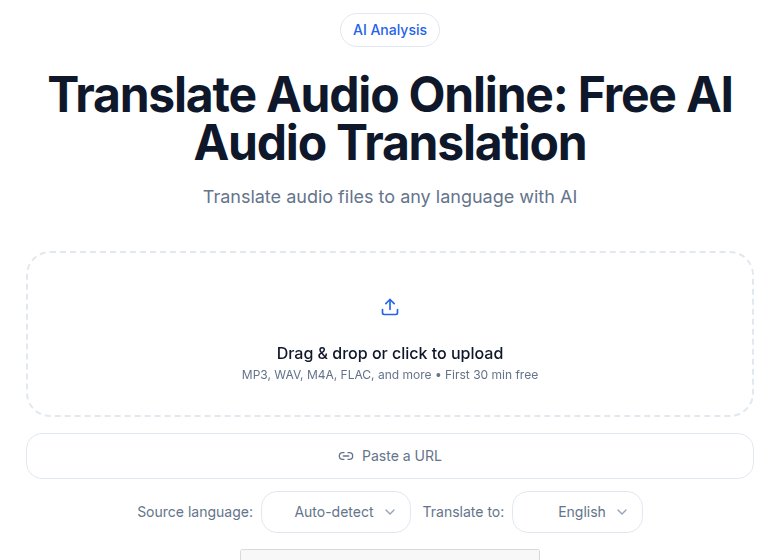 The audio-to-text tool handles multilingual uploads including auto-detection
FAQ
Is real-time speech translation good enough to replace a human interpreter in 2026?
For general business conversation between major languages, AI interpretation reaches roughly 90 to 95 percent of human quality, per field reports. For domain-heavy content (medical, legal, diplomatic) or emotionally charged material, human interpreters still win, and many jurisdictions legally require qualified human interpreters for healthcare settings. The practical answer for 2026 is: AI works well as a first pass or for low-stakes settings; humans remain essential for high-stakes contexts.
What is the actual latency of real-time translation today?
It depends on the architecture and the flavor of translation. OpenAI's GPT-Realtime-Translate delivers 400 to 900 milliseconds end-to-end for speech-to-speech across 70 input languages. Meta SeamlessM4T-v2 shows 300 to 600 ms in paper benchmarks but 800 to 1,500 ms in production deployments. The key user-experience threshold: below 800 ms feels live; above 2 seconds causes speakers to talk over the translation.
Which languages have reliable real-time translation in 2026?
Major language pairs, especially English to and from Spanish, French, German, Mandarin, Japanese, and Korean, achieve word error rates of 8 to 12 percent on clean audio. Low-resource languages, including most African and many Southeast Asian languages, score 50 to 65 percent of human quality scores on average. Translation quality drops further for those pairs because both the speech recognition and the translation models are trained on less data.
Will voice cloning plus translation actually ship in production?
It already has in limited form. HeyGen and ElevenLabs both offer dubbed video that preserves speaker voice characteristics across 90 to 175 languages, and HeyGen claims pitch and cadence are maintained with under 5 percent error rate in testing. DeepL Voice has announced a voice-preservation feature for its enterprise product, targeted for release by end of 2026. The entertainment and content-creation use cases are shipping now; real-time conversational voice cloning for consumer apps is still in research.
Sources
- Real-Time Speech Translation Vendors in 2026: 4 Tools Compared (verified July 2026)
- Real-Time Speech-to-Speech Translation Architecture Guide (verified July 2026)
- Seamless Communication: AI at Meta (verified July 2026)
- Google AI Unveils Translatotron 3 (verified July 2026)
- GPT-Realtime-Translate Model (verified July 2026)
- DeepL Voice: instant, secure voice translation for global teams (verified July 2026)
- Apple Live Translation on-device: Is It Important? (verified July 2026)
- HeyGen vs ElevenLabs vs Rask AI vs Dubverse: Best AI Dubbing Tool in 2026 (verified July 2026)
- ElevenLabs Dubbing Documentation (verified July 2026)
- AI Translation Accuracy Rate in 2026 (verified July 2026)
- AI in Interpretation: Remote Services in 2026 (verified July 2026)
Try transcription free
Convert any audio or video to clean, unwatermarked text — speaker labels, timestamps, and AI summaries included. First 30 minutes free, no account.
Related Articles

AI Translation vs Human Translator: When Each One Is Right
A stakes-based decision guide for AI vs human translation in 2026. Covers legal, marketing, and subtitle use cases with verified costs and the PEMT hybrid workflow.

The Future of AI Transcription: What to Watch in 2026
A grounded forecast of AI transcription in 2026: on-device shifts, multilingual gains, pricing pressure, diarization progress, and agentic workflows, anchored in verified 2026 trends.