
Real-Time Translation Tools in 2026: What Actually Works
Summarize this article with:
Real-time translation in 2026 works well enough for most business conversations but still makes tradeoffs between speed and accuracy that matter in practice. Meeting platforms like Google Meet, Zoom, and Microsoft Teams all ship translated captions natively, but language coverage and plan requirements vary widely. Hardware earbuds handle one-on-one dialogue best; mobile apps cover casual travel; dedicated conference services like Wordly and KUDO serve events where the audience is paying to follow along. For anything you need to archive, share, or rely on for decisions, transcribing first and translating from text still beats live output on accuracy.
The single most important thing to know about real-time translation in 2026: the speed-accuracy tradeoff is real, and every tool in this space makes a different bet on where to land. Faster output means less sentence context for the model, which means more corrections and partial translations. Slower output means the conversation has moved on before the listener catches up. The tools covered here represent five distinct approaches to that tradeoff, each suited to different scenarios.
Why Latency Is the First Metric to Check
Before asking "how accurate is it," ask "how fast does it arrive." A 95 percent accurate translation that lands three seconds late is unusable in a sales call. A 90 percent accurate translation that lands in 800 milliseconds is workable.
The technical reason is buffering. Speech models need context to commit to a translation, so vendors face a choice: wait for a full sentence (accurate but slow) or emit partial output and revise it as new words arrive (faster but flickery). The best 2026 systems use incremental decoding, which produces captions that appear word by word and sharpen in place. Voice dubbing adds another layer: after the text translation is ready, the system must synthesize audio, adding roughly 1 to 2 seconds on top of caption latency. Below 800 milliseconds feels live; above 2 seconds, speakers start talking over the translation.
For more on how accuracy compounds with latency, the transcription accuracy explained post covers the underlying ASR mechanics that feed into real-time translation pipelines.
Category 1: Hardware Earbuds
Hardware earbuds solve problems that software alone cannot: dedicated microphones tuned for speech, noise cancellation for noisy rooms, and no requirement for a laptop to be open. The tradeoff is that most consumer pairs are built for two-person dialogue.
The Timekettle W4 Pro (listed at $449, often discounted to around $380) supports 52 languages and 106 accents, covers about 95 percent of global language volume by speakers, and runs up to six hours per charge with no ongoing subscription. It works well for bilateral business meetings, travel, and vendor negotiations.
The Timekettle X1 Meeting Hub, announced in June 2026 at $849 for the standard package, takes a different form: it is a portable hub device rather than a consumer earbud pair, designed for groups up to 50 participants. It targets small conference rooms and classroom settings where multiple people need translated audio simultaneously.
Google's Live Translate, originally a Pixel Buds feature, expanded in 2026 to work with any Android headphones via the Google Translate app using Gemini 2.5 Flash Native Audio. It supports over 70 languages and preserves the speaker's tone and cadence rather than producing flat synthetic output. The catch is that it still requires a reliable internet connection and is rolling out in stages, starting with the US, Mexico, and India.
Where all earbuds struggle: group conversations with three or more speakers, unfamiliar accents, and environments with sustained background noise. Drop a consumer earbud pair into a four-person meeting and you will get cross-talk artifacts that confuse the translation model.
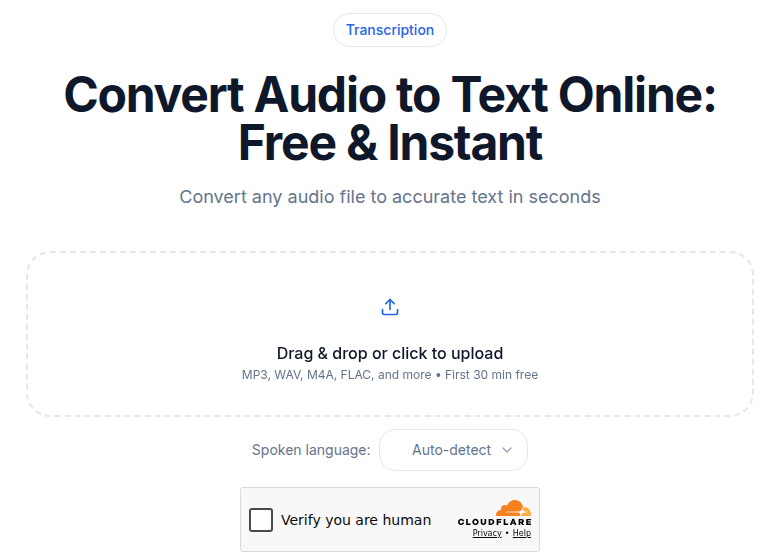 Real-time audio transcription and translation via the ConvertAudioToText audio tool
Category 2: Browser Meeting Captions
This is where most knowledge workers encounter real-time translation day to day, and the landscape changed significantly in early 2026.
Google Meet launched speech translation (not just captions, but voice dubbing that replaces the speaker's audio) as a generally available feature in February 2026. At launch, it supports bidirectional translation between English and Spanish, French, German, Portuguese, and Italian, on Business Standard and Plus, Enterprise Standard and Plus, and Google AI Pro and Ultra plans. A private preview of Gemini 3.5 Live Translate, announced in June 2026, expands Meet to 70+ languages and over 2,000 language combinations, with each participant able to hear a different language in a single meeting. Text caption translation covers 69 languages separately from voice dubbing.
Microsoft Teams offers live translated captions on Teams Premium ($10/user/month on top of existing Microsoft 365) or Microsoft 365 Copilot. Caption translation covers 28+ languages; the AI voice simulation feature, which synthesizes translated speech in your own voice, is currently limited to 9 languages: Chinese, English, French, German, Italian, Japanese, Korean, Portuguese, and Spanish. Organizers can preselect up to 10 languages on Premium plans for attendees to choose from.
Zoom includes translated captions on Workplace Business Plus, Enterprise Essentials, Enterprise Plus, and Enterprise Premier plans, or as a $5/user/month add-on for other paid accounts. Native Zoom captions support 37 source and target languages, with Greek, Norwegian, and Welsh available as targets only.
DeepL Voice for Meetings integrates directly into both Teams and Zoom as a third-party layer and covers 100+ languages. In a 2026 blind evaluation by Slator, 96 percent of linguists preferred DeepL Voice over the native translation in Google, Microsoft, and Zoom. Pricing is enterprise-negotiated; there is no published per-seat rate, but DeepL offers a free trial period.
| Platform | Approach | Languages | Plan Requirement |
|---|---|---|---|
| Google Meet | Voice dubbing + captions | 6 voice / 69 caption (70+ in preview) | Business Standard or higher |
| Microsoft Teams | Captions + AI voice sim | 28+ caption / 9 voice sim | Teams Premium or M365 Copilot |
| Zoom | Captions | 37 | Business Plus or $5/user/mo add-on |
| DeepL Voice | Caption overlay for Teams/Zoom | 100+ | Enterprise quote required |
The pattern worth knowing: English to and from Spanish, French, German, Mandarin, Japanese, and Korean is polished on every platform. Less-resourced pairs vary significantly by vendor, and are worth testing before committing to a platform for regular use with those languages.
Category 3: Mobile Translator Apps
Phone apps handle the bulk of casual real-time translation: travel, quick transactional exchanges, ordering food, on-site supplier meetings.
Google Translate's Conversation Mode remains the most widely used option. It is free, works offline with downloaded language packs, and handles short exchanges reliably. The 2026 update to the Android Translate app brought Gemini-powered audio translation to any headphones, which extends Conversation Mode beyond the phone speaker.
Microsoft Translator stands out for group settings: its group conversation mode supports up to 100 participants, each reading captions in their own language from their own device. Voice translation is available in 100+ languages at no cost. The limitation is that the app treats each pause as a turn boundary, which can fragment longer statements into multiple entries.
DeepL Voice for Conversations extends the company's web and desktop product to iOS and Android. It targets business users who need accuracy in European languages and enterprise privacy guarantees over convenience.
All mobile apps share the same weakness: multi-speaker conversations with background noise push recognition accuracy below the threshold where translation quality holds. For anything recorded on a phone that you will use later, see Category 5 below.
Category 4: Conference and Event Platforms
When attendees are paying for a multilingual experience, AI captions alone are not the standard answer. Wordly, Interprefy, and KUDO all use a hybrid model: speech recognition runs continuously, a confidence threshold determines whether the caption publishes immediately or waits for a brief revision pass, and a human interpreter can be patched in for sessions where terminology is sensitive.
Wordly charges on a usage basis, billed by minutes of live translation rather than per event. All languages are included in a single price; volume discounts of 10 to 30 percent apply to larger packages. Their website lists a Pro+ package covering 60 hours of live translation as a common starting point for organizations with recurring meeting needs. You will need to contact their sales team for a quote.
KUDO and Interprefy price per event with custom quotes based on session length, participant count, and language pairs. Both integrate with Zoom, Teams, and their own conference platforms, and both support human interpreter handoff when AI confidence drops below a threshold.
The honest assessment: AI captions are now better than median human interpreters for standard business content. For medical, legal, financial regulatory, or highly technical material, and for language pairs with limited training data, a human in the loop remains the safer choice. Treating AI and human interpretation as an either/or is a false frame; the conference platforms above are designed for both to run in parallel.
Category 5: Post-Recording Translation
This is where the accuracy ceiling is highest. You record the meeting, lecture, or interview in the source language, transcribe it to clean text, then translate from text. The pipeline takes minutes, not seconds, and the gap in output quality is significant.
The practical workflow is:
- Record in the source language, with speaker diarization enabled if your transcription tool supports it.
- Upload the audio to a transcription service that handles the source language, and review the transcript for proper nouns and technical terms before passing it to translation.
- Translate the reviewed text with a dedicated text translation tool.
- If the target audience only needs the gist, an audio summarizer step between transcription and translation can save significant effort.
For a detailed walkthrough of step one, the transcribe and translate workflow covers the full pipeline including format choices for the handoff between steps.
If you need a transcript without setting up meeting bots or recording integrations, ConvertAudioToText lets you drop in an audio file and get a timestamped transcript in 99 languages without an account. That transcript is then ready to hand to any text translation tool.
Language Pair Quality Reference
The gap between high-resource and low-resource language pairs matters more in real-time than in post-processing, because the model has less time to recover from ambiguous input.
High-resource pairs (production-ready on most platforms): English to and from Spanish, French, German, Italian, Portuguese, Dutch, Mandarin, Japanese, Korean. These pairs have the most training data and the most consistent output across vendors.
Mid-resource pairs (usable with caveats): English to and from Russian, Arabic, Hindi, Turkish, Polish, Vietnamese, Indonesian, Swedish. Quality is reliable in formal speech; degrades faster under accents and background noise.
Lower-resource pairs (improving, not production-ready for live use): Most African languages other than Arabic, smaller European languages, indigenous American languages. For these pairs, post-recording translation with a strong text-to-text model consistently outperforms any live option. See the multilingual meeting transcription guide for practical strategies.
Which Tool Fits Which Job
For day-to-day internal meetings between colleagues, the native captions in your existing meeting platform are good enough and require no additional setup. For external sales calls or partner meetings where nuance matters, DeepL Voice layered onto Teams or Zoom is worth evaluating. For travel and bilateral conversations, a consumer earbud like the W4 Pro handles most scenarios without a subscription. For events where attendees are paying to follow along, a hybrid AI-plus-human conference service is the responsible choice. For any output you will archive or act on, transcribe first and translate from text.
My take: the real-time translation category made a genuine step forward in 2026, particularly with Google's Gemini-powered voice dubbing and DeepL's expansion to 100+ languages. But the latency-accuracy tradeoff has not been solved, and anyone who tells you their tool is accurate and instant is choosing to measure one and claim the other. Know which you need before you commit.
For teams doing regular cross-language work, the transcription for international teams post covers how to build a repeatable workflow that captures both the live conversation and a high-quality text record.
Frequently Asked Questions
Which video meeting platform has the best real-time translation in 2026?
It depends on what you need. Google Meet's speech translation (voice dubbing) supports English to and from Spanish, French, German, Portuguese, and Italian on select Workspace plans, with a private preview expanding to 70+ languages. Microsoft Teams offers translated captions in 28+ languages for Teams Premium holders, and AI voice simulation in 9 languages. Zoom native translated captions cover 37 languages on Business Plus plans or via a $5/user/month add-on. DeepL Voice integrates with both Teams and Zoom and earned higher quality scores in independent evaluations. No single platform wins across all three axes of language coverage, voice quality, and plan accessibility.
What is the latency tradeoff in real-time translation?
The core tension is that speech models produce more accurate output when they have more sentence context, but waiting for that context adds delay. Below roughly 800 milliseconds, translation feels live to most listeners. Above 2 seconds, speakers start talking over the translated audio. The best 2026 systems use incremental decoding, which means you see partial captions appear and sharpen as new words arrive, rather than a wall of text that drops after the speaker stops. Voice dubbing systems add another 1 to 2 seconds on top of caption latency because they also need to synthesize audio.
Do hardware translation earbuds work in group meetings?
One-on-one dialogue is where earbuds perform best. Most consumer translation earbuds are designed for two-person conversation and produce cross-talk artifacts in meetings with three or more speakers. The Timekettle X1 Meeting Hub announced in June 2026 is specifically designed for groups up to 50 participants, but it is a hub device rather than a wearable earbud pair. Consumer earbuds like the Timekettle W4 Pro (listed at $449) work well for travel and bilateral business conversations but are not a substitute for a conference interpretation platform in large-format events.
How accurate is AI real-time translation compared to human interpreters?
For general business content in well-resourced language pairs (English to or from Spanish, French, German, Mandarin, Japanese, Korean, and similar), AI translation is competitive with median professional interpreters. For technical domains like legal, medical, or regulatory content, and for less-resourced language pairs, the gap widens. In a 2026 independent evaluation by Slator, 96 percent of linguists preferred DeepL Voice over the native translation in Google, Microsoft, and Zoom, though that comparison is against the baseline meeting-platform output rather than professional interpreters. Large events where terminology matters still benefit from keeping a human interpreter in reserve.
When should I use post-recording translation instead of live translation?
Any time you will publish, archive, share, or make decisions from the translated content, post-recording gives you meaningfully higher accuracy. The reason is simple: a translation model with full-sentence context outperforms one working from a 400-millisecond audio chunk. The workflow is straightforward: transcribe the recording with a tool that supports the source language, review the transcript for proper nouns and jargon, then translate the clean text. This approach takes minutes rather than seconds and lets a human reviewer catch errors before the output is used. Live translation is the right choice when real-time comprehension is the only goal and you will not reference the output afterward.
Sources
- Google Workspace Updates: Speech Translation in Google Meet Generally Available (verified July 2026)
- Use Live Captions in Microsoft Teams Meetings, Microsoft Support (verified July 2026)
- Enabling and Configuring Translated Captions, Zoom Support (verified July 2026)
- DeepL Voice Product Page (verified July 2026)
- Timekettle X1 Meeting Interpreter Hub Press Release (verified July 2026)
- Timekettle W4 Pro Product Page (verified July 2026)
- Google Live Translate for Any Android Headphones (verified July 2026)
- Wordly AI Pricing (verified July 2026)
Try transcription free
Convert any audio or video to clean, unwatermarked text — speaker labels, timestamps, and AI summaries included. First 30 minutes free, no account.
Related Articles

The Future of Real-Time Translation: What's Actually Coming
Sub-second speech translation is real in 2026. Here's what the technology actually does today, where it still breaks, and which trajectories are worth tracking through 2026.

Best No-Signup Transcription Tools (2026, No Account)
Eight transcription tools you can use without making an account, sorted by how "no-signup" they actually are. Honest 2026 limits on minutes, file caps, and where each one starts asking for an email.