The Future of AI Transcription: What to Watch in 2026
Summarize this article with:
The Trends That Are Real
The most significant thing happening in AI transcription right now is not a single model release. It is a structural shift: transcription accuracy is commoditizing across the major vendors, the compute cost per minute keeps falling, and the value is moving up the stack into post-processing, diarization, and full agentic workflows. The next 18 months will be shaped by those three pressures, not by any single headline release.
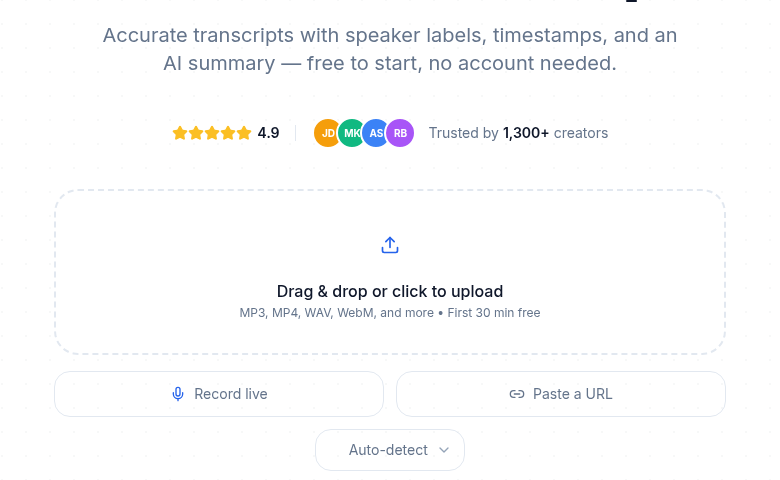 Where the pipeline stands today: upload, transcribe, structure, in minutes
Below is what the evidence actually supports, as of July 2026, framed as an honest outlook for 2027.
On-Device Transcription Is the Bigger Story
The cloud-vs-device question is the structural shift of 2027, not which model scores one point better on a benchmark.
Apple introduced SpeechAnalyzer at WWDC 2025, shipping with iOS 26. It replaces the older SFSpeechRecognizer with three composable modules: SpeechTranscriber for long-form audio, DictationTranscriber for short utterances, and SpeechDetector for voice activity. It runs entirely on-device, handles language management automatically, and ships a proprietary Apple model that benchmarks as roughly 2x faster than Whisper Large-v3-Turbo on equivalent tasks. The model ships with the OS, so apps adopting it carry no additional weight.
On the Android side, Google's Gemini Nano has powered Pixel Recorder and Call Notes on-device since Pixel 8 Pro. The Pixel 10 generation with the Tensor G5 chip makes Gemini Nano available to third-party developers via ML Kit GenAI APIs, which extends on-device audio understanding to the broader Android ecosystem.
Whisper.cpp runs usefully on Raspberry Pi 5 hardware using quantized base-English models, with sub-2-second latency on short clips. The WER on spontaneous speech is higher than cloud APIs, around 13-22% depending on audio quality, so it is not production-grade for complex recordings. For constrained, privacy-sensitive uses it is already viable.
The implications are real: if on-device transcription continues improving, the privacy-sensitive use cases (legal depositions, medical dictation, sensitive interviews) will shift on-device first. Cloud retains the edge for long-form, multi-speaker, multi-language recordings where heavier models and server-side diarization still pull ahead.
Multilingual Coverage Is Accelerating, With Caveats
The 2026 multilingual picture improved faster than most 2025 forecasts expected.
Deepgram expanded Nova-3 across multiple rounds of language additions through 2025 and 2026, adding European, Asian, and South Asian languages in successive releases. The approach is targeted: keyterm prompting and expanded vocabulary coverage, not just raw multilingual pretraining.
Meta open-sourced an Omnilingual wav2vec 2.0 model alongside a corpus covering 350 underserved languages. That kind of scale matters for the long tail of languages that Western commercial models have underprioritized.
Alibaba's SenseVoice (Tongyi SpeechTeam, released 2024) handles 50 languages with SenseVoice-Large, runs 15x faster than Whisper, and benchmarks notably stronger than Whisper for Chinese and Cantonese. Open-source models from Chinese labs are now a legitimate option for Asian-language transcription, not just a footnote.
The honest caveat: "multilingual" often means "supported" rather than "equally good." African, Indigenous, and many Southeast Asian languages still show significantly higher word error rates than English on the same models. The data gap is structural, not just a training problem. See our explainer on why AI struggles with low-resource languages for what drives that gap and what the research trajectory looks like.
Model Releases: What Is Real vs. What Is Rumor
Several significant releases have happened or are on credible trajectories. Two things the existing forecasts got wrong are worth correcting.
What has already shipped: OpenAI's shift away from standalone Whisper updates is no longer speculation. gpt-4o-transcribe and gpt-4o-mini-transcribe launched in March 2025, offering lower word error rates than whisper-1 for most audio. The GPT-Realtime-Whisper model, optimized for low-latency streaming, is now available separately. The Whisper-family roadmap is increasingly subsumed by OpenAI's broader audio model family rather than discrete Whisper large-v releases.
What is a credible cadence, not an announcement: Deepgram shipped Nova-3 in early 2025 (not "late 2025" as earlier versions of this post stated). Nova released in 2023, Nova-2 in 2024, Nova-3 in early 2025. If that cadence holds, a Nova-4 in late 2026 or early 2027 is plausible. The most likely focus areas are noisy audio handling and code-switching across languages, where Nova-3 still has documented gaps versus Whisper on certain benchmarks. But no official Nova-4 announcement exists as of the date of this post. Treat that as a pattern, not a prediction.
For a deep look at Deepgram's current model, our Deepgram Nova-3 explainer covers the architecture and accuracy data. For Whisper's trajectory, see Whisper Large-v3 explained.
Pricing Pressure Is Real, But "Free" Is Still a Funnel
Per-minute cloud transcription costs have fallen dramatically since 2022, and the trend is continuing.
Verified current rates as of July 2026:
| Provider | Model | Price per Minute |
|---|---|---|
| OpenAI | gpt-4o-mini-transcribe | ~$0.003 |
| OpenAI | gpt-4o-transcribe / whisper-1 | ~$0.006 |
| Deepgram | Nova-3 pre-recorded | Under $0.01 (volume-tiered) |
| AWS Transcribe | Standard, tier 1 | ~$0.006 (batch) |
| Self-hosted Whisper | GPU rental | ~$0.30-0.36/audio-hour |
Two structural pressures will reshape the pricing landscape through 2027.
First, self-hosting is genuinely approaching the cost of cloud APIs at meaningful volume. Whisper Large-v3 inference on a rented GPU costs around $0.30-0.36 per audio hour in compute, but that excludes infrastructure, queuing, monitoring, and engineering time. The realistic break-even for self-hosting versus managed APIs is roughly 500-2,400 hours of audio per month depending on whether you count DevOps cost. Below that volume, managed APIs are cheaper all-in even at their current prices.
Second, major LLM providers are bundling transcription into broader audio products rather than selling it standalone. OpenAI's gpt-4o-transcribe is already an integrated model, not a standalone Whisper call. Google's Gemini API includes audio understanding. The pure-play transcription API is under pressure from above (bundled LLM APIs) and from below (open-source self-hosting). The vendors most likely to hold margin are those with strong diarization, vertical specialization, and post-processing that the base models do not provide.
For a full breakdown of how pricing models differ, our transcription pricing models explained post covers metered vs. unlimited vs. bundled structures.
Free tiers remain a funnel, not a floor. Per-minute pricing is converging on compute cost, which means free tools have to monetize through subscriptions, upsells, or ads. The pattern of "free for light use, paid for UX and templates" is not going away. If you just need a clean transcript without a meeting bot or a pipeline, ConvertAudioToText offers a straightforward paid plan built on top of the same underlying models.
Diarization Is Improving, But Still Half-Solved
Speaker diarization is the most persistent failure mode in 2026 transcription. Two voices with similar fundamental frequency, overlapping speech, or speakers introduced mid-recording all break current systems in ways that are obvious to any human listener.
The benchmark progress is real. Pyannote 3.1 reports roughly 10% DER (diarization error rate) on standard benchmarks with optimized configurations. Precision-2, the commercial offering from pyannoteAI, benchmarks 14% better than Precision-1 and 28% better than open-source Pyannote 3.1. AssemblyAI's speaker embedding update documented a 30% improvement in noisy environments.
The gap that matters for 2027 is between benchmark performance and production performance. Real recordings (conference calls, multi-person interviews, field audio) expose all the edge cases that curated benchmarks smooth over. The systems are getting better on clean recordings faster than they are getting better on real-world audio. Expect continued improvement, but diarization on difficult multi-party audio will still need human review for high-stakes use cases through at least 2027.
Agentic Workflows Will Absorb the Single-Tool Category
The most interesting structural shift is not a model release. It is the absorption of standalone transcription tools into orchestrated agentic workflows.
A 2026 deployment often looks like this: a recording arrives from Zoom, Teams, or a phone call; an agent transcribes it; a second agent generates a structured summary against a domain template; a third extracts action items and creates tasks in a project management tool; and a fourth surfaces follow-up questions before the next meeting. Transcription is step two in a five-step pipeline, not the product.
Zoom's March 2026 expansion of its agentic AI platform explicitly moves the meeting assistant from recording into workflow orchestration: cross-system actions, email drafting, and trigger-based summaries all from a single meeting recording. That direction is representative, not unique.
The implication: single-purpose tools (upload audio, get text) will increasingly serve niche users who want control, privacy, or simplicity outside a corporate collaboration stack. That is not a shrinking market, but it is a different one than the enterprise meeting-automation segment.
Our agentic transcription systems post covers what this pipeline looks like technically and where the transcription step connects to downstream tools.
What Probably Will Not Happen
Some 2027 predictions circulating in vendor marketing are not well-supported by current trajectories.
Real-time transcription replacing human captioners entirely. Live broadcast captioning demands sub-second latency, complete accuracy on names and numbers, and reliable recovery from audio dropouts. AI augments human captioners in live settings; it does not replace them on high-stakes broadcasts.
A single model dominating all 7,000 human languages. Meta's Omnilingual corpus and model are significant, but 1,600 supported languages still leaves the majority of the world's languages with limited or no coverage. Coverage scales faster than accuracy; having a model that can attempt a language is not the same as having one that transcribes it reliably.
Transcription becoming free. The per-minute cost is approaching compute cost at scale, but compute cost is not zero. Free tiers are acquisition channels. The paid tier is the product.
A Note on Verticals
General-purpose transcription accuracy is converging across the major vendors. The differentiation in 2027 will come from vertical depth: custom vocabularies, domain-specific summarization, industry output formats, and compliance (HIPAA for medical, specific retention rules for legal). AWS Transcribe Medical handles clinical vocabulary and HIPAA compliance. Several specialized vendors target court reporting workflows with verbatim output and named-entity recognition for legal parties.
For general users, specialized tools are overkill. For the verticals listed, the gap between specialized and general models will likely widen as the base models commoditize and the post-processing layer becomes the actual product.
FAQ
What is the biggest change coming to AI transcription by 2027?
The biggest change is structural rather than technical: transcription is moving from a standalone product into an embedded step in agentic workflows. The accuracy gap between vendors has narrowed enough that the differentiator is increasingly what happens after the transcript, not the transcript itself.
Will on-device transcription replace cloud APIs?
Not for complex use cases. On-device transcription (Apple SpeechAnalyzer on iOS 26, Gemini Nano on Pixel devices, Whisper.cpp on edge hardware) is viable for privacy-sensitive, single-speaker, clean-audio scenarios. Cloud APIs still lead for long-form recordings, multi-speaker diarization, code-switching languages, and integrations that require post-processing.
How much does AI transcription cost in 2026, and will it keep falling?
API pricing as of mid-2026 ranges from around $0.003/min for gpt-4o-mini-transcribe to a few cents per minute for streaming APIs. Self-hosting Whisper costs roughly $0.30-0.36 per audio hour in GPU compute, but only becomes economically attractive against managed APIs above several hundred hours of audio per month. Prices will continue falling modestly, but the floor is compute cost, not zero.
Is speaker diarization reliable enough to use in production in 2027?
For clean two-to-three-speaker recordings with distinct voices, yes. For noisy multi-party calls, overlapping speech, or voices with similar acoustic profiles, the error rates are still high enough to require human review on anything high-stakes. Benchmark numbers (pyannote 3.1 at roughly 10% DER) look better than production performance on real-world audio. The gap is closing but will not close fully by 2027.
Sources
- Deepgram pricing page: https://deepgram.com/pricing
- Deepgram Nova-3 announcement: https://deepgram.com/learn/introducing-nova-3-speech-to-text-api
- Amazon Transcribe pricing: https://aws.amazon.com/transcribe/pricing/
- Apple SpeechAnalyzer documentation: https://developer.apple.com/documentation/speech/speechanalyzer
- OpenAI next-generation audio models: https://openai.com/index/introducing-our-next-generation-audio-models/
- Argmax / Apple SpeechAnalyzer coverage: https://www.argmaxinc.com/blog/apple-and-argmax
- Gemini Nano on Android: https://developer.android.com/ai/gemini-nano
- Meta Omnilingual ASR: https://www.techrepublic.com/article/news-meta-expands-ai-speech-recognition/
- SenseVoice GitHub: https://github.com/FunAudioLLM/SenseVoice
- Pyannote diarization state of the art: https://picovoice.ai/blog/state-of-speaker-diarization/
- Zoom agentic AI platform expansion: https://news.zoom.com/ec26-agentic-ai-platform-announcements/
- Self-hosted Whisper cost analysis: https://brasstranscripts.com/blog/openai-whisper-api-pricing-2025-self-hosted-vs-managed
Try transcription free
Convert any audio or video to clean, unwatermarked text — speaker labels, timestamps, and AI summaries included. First 30 minutes free, no account.
Related Articles
How to Transcribe Voice Recorder Recordings (Any Device)
Get text from any voice recorder, from Anker SoundCore Work to old Olympus dictaphones. Covers file transfer, formats, WMA conversion, speaker labels, and export options.

How AI Transcription Works: The Product Pipeline Explained (2026)
From upload to exported transcript: a clear walkthrough of every stage in the AI transcription pipeline, including VAD, ASR, diarization, post-processing, and export.