Best Recorder for Journalists in 2026: Gear by Scenario
Summarize this article with:
By Scenario
The right recorder depends on the job, not on a single spec number. A $109 pocket device that works in a quiet briefing room might ruin your audio at a noisy press scrum. What follows maps specific hardware to specific scenarios, prices verified against manufacturer and retailer pages as of July 2026.
A dedicated recorder costs less than a single billable hour at most outlets. It pays for itself the first time you avoid a corrupted file, a phone killed mid-interview by an incoming call, or a muddied clip that strips a quote you cannot get back.
Press Scrums and Crowd Situations
The Zoom H1essential is the go-to for breaking-news pack situations. It is the current production model replacing the discontinued H1n. Street price is around $110 at most retailers. Two XY-pattern condenser mics capture directional stereo, USB-C charging runs off any power bank, and the record button is a single press, no menu diving when you are shoving a recorder toward a podium.
Battery life is rated around 10 hours on two AAA batteries. It records WAV at up to 32-bit float, which means you do not have to set levels before the press secretary says something important. The float format will not clip even if the gain is too high.
The weakness is wind. Bring a foam windscreen for any outdoor briefing. Without one, a 12-mph gust will ruin more audio than a bad microphone ever would. Zoom includes a small foam slip; it helps but is not a substitute for a full dead-cat cover in real conditions.
Discreet One-on-One Source Interviews
The Sony ICD-TX660 is the recorder for situations where pulling out an obvious mic changes how a source talks. It is roughly the size of a USB drive, weighs almost nothing, and sits comfortably clipped to a jacket pocket or lying on a table between two coffee cups. Street price is around $160.
The built-in stereo microphones capture clear speech up to about 8 feet with good noise reduction. The 16GB of onboard storage holds hundreds of hours of audio at standard quality settings. You are not filling a card at a 60-minute interview.
The interface is more menu-heavy than the Zoom, which is the tradeoff for the form factor. Practice navigating to the record screen before you sit down with a source so you are not fumbling during the meeting.
Multi-Speaker Panels and Round-Table Interviews
When you have three or more speakers, separate tracks per person is the only thing that gives you clean speaker diarization downstream. The Zoom H5studio ($349.99) has two XLR/TRS combo inputs plus two built-in mic tracks, recording up to six tracks simultaneously. The H6studio ($399.99) extends that to four XLR inputs and six total tracks.
Each speaker on a dedicated lavalier mic, routed to a separate XLR channel, means AI transcription can separate speakers with very high confidence rather than guessing from timing. The accuracy gap between a mixed single-track interview and separated tracks is large enough to matter in a tight deadline.
The H5studio runs on four AA batteries for around 15 hours. It is heavier and bulkier than an H1essential, which is the legitimate reason to leave it at home for solo interviews. For round-tables, Q-and-As, or podcast-style editorial conversations, the separated tracks justify the price and bulk.
The H5studio and H6studio are the current studio-grade lineup from Zoom. The older H5 and H6 are still available at some retailers at lower prices, though the studio versions add 32-bit float recording and quieter preamps.
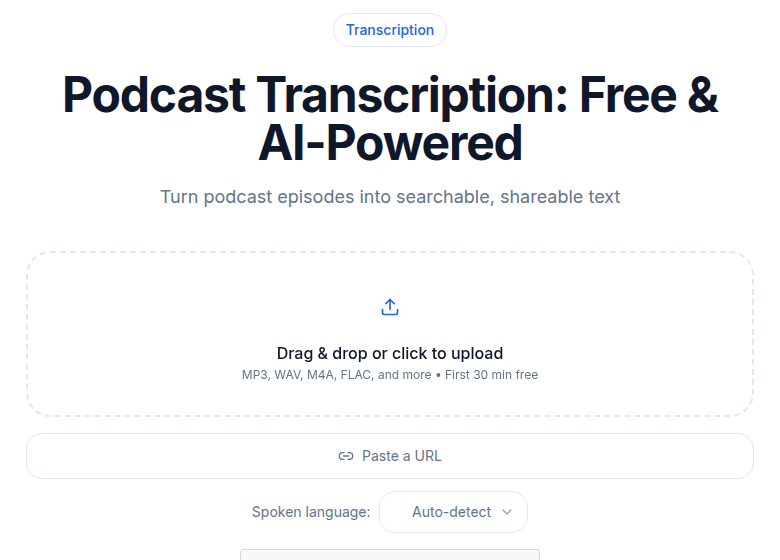 Podcast and multi-speaker transcription tool on ConvertAudioToText
Field Reporting and Outdoor Work
For outdoor field reporting where ambient noise is unavoidable, the mic choice matters more than the recorder body.
A shotgun mic with a tight pickup pattern ignores most of the noise beside and behind the speaker. The Rode VideoMicro II at $79 is the standard budget pick. It runs passively off the 3.5mm connection with no batteries, and the included dead-cat windshield handles moderate wind. Paired with any recorder that has a 3.5mm input, it gives you a tighter pickup than any built-in stereo pair.
The Tascam DR-05XP at around $109 is the budget recorder body to pair with an external mic for field work. It is the updated version of the DR-05X, adding 32-bit float recording and USB-C. Battery life is around 17.5 hours on two AA batteries. The build is plastic and the buttons are small, but the preamp is cleaner than the price suggests, and it handles an external mic without noise floor problems.
For solo stand-ups or press walks, a Rode SmartLav+ lavalier clipped to the lapel and plugged into the recorder's 3.5mm jack gets you closer voice capture than any handheld mic you point at yourself. The SmartLav+ runs around $41-49 at current retail.
Phone Kits That Get Close Enough
A dedicated recorder is the right call in most scenarios. But if the budget is genuinely zero or you need a kit that fits in a single pocket, the right phone app moves the needle more than most people expect.
On iPhone, the Hindenburg Field Recorder app ($4.99) is built specifically for journalism workflows. It gives you level meters, a one-dial compressor, marker-setting for important moments, and direct export to audio editors. The free version stops recordings after one minute, which makes it unusable in practice. The paid app is the tool NPR correspondents have cited in field reporting contexts.
On Android, a purpose-built recorder app with a proper export path matters more than which one specifically. Easy Voice Recorder Pro (around $4) handles long files cleanly and lets you sync to cloud storage.
For phone call recording specifically, the legal layer comes first. Recording laws vary by jurisdiction, some require only one-party consent, others require all parties. Check your state or country's rules before capturing any call.
When the phone is the only option, plug in an external mic. Even a $20 lavalier clipped to the source raises interview quality measurably. The SmartLav+ plugs directly into iPhones via a 3.5mm to Lightning adapter, and into Android phones with a 3.5mm jack natively.
The Mic Pairings That Matter
Hardware reporters consistently underestimate: the recorder body is half the equation. The mic determines pickup pattern, wind handling, and distance before audio starts degrading.
| Scenario | Mic pick | Approx. price |
|---|---|---|
| One-on-one interview | Rode SmartLav+ lavalier (clip to source) | $41-49 |
| Round-table / panel | Boundary mic in table center | $60-80 |
| Outdoor field reporting | Rode VideoMicro II shotgun | $79 |
| Long-distance or podium | Rode VideoMicro II or similar shotgun | $79 |
The Audio-Technica ATR4697 boundary mic (around $70 at current retail) is the standard pick for conference-table recordings. It sits flat in the center and captures omni pickup across the surface, which beats pointing a handheld at whoever is speaking.
Recording Settings That Affect Transcription Accuracy
Transcription accuracy is a function of recording quality more than AI engine quality. A clean recording on a budget recorder consistently outperforms a poor recording on expensive hardware.
Set input gain so audio peaks around -12 dB on the meter. Too hot and loud moments clip; too quiet and the source gets buried in noise floor. Spend two minutes adjusting before each interview rather than trusting the auto setting.
Record WAV at 16-bit/44.1 kHz minimum. MP3 is acceptable at 192 kbps or above, below that, transcription accuracy drops noticeably on quiet speech and consonants. The transcription accuracy guide covers the technical reasons in detail.
Use the low-cut filter (sometimes labeled HPF, set around 80-100 Hz) for indoor interviews. It removes HVAC rumble and handling noise without touching speech frequencies.
If You Buy One Thing
The Zoom H1essential plus a Rode SmartLav+ lavalier is the starter kit. Total around $155. The H1essential handles any recording scenario the built-in mics can cover. The SmartLav+ handles close interviews and phone plug-in situations. Both fit in a jacket pocket. Both run on standard batteries.
If you regularly do panel interviews or investigative documentary work, add the Zoom H5studio for the XLR inputs and separated tracks. It costs more but removes the diarization problem almost entirely.
For clean transcripts from any of these setups, ConvertAudioToText's interview tool handles multi-speaker audio and outputs speaker-labeled text without a meeting bot or installation. Upload the file after you get back to a desk.
For the full workflow from field recording to published story, the interview transcription guide covers what to do with the audio once you have captured it well. Good gear plus a clear post-capture process is the combination that cuts filing time in half.
FAQ
Does the Zoom H1essential replace the H1n?
Yes. Zoom discontinued the H1n and the H1essential is the current replacement. The main improvements are USB-C charging (the H1n used Micro-USB) and 32-bit float recording, which removes the need to manually set gain before recording. The H1essential runs around $110. Some retailers still stock H1n units at reduced prices, but Zoom no longer produces it.
What is the best recorder for phone interviews?
The Sony ICD-TX660 has a line-in jack that accepts telephone recording adapters, making it the cleanest option for capturing both sides of a call on a traditional phone or a phone with a 3.5mm headset port. For modern smartphones without a headset jack, a call-recording app combined with Bluetooth earbuds captures both sides, though audio quality is lower. The legal requirement to disclose recording varies by jurisdiction.
Does recording format matter for AI transcription?
It matters at the low end. WAV at 16-bit/44.1 kHz is reliable for any transcription engine. MP3 at 192 kbps or above performs comparably. MP3 at 128 kbps or below begins to degrade consonants and quiet speech in ways that lower accuracy meaningfully, particularly for non-English languages and accented speakers. Avoid formats that compress to very low bitrates (under 64 kbps) for any interview you intend to transcribe.
Is a dedicated recorder worth it if I already own a recent iPhone or Pixel?
For quiet, close-range, one-on-one interviews: a modern flagship phone is adequate if you keep it within 18 inches of the source. For anything else, outdoor work, press scrums, long recordings, multi-speaker conversations, or anything where a call or notification could interrupt, a dedicated recorder earns its cost on the first interview that would have gone wrong. The battery life difference alone (10-17 hours on AAs versus 2-3 hours of intensive recording on a phone) is the deciding factor for full-day reporting days.
Sources
- Zoom H1essential product page: https://zoomcorp.com/en/us/handheld-recorders/handheld-recorders/h1essential/
- Zoom H5studio product page: https://zoomcorp.com/en/us/handheld-recorders/handheld-recorders/h5studio/
- Zoom H6studio product page: https://zoomcorp.com/en/us/handheld-recorders/handheld-recorders/h6-audio-recorder/
- Tascam DR-05XP product page: https://tascam.com/us/product/dr-05xp
- Sony ICD-TX660 on Amazon: https://www.amazon.com/Sony-ICD-TX660-Digital-Recorder-Display/dp/B09Q3J873X
- Rode SmartLav+ product page: https://rode.com/en-us/products/smartlav-plus
- Rode VideoMicro II announcement (DPReview, $79 confirmed): https://www.dpreview.com/news/9479792766/rode-announces-79-videomicro-ii-with-new-design-and-improved-audio-capture
- Hindenburg Field Recorder: https://hindenburg.com/products/field-recorder/
- H5studio review (Transom, 2026): https://transom.org/2026/zoom-h5studio/
Try transcription free
Convert any audio or video to clean, unwatermarked text — speaker labels, timestamps, and AI summaries included. First 30 minutes free, no account.
Related Articles

Ethics of Interview Transcription: Core Obligations
A practical guide to the ethics of interview transcription for researchers: IRB consent scope, anonymization vs pseudonymization, cloud processing disclosure, retention, and participant review.

Fact-Checking From Transcripts: A Practical Workflow (2026)
How journalists and researchers fact-check from interview transcripts. Covers claim extraction, timestamp citation, ASR homophone errors, and audio verification workflow.