
Fact-Checking From Transcripts: A Practical Workflow (2026)
Summarize this article with:
A transcript is an index into your audio, not a substitute for it. Fact-checking from transcripts means verifying every quote against the recording, treating AI transcription errors as a real misquote risk, building a timestamped evidence chain for each claim, and cross-referencing source statements against public records. The workflow has eight steps, from building the verification chain to documenting your methodology for editorial and legal review.
The fastest way to invalidate a disputed quote is to open the audio at the exact timestamp and play it. That is what transcripts are for: not a final record, but a navigable index of everything your sources said, when they said it, and in what context.
This is a workflow for journalists, researchers, and editors who want to fact-check from interview transcripts without missing the errors that turn a careful story into a correction.
Note: The sections covering audio retention and legal protection describe general journalistic practice, not legal advice. Consult a media lawyer for guidance on your specific situation.
What a Transcript Proves (and What It Does Not)
A transcript proves:
- The source said specific words in a specific order
- At a specific timestamp in a specific recording
- In the context of a specific conversation
A transcript does not prove:
- The source was telling the truth
- The source's claims align with public records
- The source's interpretation of events is correct
- Your published story accurately reflects the full interview
Each of those gaps requires separate verification. The transcript is the starting point, not the finish line.
Step 1: Build a Verification Chain
Every quote and factual claim in your draft should trace back to three things:
- A specific transcript line with timestamp
- A specific audio file that is backed up in at least two locations
- A specific corroborating source (public record, second source, or expert) where applicable
Most newsrooms with dedicated fact-checkers operate a system where each citation in the draft points to a transcript line plus timestamp plus audio file. The fact-checker reviews the audio for each quote, then separately verifies underlying claims against public records.
For solo journalists, you build this chain yourself before publication. It is tedious. It is also how you avoid corrections that outlive the original story.
Step 2: Verify Quoted Words Against the Recording
Open the audio at each timestamped quote. Listen to 30 seconds before and after the clip. Confirm the words in the transcript match exactly what was said.
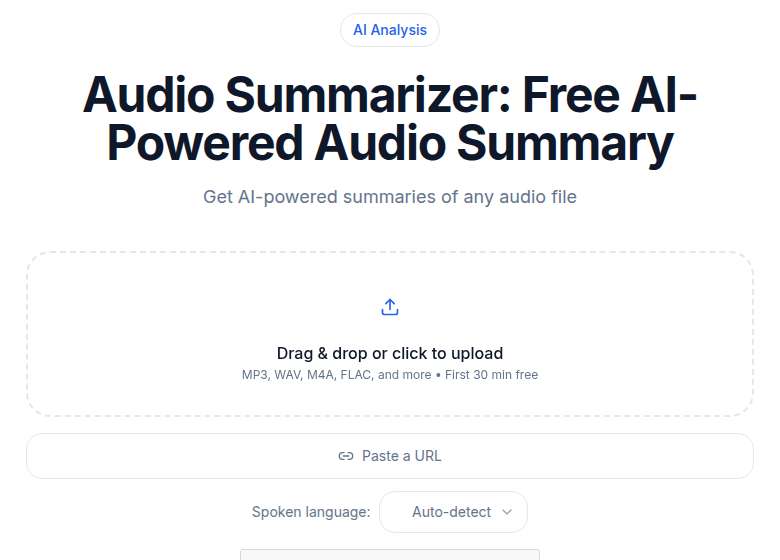 The summary view maps claims fast; verification still happens against the audio
Timestamps on every line let you jump directly to the source moment in the audio, rather than scrubbing through the whole recording.
What to catch:
Dropped negatives. "I did not authorize that" mistranscribed as "I authorized that" flips the meaning completely. Always verify negatives in significant quotes.
Transposed numbers. "Thirteen" vs "thirty," "twenty-three" vs "2,300." Especially dangerous in financial or statistical claims. Modern ASR handles numbers reasonably well on clean audio, but phone recordings and fast speech create real risk.
Homophone substitutions. AI transcription passes plausibility checks on homophones by picking the contextually likely word, but gets it wrong in niche domains. "Bail" vs "bale," "meet" vs "meat," "there" vs "their" rarely change meaning but "profit" vs "prophet," "cite" vs "site" vs "sight," or "affect" vs "effect" can. Read every homophone-prone word in critical quotes with fresh eyes.
Mangled proper nouns. People's names, company names, and place names are where AI transcription is weakest. The model has no way to know that "Smithkosky" is actually "Smitchkowsky." Always verify proper nouns against public records or the source's own materials.
Truncated context. The transcript reads "We knew about it." The audio reveals the source was describing a hypothetical, a past example, or someone else's belief. Never quote from transcript alone when the surrounding context could change the meaning.
For any quote you plan to publish, mark it "audio-checked" before it goes to an editor. Anything not audio-checked should not go to publication.
Why ASR Accuracy Figures Are Not a Safety Net
Current leading ASR systems reach 95-98% word accuracy on clean studio audio, but accuracy falls to 85-92% on video calls and to 80-88% or lower on phone recordings, heavy accents, or overlapping speech, according to 2026 benchmarks from AssemblyAI. Speaker label assignment shows a Diarization Error Rate of 10-20% in leading systems on spontaneous conversation, based on the SDBench 2025 evaluation across 13 datasets.
That means even on a clean recording, a 1,000-word interview may carry 20-50 word errors. Some are trivial ("uh" omitted). Others are not. The workflow here treats each important quote as unverified until you have listened to it yourself. For deeper context on how accuracy is measured, see what transcription accuracy really means and how speaker diarization works and where it fails.
Step 3: Verify Factual Claims Against Sources
Every factual claim a source makes that you plan to publish needs verification beyond the transcript.
Numbers. If a source says "revenue doubled last year," check against the company's filings, published statements, or earnings releases. For public companies, SEC filings are authoritative. If a number cannot be verified, either drop it, attribute it cautiously ("Smith said revenue doubled, though the company has not released audited figures publicly"), or get explicit on-record confirmation.
Names and titles. If a source refers to "the CEO of XYZ Corp," verify the current job title through the company's official channels and check spelling against the person's published bio.
Dates and events. If a source says "in 2019, we launched X," check archived press releases, Wayback Machine snapshots, or contemporaneous news coverage. Memory compresses time; people often misplace events by a year or two.
Quotes attributed to others. If your source claims someone else said something, get it on the record from that person directly. Quotes-of-quotes from a single source are weak. Verify or attribute with explicit caveat.
Step 4: Cross-Reference Multiple Interviews
When you interview multiple sources about the same events, compare their accounts systematically.
Consistency across sources strengthens a claim. Two or more independent sources agreeing on a specific detail increases your confidence before publication.
Contradictions between sources, or between a source and a public record, are often the most newsworthy element in an investigation. At minimum they require an explanation. Sometimes they are the story.
Common gaps. If three sources each avoid discussing the same topic, that pattern is itself a finding.
Outliers. One source claiming something no one else corroborates needs careful weighing. It might be the only person with direct knowledge, or it might be misremembering. Neither can be assumed.
Step 5: Build a Source Documentation Index
An investigation generating 20-50 hours of interview audio is impossible to fact-check without structure. A simple spreadsheet or Airtable table with these columns works:
- Source name
- Interview date
- Audio file location (primary and backup)
- Transcript file location
- Key claims with timestamps
- Verification status: raw / transcribed / audio-checked / claim-verified
When an editor challenges a specific claim, you search the index and immediately have who said it, when, the exact transcript line, the audio file, and what corroborating sources exist.
Step 6: Handle Contradictions Carefully
Sources contradict themselves. They contradict each other. They contradict public records.
For each contradiction:
- Confirm both versions in their respective audio files
- Assess whether the contradiction is substantive or a trivial inconsistency
- Note the contradiction explicitly in your reporting
- Give the source an opportunity to address or clarify
A source saying contradictory things on the same topic within a single interview is usually significant. A source contradicting a public record is significant. The reader deserves to know.
Step 7: Handle Edge Cases
Audio quality problems. If a key quote is unclear, do not guess. Have a second person listen and confirm, note that the quote is approximate, or drop it. Never publish a quote you are not confident of from degraded audio.
Translated interviews. When you interview in a language other than your publication's language, document the original-language transcript with timestamps alongside your translation. Note any translation choices that involved ambiguity. Original-language verification should remain possible.
Off-the-record material. When a source goes off the record mid-interview, mark that section clearly in the transcript. You can use the audio to fact-check your own understanding, but you cannot publish or quote from off-the-record sections. Most newsrooms have written policies on what this means; follow yours. The SPJ Code of Ethics recommends that journalists explain to sources what off-the-record means before granting it, and that any off-the-record arrangement be cleared with a supervisor.
Anonymous sources. Per the SPJ's published position, anonymous sources require corroboration: the transcript and audio prove the source said it to you, but other evidence proves the underlying claims are accurate. Never publish anonymous-source claims without additional corroboration.
Step 8: Document Your Methodology
For investigative or legally sensitive pieces, write down what you did:
- Number of sources interviewed
- Total hours of audio
- Date range of interviews
- Languages used
- Method of recording (in-person, phone, video call)
- Verification steps taken for each major claim
- Sources who declined to comment and what they were asked
This documentation protects you editorially and gives lawyers something to work with if the story is challenged. It also improves your own process over time.
My Take: The Timestamp Is the Citation
Journalism is getting more demanding about evidentiary standards, not less. Readers, editors, and legal teams all expect that a disputed quote can be traced to an exact moment in an original recording. The timestamp is your citation the way a page number is an academic citation.
The workflow above treats every published quote as needing two things: the exact words confirmed against audio, and the underlying claim verified against a source outside the interview. The transcript makes step one fast. Public records, official filings, and additional sources handle step two. Skipping either one turns accuracy into luck.
For how to transcribe interview recordings efficiently before starting this workflow or a broader look at how journalists use transcription day-to-day, those posts cover the upstream steps.
If you need timestamped transcripts without a meeting bot or subscription commitment, ConvertAudioToText processes audio and video with speaker labels and lets you export SRT, VTT, or plain text to carry into your verification workflow.
Common Fact-Checking Mistakes
Trusting an AI transcript without listening. On clean audio, modern ASR gets roughly 95-98% of words right. On a phone call, that drops. The 2-5% gap on good recordings includes errors that flip meaning: dropped negatives, wrong numbers, mangled names.
Not saving the original audio. Losing the file removes your only defense against a disputed quote.
Skipping cross-reference. Single-source claims are the weakest kind. Always look for corroboration before publishing.
Misattributing speaker labels. Speaker diarization in commercial ASR systems carries meaningful error rates, particularly on overlapping speech and poor audio. Verify speaker attribution before publishing any attributed quote.
Conflating "I remember" with "verified." Memory is not verification. The recording is verification.
Cutting corners on deadline. Five minutes saved is not worth the correction. Or the lawsuit.
Workflow Tools
For systematic fact-checking:
- Timestamped transcription via ConvertAudioToText's audio-to-text tool or another service with word-level timestamps
- Source database in Notion, Airtable, or a spreadsheet with verification status per claim
- Local and cloud audio backup for every file before and after publication
- Public records databases matched to your beat: SEC EDGAR for finance, PACER for federal court filings, academic databases for science
FAQ
Can I fact-check from an AI transcript alone?
No. On clean audio, leading ASR systems reach 95-98% word accuracy, but accuracy drops to 85-92% on video calls and lower on phone audio or heavy accents. The remaining error rate includes high-impact mistakes: dropped negatives, transposed numbers, wrong proper nouns. Always cross-check important quotes against the original audio.
What is the difference between verifying a quote and fact-checking a claim?
Verifying a quote means confirming the source said exactly those words in that order. Fact-checking a claim means confirming the underlying assertion is true. You need both: the transcript proves the words were spoken, but it cannot tell you whether the speaker was accurate.
How long should I keep interview audio after publication?
Industry practice runs from one year for routine stories to indefinitely for investigative pieces that could face legal challenge. Many newsrooms have written retention policies. When in doubt, keep the audio longer. Losing the file is not a defense.
What if a key quote is unclear in the audio?
Do not guess. Either have a second person listen and confirm independently, note in the article that the quote is approximate, or drop it entirely. Never publish a quote you cannot hear clearly.
Sources
- AssemblyAI: How accurate is speech-to-text in 2026 - WER benchmarks and real-world accuracy ranges by scenario
- SDBench: A Comprehensive Benchmark Suite for Speaker Diarization (arXiv 2507.16136) - 2025 diarization error rate evaluation across 13 datasets and 6 systems
- Society of Professional Journalists: Code of Ethics - Anonymous sources, off-the-record, and verification standards
- ConvertAudioToText pricing page - Free and paid plan details verified July 2026
Try transcription free
Convert any audio or video to clean, unwatermarked text — speaker labels, timestamps, and AI summaries included. First 30 minutes free, no account.
Related Articles

Ethics of Interview Transcription: Core Obligations
A practical guide to the ethics of interview transcription for researchers: IRB consent scope, anonymization vs pseudonymization, cloud processing disclosure, retention, and participant review.
How to Extract Quotes from an Interview Recording
A workflow-led guide for journalists and writers: how to extract publishable quotes from interview transcripts, with editing ethics, context rules, and approval flows.