How to Extract Quotes from an Interview Recording
Summarize this article with:
The Quote Pipeline
Getting a usable quote from an interview transcript is a four-stage process: find candidates, verify each one against the audio, clean up only what you may clean, then place them in a story with enough context that the reader understands what they mean. This post walks that pipeline step by step, from raw transcript to publishable pull-quote.
A 60-minute interview typically yields 4-6 publishable quotes. Most reporters spend 25-35 minutes on the full extraction process. With a tool that surfaces candidates automatically, the skim step collapses to under a minute. The verification and judgment calls still require a human.
Step 1: Get the Transcript Into Working Shape
Before you touch quote extraction, the transcript needs two things: speaker labels and timestamps.
A transcript that says "Speaker 1 / Speaker 2" is almost unusable for quote work. Most modern transcription tools, including audio-to-text tools that support speaker diarization, let you rename speakers before or after the run. Do it immediately, while you still remember who said what. A label like "Sen. Alvarez" is ten times faster to scan than "Speaker 2."
Timestamps matter because they are your verification link. Every quote you decide to use needs a timestamp so you can find the audio moment in under five seconds if a source later disputes the wording. Export or keep timestamps visible throughout the process.
Save the original audio file to a labeled folder. Audio is your legal and ethical record. Transcripts are working documents. Audio is evidence.
Step 2: First-Pass Skim for Candidates
Open the transcript and skim, not read. You are looking for moments worth stopping on.
Mark these as candidates:
- Definitive claims with specifics. "Profits doubled in Q3." "We will launch in September." Anything verifiable and attributed to this source.
- First-person accounts. "When I was in the room, this is what happened." The source's words are the record for events only they witnessed.
- Surprising statements. Anything that contradicted your expectations or made you look up during the interview.
- Vivid phrasing. A phrase that captures a complex idea in language no paraphrase would improve.
- Direct contradictions. If the source contradicts a prior public statement or another source you have talked to, that moment is almost always quotable.
Skip generic statements, throat-clearing, and any passage that needs three sentences of setup to make sense on its own. A quote that requires more explanation than the quote itself is probably better as a paraphrase.
A 60-minute interview typically produces 8-15 candidates. You will cut that to 4-6 final quotes.
Step 3: Surface Candidates Faster With a Journalism Template
For longer interviews, you can bypass most of the manual skim.
CATT's journalism interview template generates verbatim pull-quote candidates with speaker attribution, timestamps, and one-line context for each. The template also extracts fact-claims ranked by verifiability and suggests candidate ledes, so the quote candidates arrive pre-prioritized. On a 90-minute interview, that collapses the skim step from 15-20 minutes to about a minute of scanning.
The AI-surfaced candidates are starting points, not final quotes. You still verify each one against the audio before it goes in the story.
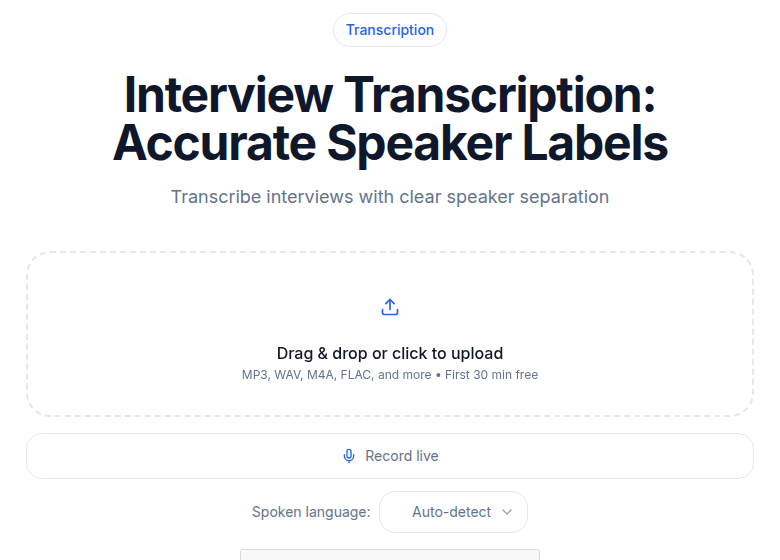 CATT's interview transcription tool showing a journalism template with speaker-labeled transcript and pull-quote candidates
Step 4: Verify Every Candidate Against the Audio
This is the step that separates professional journalism from sloppy work, and it is not optional.
For every candidate quote:
- Find the timestamp in the transcript.
- Open the audio.
- Play 10 seconds before and 10 seconds after the timestamp.
- Confirm the words match exactly.
- Note what question prompted the statement.
- Decide whether the quote fairly represents the source's actual point.
This takes 30-45 seconds per quote. For five quotes, you spend under four minutes. The errors AI transcription introduces most often:
- Dropped negatives. "I did not say that" becomes "I said that." This is the most dangerous class of error.
- Misheard numbers. "Twenty-three thousand" becomes "23."
- Misheard proper names. Proper nouns are where AI models fail most often.
- Compressed sentences. Two separate sentences merged into one with the implication changed.
If the transcript and audio disagree, the audio wins. Always.
For guidance on understanding transcription accuracy rates and what error bands mean in practice, see transcription accuracy explained.
Step 5: Decide What Context to Include
A quote out of context can mislead. The same quote with context can be the clearest sentence in the piece.
For each quote you plan to use, write down: the question that prompted it, the tone (firm, hesitant, defensive, enthusiastic), and what was said immediately before and after. That note tells you whether to use the quote cold, set it up with a framing sentence, or include the question directly.
The classic trap: a source says "I would never do that." The meaning depends entirely on what "that" refers to. If readers cannot infer the referent from your surrounding text, either provide the question or paraphrase the setup.
Also check whether the source said something similar or contradictory elsewhere in the interview. If they walked it back ten minutes later, you need to decide which version to quote, or to quote both.
Step 6: Editing Ethics: What You May Change, What Requires Markup
Most quotes need some cleanup before they are readable. Two distinct categories apply.
What you may silently remove: filler words ("um," "you know," "like") when their removal does not change meaning or tone. Even here, AP style says use ellipses and use them sparingly. If a source's hesitation was meaningful, removing it distorts the quote.
What requires an ellipsis (...) : any word or phrase cut from the middle of a sentence. This is the industry standard for indicating omission.
Original: "Well, you know, I think we should probably consider, eventually, expanding into Europe." Edited: "We should ... consider expanding into Europe."
What requires square brackets [ ] : any word you add or substitute for clarity. If you insert a name to replace a pronoun, bracket it: "She [Commissioner Park] signed the order."
What is never acceptable, regardless of notation: splicing a sentence from minute 5 with a sentence from minute 45 and presenting them as continuous speech. If two things the source said belong together, paraphrase the connective logic in your own words and quote each piece separately. Distortion by addition is, as Poynter puts it, the edit that gets reporters fired.
A note on silent grammar fixes: AP Stylebook says never alter quotations even to correct minor grammatical errors. The common-sense exception most newsrooms apply is that you may fix an obvious verbal stumble ("I goed" for "I went") only when the slip would unfairly make the source look unintelligent, and only when the fix does not change the meaning. When in doubt, paraphrase and pull only the phrase that earns its quotation marks.
Step 7: Pick the Right Verb of Attribution
Attribution verbs shape how readers interpret what was said.
- "said" is neutral. Use it by default.
- "acknowledged" implies the source admitted something against their interest.
- "insisted" implies the source defended a position under pushback.
- "claimed" signals the publication does not endorse the statement as fact.
- "argued" signals active position-taking.
- "declined to comment" for sources who refused.
- "did not respond to requests for comment" for sources who ignored you.
Avoid physical verbs you cannot verify: "laughed," "smiled," "shouted." If you cannot confirm it from the audio or from notes taken in person, do not claim it.
Loaded verbs invite readers to question your objectivity. Stick to neutral unless the action is documented.
Step 8: Place Quotes to Drive Narrative
Where a quote lands in a story changes what it does.
Lead quotes near the top of the story hook the reader. Use a strong, definitive statement here, one that makes someone want to read further.
Mid-story quotes should drive the narrative forward, not merely decorate a paragraph. Each quote should open a new angle, confirm a claim, or introduce a contradiction. Three back-to-back quotes from the same source reads like a transcript dump; break them up with narrative summary.
Closing quotes should capture the thematic point of the piece. Memorable, a little surprising, forward-looking.
For longer features, a pull-quote (enlarged and set off visually) works best under 25 words. Anything over 30 words loses impact when enlarged. One pull-quote per 400-600 words is a reasonable visual rhythm.
For the full interview-to-article workflow, including how to structure the draft around the quotes you have selected, see interview to article workflow.
Step 9: Approval Flows and Source Review
Publication policies vary, and you should know your outlet's policy before the interview, not after.
Most outlets permit reading quotes back to a source for accuracy checks, but they do not grant sources veto power over wording, context, or surrounding text. The SPJ guidance is specific: limit review to factual accuracy, make clear that only the journalist or editor can change the published text, and never send a complete draft. If a source says a quote is wrong, go back to the audio. If the audio confirms your transcript, hold the quote.
Common situations where verification with the source makes sense:
- Technical, scientific, or medical content where a misheard term could be seriously wrong.
- Quotes from non-native speakers where the transcript may not capture their intended meaning.
- Any quote where the source later contacts you to dispute the wording.
Agreeing upfront to let a source approve quotes before publication is different from voluntary accuracy-checking, and most ethics codes advise against the former. If a source makes quote approval a condition of the interview, you have a negotiation decision, not an ethics question.
Step 10: Final Cross-Check Before Publishing
Before the story goes to an editor:
- Read each quote aloud. If it sounds wrong or unnatural, check the audio again.
- Confirm every quote has clear attribution: who, when, in what context.
- Check proper names against a second source (a press release, a published profile, official records).
- Verify any number, date, or claim in a quote against public records.
- Confirm your surrounding context makes the quote's meaning clear to a reader who was not in the interview.
For investigative pieces with high-stakes quotes, have a colleague or editor listen to the relevant audio passages alongside your draft before publication.
See also: how to transcribe an interview recording for the upstream step, and fact-checking from transcripts for what to do with the claims you flagged during the skim.
Common Questions
What can I silently fix in a quote versus what requires brackets or ellipsis?
AP style is strict: never silently alter a quote, even to fix minor grammar. Filler words and casual verbal stumbles ('um', 'you know') can be removed with an ellipsis, but only sparingly. If you add or change a word for clarity, that change goes in square brackets. A name clarification looks like: 'She [Mayor Collins] approved the budget.' Changing meaning, even subtly, is never acceptable regardless of which notation you use. When in doubt, paraphrase and quote only the punchline.
Should I let sources review their quotes before publication?
Publication policies vary widely. Many major outlets permit reading quotes back to a source for accuracy checks, but they do not give sources veto power over wording or context. The SPJ guideline is narrow: limit review to factual accuracy, never send complete stories, and make clear that only the journalist or editor can change what is published. If a source claims a quote is wrong, go back to the audio. Agreeing to review as a condition of the interview is a different matter and most outlets advise against it.
How do I pick the best quotes from a long transcript?
Prioritize quotes that do something paraphrase cannot: a first-person claim only the source can make, a vivid phrase that captures a complex idea precisely, or a direct contradiction of a public record. For news writing, one to three sentences is the right length; anything over 50 words usually works better as a paraphrase with only the punchy sentence quoted directly. Aim for 4-6 final quotes from a 60-minute interview. If you have more than that, you have not edited tightly enough.
What if my transcript and the audio say different things?
The audio is always the source of truth. Never publish a transcript word without verifying it against the recording, especially for numbers, proper names, and negatives. AI transcription at 97-99% accuracy still means several errors per page on a long interview. The most dangerous misreadings are dropped negatives ('I did not' becoming 'I did') and misheard numbers. Spend 30-45 seconds per candidate quote playing 10 seconds before and after the timestamp. That check prevents the errors that end careers.
Sources
- 15 tips for handling quotes, Poynter
- Should journalists let sources look over stories before publication? Poynter (2020)
- SPJ Code of Ethics, Society of Professional Journalists
- Quotes and Attribution, The American Journalism Handbook
- Pull Quotes in Journalism, River Editor
- How to use the ellipsis in AP style, PR Daily
- Why AP Style doesn't like brackets in quotes
Try transcription free
Convert any audio or video to clean, unwatermarked text — speaker labels, timestamps, and AI summaries included. First 30 minutes free, no account.
Related Articles

Interview Transcription: The Complete 2026 Guide
A practical guide to interview transcription for journalists, researchers, HR teams, and podcasters. Covers workflow, speaker ID, tools, and real pricing.
Ethics of Interview Transcription: Core Obligations
A practical guide to the ethics of interview transcription for researchers: IRB consent scope, anonymization vs pseudonymization, cloud processing disclosure, retention, and participant review.