
How Journalists Use Transcription: Six Newsroom Scenarios
Summarize this article with:
The Six Uses
Journalists use transcription in at least six distinct situations, each with a different payoff: converting daily interview calls into quotes on deadline, excavating investigative audio, processing FOIA-released recordings, covering press conferences, writing features across weeks of tape, and publishing accessible podcast episodes. The tool is the same; the reason it matters shifts with the assignment.
Note: this post covers where transcription fits in each scenario. For step-by-step recording and upload workflows, see how to transcribe an interview recording and how to create meeting minutes from audio.
Recording laws vary by state, medium (phone vs. in-person), and whether both parties are in the same jurisdiction. This post is not legal advice. For a state-by-state reference, see recording and transcription laws by state and recording interviews legally by state.
1. Daily News: Converting a 30-Minute Call Into Copy on Deadline
The daily-news scenario is the bread-and-butter case. A city hall reporter finishes a 30-minute phone interview 90 minutes before deadline. There is no time to re-listen to the whole recording and pull timestamps by hand.
AI transcription collapses that bottleneck. Upload the call, get a searchable text document in two to three minutes, and Ctrl+F for the quote you already know is in there somewhere. The reporter writes the story while the transcript is processing; by the time the lede and background paragraphs are drafted, the text is ready to mine.
The practical difference is that the journalist can stay in the interview during the call rather than furiously scribbling verbatim quotes. Better listening produces better follow-up questions and, often, a better quote buried in the final minutes.
One constraint: phone audio quality varies. A hands-free car call with wind noise will test any transcription engine. Accuracy for clean phone recordings is consistently high; accuracy for bad phone recordings is not. The rule for daily work is to verify any quote that will appear in print against the original audio before filing.
2. Long-Form Features: Searching Across Weeks of Tape
Feature reporters often accumulate 8 to 20 hours of recorded interviews across weeks or months. Manual transcription at that scale takes 40 to 100 hours, roughly the entire reporting time again. AI transcription moves that task to a few hours of upload time, with the core value being searchability across the whole archive.
The workflow shift is from listening sequentially to searching. When a source in interview six makes a claim that contradicts something a source in interview two said, a journalist working from transcripts can surface both statements in 30 seconds. Without transcripts, reconciling those contradictions requires scrubbing through audio from memory.
My take: the biggest productivity gain in feature writing is not the time saved on transcription itself. It is the ability to treat your interview archive the way a database analyst treats a dataset, running keyword searches across all sources simultaneously and building a structured outline from the results rather than from handwritten notes.
For long-form work, speaker diarization matters. When a transcript labels every turn as "Speaker 1" or "Speaker 2," identifying who said what in multi-person interviews requires cross-referencing the audio anyway. Tools that reliably separate speakers by label reduce that friction.
3. Investigations: Building a Searchable Evidence Archive
Investigative journalism depends on recording speech to uncover facts, test claims, and hold institutions accountable. Interviews, leaked audio, public-meeting recordings, and testimony from court proceedings form the evidentiary backbone of major investigations. Transcription converts that audio into a form that can be analyzed, cross-referenced, and legally defended.
The specific advantage in investigative work is timeline construction. A reporter investigating a municipal contracting scandal might have recordings from six city council meetings spanning 18 months, three source interviews, and audio from a community hearing. Transcribing all of them creates a chronological text record. Searching for a specific contractor's name across all files surfaces every mention, along with the date and approximate timestamp.
The Center for News, Technology and Innovation found in 2025 research that newsrooms using AI transcription for investigative audio still rely on human review as a non-negotiable step, particularly because transcription engines can insert words that were never spoken, especially around long pauses or crosstalk. For an investigation where a misheard phrase becomes a misquoted official, that error has consequences well beyond a correction.
Data security is a real consideration in this lane. If recordings involve confidential sources, the transcription tool's data retention policy, server location, and encryption practices matter. Some journalist-focused tools, such as Good Tape (built by journalists at the Danish newsroom Zetland, hosted on EU servers, and set to delete recordings after transcription by default), were designed explicitly for this concern. Any tool handling sensitive source audio should have clear documentation on what is retained and for how long.
4. FOIA Audio: Processing Released Government Recordings
Freedom of Information Act requests increasingly yield audio and video files, not just PDFs. Body camera footage, recorded public hearings, voicemail logs, and 911 call archives are all obtainable through state and federal records requests. The challenge is that agencies often release dozens of hours of audio with no index, no timestamps, and no text equivalent.
A reporter who receives 40 hours of recorded city council proceedings through an open-records request faces a signal-to-noise problem. Transcription converts that bulk audio into searchable text, making it possible to identify the relevant 20 minutes without sequentially listening to all 40 hours.
One practical note: government audio often has variable quality, multiple overlapping speakers, and background noise from public chambers. Speaker diarization on these files is less reliable than on a clean one-on-one interview. Treat the transcript as a search index, not a verbatim record, and verify any publishable quote against the original audio. The audio file is the primary document; the transcript is a working index.
For background on how journalists file and use records requests in practice, the Poynter resource on public records reporting and GIJN's FOIA tips guide (linked in Sources) are useful starting references.
5. Press Conferences: Accurate Attribution Under Time Pressure
Press conferences create a specific attribution problem. Multiple officials speak over a period of 30 to 60 minutes, questions come from multiple reporters, and the story often needs to be filed within the hour. Taking notes by hand risks misattributed quotes. Recording and transcribing resolves that.
The practical value here is not speed alone. It is precision. Paraphrasing what an official said versus quoting exactly what an official said are different acts with different professional consequences. A transcript that labels speaker turns makes it straightforward to pull the direct quote and attribute it with confidence.
Tools with speaker diarization perform best in press conference settings, though they require clear audio input. A recording made from the back of a noisy room will degrade accuracy. Whenever possible, connecting to an official house audio feed or placing a recorder close to the podium microphone produces substantially better results.
For ongoing press conference coverage, the meeting transcription tool handles multi-speaker sessions and timestamps speaker turns, which helps rebuild the back-and-forth structure of a Q&A in the transcript.
6. Podcast and Broadcast Transcripts: Accessibility, Reach, and the Archive
News organizations that produce audio content are increasingly expected to publish text transcripts alongside episodes. Accessibility guidelines for publicly available web content treat transcripts as standard practice for audio, not optional. The ADA and WCAG accessibility standards apply to many institutional publishers and broadcasters, and audience expectations have shifted alongside them.
The secondary value is reach. Search engines cannot index audio. A transcript published on the episode page gives the episode a text presence in search results and provides a citable text that other journalists and readers can link to and excerpt. The 2025 Reuters Institute Digital News Report found that 75 percent of publishers were exploring making audio content available in text format, reflecting how broadly the practice has spread.
The workflow for podcast and broadcast transcripts has an extra step: formatting for publication. A raw AI transcript, even a highly accurate one, needs speaker labels cleaned up, filler words removed or reduced, and paragraph breaks inserted for readability. If the published transcript will be permanent, a human editor pass is worth the time. A transcript with obvious errors that a listener can hear the moment they compare it against the episode erodes credibility.
For podcast transcription at volume, tools with automatic paragraph segmentation and speaker labeling reduce the editing burden significantly.
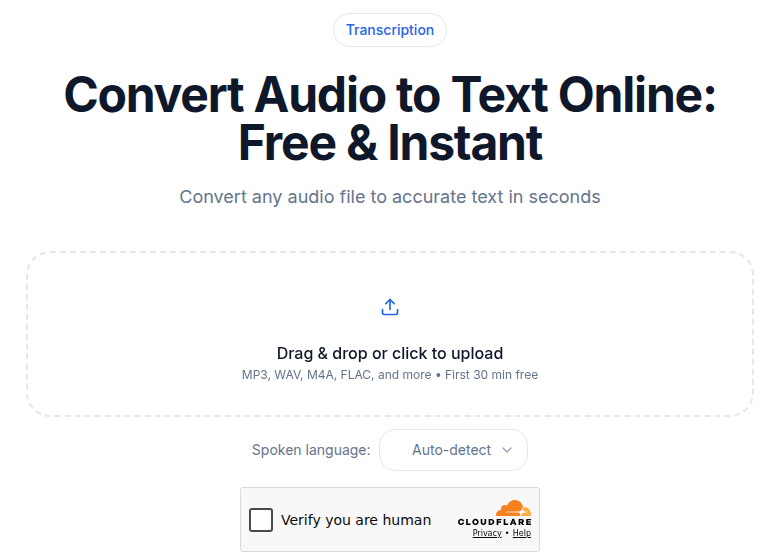
If you need clean transcripts from interviews or press conferences without a meeting bot or subscription layer, ConvertAudioToText handles uploads and URL-based sources with no required account for short files.
Accuracy, Bias, and What to Verify
AI transcription tools perform unevenly across different speakers. CNTI's 2025 research found that current tools perform well for a narrowly defined set of standard American English accents and show measurable degradation with World Englishes, African American Vernacular English, and low-resource languages. Transcription tools can also insert words that were never said, particularly around long pauses. Both patterns matter for journalistic practice.
The standard that holds across all six scenarios: every quote that will appear in print or broadcast must be verified against the original audio. A transcript is a working tool, not a final source. The audio file is the primary document.
For accuracy benchmarks and what AI transcription actually delivers, the linked post covers the technical picture in more detail.
Recording: One-Party, All-Party, and the Mixed Cases
Most of the United States requires only one-party consent to record a conversation you are participating in. Roughly 11 states require all-party consent, and several states have split rules by medium, requiring different consent standards for phone calls versus in-person conversations (RCFP Reporters Recording Guide, 2026).
Interstate calls complicate this further. A reporter in a one-party state recording a source in an all-party state may be subject to the stricter law. For any recording situation with legal ambiguity, the professional default is to inform the source that the conversation is being recorded. This resolves most consent questions and is good practice regardless of the legal minimum in a given jurisdiction.
The ethics layer is separate from the legal one. Recording in full compliance with local law is the floor, not the ceiling.
Frequently Asked Questions
Does AI transcription accuracy meet the standard for publishable quotes?
Not by itself. AI transcription tools can achieve high accuracy on clean audio, often above 95 percent on clear recordings with a single speaker, but they hallucinate words, miss technical terms and proper nouns, and struggle with overlapping speakers. Every quote intended for publication must be verified word-for-word against the original audio. The transcript is a finding tool; the recording is the record.
Can a journalist legally record a phone interview without telling the source?
It depends on the state or country and the medium. Most U.S. states require only one-party consent, meaning a participant in the conversation can record without notifying the other party. About 11 states require all-party consent. Interstate calls add further complexity. The Reporters Committee for Freedom of the Press maintains a state-by-state recording guide. This post is not legal advice; consult that resource and, for sensitive situations, legal counsel.
What is the best way to handle FOIA audio with poor recording quality?
Treat AI transcription of poor-quality government audio as a search index, not a verbatim transcript. Run the file through transcription to identify approximate timestamps and relevant sections, then re-listen to those specific segments to confirm language before quoting. For very poor audio, professional human transcription is faster than iterating on AI output.
How should journalists handle off-the-record sections in a transcript?
Note the timestamp when a source indicates they are going off the record and when they return on the record. During transcript review, mark or redact those sections according to your organization's policy before sharing or archiving the transcript. Never publish off-the-record material inadvertently included in a transcript excerpt. If the transcript will be shared with editors or colleagues, remove those sections before circulation.
Do newsrooms need to publish transcripts of their podcasts?
Legal requirements vary by organization type and jurisdiction. WCAG accessibility guidelines treat transcripts as standard practice for publicly available audio content, and many institutional publishers are subject to those standards. Beyond compliance, transcripts improve audience reach, search visibility, and citation potential. For most news podcast producers, publishing a transcript alongside each episode is now the norm rather than the exception.
Sources
- Reporters Committee for Freedom of the Press, Reporters Recording Guide: https://www.rcfp.org/introduction-to-reporters-recording-guide/
- Center for News, Technology and Innovation, AI Transcription and Translation in Journalism (2025): https://cnti.org/reports/ai-transcription-and-translation-in-journalism/
- Poynter, How Journalists Use FOIA and Public Records Reporting (2026): https://www.poynter.org/reporting-editing/2026/how-journalists-use-foia-public-records-reporting/
- Global Investigative Journalism Network, Tips for Better FOIA Requests: https://gijn.org/stories/tips-foia-rti-requests/
- Good Tape, Transcription Software for Journalists: https://goodtape.io/transcription-software-for-journalists/
- Reuters Institute for the Study of Journalism, Digital News Report 2025: https://reutersinstitute.politics.ox.ac.uk/news/our-podcast-digital-news-report-2025-episode-1-what-you-need-know
Try transcription free
Convert any audio or video to clean, unwatermarked text — speaker labels, timestamps, and AI summaries included. First 10 minutes free, no account.
Related Articles

Transcription Tips for Investigative Reporting (2026 Workflow)
Investigative transcription practices: verbatim standards, archive searchability, source protection, and secure handling.

Agentic Transcription Systems: Real Patterns for 2026
Agentic transcription goes beyond raw text. Learn the three real agent loops (verify-and-retry, terminology lookup, summary chains) that work in production today.