Recording Interviews Legally by State: A Reporter's Guide (2026)
Summarize this article with:
US recording law divides states into one-party consent (the majority, where you can record your own conversations without telling the other side) and all-party consent (around 11-12 states, where everyone must agree). When a phone interview crosses state lines, apply the stricter law. Getting verbal consent on tape takes 15 seconds and eliminates almost all the risk. This guide covers the legal framework, the journalism-specific nuances around on-record and off-record norms, and the workflow from raw recording to clean transcript.
The question of whether you legally recorded that interview is not answered by your intent. It is answered by which state the source was in, which state you were in, and whether anyone in an all-party consent jurisdiction gave explicit consent before you hit record. This guide covers the legal framework journalists actually operate under, with the journalism-specific layers on top.
This guide is general information, not legal advice. Recording laws are amended, and court interpretations shift. When the stakes are real, verify your specific state with the Reporters Committee for Freedom of the Press or your outlet's general counsel.
One-Party vs. All-Party Consent: The Core Split
US recording law divides into two categories. The majority of states use a one-party consent rule: only one participant in a conversation needs to know about and agree to the recording. When you are that participant, you satisfy the requirement yourself. You do not need to tell the source.
All-party consent states require everyone on the call or in the room to agree. Despite the "two-party" label commonly used for this category, the rule is more accurately described as all-party: if four people are on a call, all four must consent.
Federal law (18 U.S.C. 2511) sets a one-party baseline for interstate communications, but it does not preempt stricter state laws. That gap is where most journalist exposure lives.
For the full statutory text of any state, the Reporters Committee's Reporter's Recording Guide is the authoritative reference for working journalists. Use it, not this post, before you go to print on anything legally sensitive.
The All-Party Consent States (and the Contested Ones)
Sources on this list disagree at the margins, which is itself informative. The core group where major references consistently agree on all-party consent status includes:
| State | Consent Rule | Notes |
|---|---|---|
| California | All-party | Penal Code 632; confidential communications standard |
| Florida | All-party | Security of Communications Act; third-degree felony exposure |
| Illinois | All-party | Reformed in 2014; applies to private, surreptitious recordings |
| Maryland | All-party | Wiretapping and Electronic Surveillance Act |
| Massachusetts | All-party | Bans "secret" recordings; broad interpretation by courts |
| New Hampshire | All-party | RSA 570-A |
| Pennsylvania | All-party | Wiretapping and Electronic Surveillance Control Act |
| Washington | All-party | RCW 9.73.030 |
Several additional states appear on some lists and not others because their statutes are contested, medium-specific, or subject to unsettled court interpretation:
| State | Why It Is Contested |
|---|---|
| Connecticut | All-party for phone calls; one-party for in-person conversations under criminal law |
| Delaware | Conflicting statutes: 11 Del. C. 2402 allows one-party; 11 Del. C. 1335 requires all-party |
| Michigan | Statute written as all-party, but courts recognize a participant exception; Michigan Supreme Court has not fully resolved it |
| Montana | Listed as all-party by some sources, but application is narrower in practice |
| Oregon | All-party for in-person conversations; one-party for telephone under most readings |
My take: treat any state in the contested column as all-party for planning purposes. The cost of assuming the stricter rule is 15 seconds of disclosure. The cost of assuming the looser one and being wrong is measured in felony exposure or civil damages.
For the roughly 38 states that clearly fall in the one-party column, New York, Texas, Colorado, and Georgia are among the most commonly cited examples. But verify your specific state before relying on any list, including this one.
When a Call Crosses State Lines
This is where most journalists trip up. You are in Austin. Your source is in San Francisco. Texas is one-party. California is all-party. Which law governs?
No universal rule exists. Courts have applied the law of the state where the recording was made. Others have applied the law of the state where the source was located. The California Supreme Court held in Kearney v. Salomon Smith Barney (2006) that California's all-party rule can apply to calls placed from one-party consent states, at least when a California resident is the one whose privacy is at stake.
The standard newsroom guidance: assume the stricter rule applies whenever either party is in an all-party state. Ask for consent, get the yes on tape, and move on. The 15-second script eliminates the ambiguity.
This is also how federal wiretap exposure works. Even if your state is one-party under state law, an interstate call may bring federal law into play, and court jurisdiction questions can get complicated fast.
For the full picture on how statutes interact across state lines, see our companion post on recording laws by state in detail.
How to Get Consent on the Record
Verbal consent captured in the recording itself is the gold standard. Written consent forms add a layer, but many interview environments make them impractical. A recorded yes, with context, is what holds up.
Here is the script most newsrooms use:
- State your name and the date at the start of the recording.
- State the source's name.
- Name the purpose: "I am recording this for accuracy as we discuss the proposed transit ordinance."
- Ask directly: "Do I have your consent to record this conversation?"
- Wait for an unambiguous yes before proceeding.
If the source hesitates or says no, you have two options: take handwritten notes only, or end the session if recording is essential. What you cannot do ethically or legally in all-party states is continue recording after a refusal.
For in-person interviews, the same script works. Saying it aloud, with your recorder visible on the table, also signals professional seriousness. Many experienced sources find it reassuring rather than off-putting.
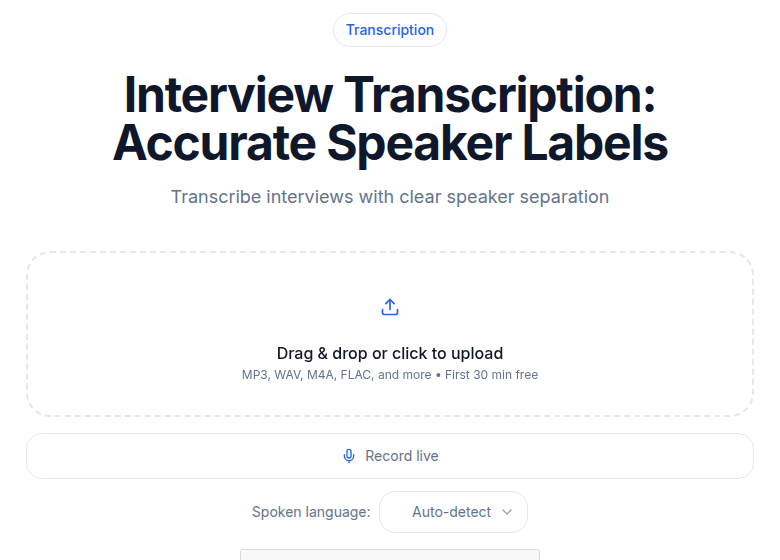 Interview transcription tool showing audio upload interface
The Journalism Layer: On-Record, Off-Record, and Recording Law Together
Recording law and journalism attribution norms are separate tracks that interact in ways that catch reporters out.
On the record means the source's words can be quoted and attributed by name. This is the default. If no ground rules were set before the conversation, assume on-record, and so should your source.
On background means the information can be published but not attributed by name. A source's title or role is often used as a descriptor. You can quote the words; you cannot attach the name.
Off the record means the information cannot be published in any attributable form. It can sometimes be used to locate other sources or public records that confirm it on the record, but the terms must be negotiated in advance. Retroactive off-record claims have no ethical force once the conversation happened on-record.
Deep background means the information shapes your reporting but cannot be attributed at all.
The recording law question interacts here in one specific way: in all-party consent states, recording an off-record conversation without the source's explicit consent to that recording is likely a legal violation, even if you never publish a word from it. The conversation being off-record for publication purposes does not mean the source consented to being recorded. These are separate permissions, and a professional reporter asks for both.
The AP and NPR style guides both recommend clarifying attribution terms before any interview begins, not mid-conversation or after the fact.
Penalties for Getting It Wrong
The original version of this post stated that Florida and Massachusetts carried "similar exposure" to California's $5,000 statutory damages. That framing is worth correcting.
California (Penal Code 632): Civil statutory damages of $5,000 per violation, or three times actual damages, whichever is greater. Plus criminal exposure.
Florida (Security of Communications Act): Third-degree felony, up to five years in prison and a $5,000 criminal fine. Civil remedy is $1,000 or $100 per day of violation, whichever is greater. The felony exposure is the bigger risk, not the civil damages.
Massachusetts: Up to five years in prison and a $10,000 criminal fine. Civil damages at $1,000 or $100 per day, plus attorney's fees and potential punitive damages.
These penalties apply per violation. A series of recordings each creates separate exposure.
Beyond the legal cost: a source who discovers they were recorded without consent will not talk to you again, and they will tell other sources. One blown trust on a beat costs years of access to rebuild.
Special Situations That Catch Reporters Out
Voicemail and ambient recording. If you set a recorder on the table before your source arrives and capture their private conversation with someone else, you almost certainly do not have consent for that portion. Stop the recording during breaks and before the agreed session begins.
Meeting recordings. Recording a Zoom or Teams call without notifying participants is risky in all-party states, regardless of whether you are a participant in the session. Most enterprise platforms now display a recording indicator. Do not disable it. For a full breakdown of the meeting-recording context, see how to transcribe a Zoom meeting.
Workplace interviews. Some states provide additional employee protections during workplace conversations, particularly around wage discussions or union organizing. One-party state or not, recording inside a private workplace can trigger separate legal frameworks.
Recording phone calls on a cell phone. Carrier policies and app policies differ from legal permissions. Your app may record; the law may prohibit it. The app does not check jurisdictions.
From Recording to Transcript: The Workflow
Once you have a legally clean recording, the immediate task is a verbatim transcript. Waiting until edit week to transcribe a 60-minute interview from memory or scratch notes is how quotes get slightly wrong.
If you just need a clean, speaker-labeled transcript without a meeting bot sitting in on your call, ConvertAudioToText's interview transcription tool handles a standard one-hour interview in a few minutes, with speaker diarization that labels who said what. Export the transcript alongside the audio and store both together in your project folder.
Most outlets require journalists to retain source recordings for at least one year after publication. Some require longer. Get written guidance from your editor or legal team on retention windows rather than guessing.
For the freelance workflow from raw recording through filed story, see transcription for freelance journalists.
Recording Outside the US
This guide covers US law only. If you report internationally even occasionally, build a quick reference for the countries you cover.
The EU's GDPR adds a data-protection layer on top of any national recording law, affecting how you store and retain interview audio. The UK splits rules between private and public communications. Canada is federally one-party consent, but provinces add context. Latin American countries vary significantly. "It's legal where I am" does not resolve whether the other jurisdiction's law creates exposure.
A Pre-Interview Checklist
Run through this before every interview:
- What state are you in? What state is the source in?
- Is either of those an all-party consent jurisdiction?
- Have you run the consent script out loud, with a response on the recording?
- Did the source agree clearly?
- Are you recording any period the source has not consented to: breaks, ambient capture, voicemail?
If all five check out, hit record. If any one is murky, take notes instead.
Frequently Asked Questions
Can a journalist legally record a phone call without telling the source?
In one-party consent states, yes, as long as you are a participant in the call. Federal law (18 U.S.C. 2511) also sets a one-party baseline. But if either party is in an all-party consent state such as California, Florida, Massachusetts, or Pennsylvania, you must disclose the recording and get consent from everyone. Because you often cannot know which state your source is calling from, most newsrooms train reporters to ask first by default.
Which states require all-party (two-party) consent for recording conversations?
Sources differ slightly, but there is a solid consensus core: California, Florida, Illinois, Maryland, Massachusetts, New Hampshire, Pennsylvania, and Washington are consistently listed as all-party consent states. Connecticut, Delaware, Michigan, Montana, and Oregon have contested or medium-specific rules where the answer depends on whether the conversation is in-person or by phone, or where courts have not fully settled the question. The Reporters Committee for Freedom of the Press maintains the authoritative state-by-state guide at rcfp.org.
What happens if a call crosses state lines between a one-party and an all-party state?
There is no universal rule, and courts have split on it. The California Supreme Court's Kearney v. Salomon Smith Barney (2006) decision held that California law can apply to calls from one-party consent states when a California resident is on the call. The safest working rule: if either party is in an all-party consent state, treat the whole call as requiring all-party consent. Explicitly ask for consent and capture the yes on the recording itself.
What are the penalties for recording without consent in all-party states?
They are serious and vary by state. California's Penal Code 632 allows civil statutory damages of $5,000 per violation or three times actual damages, whichever is greater, plus criminal exposure. Florida's Security of Communications Act treats violations as third-degree felonies, carrying up to five years in prison and a $5,000 criminal fine, with civil damages of $1,000 or $100 per day of violation. Massachusetts's wiretap statute allows up to five years in prison and a $10,000 fine, with similar civil remedies.
Does recording an off-the-record conversation create legal or ethical problems?
Both. Legally, in all-party consent states, recording a conversation that the source believes is confidential can still violate the statute even if you later agree not to publish it. Ethically, standard newsroom practice treats off-the-record as a firm agreement not to use the information for publication in any attributable form. The Society of Professional Journalists recommends clarifying the terms of any off-record agreement before the conversation starts, and most editors expect that the terms were negotiated in advance, not retroactively.
Sources
- Reporters Committee for Freedom of the Press, Reporter's Recording Guide
- Reporters Committee, Introduction to the Reporter's Recording Guide
- Justia 50-State Survey: Recording Phone Calls and Conversations
- Digital Media Law Project: Recording Phone Calls and Conversations
- RecordingLaw.com: Two-Party Consent States 2026
- California Penal Code 632, California Legislative Information
- Illinois wiretapping law reform, National Law Review
- Varnumlaw: Is Michigan a One-Party Consent State?
- SPJ Code of Ethics
Try transcription free
Convert any audio or video to clean, unwatermarked text — speaker labels, timestamps, and AI summaries included. First 30 minutes free, no account.
Related Articles

Ethics of Interview Transcription: Core Obligations
A practical guide to the ethics of interview transcription for researchers: IRB consent scope, anonymization vs pseudonymization, cloud processing disclosure, retention, and participant review.
Best Recorder for Journalists in 2026: Gear by Scenario
Hardware recorders and phone kits for journalists, matched to the work: press scrums, discreet interviews, multi-source panels, and field reporting. Prices verified July 2026.