
Transcription for Freelance Journalists: Costs and Workflow
Summarize this article with:
Freelance journalists spend $48 to $120 per interview on human transcription at standard market rates, wiping out profit margins on mid-tier assignments. AI transcription plans under $17 per month reduce that to under $2 per article at normal filing volumes. The right tool depends on your budget tier, filing cadence, and whether your outlet has a retainer deal you can tap. This post breaks down the per-story math, names the tools worth paying for in 2026, and shows a five-step solo workflow that goes from raw recording to filed draft faster than manual methods allow.
Transcription is one of the highest-leverage costs in a freelance journalist's budget, and most reporters are overpaying by an order of magnitude. At Rev's current human transcription rate of $1.99 per audio minute, a 50-minute interview costs exactly $99.50. File a 1,200-word feature for $400, subtract that plus a 25 percent platform commission, and you have cleared around $200 for a full day of reporting. That is the math that ends freelance careers. Getting the transcription line item right is not optional; it is structural.
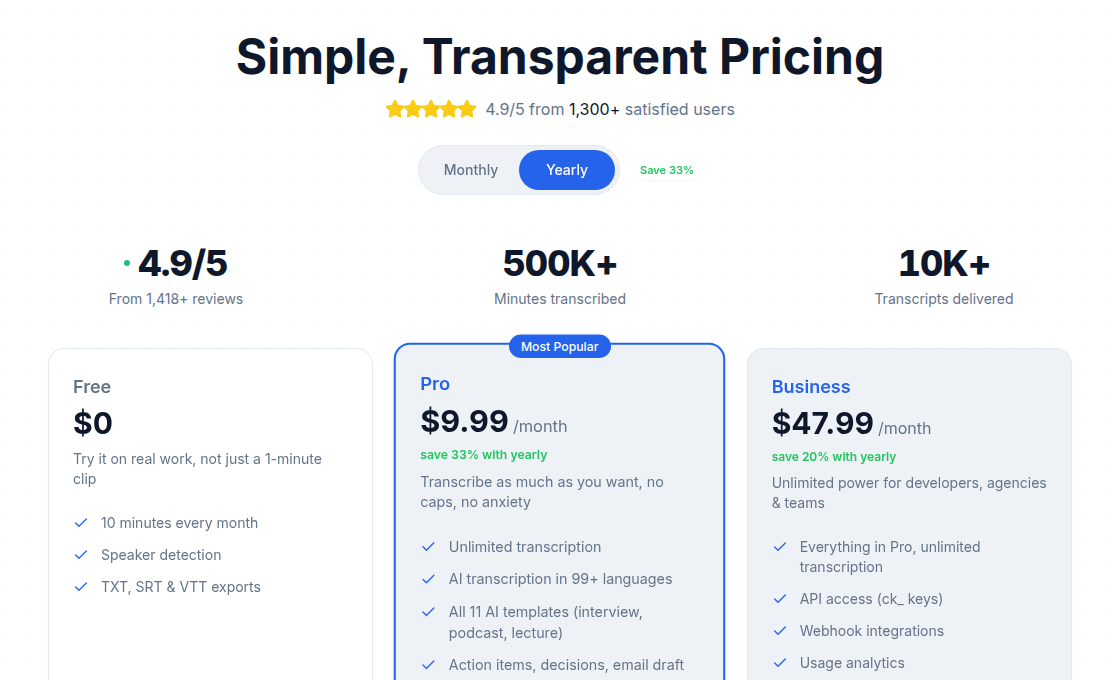 Flat-rate pricing keeps per-story transcription costs predictable
The Real Per-Story Math
The way to think about transcription is not per minute of audio. It is per article filed.
Say you file 8 articles a month, each requiring a 45-minute interview. That is 6 hours of monthly audio. Through Rev human transcription at $1.99/min, that comes to $537 per month, or $67 per article. Through TranscribeMe's entry human tier at $0.79/min, it drops to $213 per month, still $26.60 per article.
Through an AI transcription plan, the same 6 hours of audio costs you the monthly subscription fee: $9.99 on ConvertAudioToText Pro, $17 on Good Tape, $16.99 on Otter.ai Pro. Per article, that is $1.25 to $2.12 at 8 articles per month.
If you bill $0.40 per word and your average piece runs 1,200 words, you gross $480 per article. After $67 in human transcription, you net $413. After $1.25 in AI transcription, you net $479. Across 8 articles per month, the swing is $541. That is rent in most cities outside New York.
The break-even calculation also matters for choosing between per-minute AI and flat-rate subscriptions. Rev's AI transcription is $0.25 per minute pay-as-you-go. At that rate, 40 minutes of audio per month costs $10, making the Rev free tier (45 AI minutes/month) sufficient if you file lightly. Once you regularly exceed two hours of audio per month, a flat $9.99 to $17 subscription beats per-minute billing every time.
Comparing Tools Across Freelance Budget Tiers
The market splits cleanly into three tiers based on what a solo reporter can justify spending.
| Tool | Price | Limit | Best for |
|---|---|---|---|
| Rev (free) | $0 | 45 AI min/month | Occasional filing |
| Otter.ai (free) | $0 | 300 min/month | Meeting-heavy beats |
| ConvertAudioToText (free) | $0 | Up to 30 files a day, up to 30 min each (free account) | Short interviews, quick clips |
| ConvertAudioToText Pro | $14.99/month | Unlimited | Budget-conscious freelancers |
| Good Tape | $17/month | 20 hrs/month | Journalism-specific privacy needs |
| Otter.ai Pro | $16.99/month | 1,200 recording min | Multi-platform integrations |
| Trint Starter | ~$80/month | 7 files/month | Newsroom-assigned or outlet-paid |
| Rev Pro (subscription) | $59.99/month | 10,000 AI min | High-volume with team features |
| TranscribeMe (human) | from $0.79/min | Pay-as-you-go | Legally sensitive, verbatim |
| Rev (human) | $1.99/min | Pay-as-you-go | Rush deadline, contested quotes |
A few things worth knowing about specific tools before you pay:
Trint was built for broadcast and print newsrooms (BBC and Reuters are customers), and its editor is genuinely good for journalists who need collaborative features. But at roughly $80/seat/month for the Starter plan, with a hard cap of 7 files per month, it makes no financial sense for a solo freelancer paying out of pocket. The file cap is not a soft credit pool; once you hit 7, you wait for the next billing cycle. Trint belongs in the "ask your editor if the outlet has a license" category, not the "pay yourself" one.
Good Tape is worth naming because it is the only transcription tool purpose-built with source protection in mind: files are processed on EU servers, deleted automatically after transcription, and the company is GDPR-compliant by design rather than by checkbox. At $17/month for 20 hours, it is a reasonable call for investigative reporters where source confidentiality is non-negotiable. The free tier allows 3 transcriptions per month, each up to 30 minutes, which covers occasional work. ConvertAudioToText's free tier is more generous: up to 30 files a day, up to 30 minutes each on a free account.
Otter.ai is strong for beat reporters who spend time in Zoom meetings. Its meeting-bot integration (Zoom, Teams, Google Meet) auto-joins and transcribes live, which saves setup time when interviews happen on video calls. The free plan offers 300 minutes per month with a 90-minute per-meeting cap on Pro. The limit on audio file imports matters: the free tier allows only 3 lifetime imports, which is essentially nothing for a working journalist. Pro at $16.99/month removes most practical constraints.
My take: for most freelancers filing 5 to 12 stories per month, the decision is between a $9.99 unlimited plan and the $17 Good Tape tier. If you are not on an investigative beat where source protection is a hard requirement, the cheaper option is the right call. If you are on that beat, the $7 difference per month is not the thing to optimize.
If you just need a clean transcript without a meeting bot or newsroom collaboration features, ConvertAudioToText's interview tool processes the full file and returns a timestamped, speaker-labeled transcript. The Pro plan handles long recordings (links and videos up to 24 hours). If you need a burst of capacity without a subscription, the Weekly Pass gives 1,200 minutes for $9.99 one-time, valid for 7 days.
A Workflow Built for Solo Reporters
No editorial assistant, no expense account, no shared server for raw files. The workflow has to be lean enough to run on a laptop between assignments.
Step 1: Record defensively
Bring two recorders to every significant interview. A phone plus a dedicated handheld (Zoom H1n or similar) is the standard redundancy setup. For phone interviews, record both sides through a dedicated app; holding a recorder up to speakerphone drops audio quality below the threshold where AI accuracy starts degrading.
Step 2: Upload during travel time
Start the transcription job the moment the interview ends. A 45-minute file processes in 3 to 6 minutes on current AI. By the time you reach your desk or open your laptop on the train, the transcript is ready. You have not spent a single working minute waiting.
For interviews conducted in French, Spanish, Portuguese, Arabic, or other well-supported languages, modern Whisper-based pipelines handle non-English audio at accuracy close to English. This matters for reporters who cover international beats and cannot maintain separate vendor accounts for each language.
Step 3: Mark up, do not clean
Resist the reflex to edit the full transcript. You will use 5 to 10 percent of the words in your final piece. Read through and highlight quote candidates, flag fact-check items, and move on. A focused 20-minute markup pass replaces 2 hours of cleaning the entire text. On a straightforward interview-to-article workflow, most of the markup is identifying the three or four lines that will anchor your story.
Step 4: Write against the transcript
Keep the transcript open in a second window while you write. The most common source of misquoting in deadline journalism is paraphrasing from memory. The transcript next to your draft is the cheapest fact-check insurance available, and it is already paid for. See also how to extract quotes from an interview recording for more on this step.
Step 5: Archive everything
After filing, save audio, transcript, and final draft in a single project folder with a consistent naming convention: 2026-07-01_source-name_topic.mp3. The reason is not only legal, though that matters. Fourteen months from now, when you pitch a follow-up, having the original recording produces a sharper pitch than anything a competitor without that archive can write.
Negotiating Transcription Into Your Rate
Most freelancers miss this move. When you pitch a story, include transcription as a line item in your invoice when feasible. Smaller outlets often reimburse without question. Larger outlets typically do not, but you have established the expectation that transcription is a real production cost you carry, which positions you for rate conversations later.
For ongoing retainer relationships with magazines or newspapers, ask whether the outlet has a vendor arrangement. Some major publications have negotiated rates with Rev or Trint that contracted freelancers can access. Even a discounted rate that halves your per-minute cost changes the monthly math significantly.
When Paying for Human Transcription Still Makes Sense
AI transcription handles 90 percent of everyday freelance work. Three situations still justify the human rate.
Legally sensitive or verbatim-required quotes. For pieces where a single misquoted word could constitute a factual error with legal consequences, a human transcript provides a defensible chain of custody that an AI transcript does not. If you are covering a court case, quoting a public official on a controversial claim, or writing a profile where the subject is likely to dispute quotes, pay the human rate on those specific recordings. Pair it with the transcription accuracy explained post if you are unsure where the AI error risk is highest.
Heavy accents that defeat your AI service. Test once per source. If your AI transcript for a particular speaker comes back at 70 percent accuracy or worse, you will spend more time correcting it than a human transcriptionist would have spent typing it. The key word is test: do not assume, do one clip.
Languages with thin AI coverage. Major European languages, Mandarin, Japanese, Korean, and Arabic are well covered by current models. Smaller languages, some African languages, and lesser-spoken dialects may still return cleaner results from human transcription. The accuracy gap is shrinking, but it has not closed everywhere.
The hidden costs of transcription services post covers turnaround time, accuracy guarantees, and storage policies that do not always show up in the headline price, which is worth reading before committing to any paid tier.
FAQ
What is the cheapest way for a freelance journalist to transcribe interviews?
AI transcription on an unlimited flat-rate plan is the cheapest option at any filing volume above two or three interviews per month. Plans like ConvertAudioToText at $14.99/month or Good Tape at $17/month cap your monthly cost regardless of how many hours you process. If you file only once or twice a month, free tiers (Rev gives 45 AI minutes/month, Otter gives 300 minutes) may cover you without paying anything.
Can I expense transcription as a freelance journalist?
Yes, transcription software is a legitimate business expense in most tax jurisdictions because it is a direct cost of producing your work. Keep receipts and categorize it under professional software or production costs. For outlets that reimburse expenses, include transcription as a line item in your invoice with the actual monthly cost prorated per story.
Is AI transcription accurate enough for quoting sources?
For most journalism, yes. Modern AI transcription using models like Deepgram Nova or OpenAI Whisper reaches 90 to 95 percent accuracy on clear recordings. The remaining errors are almost always in proper nouns, technical terms, and heavily accented speech. The workflow fix is to read the transcript against the audio at quote candidates only, not the full text, which takes 10 to 15 minutes instead of hours.
What transcription tools do professional journalists actually use?
Tools built specifically for newsrooms include Trint (used by BBC, Reuters, and similar outlets) and Good Tape (privacy-first, EU-hosted). Otter.ai is common among freelancers for its meeting-bot integrations. For solo reporters on a tight budget, Good Tape at $17/month or a general AI transcription tool at $9.99/month delivers comparable accuracy without the enterprise price tag.
How do I handle transcription for non-English interviews?
Major European languages (French, Spanish, German, Portuguese, Italian), plus Mandarin, Japanese, Korean, and Arabic, are well covered by current AI transcription models with accuracy close to English. Smaller languages, some African languages, and less-resourced dialects still benefit from human review. Check your tool's supported language list before committing to a plan, and run a short test clip in the target language before a high-stakes interview.
Sources
- Rev.com pricing page: https://www.rev.com/pricing
- TranscribeMe transcription services: https://www.transcribeme.com/transcription-services/
- Otter.ai pricing page: https://otter.ai/pricing
- Descript pricing page: https://www.descript.com/pricing
- Good Tape pricing: https://app.goodtape.io/pricing
- Trint pricing (via Sonix research): https://sonix.ai/resources/trint-pricing/
- GoTranscript pricing calculator: https://gotranscript.com/pricing-and-cost-estimate
Try transcription free
Convert any audio or video to clean, unwatermarked text — speaker labels, timestamps, and AI summaries included. First 30 minutes free, no account.
Related Articles

Ethics of Interview Transcription: Core Obligations
A practical guide to the ethics of interview transcription for researchers: IRB consent scope, anonymization vs pseudonymization, cloud processing disclosure, retention, and participant review.

Fact-Checking From Transcripts: A Practical Workflow (2026)
How journalists and researchers fact-check from interview transcripts. Covers claim extraction, timestamp citation, ASR homophone errors, and audio verification workflow.