Ethnographic Interview Transcription: Field Audio
Summarize this article with:
Ethnographic transcription is harder than research-interview transcription because the audio is messier, the language may shift mid-sentence, and the context that gives words meaning often lives outside the recording. This guide covers the field-to-analysis pipeline: triage, language-honest AI use, annotation conventions, and data protection for sensitive fieldwork. AI speeds up the first pass significantly, but careful human review and field-note integration remain the analytic core. Wolof is not yet well-supported by mainstream engines; Swahili and Hausa are supported but at higher error rates, so careful review is non-negotiable for either.
Ethnographic transcription starts with a harder problem than most interview research: the audio was never meant to be clean. Field recordings pick up ambient sound, participants interrupt each other, conversations switch languages mid-sentence, and the moment that gives a quote its meaning may have happened thirty seconds before the recorder was turned on. Getting the transcript right means handling all of that without losing the context that makes the data worth having.
This guide covers the workflow that working ethnographers actually use, the honest limits of AI tools for low-resource languages, and the annotation and ethics practices that let transcripts serve as analytic data rather than just text.
What Is Ethnographic Transcription, Really?
Standard research-interview transcription takes structured audio and turns it into words. Ethnographic transcription is different in three ways that shape the entire workflow.
Setting is part of the data. A twenty-minute conversation that happened while a participant was mending nets at the dock cannot be analyzed as if it occurred in a neutral room. The transcript needs to carry that context, or it loses analytic meaning.
Speech is genuinely informal. Participants do not give clean monologues. They interrupt themselves, gesture at things the recorder cannot see, and switch between registers or languages in ways that carry meaning. Jefferson notation and GAT capture interaction at the finest grain, marking overlaps, pauses, and intonation. For most cultural anthropology fieldwork, a cleaner transcript with bracket annotations for context and code-switching serves better.
The relationship is data too. Ethnographers build trust over months. What a participant is willing to say to a researcher in month six differs from month two. The transcript captures words; the field note captures that relationship trajectory. Neither is sufficient alone.
Accepting these limits is the first methodological move. The second is building a workflow that keeps context attached to words.
Before You Transcribe: Triage
Not every hour of audio earns full transcription. A ninety-minute recording that turned out to be about sports results deserves a short summary in your field notes, not a full transcript. Spending review time on audio that does not feed your analysis is wasted effort at exactly the stage when time matters most.
A practical three-tier system:
- Full transcription: Audio that directly addresses your research questions or contains unexpected analytic value.
- Summary transcription: Important context or relationship-building material that you may need to revisit but is not primary data.
- Note-only: Off-topic, background, or social audio. Log it, move on.
Mark these categories in your file system before the transcription stage begins. A folder structure like full/, summary/, note-only/ under each fieldwork date costs ten minutes to set up and saves hours later.
Field-to-Transcript Pipeline
Step 1: Field notes run parallel to recordings
Every recording needs a brief accompanying note created the same day: date, location, participants, physical setting, what was happening before the recorder started, what triggered the conversation. Two or three sentences. Without these notes, a recording from early in your fieldwork can feel like a stranger's conversation by the time you transcribe it six months later.
Step 2: Back up audio daily
Field environments are hostile to electronics. Heat, humidity, drops, theft. Audio that exists on one device will eventually be lost. The standard practice is daily backup to a second device and weekly backup to encrypted cloud or external storage when connectivity allows. For projects in regions with intermittent connectivity, an encrypted external drive carried separately from your recorder is the minimum.
Step 3: Transcribe in the original language
Transcribe first, translate later. Translating at the transcription stage introduces interpretive choices before you have finished your analysis, and those choices become invisible to anyone who reads the final write-up.
The honest picture on AI language support in mid-2026: tools built on Whisper or AssemblyAI handle French, Spanish, Portuguese, and German well. Swahili and Hausa are supported in both Whisper and AssemblyAI Universal-2, but both engines document them at higher error rates, with word error rates between 25 and 50 percent reported for Swahili and similar ranges for Hausa. Budget substantially more review time per audio hour than you would for a European language.
Wolof is not on the supported language list for any mainstream transcription engine as of mid-2026. For Wolof fieldwork, a bilingual research assistant remains the more reliable path. AI can still help with the French or mixed portions of a recording.
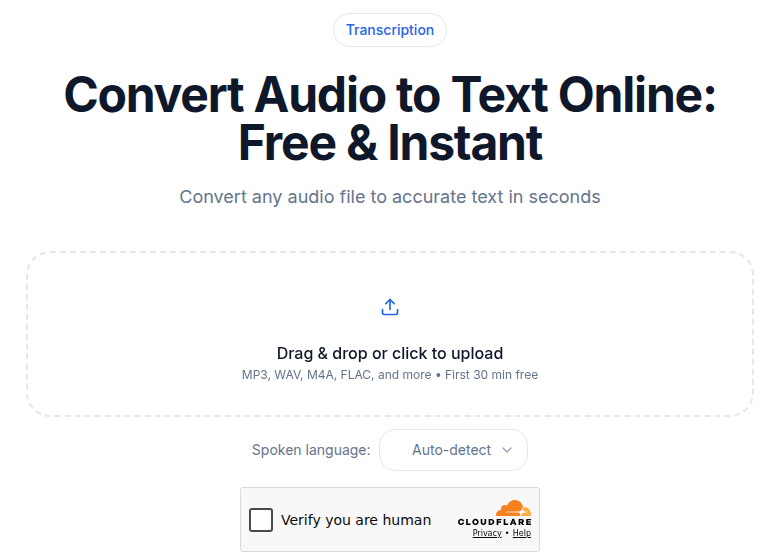 Field recordings upload as-is: ambient context stays in the audio archive
For Arabic fieldwork, major engines handle Modern Standard Arabic and some widely spoken dialects but performance on minority or regional dialects is uneven. Always test your specific audio variety before committing to a tool.
Step 4: Annotate, not just correct
After the AI produces a draft, your review pass should add context, not only fix errors.
Useful annotation conventions:
- Code-switching:
[switches to French]or[switches to Wolof] - Setting interruptions:
[colleague enters room],[sound of boat engine] - Non-verbal:
[laughs],[gestures toward the dock] - Untranslated terms with gloss:
nguël gi (the older brother)
These annotations are what let the transcript serve as analytic data. They also become the source material for the thick description that Clifford Geertz's framework demands: not just what happened, but the layered context of meaning around it. A transcript without annotations is thin description. The same text with setting, relationship, and code-switching markers approaches the ethnographic standard.
One important mechanical point: include the researcher's turns in the transcript. Transcripts that hide the ethnographer's questions produce analyses that hide their own positionality. That is not methodologically defensible.
For a deeper look at what happens at the analysis stage after transcription, the speaker diarization explained guide covers how speaker labels interact with multi-party conversation data.
Step 5: Connect transcripts to field notes
Each transcript should reference its companion field note by file name. A consistent naming convention makes this automatic: 2025-09-14_dock-conversation_M.Sow.txt for the transcript and 2025-09-14_field-note.md for the note. In your QDA software, link documents rather than copying context into the transcript itself.
Step 6: Translate selectively, at the writing stage
Translate only the specific quotes you intend to use in your write-up. This preserves the original language for your own analytic memory, keeps interpretive choices visible (you can footnote difficult translations), and maintains the participant's voice in the final text. Full upfront translation strips out exactly what ethnographic research is supposed to surface.
Transcription Conventions Across Ethnographic Traditions
Different traditions use different conventions, and mixing them across a project creates more problems than it solves.
Sociolinguistic ethnography often uses Jefferson notation, which captures turn-taking, overlap, and pause duration with precise symbols. This level of detail matters when the analytic focus is on interaction structure itself, not just content.
Cultural anthropology typically uses cleaner transcripts with bracket annotations for context and code-switching. The conversation is data, but the analytic focus is usually meaning, not interactional mechanics.
Critical ethnography sits between the two. Detailed enough to support discourse analysis, readable enough to feed thematic and narrative coding.
Pick a convention before the transcription stage and document it in your methods section. Consistency matters more than which system you choose.
Protecting Participants in the Transcript
Ethnographic research often involves sensitive material: marginalized communities, politically risky environments, illicit economies. The transcript layer needs to match the ethics of the research.
Pseudonyms before sharing. Apply pseudonyms during transcript review, before any file leaves your control. Keep a separate encrypted key that maps pseudonyms to real identities. Never store the key file in the same location as the transcripts.
Local processing for high-risk material. When the risk profile is high, run transcription on a local machine rather than uploading to a cloud service. Open-source Whisper running locally is the standard tool for this. It is slower than cloud APIs but keeps the audio entirely off external servers.
Storage hygiene. Audio of sensitive material should not sit indefinitely in cloud services. Transcribe, then delete from cloud storage if the material warrants it, retaining only encrypted local copies.
The ethics of interview transcription guide covers the broader ethical layer that applies to all interview research, including anonymization strategies and consent documentation.
Working Across Languages in NVivo and MAXQDA
Multi-language ethnographic projects break some assumptions in standard QDA software. Both NVivo and MAXQDA can import non-English transcripts. MAXQDA has particularly strong multilingual interface support across multiple languages and handles text, audio, video, and geodata in a single environment. NVivo handles the widest range of data types, which matters for projects that combine fieldwork notes, interview recordings, and archival material.
The pragmatic approach for multi-language projects is a parallel coding strategy: code in the original language for analytic depth, then code translated quotes separately for any committee-facing or published write-up. The NVivo vs AI transcription guide covers the workflow for combining AI output with QDA software in more detail.
Time Budget for Dissertation-Scale Fieldwork
A typical ethnographic dissertation includes thirty to eighty hours of audio. After triage, expect fifteen to forty hours of full transcription.
AI processing time: Under two hours of compute time for forty hours of audio.
Review and annotation time: Thirty to sixty minutes per audio hour for English and major European languages. Budget sixty to ninety minutes per hour for Swahili or Hausa audio. For Wolof audio, plan on a bilingual reviewer spending close to full listening time.
Selective translation: One to three hours per dissertation chapter for quote-by-quote translation work.
Total focused effort: Fifteen to thirty hours for a dissertation-length project, assuming disciplined triage.
If you just need clean transcripts of field recordings without a meeting bot or video platform, ConvertAudioToText handles multilingual audio upload and produces speaker-labeled output. The Pro plan runs from $14.99 per month for unlimited transcription, which makes the per-file cost essentially nothing for a dissertation project. On a free account your first file runs on the premium engine (up to an hour), then it keeps transcribing free: up to 30 files a day, up to 30 minutes each. Reading and copying transcripts is free, which is enough to test your specific audio before committing.
Common Mistakes That Show Up in Ethnographic Writing
Three patterns weaken otherwise strong ethnographic work.
Decontextualized quotes. A vivid quote without setting and relationship context becomes generic. The annotation and the field note are what give the quote ethnographic weight.
Over-translated transcripts. Translating away the participant's voice strips out what ethnographic research is supposed to surface. Keep original-language phrases visible in the write-up, even when you translate the surrounding passage.
Hidden researcher presence. The ethnographer's question shapes the answer. Transcripts that cut the researcher's turns produce analyses that conceal their own interpretive frame. Include your side of the conversation.
My take: the transcription stage is not where ethnographic analysis happens, but it is where the raw material either retains or loses its analytic value. A transcript that carries setting, relationship context, and code-switching markers is genuinely different data from one that strips those things out. The tooling is easier than it has ever been. The intellectual discipline of keeping context attached is still the work.
For further context on what accuracy actually means for qualitative fieldwork, transcription accuracy explained covers word error rates and what they mean for real analysis use cases.
Common Questions
Can AI transcription handle code-switching between two languages?
Partially. Tools built on AssemblyAI's Universal-2 or Whisper can pick up alternating French and English reasonably well, but they tend to normalize code-switches rather than flag them, which strips out exactly the information ethnographers need. The practical fix is to run the AI pass first, then manually mark each language shift during review using a consistent bracket convention like [switches to French]. Automatic language detection can misread which language is active mid-sentence, so never rely on it alone for code-switching data.
What do I do about Wolof, Hausa, or Swahili audio?
Wolof is not on the supported language list for any mainstream engine as of mid-2026. Hausa and Swahili are supported by Whisper and AssemblyAI's Universal-2, but both fall in lower accuracy tiers, meaning error rates above 25 to 50 percent are documented. For these languages, AI gives you a rough first draft that substantially reduces typing time, but you should budget significantly more review time per audio hour than you would for a European language. For Wolof, a bilingual research assistant or a language-trained collaborator is still the more reliable path.
How do I protect participants when transcribing sensitive ethnographic data?
Three practices matter here. First, apply pseudonyms during transcript review, before the file leaves your machine, and keep a separate encrypted key that maps pseudonyms to real identities. Second, for high-risk material, run transcription locally using open-source Whisper rather than uploading to a cloud service. Third, set a clear retention policy for audio files: transcribe, then delete from any cloud storage if the material warrants it, retaining only encrypted local copies. These steps align with standard IRB expectations around data minimization and participant confidentiality.
Should I translate transcripts before or after coding?
After, or not at all at the transcript stage. The defensible ethnographic approach is to code in the original language, then translate only the specific quotes you plan to use in your write-up. Full upfront translation flattens the participant's voice, introduces interpretive choices before you have finished analysis, and makes those choices invisible to the reader. Targeted translation at the writing stage lets you add footnotes explaining difficult passages, which strengthens rather than hides the analytic move.
Sources
- AssemblyAI Supported Languages documentation
- Deepgram Models and Languages Overview
- OpenAI Whisper language support
- ConvertAudioToText pricing page
- NVivo vs MAXQDA 2026 comparison via skimle.com
- Thick Description overview via Wikipedia
- Jefferson Transcription System guide via University Transcriptions
Try transcription free
Convert any audio or video to clean, unwatermarked text — speaker labels, timestamps, and AI summaries included. First 30 minutes free, no account.
Related Articles
How to Transcribe a Focus Group
Learn how to transcribe a focus group discussion with speaker labels, review an AI summary and action items, and export a clean TXT, SRT, or VTT transcript for qualitative research.
How to Transcribe a Research Interview with Speaker Labels
Learn a practical workflow for turning research interview audio into a labeled transcript: upload your file, review speaker labels, and export TXT, SRT, or VTT.