NVivo vs AI Transcription: Different Jobs Compared
Summarize this article with:
Different Jobs
NVivo is qualitative data analysis software. AI transcription tools produce text from audio. These two things are not competing for the same task, and framing them as rivals misunderstands what each one does.
The honest question is narrower: should you use NVivo's built-in transcription, or should you transcribe outside NVivo and import the result? That question has a clear answer for most researchers, and this post walks through it.
What Each Tool Is Actually Built For
NVivo, from Lumivero, is a coding and analysis environment. It handles systematic coding, theme development, matrix coding queries, word frequency analysis, cluster analysis, project organization across dozens or hundreds of documents, and inter-rater reliability calculations (percentage agreement and Cohen's kappa). These capabilities are why qualitative researchers license it. Transcription is a feature bolted onto the platform years after the core product shipped.
AI transcription tools do one job: convert speech to text, fast, and accurately. The best current models achieve word error rates well under 10 percent on clean audio. They run more specialized acoustic models than what general-purpose research software bundles in.
If you need to transcribe your interviews and then code them, you need both. The question is which tool does the transcription step.
NVivo's Built-In Transcription
NVivo offers an automatic transcription service via a cloud-based third-party engine. Lumivero markets it at "90% accuracy from quality recordings." That figure is vendor-claimed, and real-world performance is softer.
Quirkos, a competing QDA vendor, ran a practical test on challenging audio (background noise, non-standard accent) and found NVivo ranked last among the transcription services they tested, producing output that was largely unusable on that file. NVivo also processed their sample at roughly half the speed of the faster dedicated tools.
The key facts as of 2026:
- Transcription credits are sold separately from the NVivo license
- Lumivero's published pricing: $499 for a 50-hour annual package ($0.167/min at that tier), or pay-as-you-go at $30 per single hour ($0.50/min)
- 15 free trial minutes are included
- 43 languages supported
- File cap: up to 4 hours or 4 GB per submission
- Output formats: .docx or .txt
- Built-in editor for speaker tagging and corrections
- Imports directly into NVivo after transcription
For a researcher with one short interview who wants to stay inside a single interface, the built-in option removes a step. That convenience has a real cost: accuracy and price.
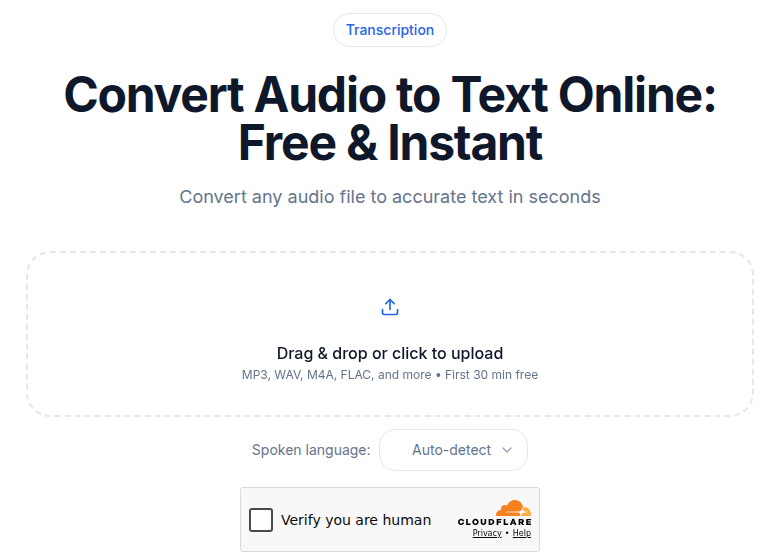 The transcription step happens before NVivo: upload, transcribe, export, import
Dedicated AI Transcription Plus NVivo Import
The pattern most experienced qualitative researchers use is to transcribe outside NVivo, then import the cleaned file. This separates two distinct questions:
Which tool produces the most accurate transcript at your price point? And which environment is best for coding and analysis?
Answering them separately almost always produces better results. Dedicated AI tools run more capable acoustic models on your audio, support more languages (Whisper-based pipelines cover 99-plus languages vs NVivo's 43), and handle multi-speaker audio more reliably. You review the transcript once, anonymize it, then import the .docx or .txt file into NVivo. From there NVivo does what it is built for.
The transcription accuracy tradeoffs between models matter more once you see how errors cascade: a misheard word that gets coded becomes a theme that does not actually exist in your data.
The Import Workflow
For a dissertation or research project with 15 to 30 interviews, the practical sequence is:
- Record interviews
- Upload audio to a dedicated AI transcription tool
- Review each transcript against the audio, correcting errors and tagging speakers
- Anonymize participant identifiers
- Import the .docx or .txt files into NVivo
- Code, run queries, build themes in NVivo
Step 3 is the one researchers most often skip. AI errors that go uncorrected propagate through your coding. A code applied to a misheard utterance becomes a theme built on noise, not data. This is true regardless of which transcription tool you use.
The interview transcription workflow covers step-by-step verification in more detail. The dissertation-specific guide addresses the scope and IRB documentation angle.
Cost Comparison
For a dissertation with 25 hours of interview audio:
NVivo bundled transcription only: One 50-hour package at $499 covers the audio, with credits valid for 12 months. You would use roughly half the package. NVivo license cost is not publicly listed in a clean tier on Lumivero's shop; published estimates for academic individual annual subscriptions range from roughly $130 for student/subscription tiers to $1,200-plus for standard academic licenses. Check your institution first: many universities hold site licenses that cover NVivo at no marginal cost to researchers.
Dedicated AI transcription plus NVivo import: A flat monthly subscription on a dedicated tool runs under $20/month for unlimited audio on most major services. For a 12-month dissertation cycle that is under $240. Your NVivo cost stays the same either way, since the transcription add-on is separate from the base license.
My take: the cost difference alone makes the dedicated-AI approach attractive. The accuracy difference makes it obvious.
What NVivo Does That No Transcription Tool Can Replace
This is the case for NVivo, and it is strong:
Matrix coding queries. Cross codes against participant demographics, interview type, or any other case attribute. Critical for any project that compares findings across subgroups. No transcription tool does this.
Coding comparison queries. NVivo calculates both percentage agreement and Cohen's kappa between two coders, supporting inter-rater reliability reporting that journals and dissertation committees require for rigorous qualitative work.
Word frequency and word tree analysis. Surface language patterns that pure code-based analysis might miss.
Project organization at scale. NVivo's folder, case, and document structure handles projects with 100-plus sources and multiple data types without degrading.
Collaboration. NVivo Collaboration Cloud lets teams code in a shared project, with version control and merge functions. The transcription step is still a single-person task; the analysis benefits from multiple coders.
For methods like thematic analysis (Braun and Clarke's six-phase framework) or grounded theory (Glaser and Strauss, refined by Corbin), NVivo provides the infrastructure to do systematic, documented, auditable analysis. The thematic analysis transcript guide and the grounded theory transcription guide go deeper on those specific workflows.
What Dedicated AI Transcription Does Better
Speed. A 60-minute interview transcribes in 3 to 5 minutes on a dedicated AI tool. NVivo's Quirkos-tested speed was roughly half-time or slower.
Accuracy on challenging audio. Models built on Whisper Large-v3 and Deepgram Nova-3 perform well on accents, non-standard speech, and moderate background noise. NVivo's bundled engine ranked last in the Quirkos real-world test on difficult audio.
Language breadth. Whisper-based pipelines support 99-plus languages, including low-resource languages that NVivo's 43-language list does not cover. For researchers working with multilingual populations or non-Western languages, this gap matters.
Speaker diarization for focus groups. Dedicated tools handle 4-to-6-speaker audio more reliably. For focus group transcription, the difference in diarization quality is material. The speaker diarization explained guide covers what to look for when the recording has overlapping speakers.
If you just need a clean transcript without a full QDA environment, ConvertAudioToText handles audio in 99+ languages with speaker detection and exports in the formats NVivo accepts (.docx, .txt).
QDA Alternatives to NVivo
NVivo is not the only qualitative analysis environment. The "AI transcription plus QDA import" workflow applies equally to:
- MAXQDA: Academic license starting around $250/year; similar query and coding features, preferred by some for its interface
- ATLAS.ti: Desktop from around $395/year, cloud version from $14/month for academics; strong network visualization
- Dedoose: $14.99/month; web-based, well-suited for teams doing mixed-methods research
The import step is the same across all of them. None bundle transcription that competes with dedicated tools on accuracy.
The coding qualitative interviews guide covers how the analytic workflow connects to transcript quality in any of these environments.
Decision Framework
Three scenarios cover most cases:
Solo dissertation, 15-30 interviews. Transcribe externally, review against audio, import to NVivo. Lower cost, higher accuracy, institutional license may cover NVivo anyway.
Team project with shared coding. Same transcription approach. One team member handles transcript review and anonymization. Import to NVivo Collaboration Cloud for shared coding. The transcription step is individual work; the analysis step benefits from multiple coders.
Quick-turn UX or market research with a 1-week timeline. NVivo is probably overkill. A lighter synthesis environment handles 6 to 10 interviews faster than NVivo's analytic depth requires.
The exception worth noting: if your institution's site license bundles NVivo transcription minutes at no marginal cost, the accuracy tradeoff may be acceptable for clean, single-speaker audio. Even then, budget more review time per transcript.
FAQ
Is NVivo a transcription tool?
No. NVivo is qualitative data analysis software. It includes an automatic transcription feature as an add-on, but its core value is in coding, querying, and analyzing text, audio, and video data. Transcription is one step in a workflow that NVivo then supports, not its primary function.
How much does NVivo transcription cost?
Lumivero sells transcription credits separately from the NVivo license. As of mid-2026, pricing is $499 for a 50-hour annual package (roughly $0.17 per minute) or $30 for a single hour on a pay-as-you-go basis ($0.50 per minute). A 15-minute free trial is included. Credits expire after 12 months.
Can I import transcripts from other tools into NVivo?
Yes. NVivo imports .docx and .txt files cleanly. The standard workflow is to transcribe in a dedicated AI tool, review and correct the transcript, then import the file into NVivo for coding. This is the approach most experienced qualitative researchers use.
Is NVivo's built-in transcription accurate enough for research?
Lumivero claims 90% accuracy from quality recordings. Independent testing (Quirkos, 2025) found NVivo's transcription ranked last among the services tested when audio was challenging: non-standard accents, background noise. On clean, standard-accent audio it performs adequately, but it consistently underperforms dedicated AI transcription models on difficult real-world recordings.
What are the alternatives to NVivo for qualitative analysis?
MAXQDA, ATLAS.ti, Dedoose, and Quirkos are the main alternatives. All support code-based analysis, matrix queries, and project organization. All accept .docx and .txt transcript imports. None bundle transcription that competes with dedicated AI tools on accuracy or language coverage. Pricing varies: Dedoose is subscription-based at $14.99/month; MAXQDA academic starts around $250/year; ATLAS.ti desktop starts around $395/year.
Sources
- Lumivero NVivo Transcription product page: https://lumivero.com/products/nvivo-transcription/
- NVivo Transcription supported languages: https://help.mynvivo.com/nvtranscription/Content/Supported_languages.htm
- Lumivero shop (NVivo licensing and transcription add-ons): https://shop.lumivero.com/qda-and-research/nvivo
- Quirkos comparison of automated transcription for qualitative research: https://www.quirkos.com/blog/post/comparing-automated-transcription-services-for-qualitative-research/
- usercall.co NVivo pricing guide (2026): https://www.usercall.co/post/nvivo-software-pricing-how-much-does-it-really-cost-in-2025
Try transcription free
Convert any audio or video to clean, unwatermarked text — speaker labels, timestamps, and AI summaries included. First 30 minutes free, no account.
Related Articles
How to Transcribe a Focus Group
Learn how to transcribe a focus group discussion with speaker labels, review an AI summary and action items, and export a clean TXT, SRT, or VTT transcript for qualitative research.
How to Transcribe a Research Interview with Speaker Labels
Learn a practical workflow for turning research interview audio into a labeled transcript: upload your file, review speaker labels, and export TXT, SRT, or VTT.