
Coding Qualitative Interviews: Transcript to Codebook
Summarize this article with:
Qualitative coding moves interview data from raw text to organized codebook through three passes: open coding (broad labels), axial coding (finding relationships), and selective coding (converging on a core category). Coding starts with how your transcript is formatted, and QDA software like NVivo or Dedoose scales the process once a pilot is solid. AI tools accelerate open coding but cannot make the analytic move from codes to themes.
You have 18 transcripts and two weeks to show your supervisor a codebook. The textbook advice to "let codes emerge from the data" is true and also not particularly useful when you are staring at 200,000 words of interview text. This guide walks through what coding actually looks like in practice: how the three passes work, what your codebook needs to contain, where AI tools help and where they do not, and how your transcript format shapes everything that comes after.
What Coding Actually Means
Coding is attaching short labels to segments of data so you can group similar content later. The labels are codes. The segments are usually a few words to a few paragraphs.
A good code captures a specific idea in a few words. "Distrust of institutional authority" is a code. "Important point" is not. "Talked about money" barely qualifies. The discipline is to write codes specific enough to be useful and short enough to remember.
For a typical 60-minute interview, expect 30 to 80 codes. Across a project of 20 interviews, you accumulate 80 to 250 distinct codes. The exact range depends on the topic and on whether you are coding inductively or deductively.
Inductive vs Deductive Coding
The two main approaches start from different places.
Inductive coding starts from the data. You read a passage, ask what it is about, and write a code. The list grows as you read, then stabilizes.
Deductive coding starts from theory or a prior framework. You apply codes from a pre-built list and add new ones only when the data demands it.
Most published qualitative work uses a hybrid approach: a small set of deductive codes tied to the research question, plus inductive codes added as patterns emerge. The choice matters for time budgeting. Inductive coding takes longer because you are building the code system as you go.
Open, Axial, and Selective Coding: The Three Passes
The three-stage coding sequence was formalized by Anselm Strauss and Juliet Corbin in their grounded theory work, described in depth in Basics of Qualitative Research (Corbin and Strauss, 2008). While they originated as grounded theory procedures, the three passes have become widely adopted across qualitative traditions as a practical structure for moving from raw text to organized analysis.
Open Coding: Breadth First
Open coding is the first pass through your data. The goal is breadth, not precision. Apply codes liberally; many will get merged or dropped later.
Rules of thumb for open coding:
- If you are stuck on whether to code something, code it. Removing a code later is easy. Re-reading transcripts to add missed codes is painful.
- Use the participant's own words when they capture something precise. "Hustle culture" (participant's term) beats "work intensity" (your gloss).
- Allow yourself obvious codes. Sometimes the obvious ones are the ones that matter most.
- Aim for 3 to 6 codes per page. Significantly fewer and you are skimming. Significantly more and you are coding noise.
A 12,000-word transcript from a 60-minute interview typically produces 40 to 80 open codes. Plan on 3 to 5 hours of coding time per interview at this stage.
Axial Coding: Finding Relationships
Once you have open codes across all your interviews, axial coding reorganizes them. You look for relationships between codes, group related codes into categories, and start to see the structure of your data.
In practice, axial coding looks like sorting your open codes into clusters. Some clusters will be obvious. Others will surprise you. Cluster names often become candidate themes in the next phase. The boundary between axial coding and theme generation is fuzzy. Different methodological traditions draw the line in different places.
For thematic analysis specifically (Braun and Clarke's six-phase framework), what happens after axial coding is described in the thematic analysis from transcripts guide.
Selective Coding: Converging on a Core Category
Selective coding focuses on the core category that addresses your research question. By this stage, your codebook is stable and you are returning to the data to validate that your themes hold up.
Selective coding is faster than open coding because you know what you are looking for. Plan on 1 to 2 hours per interview at this stage, not 3 to 5.
Selective coding is a grounded theory concept: you identify the one category that accounts for the most variance in your data and integrate all other categories around it. In thematic analysis, the analogous move is defining and naming your final themes. The underlying discipline is the same: stop accumulating and start converging.
Transcript Formatting That Eases Coding
The structure of your transcript affects how fast you can code it. This is worth deciding before you transcribe anything.
Consistent speaker labels are the single most important formatting choice. Use a predictable format across all transcripts: INT for interviewer, P01 through P20 for participants (or a real pseudonym consistent throughout). QDA software like NVivo imports these labels as node metadata, which saves hours of manual tagging.
Timestamps also matter. Adding a timecode at every 30 to 60 seconds and at key topic shifts lets you navigate directly to passages during selective coding. They are essential for any software that syncs audio to text.
Verbatim versus clean verbatim is a separate decision. Verbatim captures filler words, false starts, and pauses; it works best when how something is said matters (discourse analysis, conversation analysis). Clean verbatim removes verbal clutter while keeping meaning; it works best for faster reading and coding in interview research.
Document your format choices in your methodology section and, if your study is IRB-governed, in your IRB protocol.
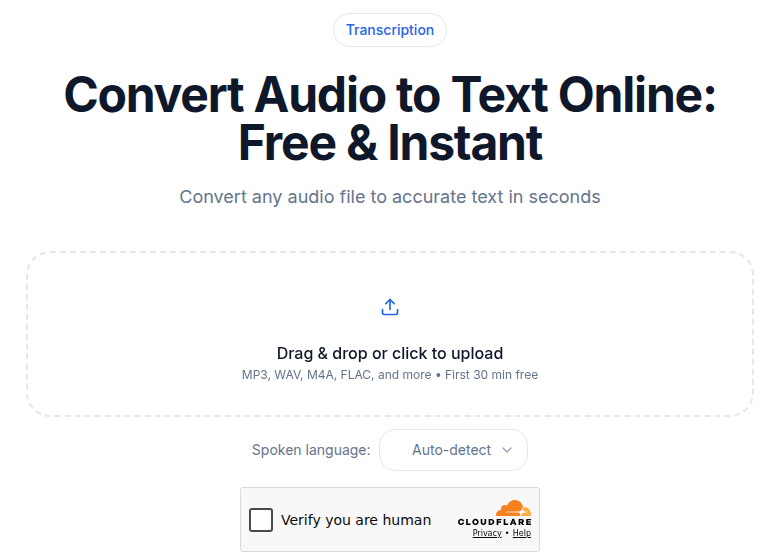 Clean transcripts in, consistent codes out: formatting starts at the upload
If you need clean transcripts with speaker labels and timestamps already formatted, the interview transcription tool outputs exactly that structure. You can drop the result directly into NVivo or ATLAS.ti without manual reformatting.
Software Options for Coding
Three categories of software handle coding work. Picking the wrong one costs you weeks.
Dedicated QDA Software
NVivo, MAXQDA, ATLAS.ti, and Dedoose are built for qualitative coding. They handle large datasets, support team coding with separate user accounts, generate codebook reports automatically, and track coding across multiple files.
The downside is cost and learning time. Here is current pricing based on vendor pages checked in July 2026:
| Software | Academic (annual) | Individual commercial | Team / monthly |
|---|---|---|---|
| NVivo | ~$1,200 per year | ~$1,800-2,500+ per year | Teams from ~$2,500/yr |
| MAXQDA | ~$253 per year | Custom quote | Custom quote |
| ATLAS.ti Desktop | ~$110 per year | ~$670 per year | Cloud from $14/mo |
| Dedoose | $12.95/mo (student) | $17.95 per active month | $13.95/user/mo (6+ users) |
NVivo's learning curve is steep: most researchers need several sessions before the core workflow feels natural, and advanced querying takes longer. If you are coding a dissertation, the investment pays back. If you are coding a single class project with 5 interviews, it might not. The NVivo vs AI transcription comparison covers the trade-offs in more detail.
Dedoose is cheaper and runs in a browser, which removes the installation problem for teams on different operating systems. ATLAS.ti Cloud offers the lowest academic entry point. MAXQDA is a strong middle ground for researchers who want desktop reliability without NVivo's price.
Word Documents With Comments
Free, familiar, and unwieldy. Works for 3 to 5 interviews. Falls apart past that.
The advantage: no one needs to learn new software. The disadvantage: aggregating codes across interviews becomes manual and error-prone. If you are running a pilot (see below), start here.
Spreadsheets
Track codes in a spreadsheet with columns for participant ID, code, quote, and analytic memo. Clunky, but transparent and easy to audit.
This setup works for deductive coding where the code list is stable going in. It works poorly for inductive coding where codes emerge as you go.
Building Your Codebook
The codebook is the document that defines every code in your analysis, with definitions and examples. Reviewers, supervisors, and journal editors ask for this. Build it as you code, not after. A codebook written at the end is usually a clean-up exercise that misses the messy reality of how codes were actually applied.
A minimum-viable codebook entry contains:
- Code name
- Definition (1 to 2 sentences)
- Inclusion criteria: when to apply this code
- Exclusion criteria: when not to apply it, especially when distinguishing it from a similar code
- 2 to 3 example quotes from your data
The exclusion criteria are the part most researchers skip and most regret. When two coders consistently disagree on one code, it is almost always because the boundary conditions were not documented.
Inter-Rater Reliability
If you are coding alone, you cannot run inter-rater reliability (IRR). If you are coding with a team, you should.
The standard approach is to have two coders independently code 10 to 20 percent of the data, then compare. Cohen's kappa above 0.70 is the widely-cited threshold for acceptable agreement. The benchmark comes from Landis and Koch (1977), who classified kappa 0.61 to 0.80 as "substantial agreement." Many clinical journals set the bar at 0.70 or higher.
If you fall below 0.70, the problem is almost always in your codebook definitions, not in your coders. Refine the inclusion and exclusion criteria for the codes where disagreement is highest, recode those passages, and measure again.
IRR is increasingly expected in qualitative journal reviews. Check your target journals before you finish data collection, not after.
AI-Assisted Coding: What Actually Helps
AI tools have entered the qualitative coding space. The honest assessment is mixed.
Where AI helps:
- Generating candidate code lists from a transcript. The AI proposes 20 to 40 codes you can review and refine. Even if half are wrong, it accelerates the open coding stage significantly.
- Finding similar passages across transcripts when you remember the gist but not the location.
- Producing first-pass summaries that orient you to each interview before deep coding.
Where AI does not help:
- Deciding which codes matter for your research question. That is your analytic judgment.
- Recognizing context-dependent meaning. A phrase that means one thing in interview 3 might carry different weight in interview 14. AI misses this regularly.
- Making the analytic move from codes to themes. AI summaries are descriptive. Themes require synthesis.
The pattern that works: use AI as a junior research assistant. It surfaces things. You decide what matters.
Common Mistakes in Qualitative Coding
Three patterns come up repeatedly.
Coding too granularly. If every interview produces 200 codes, you have over-coded. Codes lose their utility when there are too many of them. Aim for 40 to 80 per hour-long interview.
Treating codes as themes. "Funding challenges" is a code. A theme would be something like "how participants navigated the gap between promised and delivered institutional support." Themes require analytic synthesis, not just a label.
Coding only what fits the framework. If you started deductively, you risk missing patterns that did not fit your initial framework. Build in time for inductive passes even on deductive projects.
What to Do This Week
If you are starting a coding project and have not done one before, run a minimum-viable pilot. Pick three transcripts that span the variation in your sample. Code them in a Word document with comments. Build a working codebook from those three.
After the pilot you know your codes-per-hour rate, your typical codebook size, and where your method has weaknesses. Scale up to the full project from that foundation.
If you need speaker-labeled, timestamped transcripts ready for import into QDA software, ConvertAudioToText handles both the transcription and the formatting step. One less thing to do before coding starts.
For the next step once coding is done, the thematic analysis from transcripts guide covers how to move from organized codes to final themes. For research contexts with specific transcript requirements, how to transcribe an interview recording covers the preparation side in more detail.
FAQ
What is the difference between open coding and thematic analysis?
Open coding is the first pass in a grounded theory coding sequence (Strauss and Corbin), focused on applying broad labels to every meaningful segment of data. Thematic analysis (Braun and Clarke's six-phase framework) is a separate methodology with its own code-generation phase, but the two overlap substantially in practice. Researchers often use open coding language when describing the early stages of thematic analysis, which is imprecise but common. The key distinction: grounded theory aims to build theory from the data; thematic analysis aims to identify and report patterns.
How many codes should I have per interview?
For a 60-minute interview with roughly 10,000 to 12,000 words, 40 to 80 open codes is a reasonable target. Fewer than 30 usually means you are skimming the data. More than 120 usually means you are coding noise, and many of those codes will be redundant or overlap with others.
What does Cohen's kappa above 0.70 actually mean?
Kappa measures agreement between two coders while correcting for chance agreement. According to Landis and Koch (1977), kappa between 0.61 and 0.80 represents substantial agreement, and above 0.80 represents near-perfect agreement. The 0.70 threshold commonly cited in qualitative research sits within that "substantial" band. A kappa below 0.70 does not necessarily mean your coders are poor; it often means your codebook definitions need tighter inclusion and exclusion criteria.
Do I need QDA software like NVivo to code qualitative interviews?
Not for small projects. Three to five interviews can be managed with Word comments or a spreadsheet. Beyond that, QDA software starts to pay for itself in time saved on cross-interview searching, code frequency queries, and codebook report generation. NVivo and MAXQDA have academic pricing that is substantially lower than their commercial rates. Dedoose at $17.95 per active month is the lowest-cost entry point with real QDA functionality.
When should I use AI for qualitative coding?
AI is most useful at the open coding stage, where it can propose an initial list of candidate codes from a transcript for you to review and refine. It saves time but does not replace judgment. AI tools are not reliable for deciding which codes are analytically important, for recognizing context-dependent meaning across interviews, or for making the interpretive move from codes to themes. Treat AI output as a first draft that needs your analytic eye.
Sources
- Corbin, J. and Strauss, A. (2008). Basics of Qualitative Research: Techniques and Procedures for Developing Grounded Theory (3rd ed.). SAGE. https://us.sagepub.com/en-us/nam/basics-of-qualitative-research/book235578
- Braun, V. and Clarke, V. (2006). "Using thematic analysis in psychology." Verified via MAXQDA Research Guides: https://www.maxqda.com/research-guides/thematic-analysis
- Landis, J. R. and Koch, G. G. (1977). Inter-rater reliability benchmarks. Verified via: https://en.wikipedia.org/wiki/Cohen%27s_kappa
- NVivo pricing: https://shop.lumivero.com/qda-and-research/nvivo (pricing not publicly listed; figures sourced from usercall.co review, July 2026)
- MAXQDA pricing: https://www.usercall.co/post/maxqda-pricing-guide-2025-plans-costs-and-add-ons-explained
- ATLAS.ti pricing: https://www.usercall.co/post/atlas-ti-pricing-guide-2025-plans-costs-and-key-differences
- Dedoose pricing: https://www.dedoose.com/pricing/pricing-subscriptions
- Transcript formatting guidance: https://gotranscript.com/en/blog/interview-transcription-template-qualitative-research
Try transcription free
Convert any audio or video to clean, unwatermarked text — speaker labels, timestamps, and AI summaries included. First 30 minutes free, no account.
Related Articles

How to Extract Quotes from an Interview Recording
A workflow-led guide for journalists and writers: how to extract publishable quotes from interview transcripts, with editing ethics, context rules, and approval flows.
How to Transcribe Interviews for Research: A Practical Pipeline
Step-by-step workflow for transcribing research interviews: consent, recording setup, choosing transcription level, AI-assisted review, anonymization, and IRB-compliant data storage.