
Thematic Analysis from Transcripts: The Six Phases
Summarize this article with:
Braun and Clarke's six-phase reflexive thematic analysis is the most-cited qualitative method for deriving themes from interview transcripts, with their 2006 paper accumulating nearly 300,000 Google Scholar citations. Familiarization begins during transcription itself, not after it. The workflow runs through coding, theme generation, two rounds of review, and definition before write-up, and the real work sits in phases one through three. Most dissertation-scale studies produce three to six themes; fewer than three usually means themes are too abstract, more than six usually means they are too descriptive.
Thematic analysis produces defensible, structured themes from interview transcripts when you follow a clear procedure. Braun and Clarke's six-phase reflexive framework, first published in Qualitative Research in Psychology in 2006 and formalized in their 2022 book Thematic Analysis: A Practical Guide, gives you that procedure. The six phases are not a checklist you tick off in order; they are iterative, and you will move back and forth between them. But they do give your analysis a shape you can describe to a supervisor or a peer reviewer.
The Six Phases at a Glance
The framework lays out as:
- Familiarization with the data
- Generating initial codes
- Generating initial themes
- Reviewing and developing themes
- Refining, defining, and naming themes
- Producing the report
The trap most graduate students fall into is treating phases one through five as quick preparation and putting all their effort into phase six. The write-up goes slowly when the analysis is thin. When the analysis is thorough, the write-up almost writes itself.
Phase 1: Familiarization (It Starts During Transcription)
Familiarization begins the moment you engage with the audio, not when you open the transcript file. Braun and Clarke note that manual transcription, when feasible, creates deep immersion in the data. Listening actively to a recording before or during transcription gives you tonal cues, hesitations, and emphases that the cleaned text strips out.
Once you have transcripts, the minimum for genuine familiarization is two full reads of every one, taking notes as you go. Not skimming. Reading.
A 60-minute interview typically produces 9,000 to 12,000 words of transcript. For a project with 20 interviews, you are reading roughly 200,000 words twice. Budget 25 to 40 hours for this phase alone.
Accuracy at the source matters here. If your transcript contains frequent errors, you are building your mental model of the data on a flawed foundation. Review each transcript against the audio before familiarization begins. The transcription for qualitative research guide covers that review process in detail.
If you need to get transcripts turned around quickly before starting familiarization, ConvertAudioToText generates a full transcript plus an AI-generated summary (English audio) that gives you a structured five-minute first impression of each interview before you do the deep read. The summary is not a substitute for familiarization. It is a useful orientation layer.
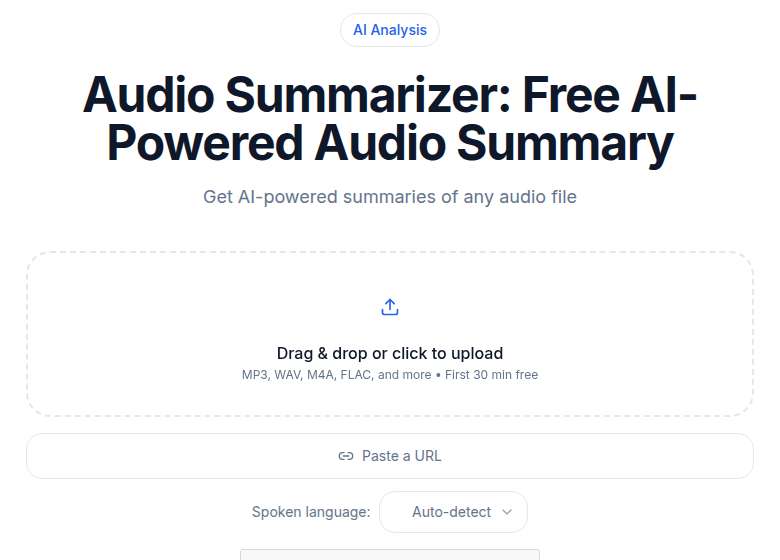 A first-pass AI summary is a familiarization aid, never a substitute for reading
Phase 2: Generating Initial Codes
Coding is where most researchers spend the bulk of their analytic time. A code is a short label attached to a piece of data capturing what it is about.
Reflexive thematic analysis is primarily inductive: codes emerge from the data rather than from a pre-existing framework. Braun and Clarke describe codes as "provisional interpretations," not fixed extractions of objective meaning. Your perspective as the researcher actively shapes what you notice. That is not a flaw in the method; it is a feature of reflexive TA, which treats researcher subjectivity as an analytic resource rather than a source of bias to eliminate.
Deductive elements are possible when your research question calls for them, but for a strongly deductive study, framework analysis or template analysis may be a better fit than reflexive TA.
For a typical project of 20 interviews, expect 80 to 200 initial codes across the dataset. The range is wide because it depends on topic breadth and how granularly you code.
Tools for Coding
You can code in any tool that lets you attach labels to text:
| Tool | Best for | Notes |
|---|---|---|
| NVivo (Lumivero) | Large datasets, structured hierarchies | Subscription and perpetual licenses; AI-assisted coding available as add-on |
| MAXQDA | Mixed methods; academic pricing | Academic licenses from roughly $250/year |
| ATLAS.ti | Visual mapping; cloud version | Student cloud plans from around $5/month |
| Word with tracked comments | Small datasets (under 5 interviews) | Free; unwieldy past that |
| Spreadsheet (one row per code application) | Audit-trail-first approaches | Awkward but transparent |
Pick one tool and use it for the whole project. Switching mid-analysis costs weeks of re-importing and re-organizing.
For a detailed comparison of dedicated QDA software against AI-assisted approaches, the NVivo vs AI transcription comparison covers the tradeoffs.
Phase 3: Generating Initial Themes
Once you have your initial codes, you cluster them into candidate themes. This is the conceptual heavy lifting.
A theme is not a topic. It is a pattern across the data that captures something analytically meaningful about your research question. A code names a specific thing in a passage; a theme names what that thing and related things tell us across multiple participants and multiple interviews.
The discipline at this stage is to write your candidate themes down, then look at the codes that fall under each theme and ask whether they actually belong together. If several codes in a cluster are actually about something different, the theme needs to split.
Most dissertation-scale reflexive TA studies produce three to six initial themes at this stage, per verified patterns in published research. Fewer than three usually means the themes are too abstract. More than six usually means they are still code-level rather than theme-level.
Phase 4: Reviewing and Developing Themes
This is the first sanity check. You take your candidate themes and test them against two levels of evidence.
Level one: internal coherence. Read all the data excerpts coded under a single theme. Do they tell a coherent story? If they feel loose, the theme may be two themes or a theme and a sub-theme.
Level two: fit with the full dataset. Go back to the original transcripts, not just the coded extracts. Are there significant parts of the data that your current themes do not account for? That gap is a signal.
Themes split, merge, get renamed, and get dropped during this phase. Plan on one to two full weeks here, not two days.
Phase 5: Refining, Defining, and Naming Themes
By phase five, your themes should be stable. Now you write a tight definition for each one. A theme definition includes:
- A clear name, four to eight words
- A two to three sentence description of what the theme captures
- Three to five representative quotes
- Notes on how the theme relates to the other themes
This document becomes the analytic backbone of your write-up. In published qualitative papers, you will often see this material summarized in the methods or early findings section.
Theme names should do analytic work, not just label a topic. "Participants discussed challenges with funding" is a code description, not a theme name. A theme name would frame what kind of challenges, why they matter, and what they tell us.
Phase 6: Producing the Report
If you did phases one through five thoroughly, the write-up takes two to four weeks for a typical dissertation chapter or journal article. The findings section usually follows your themes, with each theme anchored by the strongest two to three quotes from across your data.
Two things separate strong qualitative write-ups from weak ones.
The first is quote selection. Pick quotes that are vivid and specific. A generic quote that could come from any project does less work than a specific one that is clearly tied to your participants' experience.
The second is the analytic move. Description tells the reader what participants said. Analysis tells the reader what that means in light of your research question and the existing literature. Push every theme through the question: what does this tell us that we did not already know?
Where AI Fits and Where It Does Not
AI tools can accelerate parts of thematic analysis. They cannot replace the analytic judgment.
Where AI helps: transcription, generating a first-pass orientation summary for each interview, surfacing candidate code labels you can then evaluate and revise, identifying similar passages across interviews.
Where AI does not help: the judgment of what codes mean together, what themes capture about the data, and how findings relate to the literature. The 2022 Braun and Clarke book is explicit that reflexive TA requires the researcher's engaged subjectivity throughout. That is not a limitation of current AI; it is a feature of the method.
The AI vs human transcription comparison covers accuracy tradeoffs. The coding qualitative interviews guide covers AI-assisted coding in more depth.
My take: AI transcription is a genuine time-saver at the front end of the process, and AI summaries are a useful orientation layer. But the moment you try to use AI to generate your themes or write your analysis, you have abandoned reflexive TA for something else. Name that clearly in your methods section if you go that route, because reviewers will ask.
Time Budget for a 20-Interview Project
A defensible time budget for thematic analysis of 20 interviews:
- Transcription review (after AI generation): 15 to 30 hours
- Familiarization (two full reads): 25 to 40 hours
- Initial coding: 60 to 100 hours
- Theme generation and review: 30 to 50 hours
- Theme definition: 10 to 20 hours
- Write-up: 60 to 100 hours
Total: 200 to 340 hours. At 20 hours per week, that is 10 to 17 weeks of focused work. This is realistic for a dissertation chapter or a substantial journal article. It is not realistic to do well in four weeks.
Three Patterns That Show Up in Peer Review Rejections
Themes that are really codes. "Participants discussed challenges with funding" is a code-level description. A theme would name the underlying pattern: what kind of challenges, in what context, with what significance.
Cherry-picked quotes. Strong themes have multiple participants speaking to them from across the dataset. If a theme rests on quotes from two of twenty participants, it is an outlier observation, not a theme.
Description without analysis. The findings section reads as a summary of what participants said, leaving the reader asking "so what?" Push every theme through the question of what it tells us beyond restating the data. That move is the analysis.
For more on building a rigorous qualitative transcript foundation, the transcription accuracy guide and the speaker diarization explained guide cover the technical side of getting clean, attributed transcripts before analysis begins.
Frequently Asked Questions
What is the difference between Braun and Clarke's original 2006 thematic analysis and their reflexive TA approach?
The six phases are unchanged. The philosophical framing shifted significantly in their 2019 and 2022 work. In reflexive TA, themes are researcher-constructed patterns rather than entities discovered in the data. Researcher subjectivity is treated as an analytic resource, not a source of bias to bracket out. Inter-rater reliability coding is explicitly incompatible with reflexive TA because the method assumes that two analysts will legitimately produce different codes from the same data. If your institution or supervisor expects IRR, clarify whether they mean a different branch of TA or a different method altogether.
How many themes should a thematic analysis produce?
Most published reflexive TA studies at dissertation level produce three to six main themes, each with two to four sub-themes. Fewer than three suggests the themes may be too broad to carry analytic weight. More than six often means you are still at code-level granularity rather than theme-level. The right number is whatever accurately represents the patterns in your specific dataset.
Can you use AI tools to code qualitative transcripts?
AI tools can generate candidate code labels and surface similar passages across transcripts. Those outputs are useful starting points for the researcher's own coding, not replacements for it. Reflexive TA specifically requires the researcher's engaged judgment throughout the coding process. If you use AI-generated codes, you need to evaluate, revise, and own each one analytically. Document how you used AI tools in your methods section.
Does thematic analysis require specialist software like NVivo or ATLAS.ti?
No. Thematic analysis can be done in Word with track changes and comments, in a spreadsheet with one row per code application, or in printed transcripts with highlighters. Specialist QDA software (NVivo, MAXQDA, ATLAS.ti) speeds up large projects and makes code hierarchies and queries easier, but the analytic work is yours regardless of the tool. For projects under five interviews, Word is often the simplest choice.
How do you handle transcription errors before beginning thematic analysis?
Review each transcript against the original audio before starting familiarization. Pay particular attention to proper nouns, technical terms, and any passage where the speaker hesitated, overlapped with another speaker, or spoke quietly. Errors that stay in your transcripts become errors in your codes and eventually in your themes. AI transcription accuracy varies by audio quality and accent; always treat the AI transcript as a first draft that requires review, not a final document.
Sources
- Braun, V. and Clarke, V. (2006). Using Thematic Analysis in Psychology. Qualitative Research in Psychology, 3, 77-101. https://www.tandfonline.com/doi/abs/10.1191/1478088706qp063oa
- Braun, V. and Clarke, V. (2022). Thematic Analysis: A Practical Guide. SAGE. https://uk.sagepub.com/en-gb/eur/thematic-analysis/book248481
- Skimle. Reflexive Thematic Analysis: What Changed with Braun and Clarke's Updated Approach. https://skimle.com/blog/reflexive-thematic-analysis-braun-clarke-guide
- Surviving Research. Reflexive Thematic Analysis in NVivo: Step-by-Step Guide. https://survivingresearch.com/step-by-step-example-of-the-braun-and-clarke-reflexive-thematic-analysis-approach-using-nvivo/
- Lumivero. NVivo: AI Qualitative Data Analysis Software. https://lumivero.com/products/nvivo/
- Skimle. MAXQDA vs ATLAS.ti in 2026. https://skimle.com/blog/maxqda-vs-atlas-ti-qualitative-analysis-software-2026
Try transcription free
Convert any audio or video to clean, unwatermarked text — speaker labels, timestamps, and AI summaries included. First 30 minutes free, no account.
Related Articles
How to Transcribe a Focus Group
Learn how to transcribe a focus group discussion with speaker labels, review an AI summary and action items, and export a clean TXT, SRT, or VTT transcript for qualitative research.
How to Transcribe a Research Interview with Speaker Labels
Learn a practical workflow for turning research interview audio into a labeled transcript: upload your file, review speaker labels, and export TXT, SRT, or VTT.