
Dissertation Interview Transcription: The Doctoral Plan
Summarize this article with:
AI transcription with human review is now the standard doctoral workflow: fast, cheap enough to cover 50-80 hours of audio for under $30, and defensible at the committee table when you document your process. The hard parts are not speed or cost but IRB compliance before you touch a service, method-specific decisions about verbatim vs. intelligent transcription, and the 6-12 hours of review work that no tool can skip. A 30-80 interview doctoral project needs a structured eight-stage protocol, not a one-off upload workflow.
The transcription stage is the cheapest, least-glamorous part of a doctoral dissertation and the one that most often stalls timelines. For a 30-80 interview qualitative project, getting this stage wrong means either losing months to manual typing, spending thousands on human transcription your department won't fund, or arriving at your defense without defensible answers to the accuracy and IRB questions your committee will definitely ask.
This guide is for doctoral researchers working at full dissertation scale. If you are working on a master's thesis with fewer interviews, the transcription for thesis research post covers that scope.
Does Your Method Require Verbatim or Intelligent Transcription?
This is the first question to settle, because it determines everything downstream.
Conversation analysis and discourse analysis require full verbatim with paralinguistic notation: pauses marked by length, overlaps, intonation. AI transcription alone cannot produce this; you are doing manual notation regardless.
Grounded theory, following Glaser and Strauss or the later Corbin and Strauss formulation, requires clean verbatim at minimum for early open-coding rounds. Clean verbatim preserves all meaningful spoken content but strips filler words and false starts. As theoretical sampling progresses into later interviews, the requirement relaxes somewhat, but your methods chapter needs to say so explicitly.
Thematic analysis, as described by Braun and Clarke (2006), treats familiarization with the data as phase one of six. Clean verbatim supports all six phases adequately. The claim that thematic analysis requires only "intelligent" (heavily cleaned) transcription is not well-supported; clean verbatim is the safer default.
Phenomenology is more flexible. Intelligent transcription works for the analytic stages, but retain access to the audio for passages where the participant's exact phrasing is your evidence.
Narrative inquiry sits closer to discourse analysis. Hesitations and storytelling rhythm are data; use verbatim.
The method choice you committed to in your proposal binds you. If your proposal says verbatim and you submit intelligent transcripts, your committee will catch it.
What Your IRB Actually Needs to Know About AI Transcription
IRBs do not "approve AI" as a category. They assess whether your data handling plan matches your consent forms and protects participants. When AI transcription services enter your protocol, expect reviewers to focus on four questions.
Does the service retain your audio? If yes, for how long, and does that retention period conflict with your approved data management plan?
Is your data used for model training or product improvement? For most IRBs reviewing human subjects research, the answer must be no. Get this in writing from the vendor.
Where is data processed and stored geographically? Cross-border data transfers can implicate GDPR, PIPEDA, or your institution's own data residency policies depending on where your participants are located.
Who outside your team can access the files? Vendor staff, subprocessors, and government requests all count.
Document the answers to all four in your methods chapter. A clean documented answer ends the committee question. A vague answer creates anxiety that resurfaces as objections during the defense.
Pre-upload redaction of highly sensitive identifiers before you send audio to any cloud service is a practical control that reduces IRB risk without changing your workflow significantly.
How Long Will This Actually Take?
A doctoral project of 50 interviews at 60 minutes each produces 50 hours of audio. Here is the realistic timeline, not the optimistic one:
- AI transcription processing: 1-4 hours total (parallel processing)
- Transcript review and correction: 12-25 hours (15-30 minutes per audio hour)
- Anonymization pass: 1-2 weeks as a separate stage
- QDA import and setup: 1-2 days
- Initial coding: 75-150 hours (3-5 hours per hour-long interview for inductive coding)
- Theme development: 3-4 weeks
- Findings chapter draft: 6-10 weeks
The post-data-collection analytic stage for a project of this size realistically runs 10-18 weeks. If your program allocated 6 weeks, you are looking at an extension conversation. Plan from the real numbers before you schedule your defense.
The Eight-Stage Workflow
Stage 1: Document Your Protocols Before the First Interview
Write this document before you collect any data:
- Recording device model and settings
- File naming convention (project code, participant pseudonym, date)
- Backup procedure and schedule
- Transcription tool, accuracy review process, and reviewer
- Anonymization procedure and pseudonym key location
- Retention schedule and deletion plan
This document becomes part of your methods chapter. Writing it after data collection means reconstructing what you did, which always reads weaker under committee scrutiny.
Stage 2: Record With Redundancy
Two recording devices is not cautious overkill at doctoral scale. It is the standard. Your phone plus a dedicated handheld recorder is a common pairing. Loss of audio in a 50-interview project is not recoverable.
Copy each recording to at least two separate storage locations within 24 hours of the interview.
Stage 3: Batch Upload in Clusters
Set aside a half-day after each cluster of 5-10 interviews. Upload them together. AI transcription processes files in parallel, so ten 60-minute interviews finish in roughly the same time as one. Batching also reduces the cognitive load of managing the workflow across a project that spans months.
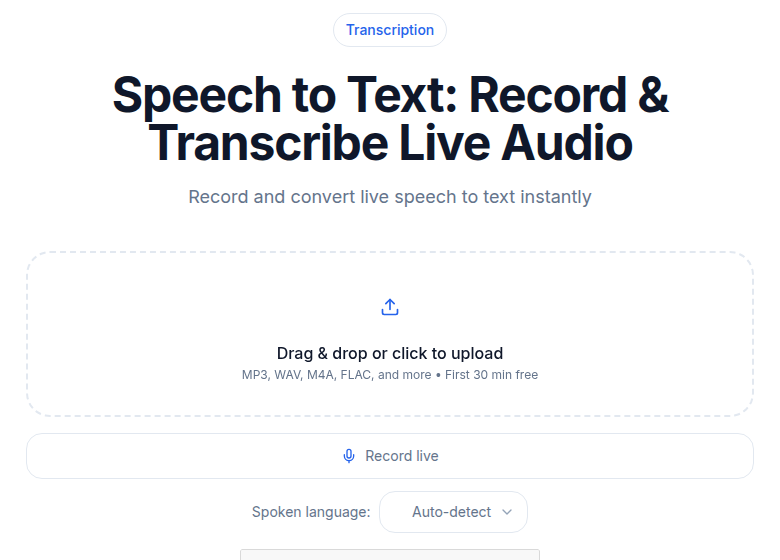 Batch-upload the interview set and work through transcripts in review order
Stage 4: Review Every Transcript Against Audio
This is the stage doctoral students skip most often and regret most at the defense. Plan 15-30 minutes of review per audio hour. For 50 hours of audio, that is 12-25 hours of focused work spread across the project.
Open the transcript alongside the audio. Correct:
- Proper nouns: names of people, institutions, places, programs
- Technical terms specific to your topic
- Numbers and dates (frequent AI error sources)
- Speaker labels where diarization misattributed a turn
Verify any passage you plan to quote directly in the dissertation against the audio before it appears in your writing.
Stage 5: Anonymize as a Separate Stage
Run anonymization as its own distinct pass, not mixed in with review. A defensible anonymization protocol:
- Replace participant names with consistent pseudonyms across all transcripts
- Replace employer names with generic descriptors ("a regional hospital," "a mid-size technology firm")
- Convert specific dates to relative time ("about 18 months ago")
- Generalize identifying career details
- Replace all third-party names the participant mentioned
Maintain an encrypted key document mapping pseudonyms to real identities. Store it separately from the transcripts, never on the same device or platform.
Stage 6: Import to QDA Software
For a 30-80 interview project, QDA software is worth the investment. NVivo, MAXQDA, and ATLAS.ti all import .docx or .txt transcripts. ATLAS.ti offers academic individual cloud plans; MAXQDA has academic license tiers; both have student pricing. Your university may also carry a site license, so check with your library before purchasing.
Treating QDA software and AI transcription as competitors is the wrong frame. AI transcription produces clean input; the QDA environment handles the coding, memos, and theoretical development. The NVivo vs AI transcription post explains how they work together.
Stage 7: Code Methodically
The coding qualitative interviews post covers coding approaches in depth. For inductive coding on a 50-interview project, budget 3-5 hours of coding per hour-long interview. That is 150-250 hours of coding work before theme development begins. This is the largest time sink in the analytic stage. It is non-negotiable.
Stage 8: Retain Per Your IRB Approval
Your IRB approval likely specifies a retention period for audio and transcripts, typically 3-7 years post-publication. Plan storage that survives this period. Encrypted external drives in a secure institutional location are the most common solution. Cloud storage with strong encryption is a viable alternative but introduces ongoing cost and dependency on a continuing service.
Budget Math at Doctoral Scale
Professional human transcription starts at approximately $1.50 per audio minute. For a 50-interview project at 60 minutes each, that is 3,000 audio minutes and $4,500 at the entry-level rate. At 80 interviews, the figure approaches $7,200. Few doctoral budgets cover this. Fewer still include the premium for accented speech, technical terminology, or rush turnaround.
AI transcription changes the calculus entirely. At $14.99 per month, a service like ConvertAudioToText covers the full dissertation audio for under $30 across two billing months (about $45 across three). A Weekly Pass at $9.99 one-time for 1,200 minutes (20 hours) is the cheapest no-setup option for smaller projects. The cost floor is not the tool; it is your own review time.
My take: the practical workflow for nearly every doctoral budget is AI transcription plus your own careful review, with human transcription reserved for two or three interviews where audio quality or a heavy accent genuinely defeated the AI. Human transcription for your entire dataset is not a quality upgrade that justifies $4,500+ when you are going to review every transcript against audio anyway.
For non-English interviews, verify that the tool you choose has validated accuracy for your specific language, not just claims of "99+ language support."
See the transcription pricing comparison for a fuller breakdown of per-minute costs across services.
Comparison: Transcription Approaches for Doctoral Scale
| Approach | Cost (50 hrs audio) | Review Time | IRB Risk Surface | Defensibility |
|---|---|---|---|---|
| Self-transcription | $0 | 150-250 hrs typing | Lowest | High |
| Human service (Rev, Ditto) | ~$4,500+ | 3-5 hrs spot-check | Low (NDA available) | High |
| AI + your review | Under $30 | 12-25 hrs | Medium (verify policy) | High if documented |
| AI only, no review | Under $30 | 0 hrs | Medium | Weak at defense |
What Your Committee Will Ask at the Defense
Three questions come up in nearly every qualitative dissertation defense.
"How did you verify the AI transcripts?" Describe a specific process: transcript open alongside audio, correcting proper nouns, technical terms, and numbers, and verifying every direct quote against the audio before it appeared in the dissertation. Specificity ends this question.
"How did you protect participant identity?" Walk through your anonymization protocol step by step. Show that you treated identifying information systematically, not on a case-by-case judgment call.
"How did your transcription method align with your methodology?" Connect your verbatim-vs-intelligent decision directly to the methodological tradition you cited. Braun and Clarke's thematic analysis framework, Glaser and Strauss's grounded theory, or your phenomenological tradition each have defensible answers, but your answer needs to be theirs, not yours.
The transcription stage is also where speaker diarization becomes important. For multi-party interviews or focus groups, verify that your tool correctly attributes speaker turns, and correct any mis-attribution in review. A transcript with swapped speaker labels can invalidate an entire analytical thread.
FAQ
Do I need to tell my IRB which transcription service I plan to use?
Yes, if you are using a third-party service to process identifiable audio recordings. Your IRB reviews whether the service retains data, uses it for model training, and stores it in a jurisdiction your protocol allows. Describe the service by name in your data management plan, document the answers to those three questions, and get those answers in writing from the vendor before you upload anything.
Does my dissertation method require verbatim or intelligent transcription?
Conversation analysis and discourse analysis require full verbatim with paralinguistic notation (pauses, overlaps, intonation). For grounded theory, following Glaser and Strauss or Corbin and Strauss, clean verbatim that preserves all meaningful spoken content is the standard starting point, particularly in early open-coding rounds. Thematic analysis as described by Braun and Clarke (2006) treats familiarization with the data as phase one, and clean verbatim is sufficient for that purpose. Intelligent transcription, which strips filler words, is defensible for phenomenology and case study cross-case analysis but should be disclosed in your methods chapter.
How long does the transcription stage actually take for a 50-interview dissertation?
AI processing itself takes minutes per file. The constraint is review time: plan 15-30 minutes per hour of audio for correction of proper nouns, technical terms, and speaker labels. Fifty interviews at 60 minutes each gives you 50 hours of audio and 12-25 hours of focused review work. Add anonymization (its own separate pass), QDA import, and initial coding, and the post-data-collection analytic stage realistically runs 10-18 weeks.
How much does it cost to transcribe a full doctoral dissertation project?
Professional human transcription starts at roughly $1.50 per audio minute (Ditto Transcripts, Rev human). Fifty hours of audio at that rate runs $4,500. AI transcription through a service like ConvertAudioToText costs $14.99 per month for unlimited audio, so the full project sits under $30 if you span two billing cycles. The practical approach for most doctoral budgets: use AI transcription plus your own review time, and reserve human transcription for the two or three interviews where audio quality or heavy accent defeated the AI.
How do I answer committee questions about transcript accuracy at the defense?
Prepare three answers in advance. For verification: describe your specific process (transcript open alongside audio, scrubbing for proper nouns, technical terms, numbers, and direct quotes verified before use in the dissertation). For anonymization: walk through your systematic protocol step by step. For verbatim vs. intelligent: connect your choice directly to your stated method and cite the methodological justification. Vague answers on any of these generate follow-up probing; specific documented answers close the question.
Sources
- Rev Pricing - AI and human transcription plan pricing, verified July 2026
- Otter.ai Pricing - Free and Pro plan limits, verified July 2026
- Ditto Transcripts: Human Transcription Cost 2026 - $1.50/min starting rate for professional human transcription
- GoTranscript: AI Transcription IRB Risk Checklist - IRB assessment focus areas for third-party AI transcription
- ATLAS.ti Pricing Guide 2026 - Academic and student pricing tiers
- Lumivero NVivo Shop - NVivo current plans and add-ons
- Braun and Clarke Thematic Analysis Overview - Six-phase framework summary
- ConvertAudioToText Pricing - Current Pro plan pricing and free tier limits
Try transcription free
Convert any audio or video to clean, unwatermarked text — speaker labels, timestamps, and AI summaries included. First 30 minutes free, no account.
Related Articles
Spotify Transcript Extractor: How to Copy and Download Episode Text
Get a Spotify podcast transcript you can copy and download: paste a public episode link, 30 minutes free with no signup, TXT or SRT files on eligible plans.
Focus Group Transcription for UX Researchers: Turn Multi-Speaker Audio Into Usable Evidence
A practical guide to focus group transcription for UX and insights teams. See how CATT handles speaker labels, timestamps, AI summaries, and clean export.