
Medical Research Interview Transcription: A Practical Guide (2026)
Summarize this article with:
Medical research interviews fall into two compliance lanes: content that qualifies as de-identified under HIPAA goes to any capable AI transcription tool, while content containing identifiable patient health information requires a HIPAA-certified vendor with a signed Business Associate Agreement. Getting this determination right before you record matters more than which transcription tool you pick. IRB protocol, consent, and data management plan are the upstream decisions that govern everything downstream.
Medical research interview transcription splits into two compliance lanes before you even open a tool: content that qualifies as de-identified under HIPAA can go to any capable AI transcription service, while content containing identifiable patient health information requires a HIPAA-certified vendor with a signed Business Associate Agreement. Which lane you are in is a legal and institutional determination, not a judgment call made at the upload screen.
Important note upfront: ConvertAudioToText does not provide a BAA and is not HIPAA-certified. It is appropriate for non-PHI medical research content. If your study involves identifiable patient health information, use a service that offers a BAA, such as Sonix Medical Enterprise or Rev.
What Determines Your Compliance Lane
HIPAA's de-identification standard defines when health information is no longer PHI. Two paths exist:
Safe Harbor. Remove all 18 enumerated identifier categories: names, geographic subdivisions smaller than a state, all date elements more specific than year, telephone numbers, fax numbers, email addresses, Social Security numbers, medical record numbers, health plan beneficiary numbers, account numbers, certificate and license numbers, vehicle identifiers, device identifiers, URLs, IP addresses, biometric identifiers (which include voice and fingerprints), full-face photographs, and any other unique identifying number or characteristic. After removal, you must also have no actual knowledge that remaining information could re-identify the individual.
The challenge for audio: voice itself is listed as a biometric identifier. A raw audio recording of a patient interview rarely satisfies Safe Harbor unless the voice is transformed or the recording is converted only to a text transcript with all other identifiers scrubbed.
Expert Determination. A qualified statistician or similarly expert professional applies generally accepted principles to determine that the risk of re-identification is very small and documents that analysis. For raw patient interview audio, Expert Determination is the more realistic de-identification path.
Limited Data Set is a separate concept worth knowing: PHI with most direct identifiers removed but with indirect identifiers like dates and geographic subdivisions retained. A Limited Data Set still requires a Data Use Agreement with any vendor who handles it.
My take: the compliance determination should happen during IRB protocol design, not retroactively when you are staring at 40 audio files. Retrofitting is expensive.
Research Methods That Generate Audio and Their PHI Risk
Different methods in medical research carry different levels of re-identification risk:
Patient experience interviews. Semi-structured interviews about living with a condition or treatment experience, typically 45 to 90 minutes. Even without explicit names, the combination of diagnosis, location, treatment timeline, and narrative detail can re-identify participants. High risk; usually requires a BAA service unless your IRB grants a non-PHI determination after rigorous de-identification.
Key Opinion Leader (KOL) interviews. Conversations with clinicians or researchers about clinical topics, typically 30 to 60 minutes. KOLs are not patients. HIPAA concerns differ unless the KOL discusses specific patient cases. Standard research confidentiality applies, but PHI considerations are lower. AI transcription without a BAA is usually appropriate if no patient cases are discussed.
Provider focus groups. Groups of healthcare providers discussing clinical workflows or barriers, often 60 to 90 minutes with multiple speakers. Without specific patient identification in the content, AI transcription is generally acceptable. Speaker diarization is critical; see speaker diarization explained for what AI tools do well and where they fail on cross-talk.
Cognitive interviews for survey development. Participants think aloud while completing survey instruments. Usually single-speaker, shorter duration. PHI risk depends on study population.
Diary studies. Participants record voice memos over a time period. Each memo is short but the corpus compounds. Privacy and IRB consideration for long-term retention applies.
Ethnographic observation in clinical settings. Field recordings in care environments may capture patient voices in the background even when the nominal subject is a provider. Those bystander voices complicate de-identification substantially.
A Practical Workflow for Non-PHI Medical Research
For research where your IRB and privacy office have determined the content is de-identified or non-PHI:
IRB protocol first. Name your transcription tool or service category in the protocol. Specify who can access audio and transcripts, how long recordings are retained, and the destruction plan. Many IRBs now require explicit participant disclosure that AI tools will process recordings. Build this into your consent form.
Participant consent. Obtain consent for recording and, if your IRB requires it, specific consent for AI-assisted transcription. The consent form should match your protocol exactly.
Recording. Standard audio recording during the interview. For remote interviews via Zoom or similar platforms, the platform's recording feature captures both sides. Audio quality directly determines transcript accuracy, especially for medical terminology and multi-speaker sessions.
File naming and de-identification. Use participant codes (P01, P02) rather than names in file names. If the content itself requires identifier removal before transcription, do that work before upload.
Transcription. Upload audio to your chosen tool. For most non-PHI medical research projects, a flat-rate unlimited plan is more cost-effective than per-minute billing across a full study. If you need a no-friction option for audio files, audio-to-text handles most standard formats used in research recording. For meeting-format interviews, meeting transcription handles multi-speaker sessions.
Review for medical terminology. AI transcription handles general vocabulary well but generates errors on drug names, anatomical terms, dosing details, and clinical shorthand. Build in a review pass before using transcripts for coding or quoting. This is not optional for publication-bound research.
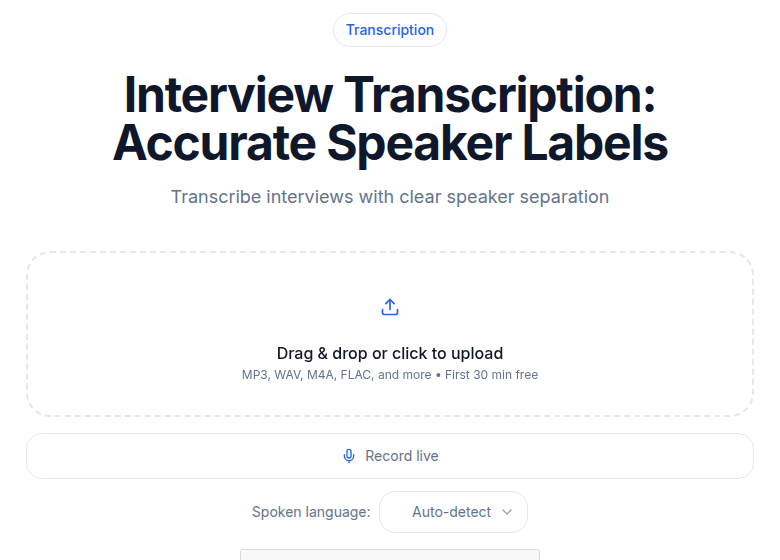 ConvertAudioToText interview transcription tool interface showing audio upload for research recordings
Coding and analysis. Standard qualitative analysis methods apply: thematic analysis per Braun and Clarke's six phases, grounded theory approaches, framework analysis. Tools like NVivo, Atlas.ti, or even structured documents work for coding. For a deeper look at thematic analysis from transcripts specifically, see thematic analysis from transcripts.
Publication quotes. Verbatim quotes in publications are attributed by participant code and demographic category. Omissions use ellipses; editorial clarifications go in brackets. Member checking, when used, works from the transcript rather than the audio.
Tools Comparison for Medical Research
The table below covers the tools most relevant to medical research contexts. Pricing models were verified against vendor pages as of July 2026.
| Tool | HIPAA BAA | Pricing Model | Best For |
|---|---|---|---|
| Sonix Medical Enterprise | Yes (included at no extra cost) | Custom volume pricing (contact sales) | PHI-containing research at scale |
| Rev (Pro or Unlimited) | Yes | AI: subscription tiers; Human: $1.99/min | PHI research needing human accuracy option |
| Otter.ai Enterprise | Yes (Enterprise only) | Custom pricing | Meeting-format clinical interviews |
| Trint | No published BAA | Per-seat subscription with file caps | Editorial/journalism workflows; not HIPAA lane |
| Happy Scribe | No BAA (GDPR/SOC2 only) | Subscription tiers (AI credits + human at $2/min) | Non-PHI multilingual research |
| NVivo Transcription | No | Prepaid hours add-on (PAYG also available) | Researchers already in the NVivo analysis ecosystem |
| ConvertAudioToText | No | Flat-rate unlimited monthly plan | Non-PHI research with high file volume |
A few notes on that table. Rev's human transcription at $1.99 per minute is the most expensive option on it but gives the accuracy level that peer reviewers expect when journals ask for original transcripts. Sonix Medical Enterprise signed a BAA at no extra cost is the cleanest HIPAA path for large studies. Happy Scribe is not HIPAA-compliant despite SOC 2 Type II certification; the two certifications are not equivalent. NVivo Transcription is worth considering only if NVivo is already your analysis environment and the integration justifies the pricing.
Cost Math for a Typical Qualitative Study
Consider a 20-interview patient experience study at 60 minutes each, plus 5 provider focus groups at 90 minutes each: 27.5 hours of audio total.
AI transcription, non-PHI service, flat-rate plan: a single month of flat-rate access covers the entire project transcription, regardless of file count.
AI transcription, per-minute (approximately $0.15 to $0.20/min at standard rates): 1,650 minutes at $0.20 per minute is roughly $330 for the AI pass alone, before any human review.
Human transcription via Rev at $1.99/min: 1,650 minutes at full rate is approximately $3,284 before any subscription discount. With the 15% Pro subscriber discount, roughly $2,791. This is appropriate for HIPAA-required research and publication-grade accuracy, but it is a significant line item in a research budget.
HIPAA-certified AI service: Sonix Medical Enterprise uses custom volume pricing. Budget accordingly and get a quote before finalizing your research budget.
The flat-rate model only applies when your IRB determination permits a non-BAA tool. For PHI research, per-minute HIPAA-certified AI or human transcription is the appropriate choice and belongs in the study budget from the start.
If you are transcribing de-identified or non-PHI research audio and want to avoid per-minute math across dozens of interviews, ConvertAudioToText handles unlimited transcription on a flat monthly plan. It is not a HIPAA-certified service and should not be used for PHI research.
KOL Research: Slightly Different Rules
KOL research with clinicians or researchers involves different privacy considerations than patient research:
PHI concerns arise only if a KOL discusses specific patient cases during the interview. If that happens, those portions may constitute PHI and should be handled accordingly. Standard practice is to instruct KOLs during consent that you are recording a professional opinion interview and that they should not reference identifiable patients.
Confidentiality matters for different reasons in KOL research. KOLs share strategic views, competitive positions, and personal opinions. Standard research confidentiality agreements and the consent process should address this. Pharmaceutical and medical device research involving KOLs also has FDA, OIG, and state-specific regulatory considerations around compensation that fall outside transcription but affect the overall compliance picture.
For KOL research without patient case discussion, AI transcription without a BAA is generally appropriate. The accuracy limitation on medical terminology still applies.
Patient Experience Research: Higher Stakes
Patient experience interviews warrant specific attention even when content is nominally de-identified:
Re-identification risk compounds in patient populations. A participant's combination of rare diagnosis, geographic area, treatment history, and interview date can re-identify them even after name removal. This is why Expert Determination rather than Safe Harbor is the realistic de-identification path for most patient audio.
Long-term retention creates ongoing risk. If your institution retains audio files for years as part of the research record, the security requirements extend across that entire retention period. Match your tool's data retention and deletion practices to your protocol.
Sensitive content is common. Patients discuss emotional, sexual, and psychological dimensions of their health experiences. Access controls and audit logging matter more in this context than in provider-only research.
Seek your IRB and privacy office's determination in writing before transcription. Do not self-assess PHI status for patient experience research.
Multi-Site and International Research
For studies spanning multiple sites or countries:
Each site may have different IRB requirements for recording and transcription. Obtain site-specific approval before recording begins at each location.
GDPR applies for EU research participants even if your institution is US-based. The transcription vendor's data handling, storage location, and retention practices must satisfy GDPR as well as any applicable local health privacy law. Many US-based vendors do not offer EU data residency by default; verify before selecting.
For multi-language studies, transcription in the source language followed by translation for cross-site analysis is the standard approach. AI vs human transcription covers the accuracy tradeoffs relevant to language decisions.
Publication and Data Sharing Considerations
Verbatim quotes from research transcripts appear in publications with participant codes and demographic categories, not names. Editing quotes for publication requires explicit notation: ellipses for omissions, brackets for clarifying additions.
Open data requirements from funders and journals increasingly require sharing de-identified transcripts. Whether your transcripts meet the de-identification standard for public sharing is a separate question from whether they were acceptable for internal analysis. Consult your privacy office before agreeing to open-data provisions in funding applications or journal submission agreements.
Journal reviewers sometimes request access to original transcripts for verification. Have a plan for this in your data management setup before it is requested under deadline pressure.
FAQ
Does ConvertAudioToText sign a Business Associate Agreement for HIPAA research?
No. ConvertAudioToText does not offer a BAA and is not HIPAA-certified. It is appropriate for medical research interviews that contain formally de-identified content or content that does not constitute PHI under HIPAA. For research involving identifiable patient health information, use a vendor that provides a signed BAA, such as Sonix Medical Enterprise or Rev (Pro or Unlimited plan).
Does voice audio qualify as PHI under HIPAA?
A person's voice can qualify as a biometric identifier under HIPAA's Safe Harbor method. If that voice can be linked back to a specific individual AND is associated with health information, the audio file is PHI. Safe Harbor de-identification of audio is harder than de-identifying text transcripts, because voice itself is one of the 18 enumerated identifier categories. Expert Determination is the more realistic de-identification path for raw audio from patient interviews.
What should my IRB protocol say about AI transcription?
Most IRBs do not assess AI tools in the abstract. They assess whether your plan protects participants and matches your consent form, protocol, and data management plan. Your protocol should name the specific transcription service or category of service, describe who can access the audio and transcripts, state the retention and destruction timeline, and match the data handling to what participants consented to. Many IRBs now require a specific disclosure to participants if AI tools will process their recordings.
How accurate is AI transcription for medical terminology?
AI transcription accuracy for medical terminology varies substantially by recording conditions. Clean single-speaker dictation can reach word error rates below 10% on well-trained models, but multi-speaker clinical conversations, cross-talk in focus groups, and background clinical noise can push error rates well above 30%. Drug names, anatomical terms, and dosing instructions are high-risk for error. Human review of AI-generated transcripts is standard practice for any research where quotes will appear in publications.
Can I use AI transcription for patient experience interviews?
It depends on the content and your IRB determination. Patient experience interviews often carry identifying content even without explicit names, because the combination of diagnosis, location, treatment history, and timeline can re-identify a participant. If your IRB and privacy office determine the content is formally de-identified or otherwise non-PHI, AI transcription tools without a BAA are acceptable. If the content is identifiable PHI, you need a HIPAA-certified tool with a BAA, regardless of how you intend to use the transcript.
Sources
- HHS HIPAA De-Identification Guidance
- Sonix Medical Transcription Pricing
- Rev Pricing and HIPAA Compliance
- Otter.ai HIPAA Compliance Announcement
- Happy Scribe Pricing
- NVivo Transcription Product Page
- Is Rev HIPAA Compliant? (Rev Support)
- HIPAA and Voice Technology (AccountableHQ)
- Using AI Transcription in Human-Subjects Research: IRB Risk Checklist (GoTranscript)
Try transcription free
Convert any audio or video to clean, unwatermarked text — speaker labels, timestamps, and AI summaries included. First 30 minutes free, no account.
Related Articles
How Interview Transcription for Recruiting Speeds Up Hiring Decisions
See how interview transcription for recruiting helps teams capture candidate answers, compare interviews fairly, and share AI summaries quickly in CATT.
How to Transcribe a Focus Group
Learn how to transcribe a focus group discussion with speaker labels, review an AI summary and action items, and export a clean TXT, SRT, or VTT transcript for qualitative research.