How to Convert OGG to Text (WhatsApp Voice Notes) 2026
Summarize this article with:
The Fast Path
Upload your .ogg or .opus file directly to ConvertAudioToText and get a transcript back in under a minute for short clips. No conversion needed. If you came here because a WhatsApp voice note landed in your files as an .opus file, that is an OGG container holding Opus audio, and it uploads identically.
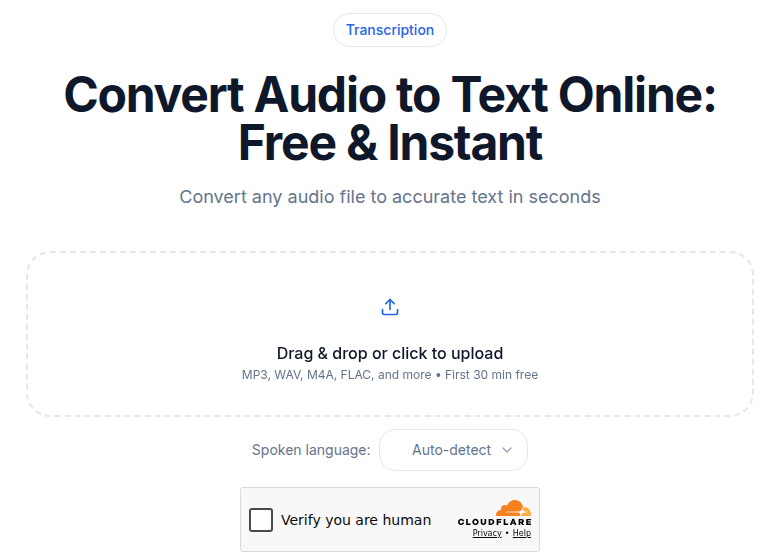 OGG and Opus voice notes upload without conversion
The rest of this post covers why OGG files behave differently depending on what created them, how to get them off your phone in the first place, and what the codec differences mean for transcription quality.
Why OGG Shows Up in Your Workflow
OGG is a container format, not an audio codec. Think of it like a ZIP file: the container holds the audio stream, and the actual encoding is done by either Vorbis (older, general-purpose) or Opus (newer, optimized for voice). Both are royalty-free, which is why they ended up inside software that did not want to pay MP3 licensing fees.
The places you most commonly encounter OGG files:
- WhatsApp voice notes, Opus codec,
.opusextension (same OGG container under the hood) - Telegram voice messages, Opus inside
.ogg, ~32 kbps, 48 kHz mono - Discord voice messages, Opus at low bitrates inside
.ogg - Audacity exports, Vorbis by default, quality level 5 (~equivalent to 128 kbps MP3 in size but higher quality due to VBR)
- GNOME Sound Recorder, PulseAudio dumps, and other Linux audio tools, typically Vorbis
- Wikipedia spoken articles and Wikimedia Commons audio, Vorbis at 96-128 kbps
Each source has its own bitrate habits and export path. The sections below go through the most important ones.
Vorbis vs Opus: What Actually Differs
Both codecs live inside .ogg containers. Telling them apart matters because some transcription tools support one and not the other.
Vorbis (standardized 2001) is variable bitrate by design. Audacity's default quality level 5 targets roughly the same file size as a 128 kbps MP3 but achieves better quality because it allocates more bits to complex passages. You will see it in recordings, podcasts, and Wikipedia audio at 128-256 kbps.
Opus (standardized 2012, RFC 6716) was built for real-time voice. It operates from 6 kbps up to 510 kbps and switches dynamically between speech and music coding modes. At 24 kbps and above, studies show automatic speech recognition accuracy within about 1.5 percentage points of lossless. Below 16 kbps, meaningful degradation begins, and WhatsApp voice notes sit right at that edge.
The extension trap. The Xiph.Org Foundation officially specifies .opus for Opus-in-OGG files (RFC 7845 / XiphWiki OggOpus). Modern tools write .opus. Older apps sometimes wrote Opus with a .ogg extension. If you see a .ogg file from WhatsApp, Discord, or Telegram and it looks suspiciously small (under 15 KB per minute of audio), it is almost certainly Opus mislabeled. Run ffprobe yourfile.ogg and look for Audio: opus or Audio: vorbis in the output to confirm.
The WhatsApp Voice Note Export Path
WhatsApp is the biggest real-world source of OGG Opus files, and getting them off your phone correctly depends on your platform.
Android
The cleanest path: open your file manager and navigate to Android/media/com.whatsapp/WhatsApp/Media/WhatsApp Voice Notes/. WhatsApp stores recordings there as .opus files with bit-for-bit original quality. Copy the file to your PC via USB or upload it directly to a cloud folder.
Alternatively, long-press a voice note in WhatsApp, tap the share icon, and send it to Google Drive or your email app. The file transfers as the original .opus.
iPhone
The iPhone path has a gotcha: the forward-and-share method (long-press, tap forward, tap the share icon) re-encodes the voice note to .m4a. You lose the original Opus stream.
To preserve the original encoding, go to Settings > Chats > Export Chat, choose "Attach Media," and save the resulting ZIP to Files. Inside the ZIP, voice notes appear as .opus files with their original encoding intact. This is the route to use when transcription quality matters.
WhatsApp records voice notes at 16 kHz, 16 kbps, mono. A one-minute note typically comes in at 110-160 KB. The narrow frequency capture (up to 8 kHz, set by the 16 kHz sample rate) covers everything needed for speech intelligibility. It does mean transcription accuracy is somewhat lower than a recording captured at higher bitrates, not because of a tool failing, but because the codec is operating near its floor.
Telegram Voice Messages
Telegram right-click on desktop (or "Save to Downloads" on Android) gives you the original .ogg file at ~32 kbps Opus, 48 kHz mono. This is a step up from WhatsApp's 16 kbps, noticeably cleaner for accented speakers or noisy environments.
On iPhone, tap the share icon on the voice message and choose a save destination. The file arrives as .ogg with the Opus stream intact.
Audacity Exports
Audacity exports OGG Vorbis (not Opus) by default, using variable bitrate. Quality level 5 out of 10 is the default; the resulting file is comparable in size to a 128 kbps MP3 but with better quality because Vorbis uses more bits on complex audio and fewer on silence.
If you are transcribing your own Audacity recordings, you can also export as Opus (File > Export Audio > Opus) and get smaller files at equivalent quality. Either works fine for transcription.
Uploading OGG Files for Transcription
Modern transcription engines handle both Vorbis and Opus inside .ogg or .opus containers directly. Do not convert to MP3 first. Running a lossy Opus file through a second lossy encoder (even at 192 kbps MP3) discards audio information. Upload the original.
If you have a tool that rejects OGG and throws a "codec not supported" error:
ffmpeg -i in.ogg -c:a libmp3lame -b:a 192k out.mp3
That converts to MP3 for compatibility. For Opus-to-Vorbis (staying in the OGG container):
ffmpeg -i in.opus -c:a libvorbis -q:a 6 out.ogg
And if a file plays fine but tools reject it (malformed headers from old encoders), rewrap without re-encoding:
ffmpeg -i broken.ogg -c:a copy fixed.ogg
Short voice notes (under 2 minutes) finish transcribing in under 30 seconds. A full Wikipedia spoken article or a 1-hour Audacity podcast export takes 2-5 minutes.
For anyone needing to pull transcripts from standard voice memo formats on iPhone, how to transcribe voice memos on iPhone covers the full export path.
Format Comparison Table
| Format | Codec | Typical Bitrate | Sample Rate | Container |
|---|---|---|---|---|
| WhatsApp voice note | Opus | 16 kbps | 16 kHz | .opus |
| Telegram voice message | Opus | ~32 kbps | 48 kHz | .ogg |
| Discord voice message | Opus | 12-32 kbps | 48 kHz | .ogg |
| Audacity default export | Vorbis VBR | ~128 kbps eq. | 44.1 kHz | .ogg |
| Wikipedia spoken article | Vorbis | 96-128 kbps | 44.1 kHz | .ogg |
| MP3 podcast | MP3 | 128 kbps | 44.1 kHz | .mp3 |
Opus at 24 kbps and above transcribes within ~1.5% of lossless audio accuracy. The accuracy ceiling for WhatsApp notes at 16 kbps is somewhat lower, reliable for clear speakers in quiet environments, variable for accented or noisy recordings.
For a broader look at how formats compare across all the common containers, supported audio formats for transcription covers the full field.
OGG-Specific Gotchas
Opus DTX gaps. Some Opus encoders use Discontinuous Transmission (DTX), inserting zero-length "comfort noise" packets during silence instead of audio data. Per the OggOpus spec (RFC 7845), these should resolve to packet loss concealment at the decoder. Most modern transcription engines handle this correctly. If your transcript has unexplained gaps at silence boundaries, try stripping and padding silence before upload:
ffmpeg -i in.ogg -af "silenceremove=stop_periods=-1:stop_duration=0.5:stop_threshold=-40dB" out.ogg
The "codec not supported" error and Opus specifically. Some older tools handle Vorbis but not Opus. This is especially common with .ogg files from messaging apps. ffprobe yourfile.ogg will confirm the codec. If it says opus and your tool rejects it, either switch tools or convert as shown above.
Multi-track OGG files from game engines. Some games (notably those using the Godot engine or older Ogg-based streaming systems) store multiple logical streams in a single container. Most transcription tools read only the first stream. If your OGG comes from a game and you are trying to pull dialogue, use ffmpeg to extract stream 0 explicitly:
ffmpeg -i game_audio.ogg -map 0:a:0 extracted.ogg
Audacity project files vs exports. Audacity's own .aup3 project format is a SQLite database, not an OGG file. You need to explicitly export (File > Export Audio) to get a playable .ogg. First-time Audacity users sometimes try to upload the project file and get an error.
When to Consider a Different Format
If you control the recording and transcription quality matters, record at 32 kbps Opus or higher, or use uncompressed WAV for short sessions. The difference between a 16 kbps WhatsApp note and a 64 kbps Opus recording is audible to both the human ear and the transcription engine.
If you just need a clean transcript of audio you recorded yourself (rather than voice notes from others), ConvertAudioToText accepts WAV, MP3, MP4, OGG, and most other containers, the cost of transcription per hour breakdown is worth reading if you are weighing free vs paid tiers for batch work.
Common Questions
Is OGG Opus better than MP3 for transcription?
At bitrates under 64 kbps, yes. Opus achieves speech recognition accuracy within about 1.5 percentage points of lossless at 24 kbps and above, while MP3 at those bitrates sounds noticeably degraded. Above 128 kbps, both formats are effectively equivalent for transcription purposes. For voice specifically, Opus has a clear advantage at the low bitrates that messaging apps actually use.
Can I transcribe Discord voice messages for free?
Yes. Right-click the voice message in Discord, copy the link, and download the .ogg file, or use Discord's "Save As" option. Upload it to a transcription tool. ConvertAudioToText transcribes the first 30 minutes with no signup at all, and a free account runs your first file on the premium engine with speaker labels, then keeps transcribing free (up to 30 files a day, up to 30 minutes each). For higher volumes, paid plans are available.
Why does my WhatsApp voice note sound fine but transcribe poorly?
WhatsApp records at 16 kbps, 16 kHz mono. At that bitrate, Opus is optimized for speech intelligibility to the human ear, which tolerates more compression than automatic speech recognition systems. Heavy accents, background noise, or fast speech that the ear fills in from context are exactly the cases where the codec's floor hurts transcription accuracy. There is nothing you can do about audio you have already received; for your own recordings, use a voice memo app that records at a higher bitrate.
Will a .opus file work the same as a .ogg file for transcription?
Yes. .opus is an Opus audio stream in an OGG container, just with the more specific extension that the Xiph.Org Foundation officially recommends. The file format is identical to a .ogg file containing Opus audio. Any tool that accepts one should accept the other. If a tool specifically rejects .opus based on the extension alone, rename it to .ogg and try again. The codec does not change.
Sources
Try transcription free
Convert any audio or video to clean, unwatermarked text — speaker labels, timestamps, and AI summaries included. First 30 minutes free, no account.
Related Articles
How to Convert AAC to Text: Streams vs M4A Explained
AAC to text: the raw-stream vs M4A container distinction that trips tools, broadcast origins, and the reliable workflow.
How to Convert FLAC to Text: Lossless Audio Guide 2026
FLAC to text for field recordings and archival interviews: why lossless helps, half-of-WAV file sizes, and the upload workflow.