Transcription Confidence Scores Explained: How to Use Them
Summarize this article with:
What the Score Actually Means
A confidence score is the engine's estimate, expressed as a number between 0 and 1, that a specific word in the transcript is correct. A score of 0.95 means the model thinks there is roughly a 95% chance it got that word right. A score of 0.42 means it was much less certain.
The score lives at the word level in most production APIs. Deepgram, for example, returns a per-word confidence field on every word object in the API response, defined in their documentation as "a floating point between 0 and 1 representing the model's estimated probability that the word was transcribed correctly." In practice you will see values clustered near 1.0 on clean audio, because on clear speech the model is genuinely confident about most words. The signal is in the outliers.
Whisper's reference output works differently. It does not expose per-word confidence natively. Instead each segment carries avg_logprob (average log probability across the segment, where more negative means less certain) and no_speech_prob (the model's estimate that no one was talking during that window). There is no direct equivalent to Deepgram's per-word score without extra post-processing of token probabilities. Tools that wrap Whisper may derive word-level estimates from alignment passes, but these are not the same as a native per-word output.
Why the Numbers Are Harder to Use Than They Look
High confidence is not a guarantee
A confidence of 0.99 means roughly one word in a hundred at that score will be wrong. Over a one-hour transcript at 8,000 words, even 1% errors at "very high confidence" produces about 80 mistakes. The bigger risk is that modern neural models can be systematically overconfident, especially in noisy conditions. Research published in 2024 and 2025 found that some ASR models incorrectly predict 10-20% of tokens with confidence above 0.70 at low signal-to-noise ratios. That is not a flaw in a single product; it reflects the way softmax probabilities in neural decoders behave when the model has not been calibration-tuned.
The practical consequence: treat high confidence as a filter, not a proof. It tells you where to spend your review time last, not where errors cannot exist.
Low confidence is not a verdict of error
The opposite is equally true. A word with 0.45 confidence might be perfectly correct. Low confidence usually means the model considered several plausible candidates and picked one by a small margin. Proper nouns the engine has seen rarely, numbers where context supports multiple values, and homophones that only disambiguate in the next sentence are the most common low-confidence words. The right response is to check those words against the audio, not to assume they are wrong.
The scores are not comparable across engines
This is the most important caveat and it is easy to miss. A 0.85 from Deepgram and a 0.85 from a different engine are not the same claim. Deepgram's own documentation puts it directly: "Confidence score definitions and calibration vary across STT providers. You cannot directly compare raw confidence distributions between providers." Different engines use different probability scales, different calibration adjustments, and sometimes different definitions of what the score even represents. If you are choosing between engines based on average confidence output, you are comparing incompatible numbers.
Meaningful engine comparison requires running both on the same audio, manually checking the output, and measuring actual word error rate. See transcription accuracy explained for how to do that correctly.
Word-Level vs. Segment-Level
Word-level confidence assigns a number to each individual word. This is the most actionable format for reviewing transcripts because you can go directly to the specific word that was uncertain.
Segment-level confidence assigns a single number to a phrase or sentence block. Deepgram's transcript-level score is the median of the word-level values in that chunk. Whisper's avg_logprob is a segment-level log probability. Both are useful for skimming a long transcript to find the rough sections, but neither tells you which word inside a flagged segment is the problem.
For practical review work, word-level is the better tool. For routing decisions (send this segment to a human reviewer), segment-level is often enough.
Calibration: What It Is and Why It Matters
A calibrated confidence score is one where the number honestly reflects accuracy. If you collected every word the engine scored at 0.90 and checked them all, exactly 90% should be correct. That is calibration. Deepgram describes its word confidence as a "calibrated probability" with that property as the goal.
Most neural models are not perfectly calibrated out of the box. They tend toward overconfidence at the high end: they call something 0.95 when the actual accuracy is closer to 0.88. Temperature scaling and other post-hoc techniques can improve this, but few products publish whether and how they apply them.
The practical response: do not assume the confidence number is a perfectly honest probability. Use it as a relative signal, not an absolute one. Verify on your own data by reviewing a sample of words at different confidence bands and seeing what fraction are actually correct. The resulting calibration curve tells you what each confidence level actually means on your specific audio type. An interview with a heavy accent will produce a different calibration curve than a studio-recorded podcast, even on the same engine.
Using Confidence Scores in Practice
Triage your review by sorting low to high
For long transcripts, sort or filter words by confidence and review the lowest-confidence ones first. Most of the real errors in a 90-minute transcript concentrate in a few hundred words below a 0.70 threshold. Reviewing those specific words against the audio catches the majority of mistakes at a fraction of the time cost of reading top to bottom.
Most consumer transcription tools expose this as color highlighting: low-confidence words appear in a different color and you click through them. If you are working with raw API output, filter the word list by the confidence field and queue up the timestamps for those words in your audio player.
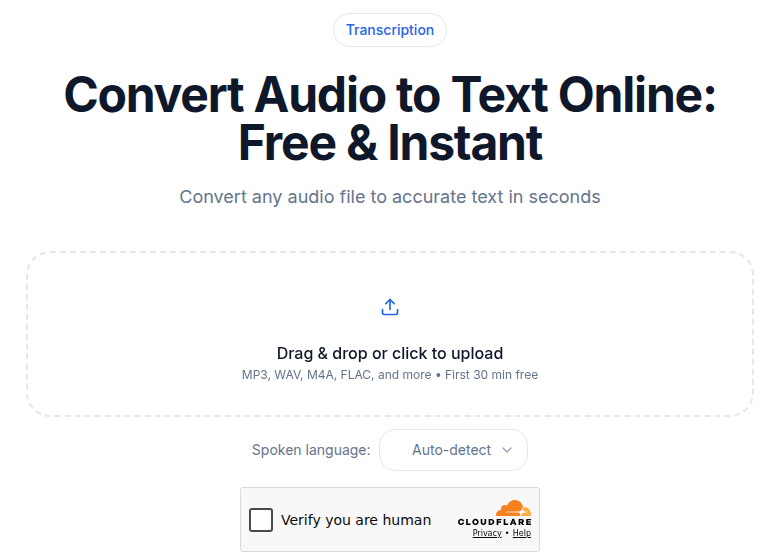 Audio upload tool in ConvertAudioToText where transcription and review begin
Set a threshold for automated QA
For high-volume or compliance-sensitive workflows, set a threshold and automatically flag transcripts or words that fall below it for human review. A common starting point is 0.80 or 0.85, but the right number depends on what your calibration check shows for your audio type.
The model's uncertainty signal becomes a built-in quality gate. This works well in any pipeline where transcript quality needs to meet a defined bar before the text feeds into downstream systems. For more on what makes a transcript cost less to produce at quality, the pricing posts cover what you are actually paying for when confidence-aware review is baked in.
Weight low-confidence matches in downstream systems
If you are building search or analytics on top of transcripts, treat the text as a noisy signal rather than ground truth. A keyword match on a word scored at 0.45 should carry less weight than a match at 0.98. An analytics dashboard counting term occurrences should consider confidence weighting. Otherwise, one confused proper noun propagates into misleading downstream data.
What Confidence Does Not Catch
Knowing the limits matters as much as knowing the use cases.
Confidence does not catch semantically plausible wrong words. "Affect" versus "effect," "principal" versus "principle," "your" versus "you're" often transcribe with high confidence because the engine committed to one before context was available to distinguish them. These are real errors the score will not flag.
Confidence does not catch hallucinations during silence. If the model generates phantom text during a silent stretch, the confidence on those phantom words might be moderate but the words are entirely fabricated. This is a separate failure mode with its own detection signals, unrelated to the word confidence field.
Confidence does not cover speaker label accuracy. The transcription confidence is about words. Deepgram also returns a speaker_confidence field on pre-recorded audio for diarization results, but this is a separate number from a separate model. The two signals are independent. A word can be transcribed correctly but attributed to the wrong speaker, and neither confidence field will flag that. See speaker diarization explained for how speaker confidence works.
Confidence does not catch dropped words. If the model failed to transcribe a word at all, there is no confidence score to flag it. Missing words are the hardest errors to detect after the fact and are outside the scope of what confidence scoring addresses.
Confidence Across Engines: Deepgram and Whisper Side by Side
| Signal | Deepgram | Whisper (reference) |
|---|---|---|
| Per-word confidence | Yes, confidence field (0-1) | Not exposed natively in API |
| Segment-level signal | Transcript confidence = median of word scores | avg_logprob (negative float, more negative = less certain) |
| Silence detection | no_speech_prob not in standard output | no_speech_prob per segment |
| Speaker confidence | speaker_confidence (pre-recorded only) | Not available |
| Ready for threshold workflows | Yes, no post-processing needed | Requires extra alignment tooling for word-level |
For users who want to build confidence-aware review or downstream weighting, Deepgram's format is more immediately practical. Whisper's avg_logprob is useful for routing decisions (flag an entire segment) but requires additional tooling to produce per-word values. See Deepgram Nova-3 explained for more on how Deepgram's engine works under the hood.
My take: the most useful thing you can do with confidence scores is run a calibration check on a sample of your own audio before building any automated workflow around thresholds. What a 0.80 means on your material is not what it means on someone else's, and the curve shifts as audio conditions change.
FAQ
What is a good confidence score for transcription?
There is no universal threshold because confidence scales differ across engines. Within a single engine, words below 0.80 are worth a second look. Words below 0.60 almost always deserve review. But these cutoffs are starting points, not guarantees: a word at 0.99 can still be wrong, and a word at 0.55 can be correct.
Are confidence scores comparable between Deepgram, Whisper, and other engines?
No. Deepgram's documentation explicitly states that confidence definitions and calibration vary across providers and that raw scores cannot be directly compared. A 0.85 from Deepgram and a 0.85 from another engine are not the same claim about accuracy.
Why does a high-confidence word sometimes turn out to be wrong?
The model commits to a word token by token, before full context is available. Acoustically similar words ('affect' vs. 'effect', 'principal' vs. 'principle') can score high confidence because the model never considered them ambiguous, even when the wrong one was chosen. Overconfidence under noise is also well-documented in ASR research.
Does a low confidence score mean the word is wrong?
Not necessarily. Low confidence signals that the model considered multiple plausible candidates and the chosen one won by a narrow margin. The winner can still be correct. The most common low-confidence words are proper nouns, numbers, and homophones where the surrounding context was not enough to lock in a clear winner.
If you want to experiment with confidence-aware transcription without setting up an account, ConvertAudioToText's audio-to-text tool processes uploads immediately and returns structured output where the underlying engine supports per-word values.
Sources
- Deepgram Confidence Documentation - definition, calibration claim, and cross-provider caveat, checked 2026-07-02
- Deepgram Diarization Documentation -
speaker_confidencefield in pre-recorded output, checked 2026-07-02 - OpenAI Whisper verbose_json fields - confirmed segment-level
avg_logprobandno_speech_prob, no native per-word confidence, checked 2026-07-02 - ASR Confidence Score Evaluation, arXiv 2503.15124 - automated error detection using confidence, 2025
- ICLR 2024 paper on ASR confidence calibration - overconfidence behavior in neural models
Try transcription free
Convert any audio or video to clean, unwatermarked text — speaker labels, timestamps, and AI summaries included. First 30 minutes free, no account.
Related Articles

Acoustic Models vs Language Models in Speech Recognition
What acoustic models and language models do in ASR, why the split mattered historically, how end-to-end systems absorbed it, and why it still explains the errors you see today.

Fix Jargon Errors in Transcription: The Glossary Pass
Your transcript turned "Kubernetes" into "cuban itties." Here is the systematic fix for technical jargon in AI transcripts, from quick find-replace to custom vocabulary APIs.