
Transcription for Academic Research: A 2026 Practical Guide
Summarize this article with:
Academic transcription decisions sit at the intersection of methodology, IRB compliance, and budget. This guide maps the full landscape: lectures, focus groups, oral history, conference recordings, and qualitative interviews, with honest cost comparisons and a workflow that scales from a solo dissertation to a funded research team. AI transcription with careful review is the default for most researchers; local-only tools remain the right call for sensitive populations.
Academic transcription is not a single problem. A sociologist recording a focus group, a historian digitizing oral history tapes, and a PhD student coding 30 interviews for a dissertation face different constraints, different ethics requirements, and different budgets. The right workflow depends on which category you are in.
This guide maps the full landscape, routes methods-depth questions to specialist resources, and gives you the decision tree to pick the right path without guessing.
The Three Constraints That Shape Every Choice
Every transcription decision in academic research sits at the intersection of three constraints.
Methodological. Different analysis traditions need different transcript formats. Thematic analysis works fine with clean, readable text. Conversation analysis needs verbatim detail including pause lengths and overlapping speech. The transcription for qualitative research guide covers format choices in depth. Do not read that section here; read it there.
Ethical and compliance. Your IRB approval governs how participant data can be handled. Cloud transcription services raise questions about data residency, retention, and model training that your consent forms may not have anticipated. These questions are not hypothetical; they come up at dissertation defenses and journal submissions.
Budget. Human transcription from Rev currently runs $1.99 per audio minute, about $119 per hour. A typical qualitative dissertation with 25 hours of interviews costs around $3,000 at that rate. Most graduate students and many funded projects do not have that line item. AI transcription changes the math, but not the review burden.
IRB Compliance: What to Check Before You Upload
Most researchers underthink the data layer. Before uploading any recording to any cloud service, verify these three things against your IRB approval language.
Data residency. Does your approval restrict where data can be stored geographically? EU-funded studies often require EU storage. Many US health studies require US-only processing. The service's data processing agreement should state this explicitly. If it does not, contact the vendor before uploading.
Retention. How long does the service keep your audio after processing? Some services delete immediately. Others retain for 30 or 90 days. Some let you configure. Your IRB approval may specify a maximum retention window for third-party processors.
Model training. Does the vendor use uploaded audio to train or improve its models? For most academic IRBs, the answer must be no. Participants consented to being recorded for your study. They did not consent to becoming training data for a commercial AI system.
For genuinely sensitive research: medical data, trauma survivors, undocumented populations, children, read the section on vulnerable populations below before choosing any cloud tool.
A Map of Academic Recording Types
Academic transcription needs break into four broad categories, each with different practical requirements.
Qualitative Interviews
One-on-one interviews are the most forgiving audio for AI transcription. A single voice, a cooperative speaker, often a controlled recording environment. Modern AI transcription handles these well, typically above 90 percent word accuracy on clear audio.
The limiting factor is technical vocabulary. Medical, legal, and highly specialized scientific terminology still produces more errors than conversational language. Budget more review time for specialist subject areas.
For deep guidance on interview-specific transcription, the how to transcribe an interview recording guide covers the full process.
Focus Groups
Focus groups are harder. Multiple voices, overlapping speech, crosstalk, and short speaker turns all compound AI errors. Speaker diarization in current AI tools identifies distinct speakers but struggles with simultaneous speech.
Plan to spend more review time per audio hour on focus groups than on interviews. If your analysis method requires conversation-level precision (who said what exactly when, and who was talking over whom), human transcription by someone trained in the relevant notation system is the practical default.
Lectures and Conference Talks
Single-speaker academic audio is some of the cleanest material for AI transcription. A lecture or keynote from a single expert speaker on a defined topic typically transcribes well.
The practical use case for researchers: converting your own recorded lectures into searchable notes, or building a corpus of conference presentations for discourse analysis. The audio-to-text tool handles this without special configuration.
Oral History and Archival Recordings
Oral history recordings introduce a different challenge set. Older recordings may have background noise, degraded audio, or dialectal variation that current AI models handle unevenly. Speaker age, regional accent, and recording generation all affect accuracy.
The standard practice in oral history is to treat AI transcripts as a first draft that requires substantial human review, not as a finished product. For archival recordings specifically, the transcript is often the preservation artifact as much as the audio itself; accuracy standards should match that weight.
Cost Comparison: Self-Type vs. Human vs. AI
Here is what 25 hours of audio actually costs across the three main approaches, as of mid-2026.
| Method | Direct cost | Your time | IRB risk profile |
|---|---|---|---|
| Self-transcription | $0 | 125-150 hrs typing | Low (data stays local) |
| Human transcription (Rev) | ~$3,000 | 5-8 hrs review | Medium (third party, but no model training) |
| AI transcription + review | $10-30/mo | 8-12 hrs review | Varies by vendor policy |
| Local Whisper (self-hosted) | $0 | 8-12 hrs review + setup | Lowest (no cloud at all) |
The AI+review option is the default for most researchers because it combines low cost, acceptable accuracy, and manageable review time. The main variable is which vendor you use and whether their data policy clears your IRB.
For more on what to ask about cost per hour and hidden fees, see the cost of transcription per hour breakdown and the hidden costs of transcription services guide.
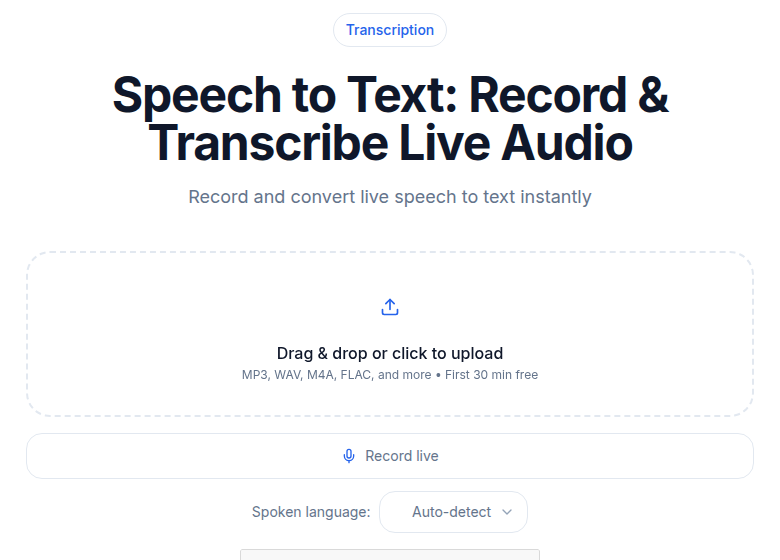 Lectures, focus groups, and talks all move through the same upload pipeline
The audio-to-text tool accepts recordings of lectures, interviews, and focus groups directly. No meeting bot required.
IRB-Safe Transcription Workflow for a Dissertation
The seven stages below cover a single-researcher qualitative dissertation with 20 to 30 interviews.
Stage 1: Standardize Your Recording Protocol
Before you record, document a protocol. Device, microphone type, file format (WAV at 16-bit/44.1 kHz is the academic standard), and file naming convention.
A consistent protocol means consistent audio quality, which means consistent transcription accuracy. If your first interview reaches 93 percent accuracy and your twentieth reaches 74 percent because you switched from a dedicated mic to your laptop, you have introduced a source of variation you cannot control in analysis.
Stage 2: Back Up Audio Immediately
After each session, copy the audio to at least two locations. One should be encrypted local storage. The other should be cloud storage that your IRB covers.
This is non-negotiable. Lost audio in an IRB-approved study is not a recoverable error. Document your backup procedure; some IRBs ask for it.
Stage 3: Choose Your Transcription Path by Data Sensitivity
Before batching uploads, classify your audio:
- Low sensitivity (no identifying detail, public topic): Any reputable AI transcription service with a clear data processing agreement.
- Medium sensitivity (named individuals, workplace settings): AI transcription with a vendor whose policy explicitly prohibits model training on user data.
- High sensitivity (vulnerable populations, medical, legal, or legally sensitive detail): Local Whisper running on your own hardware. No cloud upload at any stage.
Stage 4: Transcribe in Batches
Once you have 5 or 6 interviews recorded, batch them. AI transcription processes files in parallel; 5 files take roughly the same wall-clock time as 1. Use your consistent naming convention (P01_2026-05-15.mp3) to link audio to consent forms, demographic surveys, and other study materials.
Stage 5: Review and Correct
This is the stage most researchers skip and most regret. Plan 15 to 30 minutes of review for each hour of audio.
Open the transcript alongside the audio. Correct proper nouns, participant pseudonyms, institution names, and technical terminology. Errors caught now stay out of your analysis; errors left now propagate through every code you apply.
Stage 6: Anonymize Before Sharing
Strip identifying information before sharing transcripts with anyone outside your immediate research team, including your supervisor in some IRB contexts.
A defensible anonymization protocol:
- Replace participant names with pseudonyms or IDs.
- Replace specific employers with generic descriptors ("a regional hospital").
- Replace specific dates with relative ones ("about three years ago").
- Remove details that would identify a participant to someone in their professional or social network.
Document the protocol. Journal reviewers often ask for it. Some IRBs require it. For a fuller treatment of the ethics layer, see the ethics of interview transcription guide.
Stage 7: Import to Analysis Software
NVivo, MAXQDA, ATLAS.ti, and Dedoose all accept .docx and .txt input. Import reviewed, anonymized transcripts. Single-user licenses do not support team coding; check your licensing model before starting a collaborative analysis project.
NVivo academic licensing has moved from institutional bundles to individual subscriptions under Lumivero ownership. Check whether your institution still holds a site license before purchasing individual access.
Stage 8: Retain or Destroy According to IRB
Your approval specifies how long audio and transcripts must be retained after the study closes. Common windows are 3, 5, or 7 years. Plan storage for that period. Encrypted external drives are the most common solution for long-term retention without ongoing cloud costs.
Where Human Transcription Still Wins
Three scenarios consistently favor paying for human transcription despite the cost.
Conversation analysis and discourse analysis. Methods that require Jefferson notation, GAT notation, or other detailed transcription conventions demand a transcriptionist trained in the system. Current AI tools do not produce overlap brackets, measured pauses, or latching conventions. If your analysis depends on these, build the human transcription cost into your grant budget.
Low-resource languages with heavy accented variation. Major research languages are well-covered. Smaller and regional languages get more uneven results. Human review can recover accuracy that no AI currently matches on these materials.
Legally sensitive or chain-of-custody material. When transcripts may become evidence in legal proceedings, a documented human chain of custody matters. This rarely applies to standard academic research but sometimes affects investigative, forensic, or legal-anthropological work.
For a structured comparison of AI versus human tradeoffs, the AI vs. human transcription guide covers the accuracy, cost, and use-case dimensions.
Multi-Language Data Sets
Cross-language research adds a step to the workflow.
Transcribe in the source language using an appropriate transcription tool. Have a native speaker review the transcript before any translation happens. Translate only the segments you intend to quote directly, not the full transcript.
Treating AI translation as the primary record buries interpretive choices that your analysis should make explicit. The translation stage is analytically significant; it should not be automated away.
Working With Vulnerable Populations
Research with children, trauma survivors, undocumented individuals, and other vulnerable groups adds ethical constraints that affect which transcription tools you can use.
The conservative default is local-only transcription. Whisper, now available through simple desktop applications on Mac and Windows, runs entirely on your own hardware. No audio leaves your machine at any stage. The IRB defense is straightforward and the accuracy on clear single-speaker audio is competitive with cloud services. The trade-off is that large batches are slower and local processing requires slightly more setup.
For more on methods and ethics frameworks, the transcription for qualitative research guide covers IRB-adjacent methodology questions in depth.
Grant Budget Line Items for Transcription
If you are writing a grant that includes qualitative data collection, build transcription costs in explicitly. IRB-acceptable AI transcription is inexpensive but still takes researcher time for review. Human transcription at current rates ($1.99/min from services like Rev) is a legitimate direct cost on most funding mechanisms.
Budget language that typically passes review:
- "AI-assisted transcription with researcher review: $X/month for project duration, plus X hours researcher time at $Y/hour."
- "Human transcription for N hours of focus group audio: N hours x 60 min x $1.99/min."
If your IRB requires human transcription (some do for specific populations or methods), that cost should be explicit. Do not leave it out and then discover the constraint after funding is awarded.
Three Mistakes That Show Up at Defense
Treating the transcript as the data. The audio is the data. The transcript is a representation. Verify every direct quote against the original audio before submitting for publication or presenting at defense.
Skipping review. AI transcripts have errors. Importing them straight to NVivo without review propagates those errors through every code you apply. Reviewers and committee members sometimes catch transcript errors that undermine analytical claims.
Stopping anonymization at names. Removing names is a start. Specific employer, specific role, specific career trajectory, specific location, and combinations of several details can identify a participant to someone in their professional network. A peer reviewer can sometimes identify participants from a transcript that only had names changed.
The discipline in academic transcription is unglamorous: consistent protocols, thorough review, careful anonymization. The analysis gets to be interesting because these foundations are solid.
If you just need a clean transcript from an audio or video file without a meeting bot or specialized software, ConvertAudioToText handles uploads directly, supports 99+ languages, and does not train models on uploaded audio.
FAQ
Can I use AI transcription tools for IRB-approved research?
Usually yes, but you need to check three things before you upload anything: data residency (some IRBs restrict where data can be stored geographically), retention (how long the service keeps your audio), and model training (most IRBs prohibit participant audio being used to train AI models). Read the vendor's data processing agreement, then verify it against your approval language. If you are unsure, consult your institution's research compliance office.
What is the cheapest defensible transcription option for a dissertation?
AI transcription with thorough review is the cheapest defensible option for most qualitative dissertations. A flat-rate monthly plan costs a few dollars per month and covers unlimited audio, leaving you with 6 to 10 hours of review time for 25 hours of interviews. That compares to roughly $3,000 for professional human transcription at current per-minute rates, or 120-plus hours of self-typing.
What transcription approach is best for focus groups?
Focus groups are harder than one-on-one interviews because multiple voices overlap and speaker turns are short. AI transcription with speaker diarization identifies speakers but will still confuse overlapping voices. Plan to spend more review time per hour of focus group audio than per hour of interview audio. If you need conversation-analysis-grade transcripts with overlap notation, human transcription trained in Jefferson or GAT conventions is the only reliable path.
Do I need special tools for non-English research languages?
Major research languages (French, Spanish, German, Mandarin, Arabic, Portuguese, Japanese, Korean) are well-covered by current AI transcription engines, usually above 90 percent accuracy on clear audio. Smaller or low-resource languages vary widely. For any language, transcribe in the original language first and have a native speaker review before you translate. Never translate the full transcript with AI and treat that as your primary record.
How should I handle transcription for vulnerable populations?
The conservative standard is local-only transcription: run Whisper on your own machine so no audio ever leaves your environment. This makes the IRB defense straightforward and eliminates third-party data risk. The trade-off is that local processing is slower and requires a bit of technical setup, but there are now drag-and-drop applications that run Whisper without command-line knowledge. For populations including trauma survivors, undocumented individuals, or minors, local-only is usually the right default.
Sources
- Rev Human Transcription Pricing - $1.99/min human transcription rate verified July 2026
- ConvertAudioToText Pricing - Pro plan $14.99/mo verified July 2026
- NVivo by Lumivero - QDA software product page, academic licensing details
- OpenAI Whisper on GitHub - MIT license, local-only deployment confirmed
- Rev.ai Pricing 2026 - Human vs. AI rate comparison
Try transcription free
Convert any audio or video to clean, unwatermarked text — speaker labels, timestamps, and AI summaries included. First 30 minutes free, no account.
Related Articles

Transcription for Qualitative Research: Methods and Tools 2026
How to choose verbatim levels, handle AI accuracy limits, and move transcripts into coding and thematic analysis. A practical methods hub for qualitative researchers.
Spotify Transcript Extractor: How to Copy and Download Episode Text
Get a Spotify podcast transcript you can copy and download: paste a public episode link, 30 minutes free with no signup, TXT or SRT files on eligible plans.