
Transcription for Coaching Sessions: A Confidential Workflow (2026)
Summarize this article with:
The Coaching Loop
A good session transcript closes the loop between what was said and what gets remembered. Coaches spend 60 to 90 minutes in deep conversation, then face a notes problem: too much detail to reconstruct from memory, too little time to re-listen to full recordings. A transcript lets the coach work from the actual text of a session in 15 to 20 minutes, extract client commitments, spot recurring themes, and write a client summary in the same sitting.
This guide covers how to run that workflow confidentially, starting from the consent conversation and ending with stored notes the coach can actually use.
What Coaches Actually Use Transcripts For
The use cases fall into four categories, and they are distinct enough to warrant different handling:
Coach's working notes. After each session, the coach reads the transcript and pulls out themes, client commitments, and unresolved threads. This is for the coach's own preparation, not for the client.
Client session summary. Many coaches send a short summary to the client within 24 hours of the session. The transcript makes this 10 to 15 minutes of writing rather than 45 minutes of reconstruction from memory.
Pattern recognition across engagements. A coach reviewing six months of a single client's transcripts can identify recurring phrases, avoidance patterns, and topic clusters that are hard to see session by session.
Credentialing and supervision. ICF credential tracks (ACC, PCC, MCC) require supervised session review. Transcripts let mentor coaches assess a session faster than re-listening, which matters when submitting hours for MCC-level evidence.
Consent and the 2025 ICF Ethics Code
The 2025 ICF Code of Ethics (effective April 2025) added two requirements that directly affect transcription workflows:
Explicit AI disclosure. If you use any AI tool, including a transcription service, to process session content, you must inform the client before the engagement begins. This includes telling them who accesses the data, how long it is stored, and how it might be used. Tools like automatic meeting transcription services fall under this requirement.
Confidentiality applies to AI-processed data. The same confidentiality standards that govern human-handled session content apply to data processed by AI tools. Using a third-party transcription service does not reduce your obligations.
Practical implication for the consent conversation: before recording, be specific. Something like: "I use an AI transcription tool to create session notes. The audio is processed by [service], stored in my account for [retention period], and the raw transcript is not shared with anyone outside this coaching relationship. Is that okay with you?"
A few other consent principles that have not changed:
Per-session opt-out matters. Even with a blanket agreement in place, let the client decline recording for a specific session without explanation. Some sessions cover material the client would prefer not to have transcribed.
Verbal consent at the start, confirmed in the written coaching agreement. Both.
The Workflow
Step 1: Record With Explicit Consent
Most coaching sessions happen over Zoom, Google Meet, or Microsoft Teams. Each platform offers built-in recording, though the cloud-stored recordings from these platforms have their own data retention settings that are worth auditing.
For in-person coaching: a phone or dedicated recorder works well. Single-speaker mics on a table between coach and client are enough for diarization to work correctly.
Audio quality factors that matter for transcription:
- Both voices at similar volume levels (avoid one speaker significantly closer to the mic).
- Minimal background noise: closed doors, no HVAC hum if possible.
- Consistent connection quality for video calls (poor audio from a client on mobile on a weak connection will affect accuracy).
Step 2: Transcribe With Speaker Labels
Upload the session recording to an audio to text tool with speaker diarization enabled. For a 60-minute two-speaker session, processing takes just a few minutes, with output labeled by speaker.
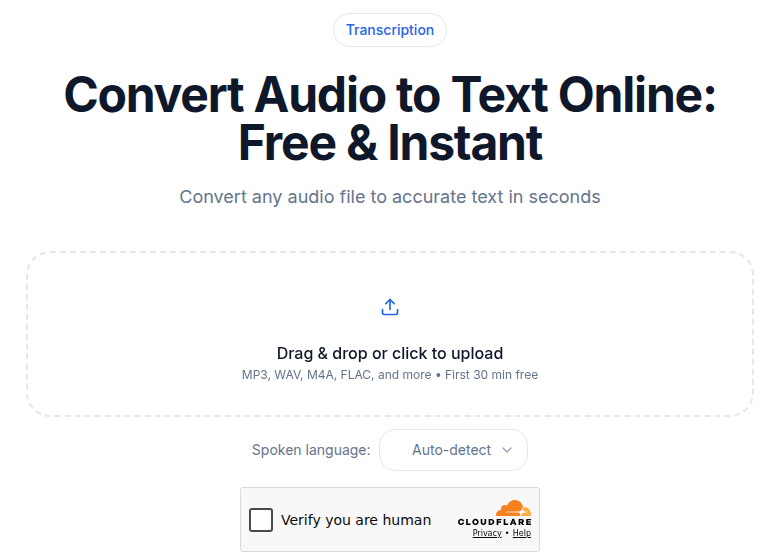 ConvertAudioToText audio upload tool for coaching sessions
The labels will initially be generic: "Speaker 0," "Speaker 1." Rename them to "Coach" and "Client" (or first names if both parties have consented to named transcripts) before saving.
For sessions with speaker diarization basics to understand, see speaker diarization explained.
Step 3: Coach's Working Notes
This is the core of the workflow. Read the transcript and extract:
- Client commitments stated during the session. Direct quotes are more useful than paraphrases: "I will email the CEO by Thursday" is more actionable in next-session prep than "planned to contact CEO."
- Recurring themes. If a word or concern has come up across multiple sessions, the transcript makes it visible.
- Moments of insight. Direct quotes from the client that capture something significant: useful to hold and sometimes to reflect back.
- Open threads. Topics that surfaced but were not fully explored.
A 60-minute session typically yields 15 to 25 minutes of focused reading to extract this material. Without the transcript, the same pass requires re-listening to the full recording.
Step 4: Client Summary (If Part of the Agreement)
If the coaching agreement includes session summaries, send within 24 hours while the session is fresh for the client too. Keep the format lean:
Subject: Notes from our session on [date]

Topics we covered:
- [Topic 1]
- [Topic 2]

Your commitments before next session:
- [Action 1]
- [Action 2]

A moment from today worth keeping:
"[Client's own words]"

Next session: [date and time]
The full transcript stays in the coach's system. The client gets the edited summary, not the raw text. Most clients do not want or need the full transcript, and sending it unedited can feel intrusive even when the client consented to recording.
What Coaches Should Not Do
Do not use session content for marketing without separate written consent. Even anonymized quotes require specific consent for external use. This is distinct from the recording consent.
Do not retain transcripts indefinitely. The coaching agreement should specify a retention period: common options are 90 days, six months, or duration-of-engagement plus one year. When the relationship ends, transcripts should be deleted or transferred to the client's exclusive control.
Do not share the full transcript by default. Summaries are client-facing. Full transcripts are coach-facing.
Do not transcribe when a client has exercised a per-session opt-out. Blanket consent does not override a specific-session refusal.
A note on HIPAA: standard coaching is not a HIPAA-regulated relationship, but if you work with health-focused coaching that crosses into clinical territory, standard transcription services may not be appropriate. For those cases, see HIPAA-compliant transcription for the relevant distinctions.
Group Coaching and Workshops
Group sessions add complexity. With six or more speakers in a room, automatic speaker diarization becomes less reliable, especially when speakers overlap. The workflow:
- Record with consent from all participants (get this in the registration or pre-workshop agreement).
- Submit to the transcription tool with speaker diarization.
- Expect generic labels: "Speaker 0" through "Speaker 5."
- Manually rename each speaker after identifying them by voice or context.
- For workshops with six or more participants, budget 10 to 20 minutes of cleanup for diarization errors on overlapping turns.
If the workshop has a meeting-style structure with defined turn-taking, meeting transcription tools handle this format well and often integrate directly with calendar and video platforms.
Meeting-Bot Tools and Why They Often Fit Poorly
Otter.ai, Fireflies.ai, and similar meeting-bot tools target team meeting use cases. They work by joining the meeting as an automated participant.
A few friction points specific to coaching use:
Their pricing structures assume multi-seat team deployment. Otter's Business plan runs $19.99 per seat per month on annual billing. Fireflies Business is $19 per seat per month on annual billing. For a solo coach who is the only user, per-seat pricing adds unnecessary overhead.
Their AI summaries are tuned for business meeting outputs: action items, decisions, follow-ups. Coaching outputs need different extraction: themes, commitment tracking, reflection prompts. The summary format does not transfer cleanly.
Their default retention settings vary by plan and are often perpetual unless manually adjusted. For coaching, the retention period should be explicitly controlled by the coach.
If you just need a clean transcript without a meeting bot joining your call, ConvertAudioToText lets you upload the recording after the session ends, no bot required. The Pro plan (unlimited transcription, 99+ languages, speaker labels) is a flat monthly fee rather than per-seat. Check the current price on the pricing page.
Storage and Retention in Practice
Where recordings and transcripts live matters for the confidentiality obligations above.
Acceptable: Private encrypted cloud folders (Google Drive or Dropbox with strong access controls and 2FA), or a dedicated coach-specific notes system like an encrypted Notion workspace.
Review your transcription provider's data retention policy before you rely on it for coaching use. Relevant questions: Does the service retain raw audio after processing? Where are transcripts stored? What happens to data when you close your account?
The ICF 2025 Code requires you to tell clients who accesses their data and how long it is stored, so you need to know those answers before the consent conversation.
Practitioner Patterns
Solo executive coach, 12 to 18 clients: Records each session, uploads immediately after, reads the transcript with a structured extraction template, sends client summary same day. Transcripts stored in encrypted notes app, deleted at engagement end.
Coaching cohort with shared methodology: Each coach transcribes their sessions and runs them through a shared extraction template aligned to the practice's framework. Monthly peer supervision uses transcripts instead of re-listening.
Internal corporate coach: Transcribes sessions for internal compliance documentation. Retention aligned to company records management policy, which is typically longer than a solo coach's default.
Coaching school for credentialing: Students submit session recordings plus transcripts as part of credential hour evidence. Mentor coaches review transcripts faster than re-listening to hours of recorded material.
FAQ
Do I need client consent to use an AI transcription tool on session recordings?
Yes, under the 2025 ICF Code of Ethics (effective April 2025). Coaches must disclose AI tool use to clients before the engagement begins, including which tools process session content, who has access to the data, and how long it is stored. This applies to transcription services. Get this in writing as part of the coaching agreement, and confirm it verbally at the start of recording.
Should I share the full session transcript with my client?
Generally, no. Most clients want a curated summary, not the raw transcript. Sending the full text can feel intrusive even when the client consented to recording. Keep the full transcript in your own notes system for session prep and pattern tracking. Send the client a short edited summary with commitments, key topics, and any quotes they might want to hold onto.
How long should I keep coaching session transcripts?
Your coaching agreement should specify the retention period explicitly. Common options are 90 days, six months, or duration-of-engagement plus one year. The 2025 ICF Code requires coaches to store and dispose of records in a way that promotes confidentiality and complies with applicable laws and agreements. When the engagement ends, delete or transfer the transcripts.
How do I handle group coaching sessions with many speakers?
For groups of six or more, expect more manual work after transcription. Automatic speaker diarization handles two-speaker sessions well but struggles with overlapping voices in a group. Plan to manually rename speaker labels after the transcript is generated. If the group follows a meeting-style structure with defined turn-taking, meeting transcription tools may work better than standard file upload. Budget 10 to 20 minutes of cleanup time per group session.
Sources
- Otter.ai pricing: https://otter.ai/pricing (checked July 2026)
- Fireflies.ai pricing: https://fireflies.ai/pricing (checked July 2026)
- ConvertAudioToText pricing: https://convertaudiototext.com/pricing (checked July 2026)
- ICF 2025 Code of Ethics summary: https://tandemcoach.co/icf-code-of-ethics/ (checked July 2026)
- ICF Code of Ethics 2025 updates overview: https://www.erickson.edu/resources/whats-new-in-the-2025-icf-code-of-ethics (referenced July 2026)
- ICF official Code of Ethics document: https://coachingfederation.org/credentialing/coaching-ethics/icf-code-of-ethics/
Try transcription free
Convert any audio or video to clean, unwatermarked text — speaker labels, timestamps, and AI summaries included. First 30 minutes free, no account.
Related Articles
Spotify Transcript Extractor: How to Copy and Download Episode Text
Get a Spotify podcast transcript you can copy and download: paste a public episode link, 30 minutes free with no signup, TXT or SRT files on eligible plans.
Focus Group Transcription for UX Researchers: Turn Multi-Speaker Audio Into Usable Evidence
A practical guide to focus group transcription for UX and insights teams. See how CATT handles speaker labels, timestamps, AI summaries, and clean export.