
Transcription for Musicians: Lyric Extraction from Vocals (2026)
Summarize this article with:
Can AI Pull Lyrics from a Track?
On an isolated vocal take, yes, reliably enough to be useful. On a full production mix, the answer is more qualified: a 2025 study published on arxiv (arxiv.org/abs/2506.15514) found that Whisper systematically deletes non-lexical vocables and backing vocals regardless of how good the preceding source separation is, and that source separation artifacts can actively trigger hallucinations. Word error rates on real song mixes hover around 20-23% before any separation, dropping modestly with high-quality stems. The single most important step you can take is running vocal isolation before transcription, not after.
Why Vocals in a Mix Are the Worst Case for Transcription Engines
Transcription models like Whisper Large-v3 and Deepgram Nova-3 are trained overwhelmingly on speech. When you feed them music, three factors compound into serious accuracy problems.
Pitched, sustained notes change the acoustic signature of the voice. A melisma holding a vowel for two seconds looks like noise to a model expecting conversational speech. The model either skips it or hallucinates a word that fits the phonetic shape.
The vocal-to-instrumental ratio determines nearly everything else. A cappella voice memos transcribe well. The same voice at minus 3 dB under a full drum-bass-keys arrangement loses a significant portion of its phonetic cues.
Whisper's internal prompting loop makes it compound errors. The model uses its previous output to condition the next segment. If it mishears one phrase, it drifts. This is why you sometimes get a transcript that starts plausibly and then produces sentences that were never sung, a known failure mode documented in the Deepgram hallucination analysis of v3.
The practical upshot: separation first, transcription second, and then a manual cleanup pass. This is not optional for any mix with significant instrumental content.
Step One: Isolate the Vocal
This is the step the existing post treated as a footnote. It should be first, because everything else depends on how clean your stem is.
HTDemucs (the fine-tuned model, htdemucs_ft) is the current open-source benchmark. Meta AI Research maintains it under the MIT license. Install with pip install -U demucs, run demucs --two-stems=vocals your_song.mp3, and you get a vocals stem and an instrumental stem. The fine-tuned variant takes roughly four times longer than the base model but produces noticeably cleaner separation on dense mixes. Independent benchmarks in 2026 consistently rank it ahead of Spleeter, the older Deezer model that has been unmaintained since 2022.
If you want a browser-based path with no installation, LALAL.AI is the principal paid option. Their pricing (checked 2026-07-01): free tier gives 10 minutes in a slower processing queue; Lite runs 6.75 EUR/month for unlimited slow-queue plus 90 fast-queue minutes; Pro is 13.50 EUR/month for 250 fast-queue minutes plus API access. The Orion engine, available on paid plans, consistently produces cleaner vocals on pop and hip-hop than the older Phoenix engine.
Spleeter is still cited in tutorials, but its 2019 model architecture is a significant step behind current alternatives on complex mixes. Use HTDemucs or LALAL.AI.
Step Two: Transcribe the Isolated Stem
Once you have a clean vocal stem, you can treat it like ordinary speech audio. The audio to text tool handles the formats musicians typically work with (WAV lossless exports, MP3 compressed takes). Upload the stem, not the mix.
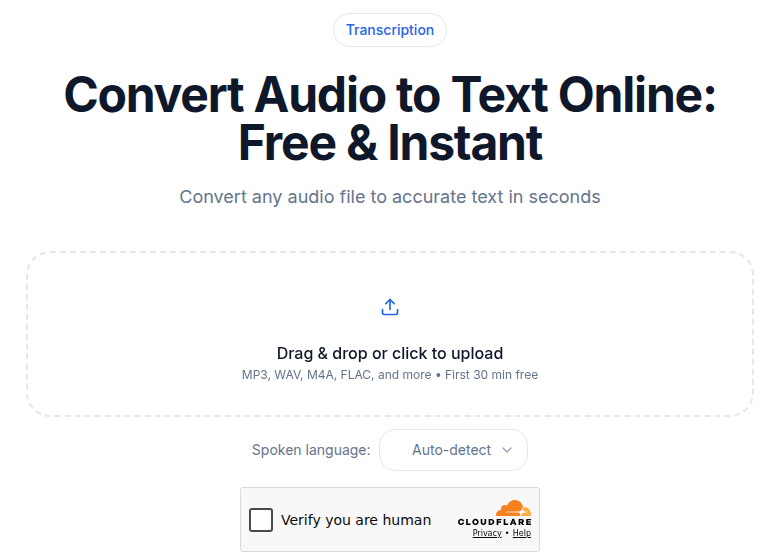 Upload isolated vocal stem for lyric transcription
Realistic accuracy on a well-isolated vocal is in the range of 80-90% word accuracy for clear enunciation in standard English or Spanish. Expect the model to miss non-lexical phrases ("ooh", "la", "yeah"), truncated syllables at phrase ends, and any backing vocal layers that the separator did not fully isolate. The transcript you get is a scaffold, not a finished lyric sheet. For a four-minute track, going from that scaffold to a complete lyric sheet typically takes 10-15 minutes by hand, versus starting from memory and taking 30-40.
For transcription accuracy on non-English tracks, Whisper Large-v3 covers 99 languages, and on isolated vocals, non-English accuracy lands in a similar range to English. Code-switching (Spanglish lyrics, Portuguese with English ad-libs) is handled but accuracy drops a few points at the language boundaries.
Use Case: Rough Demos and Voice Memo Lyrics
This is the highest-value scenario for most songwriters. You record a vocal take over a beat, the instrumental is not quiet, the lyrics are not written down yet, and you need a draft before the next session.
The workflow in practice:
- Export the vocal track with the instrumental muted or attenuated in your DAW. If you only have the mix (a reference file someone sent you, a demo bounce without stems), run HTDemucs first.
- Upload the isolated vocal to a transcription tool.
- Get the draft back, usually within a minute for a 4-minute track.
- Clean up by ear. Listen while reading. Fix the missed non-lexical phrases and any proper nouns.
Even at 80-85% first-pass accuracy, the time saving compared to transcribing from memory is real. The model does not forget lines the way human memory does two weeks after a session.
Use Case: Session Notes and Producer Talkback
Studio sessions generate hours of audio that musicians rarely archive: the producer's direction notes, the artist's between-take comments, the throwaway references. This audio is ordinary speech (no music competing with it) and transcribes at high accuracy.
Two patterns work well here. Some producers run a small field recorder like a Zoom H1n throughout the session and transcribe the full audio at the end of the day. Others transcribe only the voice memo notes they record intentionally between takes. Either way, the output is searchable text where a reference to "that drum fill on the Kendrick track from last Tuesday" can be found months later.
This is exactly what general-purpose transcription tools are built for, and accuracy will be substantially higher than on music audio. For structuring the output, see the broader meeting minutes workflow, which maps onto producer session notes closely.
Use Case: Cover Work and Reference Lyrics
Songwriters toplining to an existing reference track sometimes want the reference lyrics on paper as a starting point or a contrast document. Transcribing a commercial track from the mix directly gives roughly 75-85% on a well-produced pop track, lower on dense arrangements. Proper nouns, ad-libs, and overlapping backing vocals are where the errors concentrate.
For commercially available songs, lyric databases (Genius, AZLyrics, Musixmatch) already have the text and are faster than transcription for any widely released track. Transcription earns its place when the reference is obscure enough that the databases do not have it, or when you are working with an unmastered work tape that was never published.
Music-Specific vs. DIY Approach
There are tools that combine stem separation and transcription into a single product. Moises is the clearest example: it offers lyric transcription alongside stem isolation in one app. The free tier allows 5 tracks per month capped at 5 minutes each, showing only the first minute of transcription. Paid tiers unlock full transcription and unlimited tracks. RipX DAW PRO (one-time purchase, roughly $60-160 depending on tier per vendor pricing checked 2026-07) goes further, allowing note-level editing of separated stems, which is useful for remixing but overkill if you only want lyrics.
My take: the bundled tools are worth it if you spend serious time on stem editing and lyric work in a single place. For songwriters who only need occasional lyric drafts, the DIY path (HTDemucs for free isolation, then a general transcription tool for the text) produces equivalent results at lower cost, and you can swap in a better isolation model whenever one ships without waiting for a product update.
| Tool | Role | Cost (2026-07) | Notes |
|---|---|---|---|
| HTDemucs (htdemucs_ft) | Vocal isolation | Free, open source | Best free separator; pip install |
| LALAL.AI | Vocal isolation | Free 10 min; from 6.75 EUR/mo | Browser-based; Orion engine recommended |
| Moises | Isolation + transcription | Free tier (5 tracks, 5 min); paid for full | All-in-one; transcription quality unspecified |
| RipX DAW PRO | Isolation + note editing | One-time ~$60-160 | For stem editing, not just lyrics |
| Any Whisper-based transcriber | Transcription step | Free to metered | Use on the isolated stem, not the mix |
What AI Consistently Fails On
Three categories where the manual pause-and-listen workflow beats AI for lyrics every time.
Stacked harmonies and overlapping vocals. Two vocalists with interlocking lines produce a signal the model reads as one voice. The output merges both voices into a single transcript, usually dropping whichever is quieter. Understanding why this happens is covered in more detail in the speaker diarization post, but for lyrics the practical implication is simple: disentangling overlapping harmonies by machine does not yet work reliably.
Heavy processing effects. Light autotune is usually fine. Heavy vocoder, talkbox, or formant-shifted vocals are often unreadable. Models trained on natural voice characteristics have no reliable way to reverse extreme processing before attempting transcription.
Extreme vocal techniques. Death metal growls, intense falsetto at the upper register limit, operatic vibrato on very long held notes. Training data for these styles is thin, and the model falls back to plausible-sounding phonetic approximations that can be far from the actual lyric.
If you work primarily in these styles, the transcript might give you 40-60% of the lyrics and make you work harder to reconcile the rest. Manual transcription is faster at that error rate.
Multilingual Lyric Extraction
Whisper Large-v3 supports 99 languages, and on isolated vocal stems, non-English accuracy lands in a similar range to English clean audio. Latin pop, Afrobeats, and K-pop workflows benefit from this coverage. Code-switching (Spanglish, Portuguese with English ad-libs) is handled but loses a few accuracy points at the language boundaries. The engine labels sections but does not always correctly identify which language is active when the switch happens mid-phrase.
One useful step before committing to a multilingual transcription: verify the language detection is correct by reading the first paragraph of output. If the model misidentified the source language, the entire transcript will drift toward that wrong language, which is faster to catch early than at cleanup.
Getting Started
Pull one vocal-heavy track from your archive. If you have the stems, skip directly to the transcription step. If you only have the mix, run it through HTDemucs first (or drop it into LALAL.AI's free 10-minute tier). Then upload the isolated vocal to the audio to text tool and compare the output to what you remember. If you need a starting point without creating an account, ConvertAudioToText lets you run a transcription immediately without signup.
The accuracy you see on that first isolated vocal is a reliable indicator of how the tool will hold up across your catalog.
FAQ
Can I transcribe lyrics directly from a finished, mastered song?
You can try, but expect word error rates above 20% and systematic deletion of backing vocals and non-lexical phrases like "ooh" and "la." A 2025 arxiv study (2506.15514) confirmed these failures persist even after vocal isolation. For a polished master, the more reliable path is to isolate the vocal stem first with HTDemucs or LALAL.AI, then transcribe the stem rather than the full mix.
Does Whisper hallucinate on music?
Yes. Whisper can generate text completely unrelated to the audio when it cannot parse the signal clearly, and instrumental beds are a known trigger. Counterintuitively, running source separation before Whisper can sometimes increase hallucinations if the separation introduces artifacts. The best guard is to use a high-quality separation model (HTDemucs fine-tuned, or LALAL.AI Orion engine) rather than an older one like Spleeter, which dates to 2019 and is no longer maintained.
What is the best free vocal isolation tool before transcription?
HTDemucs (the fine-tuned version, htdemucs_ft) is free, open source under the MIT license, and maintained by Meta AI Research. Install with pip install -U demucs and run demucs your_song.mp3. It outputs vocals, drums, bass, and other stems. Independent benchmarks place it ahead of Spleeter by around 10-15% on isolation quality scores. For a no-install browser alternative, LALAL.AI offers a 10-minute free tier.
When does manual transcription beat AI for lyrics?
Three situations favor manual work: heavily processed vocals with autotune or vocoder effects; extreme vocal techniques like death metal growls or intense falsetto, where training data is thin; and stacked harmonies or two vocalists with overlapping lines, where diarization breaks down and the transcript merges both voices into one. In those cases, a pause-and-listen workflow is faster than fixing an AI draft that is more wrong than right.
Sources
- LALAL.AI pricing: lalal.ai/pricing (checked 2026-07-01)
- Moises lyric transcription feature: moises.ai/features/ai-audio-transcription (checked 2026-07-01)
- Arxiv: Exploiting Music Source Separation for Automatic Lyrics Transcription with Whisper: arxiv.org/html/2506.15514v1 (2025)
- Meta AI Research Demucs GitHub: github.com/facebookresearch/demucs (checked 2026-07-01)
- Deepgram: Whisper-v3 Hallucinations on Real World Data: deepgram.com/learn/whisper-v3-results (checked 2026-07-01)
- RipX DAW by Hit'n'Mix: hitnmix.com/ripx-daw (checked 2026-07-01)
Try transcription free
Convert any audio or video to clean, unwatermarked text — speaker labels, timestamps, and AI summaries included. First 30 minutes free, no account.
Related Articles

How to Handle Music in Transcription (2026 Honest Guide)
Music in your audio causes garbled pseudo-lyrics and hallucinations in your transcript. Here are the systematic fixes that actually work in 2026, including what tools won't tell you.
Spotify Transcript Extractor: How to Copy and Download Episode Text
Get a Spotify podcast transcript you can copy and download: paste a public episode link, 30 minutes free with no signup, TXT or SRT files on eligible plans.