
Transcription for Product Research: The Full Stack
Summarize this article with:
The Product-Research Stack
Product research is not one thing. 1:1 discovery interviews with existing users are one job. Win/loss analysis, competitive intelligence calls, and customer advisory board sessions are a different job entirely, with different goals, different interviewers, and different analysis patterns. This post covers the second category. For user-discovery workflows, the interview transcription guide handles that lane.
The connecting thread: every conversation in your product-research stack generates signal that is only usable if you can read it back later, search across it, and quote from it precisely. Transcription is the infrastructure that makes that possible.
Why Win/Loss Calls Demand Verbatim Records
Win/loss analysis is the practice of learning why deals were won or lost directly from buyers. The first reason a buyer gives you is rarely the real one. A buyer who says "we went with the cheaper option" is giving you the polite surface story. The real reason, often about trust, timeline, or a specific feature gap, surfaces two or three questions later. You cannot code that nuance from memory.
Three patterns that live in transcripts and die in notes:
Hesitation markers. "Well, I mean, kind of..." before a buyer describes your competitor is more useful than the words that follow. The hedge tells you the comparison is uncomfortable. Notes strip it out.
Competitor names mentioned in passing. Buyers will reference tools they considered without flagging them as relevant. A search across 20 transcripts for a competitor name you suspected was lurking tells you whether it is actually showing up in deals.
The pivot moment. In win/loss interviews, there is usually a sentence where the buyer's decision crystallized. It rarely sounds important when you hear it live. Reading the transcript with the full context of the interview in front of you, you can spot it.
Research by Clozd and others in the win/loss space finds that third-party interviewers get substantively better answers than internal teams. If you are running an internal program, transcripts partially compensate: a neutral analyst reading the transcript later, without the relationship baggage the interviewer carried into the call, will often catch what the interviewer missed.
Building a Win/Loss Program Around Transcripts
A running win/loss program that uses transcripts systematically looks like this:
Volume and sample. Target 15 to 20 interviews per quarter at minimum, split roughly 40% wins, 40% losses, and 20% no-decisions. The no-decision category is the most underrated: it tells you what buyers needed that neither you nor your competitor provided.
Standardize the interview guide. Use the same core questions in every interview. Transcripts from a standardized guide are searchable across the full corpus. "What almost stopped you from choosing us?" should appear in every win interview. When you have 40 transcripts and want to compare all the answers to that question, you can.
Tag by decision factor. Read each transcript and tag segments by the factors that appeared: pricing, feature gap, integration requirements, sales experience, trust and reputation, competitor strength. A simple tagging scheme, even in a shared doc, turns 20 transcripts into a frequency table.
Synthesis pass. At the end of the quarter, pull all segments tagged with each decision factor. Which factors appear most in losses? Which appear most in wins? The transcript corpus answers that question precisely in a way that CRM notes and Salesforce fields never will.
Share the quotes. Verbatim quotes from buyers, attributed to a deal type (win, loss) and a segment, are more persuasive in roadmap discussions than a PM's paraphrase. Transcripts make this frictionless.
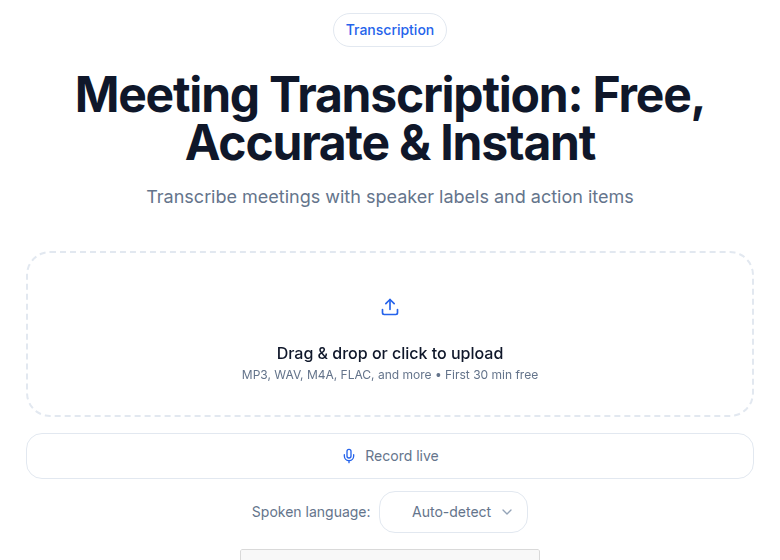 Meeting transcription interface showing speaker-labeled transcript with timestamps
Competitive Discovery Calls
Beyond formal win/loss programs, product and PMM teams run ad hoc competitive intelligence calls. These conversations, with churned customers, with prospects who chose a competitor, with analysts who cover your space, follow a different structure than win/loss interviews and produce different transcript patterns.
Churned customer calls. The goal is understanding the switching trigger. Transcripts from churned customer calls are among the most valuable assets a product team can have. They contain specific feature comparisons, workflow descriptions, and moments of frustration that are impossible to reconstruct months later from a summary. Read the transcript, do not just read your notes from the call.
Prospect research calls. When a prospect evaluates your product seriously and then goes elsewhere, a follow-up research call run by someone outside the sales team often surfaces the real competitive comparison. These transcripts should be tagged for competitor mentions and mapped to the features those competitors claimed to offer.
Analyst briefings. If you brief industry analysts, transcribing those sessions lets you track how analyst framing of your category evolves over multiple conversations. A year of analyst briefing transcripts, read back to back, shows you how the competitive narrative is shifting.
For any calls with prospects who did not become customers, confirm your data-handling practice with whoever runs the relationship. The transcript is yours to keep for internal research; sharing it widely or using it in marketing requires more care.
Customer Advisory Boards
A customer advisory board (CAB) runs typically two to four times a year, with a group of six to twelve engaged customers. The transcript from a CAB session is worth more than the transcript from any single interview because it contains group dynamics: where customers agreed with each other, where they pushed back on the product team's assumptions, and which topics generated the most discussion.
Specific things that transcripts surface in CAB sessions:
Consensus moments. When three or four customers in a row say versions of the same thing, the transcript makes this visible. In a recorded summary, consensus looks like "customers agreed that X." In the transcript, you see the actual chain of agreement, which is far more persuasive when you present it internally.
Unexpected pivots. CAB sessions sometimes produce sharp disagreements between customers. These moments tend to get smoothed over in meeting notes because they look like noise. In transcripts, they are signal: different customer segments with genuinely different needs.
Evolution across sessions. If you transcribe every CAB session over two years, you can track how the group's priorities shifted. What customers were asking for in year one that the product did and did not address, and how that shaped year two discussions.
A practical setup for CAB transcription: record the video call, run the recording through transcription with speaker diarization on, and store the transcript in a shared folder labeled by session date. This is a ten-minute workflow per session that compounds into a significant research asset.
Comparing Tools for This Research Lane
Not all transcription tools are the same fit for the win/loss and advisory-board lane. The key requirements are: speaker diarization (who said what), searchable transcript archive, and pricing that does not penalize a high-interview volume.
| Tool | Pricing model | Best for | Limits |
|---|---|---|---|
| Otter.ai | Per seat/month ($8.33 Pro, $19.99 Business, billed annually) | Live meeting capture, real-time notes | 1,200 min/mo on Pro; file imports capped |
| Fireflies.ai | Per seat/month ($10 Pro, $19 Business, billed annually) | Meeting bots, CRM sync, sales teams | Storage caps on Free/Pro; AI credits are a separate pool |
| Descript | Per seat/month ($24 Creator, $50 Business, billed annually) | Teams that need video editing alongside transcription | Media-minute caps per tier; metered AI credits |
| Trint | Per seat/month ($52 Starter billed annually) | Journalism and media teams, strong editor | Premium pricing; 7-file/mo limit on Starter |
| Happy Scribe | Subscription with minute bundles (from ~EUR 8.50/mo annually for 120 min) | Multilingual research, human proofreading add-on | Minute caps apply; overage at EUR 0.20/min |
| ConvertAudioToText | Flat monthly (Pro $14.99/mo or $99.99/yr), unlimited transcription; Weekly Pass $9.99 one-time for 1,200 min | Teams uploading batches of recorded calls without needing a meeting bot | No live meeting bot; no CRM sync |
My take: for win/loss and advisory-board transcription, where you are almost always working from a recording rather than a live bot session, the meeting-bot features of Otter and Fireflies are overhead you pay for but may not use. Descript earns its cost if your team also edits research highlight reels. Trint's per-seat pricing and file caps can add up quickly for high-volume programs.
If your team uploads recorded calls for transcription without needing a live bot or CRM integration, ConvertAudioToText handles that cleanly at a flat monthly rate. It is not the right choice if you need a bot that joins calls automatically or pushes summaries to your CRM.
For a broader view of transcription pricing models and how per-minute stacks up against per-seat and unlimited plans, that comparison is useful context before you commit to a tool.
The Analysis Layer
Transcripts are inputs. Insight is the output. For product research at this level of business consequence, a few practices sharpen the analysis:
Quote tagging with deal context. Tag each quote with the deal outcome (win, loss, no-decision) and customer segment. A quote about pricing from a mid-market loss means something different than the same quote from an enterprise win. The transcript gives you the quote; the deal context gives you what to do with it.
Competitor mention tracking. Maintain a running list of competitor mentions across transcripts, by quarter. Track frequency and context, not just presence. "They mentioned Competitor X" is less useful than "They mentioned Competitor X when describing what the ideal solution would do that we don't."
Cross-transcript search. One of the underused features in most transcript tools is full-text search across your archive. Before you build a roadmap argument, run a search for the problem you think you are solving. How many transcripts from the past year contain evidence of that problem? How many come from wins versus losses?
Counter-evidence logging. For every pattern you find, note the transcripts that contradict it. If eight of ten loss transcripts mention pricing, note the two that did not. Counter-evidence prevents confirmation bias from steering the roadmap.
Privacy and Consent for Product Research Calls
Win/loss interviews and competitive calls involve buyers and former customers, not just your own users. The consent requirements are real and vary by geography.
Standard practice for recorded research calls with buyers or former customers:
- Disclose the recording at the start: "I am recording this for internal research. Is that okay?" If they say no, turn off the recording and take notes.
- For formal win/loss programs, a brief research agreement that explains how recordings are used and stored protects both parties.
- Do not share a buyer's verbatim transcript externally without explicit permission. Internal research use is standard practice; publishing quotes with attribution is not.
- Honor deletion requests promptly. If a former customer asks you to remove their interview from your archive, do it.
For B2B programs involving enterprise customers in regulated industries, your legal team may want to review the data-handling process, particularly around storage and retention.
Building the Research Archive That Compounds
A year of product research transcripts is a different asset than 12 separate transcripts. The compounding effects:
When a new PM joins the team, they can read six months of win/loss transcripts and understand the competitive landscape without conducting fresh interviews. The institutional knowledge does not reset with headcount changes.
When a roadmap debate starts, the question "do customers actually want this?" has a searchable answer in the archive. That answer is more credible than the PM's recollection of a conversation from three quarters ago.
When a competitor makes a major move, you can search the archive for every mention of that competitor across all your research. The history of how buyers perceived them before and after the move is already in your files.
Treat the transcript archive as infrastructure, in the same category as your analytics data or your design system. The investment is small per call. The compounding value is large.
FAQ
What is the difference between product research transcription and user-research transcription?
User research, like discovery interviews or usability testing, focuses on understanding how existing users experience your product. Product research transcription, as covered here, covers a broader set of conversations: win/loss interviews with buyers, competitive intelligence calls with churned customers or analysts, and advisory board sessions. The workflows, tagging schemes, and analysis goals differ substantially. If you need the user-interview workflow, the how to transcribe an interview recording guide covers that specifically.
How many win/loss interviews do I need before transcripts are useful for analysis?
Patterns start to become visible at around 10 interviews. Most win/loss practitioners target 15 to 20 interviews per quarter as a minimum for quarterly pattern analysis. The value of transcripts at low volume is still real: you can quote precisely from any interview and search for specific terms across the set, even with a small corpus. The analysis becomes statistically meaningful at higher volumes, but individual transcript fidelity is valuable from interview one.
Should the person running the call also transcribe it, or is there a better workflow?
Separate the roles. The interviewer should focus entirely on the conversation, not on capture. Use a recording tool for the call, then run the recording through transcription after. The interviewer can add context notes immediately after the call, before reviewing the transcript, so that their fresh impressions do not contaminate their reading of what was actually said.
Does speaker diarization work well enough for win/loss interviews with two or three speakers?
Yes. Two-speaker calls, which describes most win/loss interviews, are the case where speaker diarization performs best. Accuracy typically drops slightly when four or more speakers overlap. For advisory board sessions with larger groups, speaker labels are still useful but you may need to manually correct a few label assignments, particularly when multiple speakers have similar voice characteristics or when the recording quality varies across participants.
Sources
- Otter.ai pricing page: https://otter.ai/pricing (checked July 2026)
- Fireflies.ai pricing page: https://fireflies.ai/pricing (checked July 2026)
- Descript pricing page: https://www.descript.com/pricing (checked July 2026)
- Happy Scribe pricing page: https://www.happyscribe.com/pricing (checked July 2026)
- Trint pricing via BrassTranscripts: https://brasstranscripts.com/blog/trint-pricing-2025-premium-journalism-media-costs (checked July 2026)
- ConvertAudioToText pricing: https://convertaudiototext.com/pricing (checked July 2026)
- Clozd win/loss analysis guide: https://www.clozd.com/guides/win-loss-analysis
Try transcription free
Convert any audio or video to clean, unwatermarked text — speaker labels, timestamps, and AI summaries included. First 30 minutes free, no account.
Related Articles

UX Research Transcription: Repository and Ops
How UX researchers build a transcription workflow that feeds atomic insights into Dovetail, Condens, or Looppanel, with verified pricing and tooling comparisons for 2026.
Spotify Transcript Extractor: How to Copy and Download Episode Text
Get a Spotify podcast transcript you can copy and download: paste a public episode link, 30 minutes free with no signup, TXT or SRT files on eligible plans.