
Transcription for Teachers: Class Recording Done Right
Summarize this article with:
Recording your classes and transcribing them takes under five minutes of extra effort per week, and the payoff compounds: absent students get a real record, accommodations get documented automatically, and you get a searchable archive of every analogy and example you have ever used. The main friction is privacy, not technology. A teacher-voice-only recording has no FERPA issues; a recording with identifiable student voices becomes an education record and must be handled accordingly. This post walks through the full workflow, from hitting record to recycling the transcript into study guides, sub plans, and your own professional self-review.
Recording your own class costs ten seconds of effort. The transcript pays you back for the rest of the school year. A 50-minute lesson produces roughly 7,000 words of spoken explanation, worked examples, and student questions. Without a transcript, almost all of it disappears when the bell rings. With one, you have a searchable archive, a ready-made accommodation document, and raw material for worksheets, sub plans, and your own self-review.
This post covers the teacher side of the workflow: how to record cleanly, how to stay on the right side of student privacy, and how to turn the resulting text into something useful.
Recording Without Disrupting the Room
You do not need specialized equipment. A phone clipped near your lapel or set on the front table handles a single-teacher lecture well. For seminar-style classes where students talk frequently, place the phone in the center of the table rather than keeping it on your side of the room.
Three habits that matter once you start:
- Hit record before the warm-up activity, not after. The first two minutes often contain the homework reminder, the correction from yesterday, and the context students need to make sense of the lesson. Those are the parts absent students most often miss.
- Keep one continuous file per class period. Stopping and restarting creates four audio clips you have to match later. Let it run.
- Pause for private conversations. If a student comes to your desk during work time to discuss something personal, tap pause. Resume when the conversation ends. This is the single most important recording habit and takes three seconds.
For online classes, Zoom, Google Meet, and Microsoft Teams all allow you to download the meeting recording directly. That file works exactly like a local audio file for transcription purposes.
Student Privacy: What FERPA Actually Requires
Most teachers freeze here because the rules sound complicated. They are not, once you separate two situations.
Situation 1: The recording is mostly your voice. A lecture where students appear only as brief background questions, without using their names, is generally not a FERPA-protected education record. The Department of Education's guidance is that a recording must be "directly related" to an identifiable student to qualify as an education record. A teacher-led lecture, even with incidental background voices, does not meet that bar. You can upload this to a transcription service, share it on your LMS, and use it freely.
Situation 2: The recording includes identifiable student participation. Seminars, Socratic discussions, student presentations, or any session where you address students by name fall into this category. Those portions are education records. You can still share the recording or transcript with students enrolled in that same course, in that same term, without individual consent. That covers the main use case of supporting absent students. What requires more care: sharing with parents without consent, posting publicly, or sending to a different class.
The practical upshot: add a one-sentence syllabus notice that you may record class sessions for instructional purposes, pause for private conversations, and for files containing substantial student participation, confirm that your transcription vendor has a Data Processing Agreement with your district before uploading.
A note on third-party tools: free consumer tiers of major transcription apps typically place FERPA compliance responsibility entirely on the user, and some use audio to improve their models. If your recording contains only your instruction, a vendor's no-training policy is the key thing to check. If it contains identifiable student speech, use a tool your district has already vetted, or edit out student voices before uploading.
This post is not legal advice. For recordings that contain substantial student participation, confirm your district's specific requirements with your legal or compliance office.
Transcribing: The Actual Workflow
The fastest rhythm for a teacher with five sections:
During the week: record. One button at the start, one at the end. Total added effort per class: about ten seconds.
Friday afternoon, during your planning period (20-30 minutes total): upload the week's files in a batch. Most transcription services process a 50-minute recording in two to four minutes. While the files process, you grade something else.
After transcripts arrive: skim each one for exactly two things. The homework or due-date reminder you mentioned out loud. Any student question whose answer you want to turn into a written follow-up or study resource. Everything else can wait.
For mostly-lecture recordings, ConvertAudioToText transcribes without using your audio for training ("we never train on your content"), and on the free tier source audio auto-deletes, usually after seven days. The free plan runs your first file on the premium engine (up to an hour), then keeps transcribing free with up to 30 files a day, up to 30 minutes each. If you want speaker labels, summaries and downloads on every class, the $14.99/month Pro plan is the right fit, and it covers unlimited transcription across 99 languages.
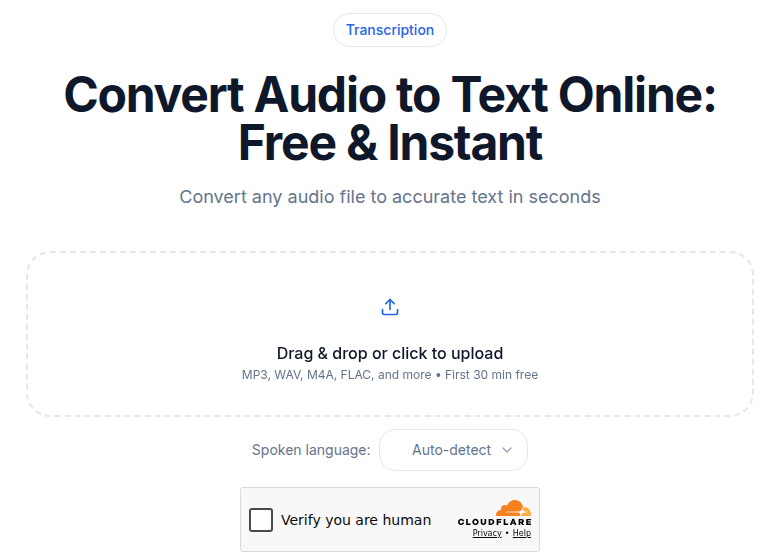 ConvertAudioToText audio upload tool in use
For meeting-format classes where you want speaker labels automatically applied to student contributions, the meeting transcription tool handles that directly.
Otter.ai is another option teachers reach for because of its Google Meet integration. The free tier gives you 300 minutes per month with a 30-minute cap per conversation, and three lifetime file imports. That cap means a single 50-minute lecture exceeds the per-session limit on free. The Pro plan removes that cap with 1,200 minutes per month. Worth noting: Otter places FERPA compliance responsibility on the user rather than operating as a district-vetted platform, so check with your district before using it for recordings that include identifiable student speech.
What to Do With the Transcript
Support Absent Students
Send the relevant transcript section plus the slide deck. This is more useful than a custom recap email because the student gets your actual explanation in your exact phrasing, not a summary. Most absent students can read a class period's worth of transcript in fifteen minutes.
For students with IEPs or 504 plans that specify alternate-format materials or audio access accommodations, a transcript is a direct, documented fulfillment of that accommodation. You generate it once; no paraprofessional time required. If a student's current plan does not mention transcripts but they would benefit, bring it up at the next IEP or 504 meeting as a low-cost addition worth formalizing.
See the companion post on accessible lectures with transcripts for a fuller treatment of accommodation applications.
Build the Flipped Classroom
If you teach a unit you have taught before, your transcript archive is your script library. Record a clean version of your strongest explanation of a concept, transcribe it, and use the transcript to write captions or a companion reading for the pre-class video. Students who struggle with lecture-format video can read the transcript instead. Students who want to rewatch can search the transcript for the exact timestamp.
For a flipped classroom setup, your transcript archive also reveals which explanations are actually efficient. A geometry teacher I worked with used her transcripts to find every place she had explained the same concept three different ways across different class periods. She kept the version that generated the most follow-up questions (a reliable signal of engagement) and dropped the other two from her slides.
Generate Study Materials Without Starting From Scratch
Skim any transcript for sentences beginning with "Remember that...", "The key thing here is...", or "So to summarize...". Those are your quiz questions and review bullets, already in language your students recognize. A five-minute pass through one transcript typically yields six to ten usable review items.
Sub plans are another dividend. Save transcripts of your strongest lessons. When you need an emergency sub plan, you have a written script the substitute can read aloud while students follow the slides. A confident sub can keep a class on track this way without any of your prep time.
Self-Review: Read Your Own Teaching
Listening back to yourself teach is uncomfortable. Reading it is more productive. Once a month, print or open one transcript and look for three things:
- Talk ratio: what fraction of the text is your voice versus student responses? Most teachers discover they talk more than they think.
- Explanation length: how many words do you spend before pausing for questions? Long unbroken explanations correlate with lower retention.
- Participation patterns: do the same student names appear repeatedly? A transcript makes this visible in a way that is easy to miss in the moment.
This kind of reflective reading is the low-tech version of tools like TeachFX, which automates the analysis. But the transcript itself, read carefully once a month, surfaces most of the same patterns at no additional cost.
For a deeper look at how transcription fits into broader note-taking and study workflows, see the post on note-taking with AI.
Building the Archive
Drop each quarter's transcripts into a shared drive folder organized by unit. When you teach the same course next year, you have a searchable record of every example, analogy, and student question that came up in real classes. The search function becomes genuinely useful: type "slope" in a geometry archive and find every time you explained it, including the off-the-cuff metaphors that were not in the slide deck.
When a parent asks what was taught last Tuesday, you forward a clean summary of that day's transcript rather than guessing from memory.
The marginal cost of making a transcript available to an absent student, once you have generated it for one purpose, is zero. That is the compounding benefit of making recording a habit: you capture once, and the text serves five different purposes across the year.
Frequently Asked Questions
Do I need student consent to record my own class?
It depends on what the recording captures. A recording of your own instruction, with no identifiable student voices or names, is not an education record under FERPA and generally requires no consent beyond a syllabus notice. If the recording includes student questions, discussions, or presentations where students are identifiable, those portions are education records. In that case, you can share the recording with students enrolled in the same course without additional consent, but sharing it outside that group (with parents, coaches, or on public platforms) requires written FERPA consent from each identifiable student. Some states also have consent laws for audio recording; check your state statute or district policy before you start.
Which transcription tools are safe to use with class recordings that include student voices?
The safest path is a tool your district has a signed Data Processing Agreement (DPA) with. Free consumer tiers of popular apps often place FERPA compliance responsibility entirely on the user and may use audio to improve their models. If your recording contains only your own voice and instruction, the threshold is lower, and a no-training policy (like ConvertAudioToText's stated "we never train on your content") addresses the main concern. For any recording with identifiable student speech, confirm your vendor's DPA status with your district's IT or legal office before uploading.
Can I share a class transcript with a student who was absent?
Yes, with the same-course constraint. Sharing a recording or transcript with students enrolled in that specific course during that term is permissible under FERPA without individual consent. You can email the relevant portion of the transcript to the absent student, or post it in your LMS behind a student login. Posting it publicly, sharing with parents without consent, or sending it to another teacher's class are all situations that require more caution.
How do I use transcripts to support IEP and 504 accommodations?
Recording lectures and providing a written transcript is a well-established reasonable accommodation under Section 504. If a student's plan specifies audio access or alternate-format materials, a transcript fulfills both. Generate the transcript, then share it via your LMS or a direct email to that student. You do not need to involve a paraprofessional or spend time manually retyping anything. If a student's plan does not yet mention transcripts but the student would benefit, bring it up at the next IEP or 504 meeting as a low-cost addition.
What is the best way to use a transcript for my own professional development?
Read it cold, at least a week after teaching the lesson. Distance makes patterns easier to spot. Look for three things: how much of the transcript is your voice versus student responses (a useful rough ratio check), how long your explanations run before you pause for questions, and whether your key definitions actually appear in the text or only on the slides. Teachers who do this once a month consistently report noticing patterns they never catch in the moment, like relying on the same three students for answers or spending twice as long on one concept as planned.
Sources
- FERPA FAQ: When is a photo or video an education record? - U.S. Department of Education, Student Privacy Policy Office
- Classroom Recordings and FERPA FAQs - UNC Charlotte Office of Legal Affairs
- Classroom Recordings and FERPA: What You Need to Know - GovFacts
- Otter.ai Pricing - Otter.ai (verified July 2026)
- ConvertAudioToText Pricing - ConvertAudioToText (verified July 2026)
- Section 504 and Recording as Accommodation - Wrightslaw
Try transcription free
Convert any audio or video to clean, unwatermarked text — speaker labels, timestamps, and AI summaries included. First 30 minutes free, no account.
Related Articles
Accessible Lectures with Transcripts: The Delivery Guide
Recorded lectures plus transcripts as universal design: disability-services workflows and the student-facing formats that work.
Best Transcription Tools for Students in 2026: Budget-Ranked
Ranked by real cost and verified free-tier limits: the best transcription tools for students in 2026, from free university options to paid picks for heavy lecture loads.